Table of Contents >> Show >> Hide
- The Viral Moment: One Commencement, Two Diplomas, Zero Dry Eyes
- Meet the Graduates: Grace Mariani and Justin, Campus Power Duo
- Why the Internet Fell in Love (and Not Just Because Justin Has Great Stage Presence)
- Service Dogs 101: What They Are (and What They Are Not)
- Behind the Cute Clip: The Serious Work of Service Dog Partnerships
- A Trend with Heart: Other Service Dogs Honored at Graduation
- What Schools (and the Rest of Us) Can Learn From Justin’s Diploma
- Conclusion: The Diploma Was PaperThe Message Was Power
- Real-Life Experiences: What It’s Like Navigating Campus With a Service Dog
Because sometimes the loudest applause at graduation is for the student who can’t even hold a penyet somehow still nails “perfect attendance.”
The Viral Moment: One Commencement, Two Diplomas, Zero Dry Eyes
Graduation ceremonies are usually a predictable cocktail: a few proud tears, a few “I can’t believe we made it” selfies, and at least one speaker who
says “the future” like they’re trying to summon it. But every once in a while, something happens that makes the whole script feel brand new.
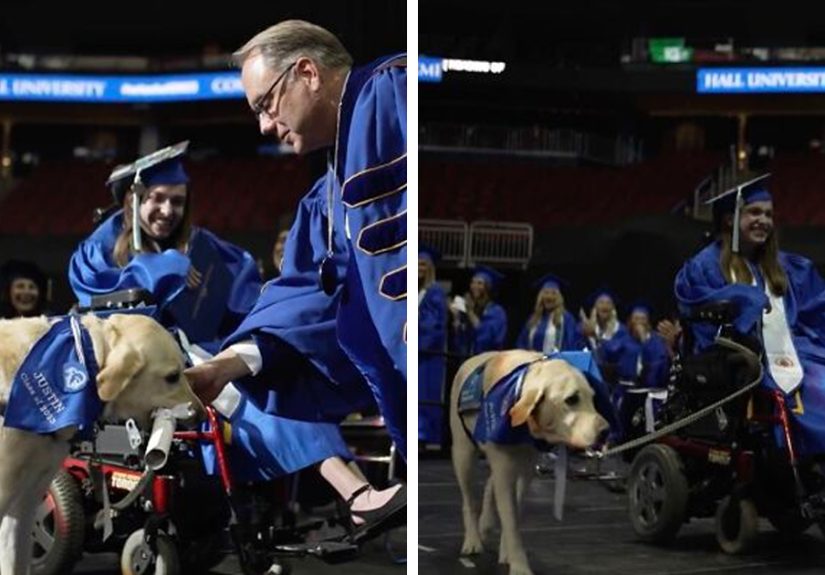
In a now-beloved graduation video, a service dog named Justin walked the stage alongside his handler, Grace Mariani, as she
received her diploma at Seton Hall University in New Jersey. Thenplot twist worthy of a standing ovationJustin received a diploma of his
own. The crowd erupted as the university president handed him the rolled certificate and Justin accepted it with the gravitas of a dog who has absolutely
been to every class and would like the record to reflect that.
On the surface, it’s adorable. Underneath, it’s something even better: public recognition of invisible laborof partnership, persistence, and the daily work
of navigating the world with a disability. The clip didn’t just go viral because it was cute (though, yes, it was aggressively cute). It went viral because it
showed a kind of teamwork most people don’t get to see up close.
Meet the Graduates: Grace Mariani and Justin, Campus Power Duo
Grace Mariani crossed the stage in her wheelchair at the Prudential Center and graduated Magna Cum Laude with a Bachelor of Science in Education.
Justinher service dog and constant companionwas right there, working quietly and confidently as if commencement stages were just another Tuesday lecture.
Justin’s “Major”: Mobility Support (with a minor in Dropped-Item Retrieval)
Justin isn’t a mascot, a therapy animal brought in for finals week, or a “my dog is basically my child” situation. He’s a service dog trained to perform tasks
that help Grace live more independently. In Grace’s own words shared through Seton Hall, one of Justin’s key jobs is picking up items she dropsbecause
reaching from a wheelchair isn’t always possible. That sounds simple until you realize how many times a day humans drop things like it’s a hobby.
Seton Hall faculty described how Grace navigated campus lifeclasses, dorms, weather, internshipswhile Justin stayed focused on his work. Classmates learned
the etiquette: no petting while he’s working. (And yes, there were moments when Grace could remove his gear so he could be a regular dog for a minutebecause
even honor students deserve a break.)
Why a Diploma for a Dog Actually Makes Sense
The diploma was honorary, of course. Justin isn’t expected to submit a résumé that reads “201-level: Advanced Napping Under Lecture Hall Chairs.”
But the gesture wasn’t a joke. It was a public thank-you for a very real contribution: Justin’s steady, trained support across the same academic journey.
If Grace earned a degree through skill and grit, Justin helped make the path physically workable day after day. This is what partnership looks like when
it’s built into routine, not reserved for highlight reels.
Why the Internet Fell in Love (and Not Just Because Justin Has Great Stage Presence)
1) It Was a Rare, Public Moment of Disability VisibilityWithout Pity
People are used to seeing disability framed as either tragedy or inspiration bait. This video skipped both. It showed a capable graduate, a working service dog,
and a community cheering them on as a team. The tone wasn’t “look how sad” or “look how miraculous.” It was: this belongs here.
2) The Crowd Reaction Was the Emotional Cherry on Top
A lot of viral clips feel staged. This didn’t. The cheers were spontaneous, loud, and joyfulthe kind of response that comes from a room full of people who
recognize effort when they see it.
3) It Hit a Universal Nerve: Everyone Loves Recognition for the “Behind-the-Scenes” Work
Whether it’s the friend who always takes notes for the group project or the barista who remembers your order when you barely remember your own phone number,
we all know there’s often someone (or some dog) making things possible in the background. Justin’s diploma was a symbolic standing ovation for that kind of work.
4) Also… It Was Hilariously Perfect
Humans invented pomp, circumstance, and awkwardly angled handshakes. Dogs invented “I will accept this document with my mouth and immediately become the
main character.” Justin didn’t bark. He didn’t fumble. He simply performed. If you’re wondering whether “Magna Dog Laude” is a thing, the internet has already voted yes.
Service Dogs 101: What They Are (and What They Are Not)
Viral moments are wonderful, but they can also stir up confusionespecially online, where every comment section includes at least one person who believes
a service dog “needs papers,” and another who thinks any dog in a vest is a “fake.”
Service Dogs Are Task-Trained to Assist a Person With a Disability
Under the Americans with Disabilities Act (ADA), a service animal is generally a dog individually trained to do work or perform tasks for a person with a disability.
Those tasks must be directly related to the disability. Examples can include retrieving dropped items, pulling a wheelchair, guiding, alerting to sounds,
or helping during medical episodes.
Emotional Support Animals Are Different
Emotional support animals can be deeply helpful, but they aren’t the same as service dogs under ADA definitions because comfort alone is not a trained task.
That distinction matters because it affects legal access to public spaces.
No, a Business Generally Can’t Demand “Documentation”
In many public settings, if it isn’t obvious what service a dog provides, staff are typically limited to two questions: whether the dog is required because of a disability,
and what work or task it has been trained to perform. They generally can’t ask for medical documents, ask about the disability, or demand a special ID card
just to let a person enter.
Training Doesn’t Have to Come From a Single “Official” Source
The ADA does not require service dogs to be professionally trained by a specific program, although many people choose nonprofit organizations with extensive
standards and long-term support. The key is that the dog is trained to perform disability-related tasks and behaves appropriately in public.
Behind the Cute Clip: The Serious Work of Service Dog Partnerships
Training Is Real LaborFor the Dog and the Handler
A good service dog is not simply “well-behaved.” They’re trained for public access and for specific tasks, and they have to perform reliably in messy,
unpredictable real life: crowded hallways, loud arenas, random clapping, rolling backpacks, and that one person who tries to make kissy noises from six feet away.
Programs Like Canine Companions (and Why Standards Matter)
Grace received Justin through Canine Companions, a national nonprofit known for providing service dogs and follow-up support to people with disabilities.
Organizations like this often participate in accreditation and standards frameworks in the assistance dog world, emphasizing ethical training, client support,
and responsible placement.
Service Dogs Help Unlock Education Access in the Most Practical Ways
“Access” isn’t just ramps and elevators. It’s the ability to move through a day without constantly needing to ask for help. A service dog can reduce barriers
in hundreds of small momentslike retrieving a dropped ID card, pulling open a heavy door, or helping a handler keep medical episodes safer.
In Grace’s case, Seton Hall shared that Justin helps with picking things up she can’t reach from her wheelchair. That’s independence in actionquiet,
repetitive, and hugely meaningful.
A Trend with Heart: Other Service Dogs Honored at Graduation
Justin isn’t the first service dog to get a “diploma moment,” and that’s part of why this story resonates. Some universities and communities have recognized that
when a student brings a service dog through years of classes, internships, and campus life, it’s genuinely a team accomplishment.
Example: Griffin at Clarkson University
In a widely covered earlier story, a service dog named Griffin received an honorary diploma alongside his handler, Brittany Hawley,
as she completed her master’s degree in occupational therapy at Clarkson University. Coverage described how Griffin accompanied her through classes and
practical trainingdoing the work of a service dog while she did the work of a graduate student. It’s the kind of partnership that doesn’t fit neatly into a caption,
which is exactly why it sticks with people.
What These Stories Signal
These “dog diploma” moments aren’t about pretending dogs are humans. They’re about acknowledging reality: service dogs often make higher education more accessible,
and they deserve respectnot as a novelty, but as working partners.
What Schools (and the Rest of Us) Can Learn From Justin’s Diploma
1) Normalize Accessibility Without Making It Awkward
The best support isn’t performative. It’s practical. When campuses build accessibility into housing, classrooms, and event planning, students spend less energy
“figuring out how to participate” and more energy actually learning.
2) Teach Service Dog Etiquette Early
A quick orientation slide could prevent a thousand micro-problems:
- Don’t pet, distract, feed, or talk to a working service dog without permission.
- Give the team space in crowded areas.
- Ask the handlernot the dogif you need to communicate.
- Assume the dog is working unless clearly told otherwise.
3) Celebrate Partners, Not Just Individuals
Graduation is about achievementbut achievement rarely happens alone. Justin’s honorary diploma worked as a symbol because it highlighted that truth.
The message wasn’t “Grace succeeded because of a dog.” It was “Grace succeeded, and Justin was part of the system that helped her do it independently.”
4) Better Conversations Beat Comment-Section Chaos
Viral videos can trigger debates about “real” service dogs, access, and bad actors. Schools and employers can reduce confusion by communicating clear,
lawful policiescentered on disability access and public behavior, not vibes.
Conclusion: The Diploma Was PaperThe Message Was Power
The internet didn’t fall for a gimmick. It fell for a truth: when people with disabilities have the support they need, they thriveand sometimes that support
comes with four paws, a calm stare, and an impressive ability to retrieve whatever you just dropped for the fifth time today.
Justin receiving a diploma alongside Grace Mariani wasn’t just a cute moment at a Seton Hall graduation. It was public recognition that accessibility is not
charityit’s fairness. It was a reminder that independence can look like teamwork. And it proved, once again, that dogs will happily steal the spotlight,
but only after they’ve done the work.
Real-Life Experiences: What It’s Like Navigating Campus With a Service Dog
Viral videos show the highlight reel. Daily life is the unglamorous training montageexcept it lasts four years and includes dining halls, group projects,
and the mysterious phenomenon of college doors that weigh approximately the same as a small planet.
Students who work with service dogs often describe the first weeks on campus as a crash course in logistics. Where does the dog settle during lectures?
Is there enough floor space in tightly packed classrooms? Do professors understand that the dog is medical equipment and not an icebreaker? Most teams
solve these questions with a mix of planning and calm repetition: pick a consistent spot, arrive early when possible, and communicate needs without apologizing
for existing.
Dorm life brings its own set of “small but constant” considerations. A service dog needs routinebathroom breaks, water, quiet restinside a schedule that is
basically designed by a sleep-deprived raccoon. Handlers often coordinate with disability services and housing staff so the living space works for both the
student and the dog, especially if mobility devices, medical equipment, or accessible bathroom setups are involved. A surprising number of issues get solved by
simple, practical adjustments: a slightly larger room layout, a clear route to an outdoor relief area, and a plan for emergencies.
Then there’s the social sidewhere the dog can be both a bridge and a barrier. Many handlers say service dogs help them meet people naturally, because strangers
are curious. The good part: you don’t have to work hard for small talk when a Labrador is quietly existing near your desk. The hard part: curiosity can turn into
distraction, entitlement, or constant interruptions. One of the most common experiences service dog handlers report is having to become a polite but firm educator:
“Please don’t pet himhe’s working.” Over and over. Sometimes multiple times a day. It’s a sentence that should come with extra credit.
Group projects can be unexpectedly revealing. In the best cases, classmates treat the dog like background infrastructurepresent, normal, not a spectacle. In the
worst cases, people center the dog instead of the person, or assume the handler is “lucky” rather than recognizing the labor required to maintain training and
public access behavior. Handlers often develop a calm script: a quick explanation of what the dog does, a reminder not to distract, and then a pivot back to the
assignment like, “Anyway, about the presentation rubric…”
Campus events add another layer: crowds, loud music, applause, confetti, and sensory overload. A well-trained service dog can handle these environments, but it
still takes energyjust like it does for the handler. Many teams scout venues, choose seating that provides space, and plan exits if the environment becomes too
chaotic. For students with mobility impairments, those choices can be the difference between participating fully and spending the entire event trying to “make it work.”
And yes, there are moments of pure sweetness. A professor who quietly makes sure there’s space near the front. A classmate who holds a door without making a big deal.
A friend who asks the handler first before interacting with the dog. Those moments matter because they create a campus culture where accessibility feels ordinarynot
like a special favor.
The takeaway from experiences like these is simple: a service dog isn’t a shortcut. It’s a partnership. It requires training, patience, advocacy, and constant attention
to boundaries. When a university community understands thatand supports the team with practical inclusionstudents don’t just “get through” college. They belong there.
That’s why Justin’s diploma hit so hard: everyone recognized what the video didn’t have time to showthe everyday work that made that walk across the stage possible.