Table of Contents >> Show >> Hide
- Why Shadow Art Feels So Alive
- 21 Clever Shadow Art Installations That Turn the Everyday Into Something Magical
- 1. Kumi Yamashita’s folded paper portraits that reveal human profiles
- 2. Yamashita’s Chair, where carved wood becomes a seated figure
- 3. Her number-and-letter arrangements that transform into faces
- 4. Tim Noble and Sue Webster’s trash piles that become self-portraits
- 5. Their reclaimed-wood shadow sculptures that hide order inside disorder
- 6. Larry Kagan’s tangled steel webs that draw pictures with darkness
- 7. Rashad Alakbarov’s found-object cityscapes made from suspended clutter
- 8. Alakbarov’s shadow compositions that create words and human figures
- 9. Damon Belanger’s bench shadow that turns into a giant dog
- 10. His bike-rack shadows that bloom into cheerful flowers
- 11. The streetlight pole that suddenly becomes a dragon
- 12. A mailbox that projects monster energy instead of mail energy
- 13. A robot-band feeling created from everyday street fixtures
- 14. Anila Quayyum Agha’s Intersections, a cube that transforms an entire room
- 15. Agha’s later geometric light works that turn pattern into atmosphere
- 16. Laurent Craste and Dpt.’s porcelain vases with animated shadows
- 17. Soo Sunny Park’s chain-link fencing turned into a floating light web
- 18. Wang Ningde’s shadow photographs built from hundreds of small elements
- 19. William Kentridge’s found-object shadow theater on a grand scale
- 20. Andy Warhol’s Shadows, which turns a fleeting shape into a panorama
- 21. The larger genre itself, where ordinary objects become secret image machines
- What These Installations Say About Creativity
- The Experience of Seeing Shadow Art in Person
- Conclusion
Most art asks you to look at the object. Shadow art installations ask you to look at the object, the wall, the light source, and your own assumptions all at once. That is the fun of it. A pile of junk turns into a portrait. A wooden chair suddenly reveals a seated girl. A boring sidewalk bench grows the shadow of a giant dog. In other words, shadow art is what happens when sculpture decides to develop a secret identity.
What makes this kind of installation art so irresistible is the surprise factor. The materials are often plain, even humble: paper, wire, scrap wood, trash, chain-link fencing, carved panels, or familiar street fixtures. But once light hits them from the right angle, those ordinary objects become something bigger, stranger, and far more alive. Great shadow sculptures do not just show off technical skill. They also remind viewers that perception is slippery, imagination is powerful, and a “simple object” is rarely that simple.
Below are 21 clever shadow art installations and object-based light works that capture that magic especially well. Some are museum pieces, some are public art, and some are the kind of works that make you mutter, “Well, now I have trust issues with furniture.” Together, they show why light and shadow art continues to fascinate designers, artists, curators, and anyone whose brain enjoys a good visual plot twist.
Why Shadow Art Feels So Alive
Shadow art installations work because they operate in two realities at once. In one reality, you see material: carved wood, twisted steel, folded paper, found objects, or painted pavement. In the other, you see image: a face, an animal, a skyline, a figure in motion, or a room washed in patterned darkness. The gap between those two realities is where the wow factor lives.
That gap also makes shadow art unusually human. It depends on viewpoint, attention, and discovery. You do not passively consume it; you solve it. Your eyes gather the clues, your brain tries to connect the dots, and then suddenly the hidden image clicks into place. That moment is tiny, but it feels theatrical. It is also why the best light and shadow art stays with people long after they leave the gallery or sidewalk where they found it.
21 Clever Shadow Art Installations That Turn the Everyday Into Something Magical
-
1. Kumi Yamashita’s folded paper portraits that reveal human profiles
Kumi Yamashita has made a career out of proving that paper is capable of keeping secrets. In her shadow-based portrait works, folded sheets look abstract up close, but when lit precisely, they cast crisp human profiles. The brilliance is not just in the technical control. It is in how a crumpled, physical object suddenly produces something tender and deeply human.
-
2. Yamashita’s Chair, where carved wood becomes a seated figure
One of the smartest examples of shadow sculpture is Yamashita’s Chair. On first glance, it reads as a slender wood object with elegant carving. Under directed light, though, its shadow becomes a girl sitting in a chair. The object does not imitate the figure literally. Instead, it lets the shadow do the storytelling, which is exactly why the illusion lands so hard.
-
3. Her number-and-letter arrangements that transform into faces
Yamashita also uses everyday symbols like numbers and letters to build wall-based installations that cast monumental profiles. This is clever on multiple levels. The components feel impersonal, almost mechanical, but the result is unmistakably human. It is a visual reminder that modern life reduces people to codes all the time, while art can still give those codes a pulse.
-
4. Tim Noble and Sue Webster’s trash piles that become self-portraits
If shadow art had a punk chapter, Tim Noble and Sue Webster would own it. Their famous assemblages of garbage, scrap, and other cast-off materials look chaotic in the round. Add a controlled light source, and those messes project sharply recognizable silhouettes, often of the artists themselves. It is gross, funny, smart, and weirdly elegant all at once.
-
5. Their reclaimed-wood shadow sculptures that hide order inside disorder
Another reason Noble and Webster’s work remains so influential is that it turns visual confusion into precision. Reclaimed wood and rough fragments seem unruly until the shadow resolves into a legible image. That contrast is the whole point. The object says “junk drawer apocalypse,” while the shadow says “surprise, I am actually a portrait.” Few artists weaponize contradiction this well.
-
6. Larry Kagan’s tangled steel webs that draw pictures with darkness
Larry Kagan’s sculptures look like steel has been caught mid-thought. His twisted metal constructions appear abstract until light hits them at just the right angle and the wall suddenly displays a figure, animal, or symbolic image. The genius here is that the sculpture is both dense and airy. It feels like drawing in three dimensions, with shadow acting as the final line.
-
7. Rashad Alakbarov’s found-object cityscapes made from suspended clutter
Rashad Alakbarov arranges seemingly random objects so their shadows form city skylines and other recognizable scenes. This kind of installation is especially satisfying because the physical components do not politely hint at the final picture. They resist it. Then the light flips on and suddenly urban order emerges from material chaos. It is like watching a junk pile remember architecture.
-
8. Alakbarov’s shadow compositions that create words and human figures
Some of Alakbarov’s works use translucent and everyday materials to build projected silhouettes of text, faces, or expressive bodies. The emotional impact comes from the tension between mess and meaning. Viewers see dangling stuff first, then image second. That delay matters. It makes the shadow feel earned, and the installation becomes a small performance in perception.
-
9. Damon Belanger’s bench shadow that turns into a giant dog
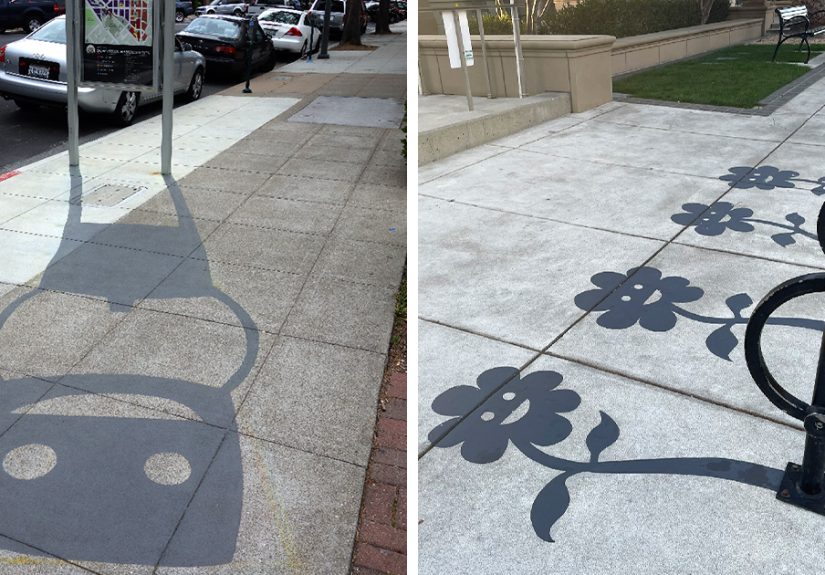
Public art gets extra points when it ambushes people on an ordinary walk, and Damon Belanger’s painted shadow works in Redwood City do exactly that. One of the most memorable examples turns a simple bench into the source of a huge dog-shaped shadow. It is playful, accessible, and immediate. You do not need an art-history degree; you just need eyeballs.
-
10. His bike-rack shadows that bloom into cheerful flowers
Belanger’s bike racks do not settle for being bike racks. With painted “shadows” extending across the pavement, they become giant flowers. That transformation is clever because it preserves the original object while letting imagination hijack it. The work proves that shadow art does not always need a gallery wall or a spotlight. Sometimes all it needs is a sidewalk and a sense of humor.
-
11. The streetlight pole that suddenly becomes a dragon
A shadow in the shape of a dragon is exactly the sort of visual nonsense the world needs more of. Belanger’s pole-based piece is effective because it takes the most forgettable kind of urban furniture and gives it a fantasy upgrade. The result feels cartoonish in the best possible way, like a city block briefly deciding to become a storybook.
-
12. A mailbox that projects monster energy instead of mail energy
Belanger’s project thrives on this idea: the object stays practical, but the shadow misbehaves. A mailbox can suddenly appear to cast a creature-like silhouette instead of a predictable patch of gray. That playful mismatch pulls pedestrians into the work. For a moment, the street stops being infrastructure and starts acting like a stage set with excellent comedic timing.
-
13. A robot-band feeling created from everyday street fixtures
Several of Belanger’s shadow designs lean into robotic and cartoon forms, turning humble urban objects into characters with attitude. This matters because it broadens the definition of shadow art installations. Not every example needs to happen indoors or rely on projected light. Painted shadow interventions can deliver the same conceptual thrill by making ordinary objects feel unexpectedly animate.
-
14. Anila Quayyum Agha’s Intersections, a cube that transforms an entire room
Anila Quayyum Agha’s Intersections takes the logic of shadow art and expands it architecturally. A carved cube with internal light throws intricate patterns across walls, floor, and ceiling, turning a gallery into a luminous chamber of lace-like darkness. It is less about one object becoming one figure and more about one object making an entire space come alive.
-
15. Agha’s later geometric light works that turn pattern into atmosphere
What makes Agha’s installations so compelling is how they convert ornament into environment. The object in the middle may be static, but the room feels active, almost breathing, as shadows wrap every surface. These works show that shadow art can be immersive instead of merely illustrative. You do not just look at it. You step inside it and become part of the composition.
-
16. Laurent Craste and Dpt.’s porcelain vases with animated shadows
Some shadow installations are clever because they move. In the interactive work created by Laurent Craste and Dpt., irregular porcelain forms cast animated shadow scenes when the light shifts. That is a wonderful twist: the solid object seems formal and still, while the shadow behaves like cinema. Suddenly a vase is not just decor. It is a tiny theater with better lighting.
-
17. Soo Sunny Park’s chain-link fencing turned into a floating light web
Chain-link fencing is not usually associated with beauty. It tends to say “keep out,” not “please gasp dramatically.” But in installations built from fencing and light-reactive material, Soo Sunny Park transforms that industrial texture into a glowing, shadow-rich environment. The familiar grid becomes airy and dreamlike, proving that ordinary construction materials can deliver genuine wonder.
-
18. Wang Ningde’s shadow photographs built from hundreds of small elements
Wang Ningde’s work shows how shadow can behave like photography without acting like photography. Built from many suspended or layered components, the final image reads as a face or portrait from a distance. Up close, it dissolves into parts. The effect is both sculptural and ghostly, which makes it a strong example of how light and shadow art can blur mediums.
-
19. William Kentridge’s found-object shadow theater on a grand scale
William Kentridge often uses cut paper, props, film, and sculptural staging to create a world where shadows carry narrative weight. His installations and moving-image works are not the same as a single-object shadow trick, but they belong in the conversation because they make silhouettes feel dramatic, political, and alive. The shadow stops being decoration and becomes a performer.
-
20. Andy Warhol’s Shadows, which turns a fleeting shape into a panorama
Warhol’s Shadows takes a different route into the subject, stretching a single elusive motif across a large-scale installation. It is a reminder that shadow art does not need to be cute or illusionistic to be powerful. Sometimes the clever move is repetition. By giving a passing shadow monumental scale, Warhol turns something temporary into something immersive and strangely cinematic.
-
21. The larger genre itself, where ordinary objects become secret image machines
The most clever shadow installation may be the entire category. Chairs, fences, scrap heaps, folded paper, letters, vases, and street furniture all become image machines under the right conditions. That is why this art form keeps spreading across galleries, museums, and public spaces. It flatters the viewer’s curiosity while revealing that the ordinary world is one lighting change away from mischief.
What These Installations Say About Creativity
There is a reason shadow art installations feel so modern, even when they rely on one of the oldest visual phenomena on earth. They reward re-seeing. In a culture that loves speed, they make people pause. In a culture obsessed with polished surfaces, they often start with materials that are rough, discarded, industrial, or mundane. And in a world where images are endlessly edited on screens, these works create astonishment the analog way: with placement, patience, physics, and a very disciplined light source.
That matters for designers and artists, but it also matters for everyday viewers. These installations quietly teach a creative lesson that is bigger than art. Meaning is often hiding in arrangement. Beauty is often hiding in context. And sometimes the difference between “random object” and “unforgettable image” is not more material at all. It is simply a new angle.
The Experience of Seeing Shadow Art in Person
Looking at photos of shadow art is fun. Seeing it in person is a whole different animal. The first thing that changes is scale. In an image, the illusion seems neat and clever. In a room, it can feel eerie, funny, intimate, or overwhelming. You become aware of where you are standing, where the light is placed, how far the wall is from the object, and how much the whole illusion depends on physical space. It stops being just an image and starts feeling like an event.
There is also a tiny burst of suspense that happens before the reveal. Your eyes move from the object to the shadow and back again, trying to reconcile the two. That mental lag is part of the pleasure. A heap of scrap should not become a portrait. A carved block should not become a face. A fence should not become a glowing atmospheric cloud. And yet there it is, casually ignoring your expectations. Shadow art is one of the few forms of contemporary installation art that can make adults experience the same delighted confusion usually reserved for kids seeing a magic trick.
Public shadow works add another layer because they interrupt routine. Imagine heading to lunch, checking your phone, and then noticing that the shadow by a bike rack looks like a bouquet or a robot or some giant creature that absolutely was not there in your emotional planning for the day. That kind of artwork earns attention without begging for it. It sneaks into ordinary life and improves the mood with almost suspicious efficiency.
Gallery-based shadow installations feel different. They are quieter and more theatrical. The lighting is controlled. The walls become active participants. Sometimes the room feels as important as the object, especially in immersive works where patterns flood the space. Viewers start moving more slowly, not because a sign told them to, but because the work demands a better pace. You are not just looking at a sculpture. You are negotiating with light, darkness, angle, and scale.
Another striking part of the experience is how social it becomes. People rarely keep shadow art to themselves. They point. They laugh. They call someone over. They take one step left and say, “Wait, stand here.” It creates shared discovery, which is harder to pull off than it sounds. A lot of art is moving or impressive, but shadow art is especially good at making strangers behave like teammates solving the same visual puzzle.
And then there is the aftereffect. Once you have spent time with strong shadow sculptures, the world outside starts acting suspicious. A pile of coats on a chair looks like it might secretly be a horse. A bent signpost seems one dramatic sunset away from becoming modern mythology. A kitchen colander starts looking dangerously artistic. Good shadow art installations do not end when you leave them. They retrain your eye. Suddenly ordinary objects seem less finished, less fixed, and much more capable of surprise.
Conclusion
The best shadow art installations do more than create optical illusions. They show how imagination can be engineered from the plainest materials imaginable. Whether the artist is working with trash, paper, steel, carved wood, fencing, pavement, or a single lit cube, the result is the same: ordinary objects come alive because light reveals a hidden version of them. That is why this corner of contemporary art remains so satisfying. It is technical, playful, conceptual, and deeply accessible all at once.
If great design is partly about making us notice what we usually ignore, then shadow art may be one of the smartest visual forms around. It turns the overlooked into the unforgettable. It makes walls part of the artwork. It makes viewers part of the discovery. And it proves, again and again, that even the most familiar object might be one beam of light away from becoming the star of the room.