Table of Contents >> Show >> Hide
- Why Jumping Higher Matters in Basketball
- Way 1: Build Lower-Body Strength That Actually Transfers to the Court
- Way 2: Use Plyometrics to Turn Strength Into Explosiveness
- Way 3: Fix Your Jump Mechanics, Mobility, and Recovery
- A Simple Weekly Plan to Improve Your Vertical
- Common Mistakes That Keep Players From Jumping Higher
- Final Thoughts
- Real-World Experiences: What Players Learn When They Try to Jump Higher
If you want to jump higher in basketball, welcome to the club. It is a very crowded club. Every hooper who has ever bricked a dunk, lost a rebound to someone shorter, or stared at the rim like it personally offended them has had the same thought: “I need more bounce.”
The good news is that a better vertical is not some mystical gift handed out only to genetic lottery winners. Yes, genetics matter. No, that does not mean you are stuck jumping like your sneakers are filled with wet sand. In most cases, players improve their vertical jump when they train the right qualities in the right order.
If you strip away the hype, most effective vertical jump programs come down to three things: building more force, learning to apply that force fast, and fixing the habits that quietly kill explosiveness. That is exactly what this guide covers.
Why Jumping Higher Matters in Basketball
A higher vertical jump is not just about dunking for social media and then pretending you have “always had hops.” It affects real basketball skills. A better jump can help you finish through contact, rebound outside your area, block shots, elevate quicker on jumpers, and win second-effort plays around the rim.
In simple terms, a stronger vertical helps you play above the crowd. And in basketball, life gets easier when you can spend a little more time above the crowd.
Way 1: Build Lower-Body Strength That Actually Transfers to the Court
Strength is the engine behind your vertical
If you cannot produce force, you cannot produce lift. That is the unglamorous truth. Jumping higher starts with becoming stronger, especially through the hips, glutes, quads, hamstrings, calves, and trunk. Think of strength as the engine and explosiveness as the turbo button. If the engine is tiny, the turbo does not have much to work with.
This is why athletes who improve their squat strength, hinge strength, and single-leg stability often see their jump improve too. More force into the floor gives you more force back from the floor. Basketball may look flashy, but physics remains annoyingly serious about this stuff.
The best strength exercises for basketball players
You do not need a circus workout. You need a small group of movements done consistently and progressed over time.
- Back squats or front squats: Great for building lower-body force and teaching you to drive hard through the floor.
- Trap-bar deadlifts or Romanian deadlifts: Excellent for posterior-chain power, which matters a lot when you explode upward.
- Bulgarian split squats: Gold for basketball players because the game is full of single-leg force production.
- Step-ups: Useful for leg drive, hip stability, and reducing side-to-side imbalances.
- Calf raises and soleus work: Not sexy, but very helpful. Your ankles and lower legs help finish the jump and absorb landing forces.
- Core bracing work: Planks, carries, anti-rotation drills, and hanging leg raises help you transfer force without leaking energy.
Do not ignore unilateral training
Basketball is not played in a perfectly even, two-footed laboratory. Players cut, plant, stop, and jump off one leg all the time. That is why single-leg strength matters. Split squats, lunges, step-ups, and single-leg RDLs do more than make your workout feel rude. They improve balance, help correct asymmetries, and build the kind of stability that shows up in real game movement.
If one leg is much weaker than the other, your jump mechanics usually know it, even if your ego does not.
How to train for strength without turning into a slow-moving forklift
The goal is not bodybuilding fluff or endless leg days that leave you walking like a broken folding chair. The goal is useful strength.
A practical setup for most players is two or three lower-body lifting sessions per week. Focus on big compound lifts first, then accessory work second. Use progressive overload, but do not chase fatigue just because it feels productive. Some of the best jump training looks almost boring on paper: clean movement, good rest, smart loading, repeat.
Example lower-body strength session:
- Trap-bar deadlift: 4 sets of 4 to 6 reps
- Bulgarian split squat: 3 sets of 6 to 8 reps each leg
- Romanian deadlift: 3 sets of 6 to 8 reps
- Standing calf raise: 3 sets of 10 to 15 reps
- Pallof press or weighted plank: 3 sets
Train hard, but leave a rep or two in the tank on most sets. You are trying to become explosive, not audition for the role of “guy too sore to bend down for a loose ball.”
Way 2: Use Plyometrics to Turn Strength Into Explosiveness
Plyometrics teach your body to be springy
Strength helps you create force. Plyometrics help you create force fast. That difference matters.
Plyometric training improves the stretch-shortening cycle, which is your body’s ability to absorb force and then rapidly redirect it. In basketball terms, this is the magic behind quick second jumps, snappy takeoffs, and explosive movement in traffic. It is not just “jumping a lot.” It is training your nervous system and tissues to react with speed and precision.
This is why a player who is strong but slow can still get out-jumped by someone lighter, springier, and more reactive.
The most useful plyometric drills for basketball
You do not need fifty-seven random jump drills copied from a highlight page. You need a progression.
- Pogo jumps: Great for ankle stiffness, quick contacts, and lower-leg elasticity.
- Squat jumps: Useful for teaching pure force output with minimal momentum tricks.
- Box jumps: Helpful when done correctly, especially for intent and landing control.
- Broad jumps: Build horizontal force that can also support faster first steps and better approach jumping.
- Lateral bounds or skater jumps: Basketball is not only vertical. Lateral force matters too.
- Approach jumps: One of the best sport-specific drills because it teaches you to convert speed into lift.
- Single-leg hops and bounds: Great for advanced players who already have solid control.
Landing mechanics matter more than most players think
Here is a sneaky truth: some players do not need harder plyometrics yet. They need better landings. If you land like a piano fell out of the sky, your body is telling on you.
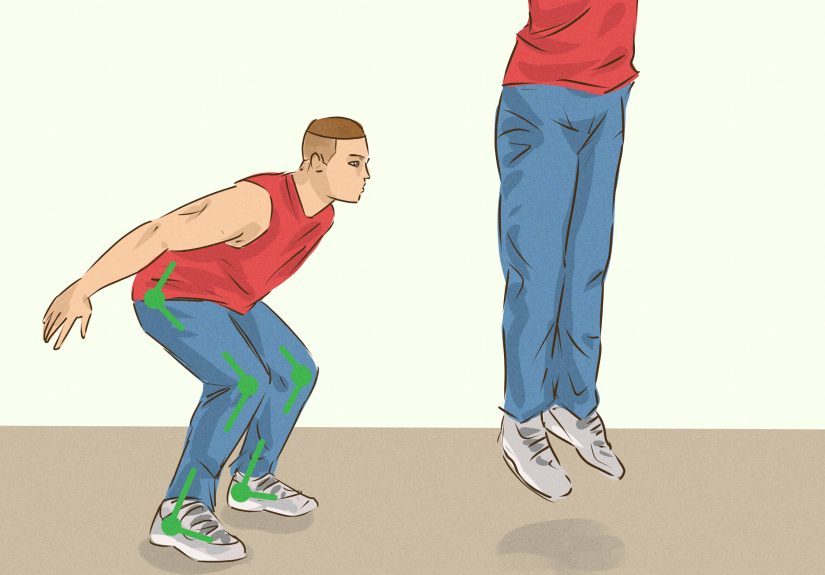
Good landing mechanics look balanced and quiet. Your knees should track well, your torso should stay under control, and your feet should not slap the floor like they are filing a complaint. Learning to absorb force cleanly helps you stay healthier and gives you a better base for more advanced jump work.
This is also why low-level drills still matter. Pogo jumps, snap-downs, low box landings, and controlled bounds may not look cool, but they build the control that keeps higher-intensity work useful instead of reckless.
How much plyometric work should you do?
More is not always better. In fact, too much jumping usually backfires. Your best jumps happen when you are fresh enough to move fast and cleanly.
For many players, two plyometric sessions per week is a smart place to start. Keep the volume moderate, the intent high, and the quality sharp. Do your explosive work early in the workout, before fatigue turns your mechanics into a science experiment.
Example plyometric session:
- Pogo jumps: 3 sets of 15 to 20 seconds
- Squat jumps: 4 sets of 4 reps
- Broad jumps: 4 sets of 3 reps
- Approach jumps: 5 to 6 total quality attempts
- Lateral bounds: 3 sets of 5 each side
Rest enough between sets to stay explosive. This is power training, not punishment.
Way 3: Fix Your Jump Mechanics, Mobility, and Recovery
Technique can unlock inches you already own
Some players try to jump high with the coordination of a shopping cart. They are strong enough, but their timing is off. Better mechanics can create fast improvement, especially for newer athletes.
Here are a few jump cues that often help:
- Use a quick dip: Do not sink forever into the loading phase. A fast, athletic countermovement is usually better.
- Swing your arms aggressively: The arm swing contributes more than people think.
- Finish tall: Extend through the hips, knees, and ankles. Think “reach through the ceiling.”
- Practice one-foot and two-foot takeoffs: Different game situations use different patterns.
- Own the penultimate step on approach jumps: That final setup step helps convert speed into lift.
If you have ever seen a player who does not look outrageously strong but still floats, there is usually some technical efficiency involved. Sometimes the body is ready before the pattern is.
Mobility and stiffness both matter
This part confuses a lot of people. To jump higher, you need enough mobility to get into good positions and enough stiffness to rebound out of them quickly. Too stiff and you move like a folding ladder. Too loose and you bleed force.
For most basketball players, it helps to keep ankles, hips, and thoracic spine moving well. A simple dynamic warm-up before training can improve movement quality and prep you for explosive work. Think ankle rocks, hip openers, high knees, skips, side shuffles, and bodyweight squats. Nothing fancy. Just effective.
Recovery is not optional if you want real results
This is the part many athletes skip because sleep is less exciting than box jumps. Unfortunately, your muscles and nervous system do not care what feels exciting. They care whether you recover.
If you jump hard, lift hard, play often, and sleep poorly, your vertical can stall even while you are “working hard.” Recovery habits that matter include:
- Sleep: This is when much of your tissue repair and adaptation happens.
- Hydration: Dehydration can crush performance and make recovery harder.
- Smart scheduling: Do not stack your hardest jump work on top of your most exhausting court days every single week.
- Deloads and lighter weeks: Your body likes progress, but it also likes not being bullied nonstop.
Sometimes the reason a player is not jumping higher is not that they need a new exercise. It is that they are doing too much, recovering too little, and wondering why their legs feel like expired batteries.
A Simple Weekly Plan to Improve Your Vertical
Here is a practical template for a basketball player who also wants to keep skill work in the mix:
Monday: Strength + Low-Volume Plyometrics
Squats, split squats, core work, then squat jumps and pogos.
Tuesday: Basketball Skills + Light Conditioning
Shooting, ball-handling, footwork, easy movement quality work.
Wednesday: Recovery or Mobility Day
Light mobility, walking, foam rolling, easy shooting.
Thursday: Strength + Approach Jump Work
Deadlifts or hinges, step-ups, calf work, then approach jumps and bounds.
Friday: Skills + Reactive Plyometrics
Short, crisp session with lateral bounds, snap-downs, or low-volume box jumps.
Saturday: Scrimmage or Game Play
Let the training transfer to real basketball.
Sunday: Full Rest
Yes, actual rest. Your vertical would like to file a thank-you note.
Common Mistakes That Keep Players From Jumping Higher
- Only doing random jump drills: Without strength, you cap your ceiling.
- Lifting heavy but never moving explosively: Strength without speed is incomplete.
- Doing too much volume: Fried legs do not jump well.
- Ignoring single-leg work: Basketball exposes imbalances fast.
- Skipping warm-ups: Your first explosive rep should not be your body’s first surprise of the day.
- Chasing soreness instead of performance: You are training to jump higher, not limp dramatically.
- Expecting a miracle in one week: Athletic development is still development.
Final Thoughts
If you want to jump higher in basketball, stop looking for a magic drill and start building a better athlete. The three big levers are simple: get stronger, get more explosive, and recover like your performance depends on it, because it does.
Build force with smart strength training. Convert that force into bounce with plyometrics. Then protect your gains with better mechanics, better movement quality, and better recovery habits.
Do that consistently, and your vertical jump has a much better chance of improving. Maybe you start finishing above the rim. Maybe you snag rebounds that used to be out of reach. Maybe your friends stop saying “almost” every time you try to dunk. That alone is worth the effort.
Real-World Experiences: What Players Learn When They Try to Jump Higher
One of the most common experiences players have when chasing a higher vertical is realizing that progress does not feel dramatic at first. It usually feels subtle. A player starts training and expects fireworks in ten days. Instead, what happens is smaller. Their warm-up feels smoother. Their legs feel more stable on hard stops. Their first jump in practice is not wildly different, but their third and fourth jumps look sharper. Then, a few weeks later, they notice they are touching a little higher on the backboard without thinking much about it. That is how real progress often enters the room: quietly, without a marching band.
Another common experience is discovering that strength work changes confidence as much as it changes performance. Players who consistently squat, hinge, split squat, and train their core often say the court starts to feel less chaotic. Contact feels easier to handle. Landing feels safer. Rebounding feels less like guesswork and more like a collision they are prepared to win. They may begin the process thinking, “I just want to dunk,” but along the way they realize they are moving better everywhere. The vertical jump becomes the headline, but the supporting cast is better balance, better braking, and a stronger base in traffic.
Plyometric training creates its own learning curve. At first, many players treat every jump drill like a contest and try to explode on every rep with no control. Then they see video of themselves landing like a folding table tossed down a staircase. That is usually the moment things click. The best jumpers are not just powerful; they are organized. Once players learn to stay balanced, strike the ground cleanly, and use quick, sharp contacts, the drills stop looking sloppy and start looking athletic. The difference is obvious. Same effort, better shape, better bounce.
Players also learn that recovery is not a boring side note. It is often the reason progress finally appears. A lot of hoopers live in a cycle of hard practice, pickup runs, extra workouts, poor sleep, questionable hydration, and then confusion about why their legs feel dead. When they finally sleep more, spread out intense sessions, and stop trying to max out every day, their jump often improves. Not because they found a secret exercise, but because their body finally had a chance to absorb the work. It is deeply unfair and completely true.
There is also the emotional side of this process. Chasing a better vertical can be humbling. Some days you feel springy and think you have cracked the code. Other days the rim looks taller, your legs feel heavy, and your best effort seems to produce the vertical leap of a disappointed office chair. That is normal. Progress in athletic performance is rarely linear. The players who improve most are usually the ones who stay patient through those swings, trust the training, and keep stacking quality weeks.
In the end, the biggest experience many athletes report is this: jumping higher changes how they see themselves as players. They stop training like someone hoping for random luck and start training like someone building a skill. That mindset shift matters. A better vertical is not just inches. It is preparation, consistency, and proof that smart work compounds. And once a player feels that, the rim starts looking a little less like a dream and a little more like an appointment.