Table of Contents >> Show >> Hide
- Because the Moon Was Never Just a Rock in the Sky
- Because Science Needed More Than a Flyby
- Because Walking on the Moon Taught Earth About Earth
- Because the Moonwalk Was Also a Technology Demo on the Largest Possible Stage
- Because the Experience Itself Mattered
- Because the Moon Changed the Meaning of “Possible”
- Because “Why I Walked on the Moon” Is Really a Question About Human Nature
- Additional Experiences Related to “Why I Walked on the Moon”
- Conclusion
The title sounds wonderfully dramatic, doesn’t it? Like someone kicked open a lunar hatch, looked around, and said, “Well, I didn’t come all this way to just stare out the window.” But behind that swagger lies a serious question: why did anyone walk on the Moon in the first place? Why risk billions of dollars, years of engineering, and more stress than a coffee maker in a newsroom just to put boots in gray dust?
The honest answer is that no single reason explains it. The Moon was a political goal, a scientific laboratory, a technological proving ground, and a psychological mirror held up to humanity. Apollo was never only about flags and footprints. It was about proving that human beings could set a nearly impossible goal, build the tools to reach it, survive the trip, and come home with knowledge that changed how we think about Earth, space, and ourselves.
So if you ask, “Why I walked on the Moon,” the answer is bigger than one astronaut and bigger than one mission. It includes presidents, engineers, geologists, mathematicians, test pilots, seamstresses, software pioneers, and thousands of people whose names never made the headlines. It also includes curiosity, pride, fear, ambition, and that deeply human urge to go see what’s over the next horizon, even if the next horizon is 238,900 miles away and has no air, no weather, and absolutely terrible real estate prices.
Because the Moon Was Never Just a Rock in the Sky
A national challenge became a human one
In the early 1960s, the race to the Moon was inseparable from the Cold War. The United States was not simply daydreaming about space because the Moon looked pretty. It was reacting to Soviet successes in rocketry and human spaceflight, and space had become a stage where technology, military capability, national confidence, and political ideology all performed at once. When President John F. Kennedy committed the nation to landing a man on the Moon and returning him safely to Earth before the decade was out, he turned a scientific ambition into a national deadline.
That political pressure mattered. It concentrated money, talent, and urgency in a way that peacetime bureaucracy rarely does. NASA’s own summary of Apollo’s goals shows that the program was not only about touching the Moon. It aimed to establish new space technology, secure American preeminence in space, carry out scientific exploration, and develop human capability to work in the lunar environment. In other words, the Moon landing was both the headline and the laboratory.
That also explains why the question “Why walk?” mattered so much. Orbiting the Moon was impressive. Photographing it was useful. Landing on it was extraordinary. But walking on it changed the mission from remote observation into direct exploration. A boot print meant a person had arrived in a place previously known only by telescope, theory, and robotic reconnaissance. It turned the Moon from an object into a field site.
Because Science Needed More Than a Flyby
Robots opened the door, but people did the fieldwork
Before Apollo astronauts ever bounced across lunar dust, NASA had to answer a very awkward question: would the Moon actually hold them up? Earlier theories imagined the surface might be buried beneath deep powder, like cosmic quicksand with worse public relations. Robotic missions such as Ranger, Surveyor, and Lunar Orbiter helped settle those fears. They photographed the surface, tested landing conditions, and mapped safer regions for future crews. That groundwork made Apollo possible.
Still, machines alone could not do everything Apollo needed done. Astronauts on the Moon were not tourists with excellent transportation. They were field researchers in bulky suits. They deployed instruments, collected rocks, described terrain, solved problems in real time, and made judgments that no remote operator in the 1960s could make fast enough from Earth. The ability to improvise mattered. Humans could notice unexpected features, change collection priorities, and physically navigate an alien landscape that had looked deceptively smooth from orbit.
Apollo 12 proved how quickly lunar operations became more sophisticated. That mission made a pinpoint landing near the robotic Surveyor 3 spacecraft, letting astronauts inspect and retrieve parts from a machine that had been sitting on the Moon for years. That was not symbolism. That was practical science and engineering: precision navigation, geology, and hardware analysis all bundled into one dusty outing.
And then came the treasure haul. Across six Moon landings, Apollo astronauts collected 2,196 samples totaling 842 pounds of lunar material. Those rocks and soils did much more than fill museum cases. They transformed planetary science. They helped scientists better understand volcanic history on the Moon, the age of different lunar surfaces, and the violent processes that shaped rocky worlds. In a very real sense, the Moon walked back into Earth’s laboratories inside sealed sample containers.
Because Walking on the Moon Taught Earth About Earth
The lunar mission had earthly consequences
One of Apollo’s greatest tricks was making a Moon mission tell us more about our own planet. NASA later noted that Apollo research benefited Earth science directly. Missions in Earth orbit took images in different wavelengths that helped scientists spot patterns not obvious from the ground, and that work fed into later programs such as Landsat. Apollo hardware and engineering lessons also influenced Skylab and the Space Shuttle.
The Moon, ironically, became a classroom for Earth systems, engineering discipline, and long-duration planning. The mission forced people to think in systems: life support, communication delays, material failure, navigation, energy budgets, redundancy, and human performance under extreme pressure. That systems thinking did not stay on the launch pad. It spilled outward into aerospace, computing, imaging, materials, and project management.
Even culturally, Apollo changed how people saw Earth. Photos taken during the Apollo era showed a small, bright planet suspended in darkness, with no visible borders and no room for national ego once you backed far enough away. Smithsonian reporting has noted that Apollo imagery helped strengthen environmental awareness. It is one thing to discuss “the planet” in speeches. It is another to see it, vulnerable and complete, floating in black silence like the most precious marble ever lost in a very large room.
Because the Moonwalk Was Also a Technology Demo on the Largest Possible Stage
The hardware was heroic, but the computer was quietly absurd
Apollo is often remembered through giant images: the Saturn V rocket, the lunar module, the ladder, the flag, the boot print. But one of the program’s biggest revolutions sat in a much smaller box. The Apollo Guidance Computer, developed through MIT’s Instrumentation Laboratory, helped control navigation and guidance for the mission. MIT has described it as the first significant use of silicon integrated circuit chips, and that matters because it pushed microelectronics forward in a way that echoed far beyond spaceflight.
This little machine had to be compact, reliable, and tough enough to support one of the most unforgiving journeys ever attempted. It existed in a period when many computers still occupied entire rooms and behaved like overcaffeinated filing cabinets. Apollo needed something far smaller and far smarter. The result accelerated computing development and helped prove that digital systems could guide life-or-death operations in real time.
And Apollo did not merely test machines. It tested how humans and machines would work together. Lunar flight was a dance between automated systems and highly trained astronauts who had to interpret data, intervene when needed, and make judgment calls under extraordinary conditions. The Moon landing was not “man versus machine” and it was not “man replaced by machine.” It was an early master class in human-machine partnership.
Because the Experience Itself Mattered
You cannot get the full answer from instruments alone
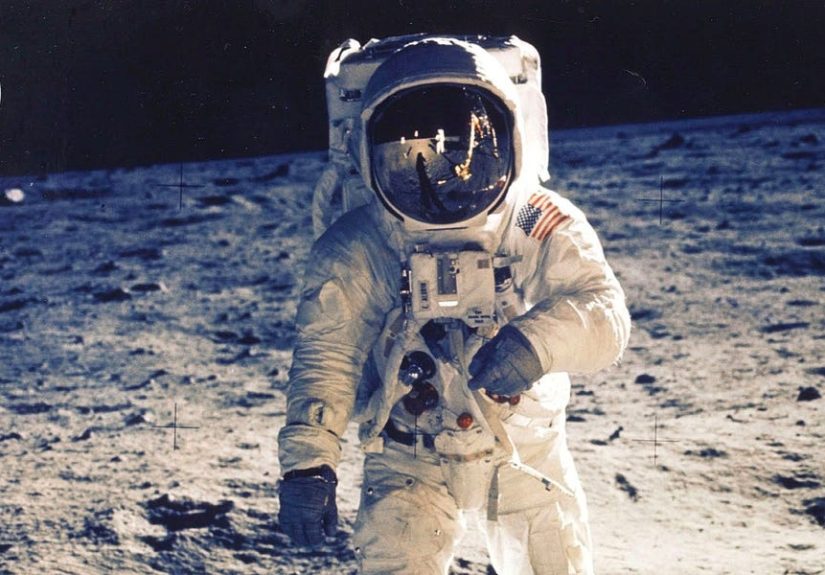
Buzz Aldrin’s reflections on walking on the Moon remain striking because they are so sensory. He remembered the perfect little waves of dust rolling away from his boots, the strange pleasure of moving in one-sixth gravity, the clean blackness of the sky, and the overwhelming quiet. Later, back inside the lunar module, he recalled the smell of lunar dust as something like gunpowder. That is the kind of detail no robotic probe volunteers. A machine can measure chemistry, but it does not tell you what a new world feels like.
NASA had worked hard to prepare astronauts for that unfamiliar movement. Langley researchers used reduced-gravity simulators to study how people might walk, run, and work under one-sixth Earth gravity. That work sounds almost comical on first read, as if the agency built the world’s most expensive weird treadmill, but it addressed a serious problem. If astronauts could not move efficiently, they could not explore efficiently. On the Moon, even walking had to be engineered.
That is another reason the Moonwalk mattered. It proved humans could physically adapt to another world. The accomplishment was not just reaching the surface. It was functioning on the surface: climbing down, balancing, collecting, carrying, deploying, documenting, and returning. Apollo did not simply answer “Can we land?” It answered “Can we work there?”
Because the Moon Changed the Meaning of “Possible”
Apollo made the future feel less theoretical
Before Apollo, a trip to another world belonged mostly to science fiction, sketches, pulp covers, and brave predictions. After Apollo, it belonged to history. That shift is difficult to overstate. Once human beings had gone to the Moon, stepped out, worked, collected samples, and returned home, future exploration no longer sounded like fantasy. It sounded like an engineering challenge.
That legacy still matters. Apollo 11 fulfilled Kennedy’s original mission objective, but the broader Apollo program showed that lunar exploration could evolve rapidly. Six missions landed astronauts on the Moon. Twelve people walked there. Twenty-four made the trip to lunar space between 1968 and 1972. Apollo 12 demonstrated pinpoint landing. Later missions expanded science operations and the amount of work crews could do on the surface. Each mission widened the idea of what “going to the Moon” could mean.
And the samples still speak. NASA continues studying Apollo material with tools more sensitive than anything available in 1969 or 1972. That means the Moon missions are not sealed in history; they are still active in science. The astronauts came home decades ago, but some of their most important conversations with researchers are still happening, just in laboratories instead of mission control.
Because “Why I Walked on the Moon” Is Really a Question About Human Nature
Curiosity, courage, competition, and continuity
So why walk on the Moon? Because nations compete. Because science asks difficult questions. Because engineers like impossible deadlines almost as much as they fear them. Because pilots trust checklists. Because geologists dream in rocks. Because some goals are so difficult that they organize entire generations of effort. And because humanity has always looked upward and wondered whether looking was enough.
Buzz Aldrin later wrote that his own motivation burned as brightly as ever: a desire to contribute to a continuous human presence in space. That personal motive fits neatly inside the larger Apollo story. The Moon was not only a destination. It was a threshold. Walking there was a statement that human beings did not have to remain permanent residents of one world.
The most useful answer, then, is this: I walked on the Moon because it united urgency and wonder. Politics got the rocket funded. Science justified the mission. Technology made it possible. Human skill made it real. And the experience made it unforgettable.
If that sounds lofty, good. It should. Walking on the Moon was not normal, reasonable, or convenient. It was expensive, dangerous, difficult, and outrageously ambitious. Which, in fairness, is often how history’s best ideas first look.
Additional Experiences Related to “Why I Walked on the Moon”
To understand the emotional weight of the Moonwalk, you have to imagine the collision of opposites the astronauts experienced. Everything about the mission was loud, violent, and mechanical right up until the moment it was not. Launch was thunder, vibration, fire, and acceleration. Training was endless repetition, technical language, pressure, and procedure. Mission control was all voices, numbers, alarms, and checklists. Then suddenly there was the lunar surface: silent, stark, and oddly delicate. One boot step could send gray dust drifting in soft arcs. The contrast itself must have felt unreal, as if the universe had a talent for dramatic timing.
There was also the strange physical comedy of learning how to move where your body had no lifetime of practice. On Earth, you do not think about walking because gravity has coached you since infancy. On the Moon, gravity became a new manager with confusing expectations. Astronauts found that the elegant stride of movies was not always practical. Hopping, loping, and short bounding motions often worked better. The Moon did not care whether anyone looked graceful. It rewarded efficiency, balance, and not falling over in a pressurized suit that made every movement more complicated.
The suits themselves shaped the experience. A Moonwalker was never simply a person outdoors. He was a person inside a portable spacecraft, carrying life support on his back and operating through layers of engineering. That meant every simple human action became a tiny negotiation with the suit. Bend too quickly and the pressure fought back. Reach awkwardly and the joints reminded you who was boss. Pick up a rock and you were doing geology through gloves. Even so, the astronauts managed useful fieldwork because the suit, for all its stubbornness, gave them the power to survive where survival had no natural business existing.
Then there was the view. The Moon did not offer the cozy scenery of Earth. No rustling trees. No blue haze. No weather. No distant birds deciding to be noisy at exactly the wrong time. What it offered instead was purity: hard light, hard shadow, a black sky, and a horizon that seemed strangely close because the Moon is smaller than Earth. Aldrin’s memory of the quiet captures something essential here. The silence was not peaceful in the ordinary sense. It was total. It made the astronauts more aware that they were visitors in a place that would remain exactly itself whether humans came or not.
That psychological effect may be one of Apollo’s least measurable but most important results. Walking on the Moon exposed people to a world that was profoundly real yet emotionally difficult to categorize. It was familiar enough to stand on and alien enough to unsettle every instinct. The ground held. The dust moved. The light behaved strangely. Earth hung in the sky not as “up” or “down” but as home made visible. That image alone explains a great deal about why the Moonwalk still matters. It turned home into something you could point at.
The experience also carried responsibility. The astronauts were not there only to marvel. They had timelines, tasks, samples to collect, experiments to deploy, and a spacecraft waiting to take them back to orbit. Wonder had to coexist with procedure. That balance is part of what made Apollo so compelling. The Moonwalk was both transcendent and practical. One minute a person could be absorbing the fact that he was standing on another world; the next minute he needed to remember where the tool carrier was and whether the sample bag was secure. The sublime and the logistical shared the same footprint.
In that sense, the lived experience answers the title better than any slogan does. I walked on the Moon because walking there was the only way to turn a giant national promise into human reality. I walked there to test whether people could work on another world. I walked there to gather evidence, not just admiration. I walked there to learn what machines could not fully report. And I walked there because once humanity gained the power to reach another world, not trying would have felt like closing a door we had spent years building just to open.
That is why the Moonwalk endures. It was not merely a triumph of arrival. It was a triumph of experience. A person went, felt, adapted, observed, collected, and returned with stories and samples that still shape science and imagination. The Moon did not become ordinary after Apollo, but it became reachable. And once a place becomes reachable, history starts asking a new question: not “Why go?” but “What do we do next?”
Conclusion
“Why I Walked on the Moon” sounds like a personal confession, but it is really a summary of one of humanity’s biggest collective achievements. We walked on the Moon because the moment demanded courage, because science needed contact, because technology needed a proving ground, and because human beings are rarely satisfied with admiring a frontier from a safe distance. Apollo turned lunar wonder into lunar work. That is why the footprints still matter. They were not just marks in dust. They were proof that curiosity, discipline, and imagination can all wear the same boots.