Table of Contents >> Show >> Hide
- The Story Behind the Victoria Cabin Makeover
- A Small Cabin with a Big Design Brain
- The Ikea Kitchen Upgrade That Steals the Scene
- The Japanese Bath: A Small-Space Luxury with Soul
- Custom Furniture, Handmade Details, and the Beauty of Prototypes
- Landscape as the Real Artwork
- Why This Cabin Makeover Feels Modern Without Feeling Trendy
- Practical Ideas Inspired by the Ross Farm Cabin
- Experience Notes: What This Cabin Makeover Teaches About Living with Less, Better
- Conclusion
Some cabins whisper. Some cabins creak. And then there is Ross Farm Cabin in South Gippsland, Victoria, a tiny rural retreat that somehow manages to say, “Yes, I am humble,” while also casually serving a Japanese timber bath, custom furniture, raw brass, blackened steel, and an Ikea kitchen upgrade that looks far too polished to have begun with off-the-shelf bones.
This inventive Victoria cabin makeover is the work of Melbourne interior designer Andrea Moore of Studio Moore, in collaboration with her father, Lindsay Moore. Their project transformed a tired farm cottage on a former dairy property near Meeniyan into a deeply atmospheric one-bedroom stay. The result is not the sort of glossy renovation that shouts across the internet in all caps. It is quieter, warmer, and more interesting: a cabin that understands restraint, craft, and the power of letting timber do the emotional heavy lifting.
At a time when many small-space makeovers try to look bigger, brighter, and more expensive at any cost, this Australian cabin remodel takes a different route. It leans into compactness. It celebrates material honesty. It uses design not to erase the building’s rural past, but to sharpen it. And yes, it includes an Ikea kitchen hack so good it deserves a polite round of applause from anyone who has ever tried to make flat-pack cabinetry look custom.
The Story Behind the Victoria Cabin Makeover
Ross Farm began as an old dairy farm on the outskirts of Meeniyan, a small town in Victoria’s South Gippsland region. The Moore family had long ties to the area, and the property’s transformation unfolded slowly rather than as a one-weekend miracle montage. There were disused agricultural buildings, practical limitations, family memories, and the kind of rural structures that do not become beautiful by accident. They need patience, tools, and at least one person willing to say, “I can probably make that,” before disappearing into a shed.
The Cabin was the first of three accommodation spaces developed at Ross Farm, followed by The Barn and The Dairy. Andrea shaped the design vision, while Lindsay, a retired veterinarian with serious making skills, helped bring many of the pieces to life by hand. That father-daughter collaboration is one of the reasons the cabin feels so personal. It is not merely styled; it is made. There is a difference, and your eyeballs know it immediately.
The original building was modest, but that limitation became a strength. Rather than over-expand or over-decorate, the makeover focused on improving the cabin’s relationship with the surrounding landscape. The entry was reworked, new openings were introduced, and the interior was given a clear material language: pale plywood, local cypress, eucalyptus-inspired green tones, concrete, brass, leather, and blackened steel.
A Small Cabin with a Big Design Brain
The best small cabin design ideas usually begin with one simple question: what should the space make you feel? In the Ross Farm Cabin, the answer is calm, grounded, and slightly smug that you packed linen instead of synthetic fleece. The living area combines plywood with sage-green accents and worn leather, creating a mood that is rural without feeling dusty, minimalist without feeling cold, and refined without acting like it has never met a muddy boot.
The cabin’s palette is one of its strongest lessons. Instead of relying on trendy colors that might expire faster than an avocado on a sunny windowsill, Andrea used tones connected to the local environment. Soft greens echo the rolling landscape. Pale timber reflects the surrounding natural materials. Dark metal and brass provide contrast and durability. The whole interior feels edited, but not empty.
Why the Material Palette Works
Natural wood plays the starring role. Plywood is used not as a cheap background material, but as an architectural element that defines zones and adds warmth. Local cypress appears in the bathroom and bath area, where its aroma and insulating qualities become part of the experience. Brass is used sparingly, which is important because brass, like cologne, works best when it does not announce itself from across the room.
Blackened steel brings the kitchen into sharper focus. It adds depth, durability, and a little dramatic tension against the soft timber. The effect is not industrial in a cold warehouse sense. It is more like “farm utility went to design school and came back with excellent posture.”
The Ikea Kitchen Upgrade That Steals the Scene
Let us discuss the kitchen, because this is where the cabin makeover delivers one of its cleverest moves. The existing Ikea kitchen was not ripped out and replaced with a budget-destroying custom installation. Instead, it was upgraded with new blackened steel fronts, folded steel handles, a concrete sink, a hefty wood chopping block, and a brass countertop and backsplash.
This is the magic of a smart Ikea kitchen hack: keep the useful bones, upgrade the visible surfaces, and suddenly the whole thing looks custom. In small cabin kitchens, that strategy can be especially effective because every inch is on display. There is no “back kitchen” where clutter can hide and think about its life choices. The cabinetry, sink, counter, and backsplash all need to work hard visually and practically.
The Ross Farm kitchen works because it avoids the most common mistake in budget-friendly renovations: pretending everything is expensive. Instead, it creates honest contrast. Ikea cabinetry provides the functional framework. Hand-finished metal, concrete, wood, and brass give the room individuality. The result feels bespoke because the details are specific, not because every component came with a luxury price tag.
What Homeowners Can Learn from the Kitchen
The takeaway is not that every kitchen needs blackened steel fronts and a brass backsplash, though nobody would blame you for staring at that idea a little too long. The real lesson is that affordable systems can become extraordinary when paired with thoughtful craft. Cabinet boxes are often less important than doors, pulls, counters, lighting, and proportions. In other words, the face of the kitchen matters. Your cabinets may have humble origins, but with the right upgrade, they can develop a mysterious past and a very good jawline.
For homeowners, renters, and cabin dreamers, the principle is practical: invest in touchpoints. Handles, sink surrounds, work surfaces, lighting, and open shelving are the places people notice and physically interact with. Improve those, and even a modest kitchen can feel intentional.
The Japanese Bath: A Small-Space Luxury with Soul
One of the most memorable parts of the Ross Farm Cabin is the Japanese-inspired bath area. What had once been a dilapidated shed attached to the cabin became a deeply atmospheric bathing room lined in cypress sourced from the surrounding hills. The timber bath is not just a decorative gesture; it changes the rhythm of the stay. It asks guests to slow down, soak, breathe, and stop checking whether anyone liked their photo of toast.
This is where the cabin’s Japanese and Scandinavian influences become clearest. The room favors simplicity, natural materials, and sensory experience over excess. It is not trying to be a spa with twelve unnecessary buttons and a towel folded into a swan. It is quieter than that. The warmth of timber, the handmade quality of the bath, and the view toward nature create a retreat that feels deeply connected to place.
Why Japandi Design Fits the Cabin So Well
Japandi design, a blend of Japanese and Scandinavian sensibilities, is often associated with clean lines, natural materials, subtle colors, and functional beauty. The Ross Farm Cabin fits that spirit without feeling like it is chasing a Pinterest label. The connection is more organic. Both Japanese and Scandinavian design traditions value restraint, craft, and nature. Those values are also central to this cabin.
The key is balance. Too much minimalism can feel like a waiting room for monks with excellent credit scores. Too much rusticity can feel like a bear-themed souvenir shop. This cabin avoids both extremes. It has roughness, but also elegance. It has simplicity, but also depth. It feels handmade, but never unfinished.
Custom Furniture, Handmade Details, and the Beauty of Prototypes
Many of the cabin’s furniture pieces, fixtures, basins, lights, and pieces of hardware were designed by Andrea and made by Lindsay or local craftspeople. That explains why the cabin feels unified. The objects do not seem imported from separate moods. They belong to the same design conversation.
The cypress stool in the bath area, the inset bed niche, the standing brass valet with mirror and towel hook, and the custom sink details all show a willingness to prototype. Not every home can include handmade hardware, of course, but the thinking behind it is widely useful. When a small space has unusual needs, custom does not always mean extravagant. Sometimes it means solving one problem beautifully instead of buying three generic objects that almost work.
The bedroom is a good example. The bed is set into a plywood niche, giving the sleeping area a tucked-away feeling. Integrated storage keeps the compact room functional. A window bench doubles as both seat and table. Every element has a job, and several have more than one. That is small-space design doing its taxes properly.
Landscape as the Real Artwork
One reason this Victoria cabin makeover feels so successful is that it does not treat the view as an afterthought. The cabin sits in South Gippsland, near Wilsons Promontory, with views across the Tarwin Valley. The design emphasizes those outdoor connections through carefully placed doors, windows, and deck spaces.
In many cabin renovations, the temptation is to fill interiors with themed décor: antlers, plaid, vintage signs, maybe one wooden bear looking emotionally unavailable. Ross Farm avoids that trap. Instead of decorating the cabin to death, it lets the landscape do a lot of the talking. The interior becomes a frame for weather, light, hills, garden produce, and the slow theater of rural life.
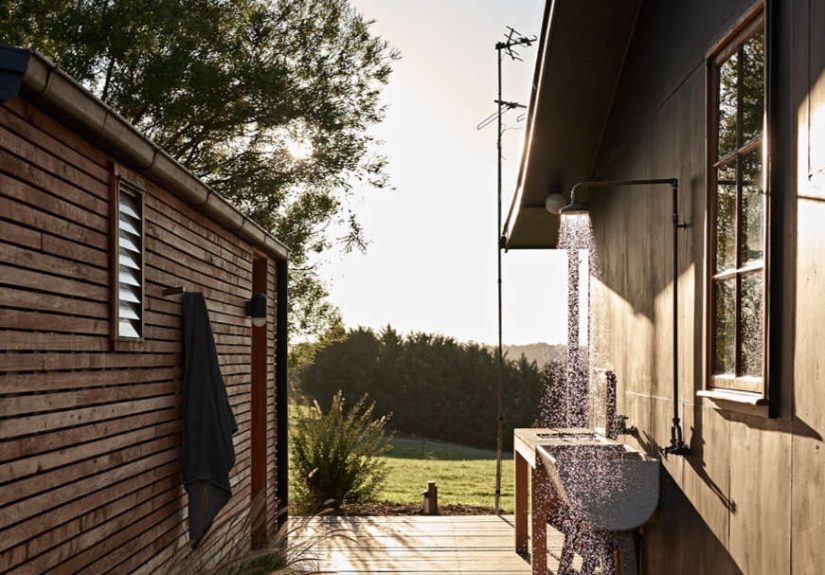
Guests can pick herbs from the kitchen garden, collect eggs from resident hens, cook in the well-equipped kitchen, rinse off in the outdoor shower, or gather by the fire pit. These experiences are not separate from the design; they are part of it. The cabin is built around rituals, not just rooms.
Why This Cabin Makeover Feels Modern Without Feeling Trendy
The Ross Farm Cabin is highly photogenic, but it does not feel like it was designed only to perform on a screen. That is increasingly rare. Many interiors now chase instant recognizability: the same arch mirror, the same boucle chair, the same vase filled with stems that look expensive and slightly thirsty. This cabin goes in a slower direction.
Its modernity comes from clarity. The floor plan is compact and purposeful. The material palette is restrained. The furniture is functional. The handmade elements give the rooms texture and personality. Nothing feels random. Nothing begs for attention. The whole project suggests that good design is not about adding more; it is about choosing better.
The Power of Restraint
Restraint does not mean plainness. In fact, it often makes details more powerful. A brass backsplash matters more when it is surrounded by matte timber and blackened steel. A handmade bath matters more when the room is free of unnecessary decoration. A view matters more when the window is placed with intention.
This is one of the strongest SEO-friendly lessons for readers searching for cabin makeover ideas, Ikea kitchen upgrades, small cabin interiors, or Australian cabin design: a memorable renovation does not need endless square footage. It needs a clear point of view.
Practical Ideas Inspired by the Ross Farm Cabin
Homeowners can borrow several ideas from this project without moving to a former dairy farm, befriending a metalworker, or becoming suspiciously good at joinery overnight.
1. Upgrade the Surfaces People Notice Most
If your kitchen layout works, consider improving the cabinet fronts, hardware, countertop, backsplash, and lighting before replacing everything. A simple Ikea kitchen can feel custom when paired with high-impact materials and better proportions.
2. Let One Material Create Continuity
The cabin uses timber as a unifying thread. In your own home, one repeated materialwood, stone, steel, limewash, or even a consistent paint tonecan connect rooms and make a small space feel more intentional.
3. Design Around Rituals
Instead of asking only how a room should look, ask what daily rituals it should support. Morning coffee, reading by a window, cooking from the garden, bathing slowly, or sitting by a fire can guide better design decisions than simply copying a mood board.
4. Use Contrast Carefully
The Ross Farm Cabin pairs pale timber with dark steel and warm brass. Contrast gives the interior energy, but it is controlled. Too many competing finishes can make a small room feel nervous. Nobody wants a nervous kitchen.
5. Make Storage Disappear
Built-in benches, bed niches, wall hooks, compact shelving, and multipurpose furniture keep small cabins livable. The goal is not to hide life completely, but to give everyday objects a proper home so they stop gathering in piles like tiny domestic rebellions.
Experience Notes: What This Cabin Makeover Teaches About Living with Less, Better
Spending time with a project like Ross Farm Cabin, even from a design-analysis perspective, makes one thing clear: small spaces are brutally honest. They do not let bad decisions hide in the guest wing. Every handle, corner, window, stool, and shelf has to justify its existence. That can sound intimidating, but it is also liberating. When a home is compact, the design brief becomes sharper. You are not decorating emptiness; you are shaping use.
The experience most closely associated with this cabin is slowness. That sounds simple, but it is difficult to design. Slowness is not created by placing a ceramic bowl on a table and calling it mindful. It comes from material warmth, softened light, comfortable proportions, and rooms that support calm behavior. The Japanese timber bath encourages soaking. The window bench encourages pausing. The kitchen garden encourages cooking with what is close by. The fire pit encourages staying outside after sunset instead of retreating immediately to a screen.
Another experience worth noting is the emotional quality of handmade details. In an age of fast interiors, handcrafted objects carry a different kind of value. They are not perfect in the factory sense, but they feel alive. A handmade stool or custom handle can become more memorable than a luxury brand piece because it belongs to the place. It has context. It is not just purchased; it is resolved.
The cabin also shows how budget-conscious decisions can become design strengths. The Ikea kitchen upgrade is a perfect example. Rather than hiding the fact that the kitchen began with accessible cabinetry, the project uses that practical foundation as a springboard. This is useful for anyone renovating on a real-world budget. You do not need every component to be custom. You need to know where custom effort matters most.
For travelers, the experience of staying in such a cabin would likely feel different from staying in a standard rental. The design is not merely a backdrop; it sets the pace. The materials invite touch. The view pulls attention outward. The compact plan makes daily actions feel deliberate. Cooking, bathing, reading, and stepping outside become part of the architecture. That is the difference between accommodation that simply houses guests and accommodation that changes their tempo.
For designers, the project is a reminder that constraints can be generous. A small footprint, an old farm building, a limited palette, and a desire to make things by hand could have produced something awkward. Instead, those constraints created focus. The cabin is inventive because it does not try to solve every problem with size or spending. It solves them with attention.
For homeowners, the most useful experience-related lesson may be this: atmosphere is built through consistency. If you want a home to feel calm, every decision has to support that goal. Lighting, storage, color, texture, hardware, furniture, and views all matter. You cannot create serenity with one linen pillow if the rest of the room is yelling. Ross Farm Cabin succeeds because its details speak the same language, and thankfully, none of them use all caps.
Conclusion
A Young Australian Designer’s Inventive Victoria Cabin Makeover, Ikea Upgrade Included is more than a charming design story. It is a case study in how thoughtful restraint, family collaboration, natural materials, and clever reuse can turn a modest rural structure into a destination with soul. Andrea and Lindsay Moore did not simply renovate a cabin; they crafted an experience that honors place, function, and the quiet luxury of well-made things.
The cabin’s Ikea kitchen upgrade proves that accessible materials can become extraordinary when handled with imagination. The Japanese timber bath shows how a small room can become the emotional heart of a home. The plywood-lined bedroom, handmade details, brass accents, and landscape-focused layout all reinforce one central idea: good design is not about having more. It is about making each choice matter.
In a world full of fast makeovers and copy-paste interiors, Ross Farm Cabin feels refreshingly grounded. It is rustic, but not rough. Minimal, but not empty. Stylish, but not smug. And yes, it gives Ikea cabinetry the glow-up of a lifetime.