Table of Contents >> Show >> Hide
- Who Is the Artist Behind the Spilled Coffee Monsters?
- How Spilled Coffee Becomes Monster Art
- Why Coffee Stain Monsters Are So Appealing
- From Accident to Art Series: The Power of a Repeatable Idea
- The Role of Chance in Art
- Why the Internet Loves Coffee Monsters
- Creative Lessons From Spilled Coffee Monster Art
- How to Try Coffee Monster Art at Home
- Why This Project Matters More Than It First Appears
- Experiences Related to “Artist Imagines Spilled Coffee As Monsters”
- Conclusion
Most people see spilled coffee and think, “Great. Now my desk smells like regret.” Stefan Kuhnigk looked at a brown splash on paper and saw a monster waiting to be born. That difference is exactly why his playful art project, known as Coffeemonsters, feels so delightful: it turns a tiny workplace accident into a whole population of strange, funny, fuzzy, toothy, wide-eyed creatures.
The idea is simple enough to explain in one sentence: coffee is spilled on paper, the stain dries, and the artist draws a monster around whatever shape appears. But the result is much richer than a clever doodle. It is part illustration, part character design, part creative exercise, and part reminder that art does not always arrive wearing a fancy velvet jacket. Sometimes it arrives as a caffeine puddle.
“Artist imagines spilled coffee as monsters” sounds like a quirky headline, but behind it is a surprisingly strong creative lesson. Kuhnigk’s work shows how accidents can become style, how randomness can become character, and how a humble stain can do what many blank sketchbooks fail to do: get an artist started.
Who Is the Artist Behind the Spilled Coffee Monsters?
The artist most closely associated with this imaginative coffee stain art is Stefan Kuhnigk, a German illustrator, designer, and copywriter from Hamburg. His Coffeemonsters project reportedly began in 2011 after he spilled coffee on a sheet of paper and noticed a creature-like shape inside the stain. Instead of tossing the paper away, he let the mark dry and added lines, eyes, limbs, teeth, expressions, and personality.
That first accident turned into a creative ritual. Kuhnigk began dripping coffee onto paper intentionally, waiting for the stains to dry, then studying the shapes until a character revealed itself. Some of his monsters look cuddly enough to host a children’s birthday party. Others look like they would steal your sandwich, blame the printer, and vanish into the office supply closet.
The charm of the project is not just that the monsters are cute or weird. It is that each one feels discovered rather than forced. The coffee stain creates the body, the mood, the posture, and often the attitude. Kuhnigk’s job is not to dominate the accident but to collaborate with it. In a world where many creative works are polished until they squeak, Coffeemonsters keeps the delicious wobble of imperfection.
How Spilled Coffee Becomes Monster Art
The process behind coffee stain monsters is wonderfully low-tech. There is no need for expensive software, rare pigments, or a studio so pristine that breathing near it feels illegal. The basic ingredients are coffee, paper, patience, and a playful eye.
Step 1: The Coffee Makes the First Move
The stain begins as a drop, splash, smear, or blot. It may spread in a round puddle, branch into little rivers, or dry with darker edges. Coffee behaves unpredictably on paper because liquid, gravity, paper texture, and evaporation all join the party. The artist does not fully control the mark. That is the point.
Step 2: The Stain Dries Into a Shape
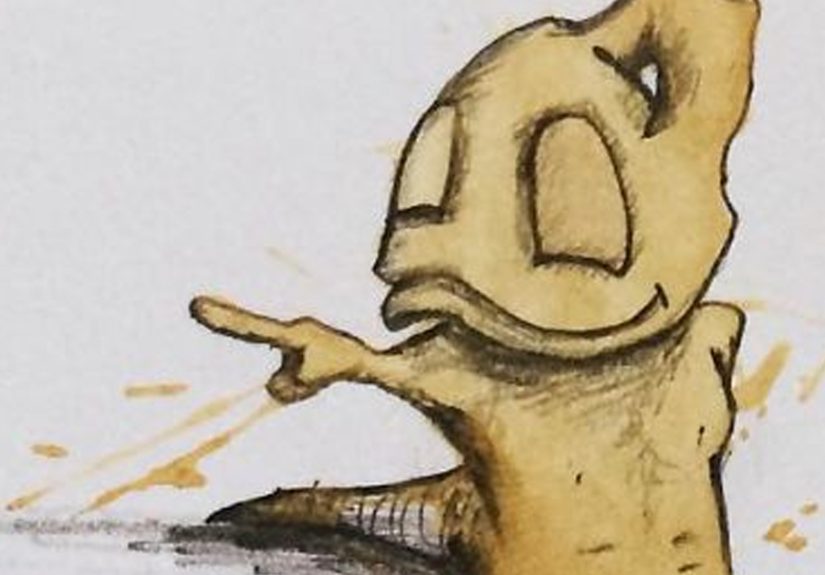
Once the coffee dries, the stain becomes a map. A darker edge might suggest a jaw. A small blob might become a nose. A long drip might turn into a tail, leg, horn, tongue, or suspiciously dramatic eyebrow. In Kuhnigk’s case, the drying period is part of the creative pause. The paper needs time, and the artist needs distance.
Step 3: The Artist Finds the Creature
This is where the magic happens. The artist studies the random mark and asks, “What lives here?” A stain that looks like a potato today might become a grumpy whale tomorrow. A splash with three points could become a crown, antlers, wings, or the hair of a monster who clearly owns too much hair gel.
Step 4: Ink or Pencil Gives It Personality
Eyes, mouths, legs, claws, stripes, speech bubbles, props, and tiny details turn the stain into a character. The coffee remains visible, so the final image still feels rooted in the original accident. The monster is not drawn over the stain so much as drawn out of it.
Why Coffee Stain Monsters Are So Appealing
Coffee stain art works because it sits at the intersection of three things people naturally enjoy: surprise, pattern recognition, and personality. A plain brown blotch is not especially exciting. But once it gets eyes, suddenly your brain says, “Oh no, I have feelings about this beverage goblin.”
We Love Seeing Faces in Random Things
Humans are excellent at finding faces and figures in ordinary objects. We see faces in electrical outlets, animals in clouds, grins on car bumpers, and judgmental expressions on burnt toast. This tendency is often called pareidolia. It helps explain why coffee monsters feel instantly readable. The stain may be abstract, but once an artist adds a few well-placed features, the brain happily completes the character.
That is one reason Kuhnigk’s work travels so well online. Viewers do not need an art history degree to understand it. They see the before-and-after logic immediately: random coffee splash becomes creature. The transformation is fast, visual, and satisfying. It is the artistic equivalent of watching a messy room become cozy in thirty seconds.
The Monsters Feel Handmade and Human
In the age of polished digital visuals, coffee stain monsters feel refreshingly physical. You can sense the paper, the liquid, the waiting, and the hand-drawn line. The brown stain is not a perfect shape. It has feathered edges, uneven tones, and little surprises. Those imperfections make the monster feel alive.
This is also why handmade art often carries emotional warmth. A perfect circle can be impressive, but a strange splatter with tiny legs can be lovable. The viewer sees the artist’s decision-making in every line: where the eyes go, how the mouth curves, whether the creature looks shy, chaotic, hungry, heroic, or like it just remembered it left laundry in the washer.
From Accident to Art Series: The Power of a Repeatable Idea
One spilled coffee monster is cute. Hundreds of them become a universe. That is where Kuhnigk’s project becomes especially smart from both an artistic and branding perspective. He did not simply create one novelty image. He built a repeatable creative system.
The formula is clear: coffee stain plus imagination equals monster. Yet each result is unique because every stain is different. This gives the series consistency without boredom. Viewers know what kind of surprise they are getting, but they do not know what the next creature will look like.
That is a powerful lesson for artists, content creators, and designers. A good series often needs a simple rule. The rule gives the audience something to recognize. The variation gives them a reason to return. Coffeemonsters does both. It is familiar enough to be memorable and flexible enough to keep growing.
The Role of Chance in Art
Kuhnigk’s spilled coffee monsters also belong to a long artistic tradition of using chance. Many modern and contemporary artists have explored accidents, randomness, splashes, drips, and unexpected marks. The difference is that Coffeemonsters makes chance friendly and accessible. Instead of asking viewers to stand in a gallery whispering, “What does it mean?” it invites them to smile and say, “That blob has opinions.”
Chance-based art works because it breaks the stiffness of the blank page. A blank page can be intimidating. It asks the artist to invent everything. A stain, however, offers a starting point. It says, “Here is a shape. Deal with me.” That constraint can be freeing. The artist does not begin from nothing; the accident has already made the first move.
This is why the project resonates beyond illustration. It speaks to anyone who has ever made a mistake and wondered whether it could become something useful. The coffee spill is not erased. It is elevated. The flaw becomes the feature. The mess becomes the mascot.
Why the Internet Loves Coffee Monsters
Coffee monsters are extremely shareable because they combine three internet-friendly ingredients: visual surprise, cuteness, and a short story. A viewer can understand the concept in seconds, enjoy the character, and imagine making a version themselves. That makes the project feel participatory even when people are simply scrolling.
The monsters also benefit from coffee culture. Coffee is already tied to morning routines, office life, creativity, late nights, and mild personality changes before 9 a.m. Turning coffee into a cast of monsters feels oddly appropriate. Anyone who has spoken to another human before their first cup understands that coffee and monsters have always been close relatives.
There is also a gentle humor in the medium. Coffee is usually treated as fuel, comfort, or survival juice for inbox warriors. Kuhnigk turns it into a drawing partner. The same drink people rely on to function becomes the raw material for small imaginary beings. It is both ordinary and magical, which is exactly the kind of contrast that makes art memorable.
Creative Lessons From Spilled Coffee Monster Art
1. Start With What Is Already There
Artists often feel pressure to create something entirely original from scratch. Coffee stain monsters suggest a different approach: begin with the marks life gives you. A stain, shadow, crack, scribble, or torn edge can become the seed of an idea. Creativity is not always invention from zero. Sometimes it is attention.
2. Let Mistakes Stay Visible
The coffee stain remains part of the final artwork. It is not hidden. That is important. If the stain were completely covered, the piece would lose its story. The visible accident gives the monster its origin, texture, and charm. In creative work, traces of process can make the final piece more interesting, not less.
3. Build a Habit, Not Just a Moment
The lasting strength of Coffeemonsters comes from repetition. A fun idea became a daily or near-daily practice. This matters because creative identity is built through return. One good idea can inspire attention; a sustained series can create a recognizable world.
4. Add Personality, Not Just Detail
The best coffee monsters are not merely decorated stains. They have mood. A tiny eye tilt can make a creature nervous. A crooked mouth can make it smug. A little arm raised in confusion can turn a blob into a character. Personality is what turns a doodle into something viewers remember.
How to Try Coffee Monster Art at Home
You do not need to be a professional illustrator to try this. In fact, the whole point is to let go of perfection. Start with a sheet of thick paper, a small amount of coffee, and a safe surface that will not cause household drama. Drip or dab the coffee onto the paper, then let it dry completely. Once dry, rotate the page and look for possible creatures.
Ask simple questions: Where could the eyes go? Is this shape standing, flying, melting, dancing, or sneaking toward a cookie? Does the stain look friendly, sleepy, dramatic, or villainous? Add only the lines needed to bring that personality forward.
For beginners, black pens work well because they contrast nicely with the brown stain. Pencils can create softer characters. White gel pens can add highlights or tiny teeth. Colored pencils can add cheeks, hats, scarves, or other details, though using too much color may reduce the coffee’s natural charm.
The goal is not to copy Kuhnigk’s style exactly. The goal is to train your eye to find possibility in random marks. Once you start doing it, you may begin seeing creatures in tea rings, watercolor blooms, ink smudges, and possibly that mysterious spot on the kitchen counter. Art has a way of multiplying once invited in.
Why This Project Matters More Than It First Appears
At first glance, coffee monsters are simply fun. And they are fun, proudly and gloriously. But they also say something meaningful about the creative mindset. They show that art can begin before the artist feels ready. They prove that constraints can spark invention. They remind us that humor and craft can live comfortably in the same small drawing.
The project also challenges the myth that creativity must be dramatic. No thunderbolt. No mountain cabin. No mysterious scarf. Just coffee, paper, time, and curiosity. That is encouraging because it brings creativity back into daily life. It suggests that inspiration may be hiding in ordinary routines, waiting for someone to look twice.
In that sense, “Artist Imagines Spilled Coffee As Monsters” is more than a description of quirky illustrations. It is a philosophy in miniature. The world makes marks. The artist pays attention. Something unexpected crawls out, waves three arms, and asks to be named.
Experiences Related to “Artist Imagines Spilled Coffee As Monsters”
Anyone who has tried making art from accidental stains quickly learns that the hardest part is not drawing. The hardest part is resisting the urge to control everything. The first time you drip coffee on paper, you may feel ridiculous. You may also feel slightly guilty for wasting coffee, which is understandable. Coffee has emotional value. But once the stain dries, the page begins to feel less like a mess and more like a puzzle.
One common experience is the “rotation moment.” You stare at the stain in one direction and see nothing. Then you turn the page sideways, and suddenly there it is: a turtle with stage fright, a bat wearing a cape, a tiny dragon who has definitely missed his bus. This moment is addictive because it feels like discovery. You are not forcing a picture onto the page; you are uncovering a picture that was almost there.
Another experience is learning that simple lines are often better than complicated ones. Beginners sometimes add too many details because they want the monster to look impressive. But the funniest creatures often come from restraint. Two eyes, one mouth, a few legs, and one absurd expression can be enough. A coffee stain already has texture and movement. The artist’s job is to guide the viewer, not bury the original shape under a full costume department.
Coffee monster art can also be surprisingly relaxing. Because the stain is random, there is no perfect version to compare against. You cannot say, “This coffee blob should have looked more realistic,” because coffee blobs are not known for their strict anatomy. That freedom lowers the pressure. It allows the artist to play, experiment, and laugh at strange results. Even a “bad” monster can become a good character if you give it the right expression. A lopsided creature may look confused, and confusion is a perfectly valid personality.
Teachers, parents, and workshop leaders can use this kind of activity to help people loosen up creatively. It works for children because it feels like a game. It works for adults because it sneaks past perfectionism. Many grown-ups freeze when asked to draw something from imagination, but they can respond to a stain. The mark gives permission. It says, “You do not have to be brilliant. Just be curious.”
There is also a satisfying storytelling layer. After drawing a monster, you can name it and write a tiny biography. Maybe it lives under a café table and collects sugar packets. Maybe it only speaks in espresso foam. Maybe it is afraid of spoons. These little stories make the drawings feel complete and help writers practice character development in a playful way.
The biggest takeaway from experiencing coffee stain monster art is that creativity often begins with a shift in attitude. A spill can be a problem, or it can be a prompt. A stain can be damage, or it can be a doorway. Stefan Kuhnigk’s Coffeemonsters became popular because they capture that shift beautifully. They invite us to stop treating every accident as a failure and start asking the more interesting question: “What could this become?”
Conclusion
Stefan Kuhnigk’s spilled coffee monsters prove that imagination does not need perfect conditions. It needs attention, humor, and the courage to let accidents participate. A random coffee stain becomes a creature because the artist chooses to see possibility where most people see cleanup duty.
That is the real joy of Coffeemonsters. They are funny, strange, handmade, and easy to love, but they also carry a bigger creative message. The next great idea may not arrive as a polished plan. It may arrive as a blotch, a splash, a mistake, or a tiny brown monster waiting patiently on a piece of paper.