Table of Contents >> Show >> Hide
- Meet Truth: A Coffee Roastery That Looks Like It Runs on Imagination
- Steampunk 101 (Without Charging You Admission)
- Why Steampunk Works Ridiculously Well for a Coffee Roastery
- Design Deep-Dive: What You See Inside Truth (And Why It Works)
- Industrial bones + Victorian polish
- Metal piping, gauges, copper, and the “coffee lab” vibe
- Furniture that feels built for plotting (or brunch)
- Props and curios that feel curated, not random
- Lighting: warm glow over cold metal
- Color palette: soot, brass, leather, espresso
- Even the restrooms get the memo
- Design Lessons You Can Borrow (Legally) for Your Home or Café
- Steampunk Without Going Full Cosplay
- Experiences: What It Feels Like Inside Truth (A 500-Word Taste of the Atmosphere)
- Conclusion
Some cafés serve coffee. Others serve coffee and an unsolicited time-travel fantasy. Truth Coffee Roasting in Cape Town does the second one with gusto: a steampunk-meets-industrial “coffee lab” where brass, leather, pipes, and lovingly over-the-top machinery turn your morning flat white into a full-blown Victorian adventure (top hat optional, but emotionally encouraged).
This isn’t steampunk in the “I glued gears to a mason jar” way. It’s a cohesive, immersive interior concept that makes the roasting process feel like theaterbecause, frankly, espresso machines already look like they’re seconds away from launching a submarine.
Meet Truth: A Coffee Roastery That Looks Like It Runs on Imagination
Truth Coffee Roasting is based in Cape Town’s City Centre, set in a warehouse-style space that leans into the romance of craft: roasted beans, visible equipment, and a room that feels engineered rather than simply decorated. The venue has been praised as a destination in its own right, not just a pit stop for caffeinepartly because the interior is bold enough to make even non-coffee people say, “Okay fine, I’ll try the pour-over.”
According to Truth’s own HQ site, it was named “The World’s Best Coffee Shop” by the UK’s The Daily Telegraph for two years in a row, and the brand leans hard into making coffee feel like an experience, not a commodity. It’s a smart hospitality move: when the space tells a story, customers linger longerand they remember you when they get home.
Steampunk 101 (Without Charging You Admission)
Steampunk started as a genre rooted in 19th-century, steam-era technologyVictorian society reimagined with a fantasy engineering twist. As an aesthetic, it’s basically: polished brass meets soot, antiques meet invention, and everything looks like it was built by a brilliant mechanic who also writes poetry and refuses to use plastic on principle.
In interiors, steampunk often borrows from industrial design (exposed structural elements, metalwork, utilitarian forms) and layers on Victorian warmth (leather, velvet, rich woods, ornate details). Done well, it feels curated and cinematicnot cluttered.
Why Steampunk Works Ridiculously Well for a Coffee Roastery
1) Coffee equipment already screams “engine room”
Espresso machines, roasters, grinders, gauges, steam wandscoffee gear is inherently mechanical. Truth’s designer reportedly leaned into this, comparing the “form factor” of espresso machines and roasters to the Victorian-futuristic fantasy of steampunk. That’s design alignment at its finest: the concept matches the function, so the theme never feels like a costume party that got out of hand.
2) The brand story becomes physical
Many cafés talk about craft and precision. Truth makes you feel it. When your surroundings look like a hand-built laboratory full of valves, copper, and contraptions, the idea of “carefully roasted beans” becomes believableeven before the first sip.
3) It turns waiting into wandering
A good themed interior gives your eyes something to do while your drink is being made. Steampunk is especially effective because it’s packed with detail. You can stand in line and play a game of “spot the weird antique object” and still not run out of things to notice.
Design Deep-Dive: What You See Inside Truth (And Why It Works)
Industrial bones + Victorian polish
Industrial design typically celebrates raw structural featuresbrick, beams, concrete, exposed pipesrather than hiding them. Truth takes that logic and dresses it up: the rugged base feels like a workshop, while the Victorian notes add warmth and drama. It’s an essential balancing act: too much industrial can feel cold; too much Victorian can feel heavy. Steampunk is the bridge that lets both coexist.
Metal piping, gauges, copper, and the “coffee lab” vibe
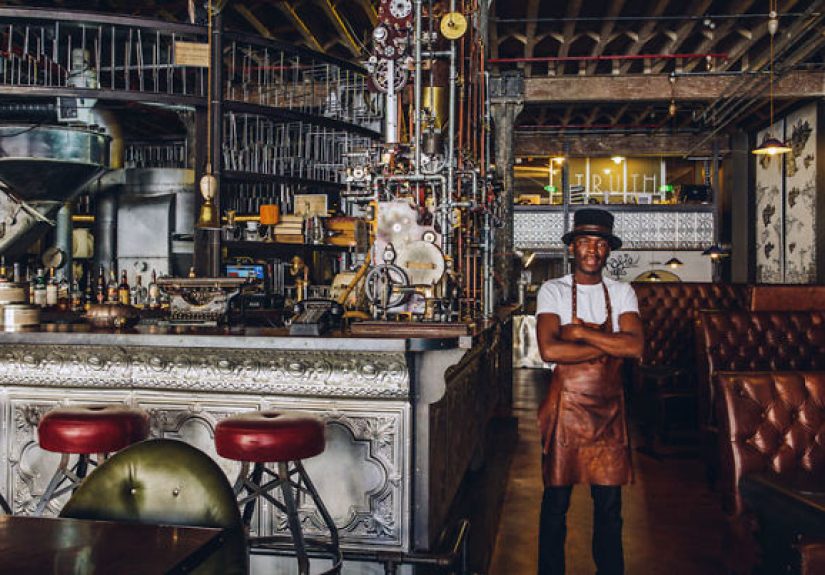
Truth has been described as having a “coffee lab” atmosphere, featuring a vintage roaster and an industrial-chic interior with copper and gauge-heavy details. The visual language is consistent: tubes, dials, metallic finishes, and the sense that something fascinating is always “in progress.” If your goal is to communicate craft, showing the mechanicsreal or impliedis a strong move.
Furniture that feels built for plotting (or brunch)
One standout detail reported in design coverage is the use of large saw-blade tabletopsan audacious choice that telegraphs “workshop energy” without making anyone actually do work. Add in plush, overstuffed booths and you get the best of both worlds: visually tough, physically cozy.
That comfort piece matters. Industrial/steampunk spaces can become hard and echoey if you don’t soften them. Upholstery, wood tones, and intimate seating zones keep the room from feeling like you’re drinking espresso inside a train station boiler room.
Props and curios that feel curated, not random
Truth’s space has been described as packed with “visual candy”: vintage typewriters, Singer sewing machines, and old candlestick telephones are among the reported elements. The trick is that these objects aren’t just decorationthey reinforce the story of an analog, mechanical era where everything had weight, texture, and moving parts.
The best steampunk interiors treat props like a museum would: each piece contributes to a narrative. The worst ones treat props like a garage sale with mood lighting. Truth lands on the museum side (but with better coffee).
Lighting: warm glow over cold metal
Industrial materials can skew cool. Steampunk fixes that by leaning into warm, amber-leaning light, reflective metals, and shadow play. Pendant lights, focused task lighting, and highlights on brass/copper surfaces create depth. Instead of flattening the room, lighting makes it feel layeredlike the space has “chapters.”
Color palette: soot, brass, leather, espresso
A strong steampunk palette is usually built from dark neutrals (charcoal, black, deep brown), warmed up with metallics (brass, copper) and rich textures (leather, worn wood). It’s basically the color story of a perfect cappuccino: deep, dark base; caramel highlights; creamy softness. Conveniently on-brand.
Even the restrooms get the memo
Great themed design doesn’t stop at the “main room.” Truth’s design coverage notes details extending into the restrooms, including exposed copper pipes and vintage-style fixtures. That’s how you know the concept is intentional: no “theme drop-off” the moment you leave the espresso bar.
Design Lessons You Can Borrow (Legally) for Your Home or Café
Start with a “hero machine,” then build the story around it
Truth succeeds because the machinery language is central. At home, your “hero machine” could be an espresso setup, a vintage bar cart, a statement clock, or a brass-and-wood bookshelf. Pick one anchor that says “steampunk,” then let everything else support it. Theme should feel inevitable, not forced.
Mix raw + comfortable so it feels livable
Designers often warn that industrial spaces can feel stark unless you add warmth. Use soft seating, layered textiles, and a few tactile materials (leather, wool, distressed wood) to keep your space inviting. Think: workshop vibe, but your spine is still respected.
Expose elements on purpose
Exposed pipes and ductwork can look stylishif they’re treated like a deliberate design feature. Painting, repeating forms, and thoughtful placement matter. The goal is “designed,” not “unfinished.” Steampunk loves visible systems, but it loves intentional visible systems.
Curate props like you’re building a film set
Fewer, better objects win. A typewriter, an old phone, and a vintage instrument panel can look incredible if you give them space and good lighting. Ten random gears glued to everything is how you end up living inside an Etsy listing.
Don’t forget flow and function
Restaurants and cafés live or die by movement: ordering, pickup, seating, clearing, service. The best themed interiors leave room for people to circulate and for staff to do their jobs without performing parkour. If you’re designing a hospitality space, sketch the traffic patterns before you buy a single “quirky contraption.”
Steampunk Without Going Full Cosplay
If you love the Truth look but don’t want your dining room to feel like a dirigible exploded, go subtle: incorporate one or two metallic finishes (brass hardware, copper pendant lights), add rich textures (leather chair, dark wood), and use industrial elements (open shelving, exposed structure) as the base. Keep your palette controlled. Steampunk is dramatic, but it’s still designnot a scavenger hunt.
Experiences: What It Feels Like Inside Truth (A 500-Word Taste of the Atmosphere)
You step off the street and into a space that feels less like “a café” and more like “an inventor’s headquarters that happens to serve croissants.” The air carries that unmistakable perfume of freshly roasted beanswarm, nutty, a little smokylike the building itself is exhaling espresso-scented confidence. Before you even reach the counter, your eyes start doing laps: pipes run where you’d expect clean drywall, gauges wink from unexpected angles, and metallic surfaces catch the light like they’re trying to flirt with you.
The soundtrack is a mix of clinks, hiss, and low conversationthe kind of ambient noise that makes you feel productive even if your only plan is to stare lovingly at foam art. The roaster and equipment don’t hide. They stand there, unapologetically mechanical, reminding you that coffee is not magic… it just looks like it when it’s done well. Nearby, the décor keeps rewarding curiosity: antique-style objects that look like they’ve survived multiple lifetimes, details that seem pulled from a Victorian workshop, and tables that feel “built” rather than “bought.”
Ordering becomes part of the show. The menu doesn’t just offer coffee; it offers choices that sound like they belong in an adventure novel. If you go for a blend with a dramatic name, you half-expect it to arrive with a plot twist. When your drink is made, you watch the process the way you’d watch a craftsman at a benchmeasured, precise, slightly theatrical. The espresso machine releases steam with a little burst of drama, like it knows it’s in the spotlight.
Then you sit, and the genius of the interior clicks: it’s not only visually intense; it’s physically welcoming. The seating feels intentionally cozy, giving you permission to slow down. You notice how the warm lighting softens the metal and makes the room feel golden rather than cold. You start catching small momentsreflections on brass, the contrast of dark surfaces against copper highlights, the way a utilitarian element becomes decorative simply by being repeated and aligned. You realize the interior isn’t chaos; it’s choreography.
The longer you stay, the more the place turns into a memory you can describe. Not “the coffee shop with good lattes,” but “the steampunk roastery that felt like a coffee laboratory in a vintage machine room.” That’s the real takeaway: the design doesn’t just frame the coffeeit makes the coffee feel like it belongs to a world. And when a space gives you a world, you don’t rush. You linger. You take photos. You tell friends. You secretly wish your own kitchen came with copper piping and an air of mystery.
Conclusion
Truth Coffee Roasting is a masterclass in themed interior design done right: concept aligned with function, industrial structure warmed with comfort, and steampunk storytelling layered into every corner. It proves that “bold” doesn’t have to mean “messy,” and that the best hospitality spaces don’t just serve productsthey serve atmosphere. If you’re hunting for inspirationwhether you’re designing a café, refreshing a home bar, or just curious how far interior design can goTruth is a reminder that when you commit to a story and execute it with craftsmanship, people don’t just visit. They remember.