Table of Contents >> Show >> Hide
- The biggest new feature is invisible: a smarter digital backbone
- Block 4 is where the F-35’s new features really come alive
- A stronger sensor suite: from APG-85 radar to better fusion
- Electronic warfare is becoming a bigger part of the F-35’s personality
- More weapons flexibility means more mission flexibility
- ODIN is a support feature, but it may be one of the most practical upgrades
- Some “new features” are already here, while others are arriving in stages
- What the F-35’s new features really mean
- Experience: Living With the F-35’s New Features
- Conclusion
The phrase “F-35 new features” sounds simple enough. Maybe you picture a shinier screen, a cooler radar graphic, or a software update that arrives with all the drama of a phone notification. In reality, the newest F-35 features are much bigger than that. They are part of a deep modernization effort that changes how the jet thinks, sees, fights, shares data, survives, and gets maintained.
In other words, the F-35 is not just getting a few add-ons. It is getting a serious brain-and-nervous-system upgrade. And that matters, because the modern air war is less about one pilot heroically doing everything by gut instinct and more about who can process information, fuse sensors, survive in a nasty electronic environment, and act faster than the other side. The F-35 was always built to play that game. Its newest features are meant to keep it from becoming yesterday’s very expensive smartphone.
The headline items usually get the most attention: Technology Refresh 3 (TR-3), the Block 4 modernization package, the APG-85 radar, improved electronic warfare, Multi-Ship IRST, more weapon flexibility, and the newer ODIN support environment. But the real story is how these pieces work together. The latest F-35 features are not isolated gadgets. They form a layered upgrade that aims to make the jet more lethal, more survivable, and more useful in a joint fight.
The biggest new feature is invisible: a smarter digital backbone
Let’s start with the least glamorous and most important change: TR-3. If the F-35 were a city, TR-3 would be the power grid, the fiber network, and the control center all rolled into one. It gives the aircraft a more powerful integrated core processor, more memory, and an improved cockpit display environment. That does not sound as thrilling as a missile launch, but this is the hardware foundation that lets later capabilities exist at all.
The older F-35 was already advanced, but modern combat systems are greedy. They want more computing power, more storage, faster processing, more stable software, and enough display bandwidth to keep the pilot informed without turning the cockpit into a game of information dodgeball. TR-3 is designed to solve that. It provides the architecture needed for new sensors, new software loads, improved data fusion, and upgraded electronic warfare functions.
This matters because a fifth-generation fighter is only as good as its ability to turn massive amounts of information into clear decisions. The F-35’s job is not just to fly low and fast. It has to collect signals, compare tracks, separate threat from noise, share targeting data, and present the pilot with something closer to “here’s what matters” than “good luck, pal.” TR-3 is what helps the jet do that with more speed and less digital wheezing.
Block 4 is where the F-35’s new features really come alive
If TR-3 is the foundation, Block 4 is the house being built on top of it. Block 4 is the broad modernization effort tied to the F-35’s newest capabilities. It is often described as the most significant evolution of the aircraft so far, and that description is fair. The goal is to sharpen the F-35 across the board: better sensors, improved target recognition, added non-kinetic electronic warfare options, more weapon choices, and greater flexibility in how the jet communicates across the battlespace.
That last part is easy to overlook, but it is a big deal. In a modern fight, the winning platform is often the one that can act as an information quarterback while still remaining hard to detect. The F-35 was already strong in this area. Block 4 is supposed to push it further, making the aircraft less like a stealthy lone wolf and more like a stealthy team captain that happens to carry weapons internally.
This is also why discussions about F-35 new features keep circling back to sensors, software, and mission systems instead of only airframe changes. The jet’s future value is tied to how well it can keep upgrading those digital layers over time. You do not stay relevant in a high-end air war by polishing the canopy and hoping for the best.
A stronger sensor suite: from APG-85 radar to better fusion
APG-85 radar
One of the most discussed additions in the F-35 modernization roadmap is the AN/APG-85 radar. It is meant to replace the earlier APG-81 and serve as a key part of the aircraft’s future sensor suite. In plain English, this is the sort of upgrade that can help the F-35 detect, track, and understand threats with better fidelity in messy, contested environments.
Radar upgrades matter because radar is not just about finding a dot in the sky. In a modern AESA-equipped stealth fighter, radar performance influences air-to-air detection, air-to-ground mapping, tracking quality, resistance to jamming, and how well the aircraft works with its other sensors. The APG-85 is important not because it is a shiny new part number, but because it is tied to the F-35’s long-term sensor growth.
That said, modernization in real life is never a smooth movie montage. New radar fielding has faced schedule pressure, which is a useful reminder that next-generation capability often arrives in uneven waves. The feature is real. The rollout has just been less tidy than a marketing brochure would prefer.
Multi-Ship IRST and richer sensor fusion
Another intriguing piece of the F-35’s future feature set is Multi-Ship IRST, or multi-aircraft infrared search and track capability. That sounds technical because it is technical. The short version is that it helps multiple F-35s work together to improve passive detection and tracking through shared sensing.
Why does this matter? Because passive sensing is gold in a stealth fight. If you can detect and build a track without loudly announcing yourself, you keep your tactical edge. A more networked IRST approach can give formations of F-35s a better way to locate and understand airborne threats while relying less on a single aircraft doing all the work alone.
Add in improved target recognition and stronger data fusion, and the result is a jet that is supposed to make more sense of a complicated environment, faster. The pilot is still essential, of course. The point is to let the pilot spend less time sorting through clutter and more time making decisions that matter.
Electronic warfare is becoming a bigger part of the F-35’s personality
One of the most important new F-35 features is the push toward better electronic warfare and countermeasures. This is not the flashy part of the airplane that gets turned into posters, but it may be one of the most decisive in actual combat. Modern air combat is fought in the electromagnetic spectrum as much as in physical space. If the enemy can detect you, jam you, spoof you, or guide weapons onto you, your beautiful stealth shape suddenly has a very stressful day.
Block 4-related improvements are tied to more advanced electronic warfare functions, updated countermeasures, and better sensing and signal processing. That means the F-35 is not only trying to hide better; it is also trying to understand and manipulate the threat environment more effectively. This supports missions such as threat identification, self-protection, and electronic attack support.
Put simply, the F-35’s future edge is not just “I’m hard to see.” It is increasingly “I can see you, understand your emissions, share that picture with friendly forces, and make your kill chain a whole lot uglier.” That is a much more powerful sentence.
More weapons flexibility means more mission flexibility
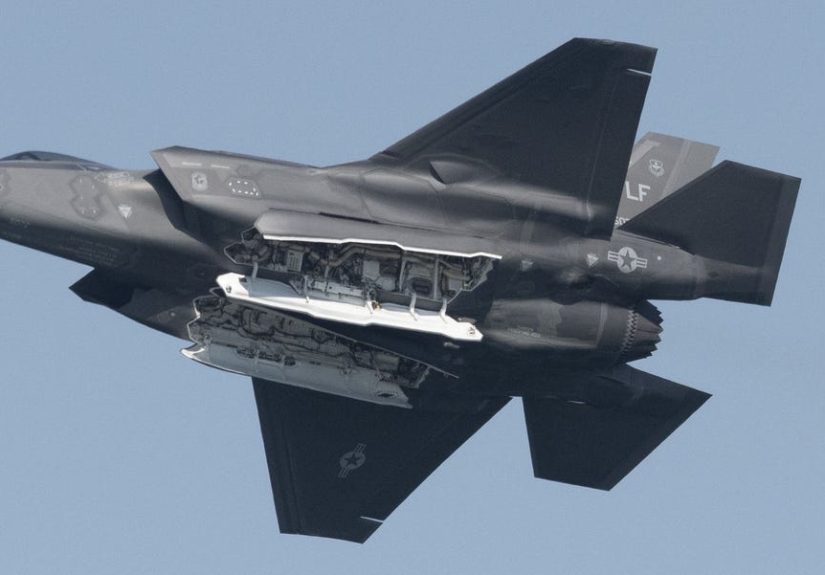
Another area where the F-35 is gaining ground is weapons integration. Official modernization descriptions point to increased missile-carriage capacity and more support for new precision weapons. For operators, this changes the jet from a very capable stealth striker into a more flexible mission platform that can adapt to a wider range of targets and threat sets.
A good example is the integration work for the AARGM-ER, a weapon associated with suppression and destruction of enemy air defenses. That kind of integration matters because it expands what the F-35 can do on the first days of a conflict, when air defenses are still dangerous and stealthy stand-in platforms are especially valuable.
The aircraft has also continued to gain credibility in specialized mission sets through milestones such as the F-35A’s path into the B61-12 nuclear mission. Whether or not that role is the first thing most readers think of, it underscores a larger point: the F-35’s new features are broadening the aircraft’s mission portfolio, not narrowing it.
This is what makes the modernization story important for strategists and not just aviation fans. Every added weapon, sensor, and software layer changes how commanders can use the aircraft. A stealth fighter that can scout, share, strike, survive, and support coalition operations becomes more than a jet. It becomes a systems hub with wings.
ODIN is a support feature, but it may be one of the most practical upgrades
Not all F-35 new features sit in the nose or the weapons bay. Some live in the support ecosystem. ODIN, the Operational Data Integrated Network, is part of the ongoing shift away from the more criticized ALIS setup. The goal is straightforward: reduce maintainer workload, improve support performance, and make the logistics and mission-planning side of the F-35 less cumbersome.
That is not as cinematic as a radar upgrade, but ask any maintainer and you will quickly discover that glamorous jets become paperweights when support systems are clunky. A fighter’s combat value depends on readiness, and readiness depends on whether people can diagnose problems, manage data, track maintenance, and get the airplane back into service without feeling like they are wrestling a possessed office printer.
ODIN matters because it acknowledges a truth defense programs sometimes learn the hard way: the airplane is only part of the weapon system. The data environment, the support hardware, and the mission-planning tools all shape whether that expensive jet is actually available when someone needs it.
Some “new features” are already here, while others are arriving in stages
It is important to be honest here: not every new F-35 feature is fully fielded across the fleet today. Some are available in early form, some are rolling out in increments, and some are still caught in the very unromantic realities of software maturity, test schedules, retrofits, and production timing. The GAO has been clear that TR-3 and Block 4 timelines slipped, and official reporting has shown that the final shape of Block 4 has evolved over time.
That does not mean the features are imaginary. It means the F-35 modernization story is best understood as an ongoing transition rather than a single grand reveal. The aircraft is becoming more capable, but not every squadron gets every benefit all at once. Think less “instant transformation” and more “flying software ecosystem under constant revision.”
Oddly enough, that is probably the most realistic sign that the program is aimed at future relevance. Modern fighters are not frozen in time. They survive by being upgraded, retested, refined, and upgraded again. Messy? Yes. Necessary? Also yes.
What the F-35’s new features really mean
So, what are the F-35 new features in plain English? They mean a faster digital brain, more room for advanced software, stronger sensor growth, better radar potential, richer passive tracking, more capable electronic warfare, broader weapons integration, smarter logistics support, and an aircraft that is being shaped to stay relevant against future threats.
The smartest way to think about the modernized F-35 is this: it is evolving from a very advanced stealth fighter into a more mature combat network node. It still looks like a jet, flies like a jet, and fights like a jet. But more than ever, its edge comes from how it processes and shares information while staying hard to kill.
That is the real answer to the question of what is new. The F-35 is getting better at being a weapon, a sensor, a teammate, and a platform for future upgrades all at once. That is a lot to ask from one aircraft. Then again, asking for too much from the F-35 has been kind of the whole project from the beginning.
Experience: Living With the F-35’s New Features
If you step back from procurement charts and acronym avalanches, the experience of the F-35’s new features is really the experience of a fighter becoming more useful in real time. For a pilot, the difference is not usually one dramatic moment. It is the accumulation of small advantages: a cleaner display, faster system response, a track that resolves sooner, a warning that appears with more clarity, or a mission picture that makes sense before the situation turns ugly. In a high-threat environment, that kind of improvement is not cosmetic. It is survival disguised as convenience.
For maintainers, the experience is different but just as important. They do not care whether a capability sounds futuristic if it makes troubleshooting harder, adds more steps, or turns routine maintenance into a scavenger hunt. That is why ODIN and the broader support modernization matter so much. The real-world experience of a “new feature” is not complete until the aircraft can be serviced, updated, and returned to the line without a support system throwing a tantrum. A smarter fighter that is always down for admin reasons is still just a very expensive lawn ornament.
For commanders, the experience is about options. A better radar, improved passive tracking, stronger electronic warfare, and broader weapons integration all change mission planning. Suddenly, a formation can do more without asking for as much external help. It can find targets differently, share information faster, and shape the fight instead of simply reacting to it. That does not mean the F-35 becomes magical. It means it becomes more flexible, which in military planning is usually worth its weight in gold, fuel, and headache relief.
Allied operators feel this too. The F-35 is not just a U.S. airplane with a giant guest list. It is a coalition platform, and new features ripple across partner planning, tactics, and interoperability. When modernization improves data sharing, mission systems, and common capabilities, it can make mixed formations more coherent and more useful. That is one reason the F-35 keeps being described as a force multiplier. The jet is valuable on its own, but its bigger trick is often making everything around it more effective.
There is also a psychological side to the experience. New features create confidence when they work and frustration when they arrive late. That tension runs through the F-35 story. Operators want the improvements now, testers want them stable, maintainers want them supportable, and budget watchdogs want them affordable. Everyone is technically right, which is probably why the modernization process can feel like a family road trip where every passenger has a valid complaint. Even so, the direction of travel is clear: more computing power, better sensing, stronger survivability, and wider mission utility.
In the end, the lived experience of the F-35’s new features is not about one spectacular piece of technology. It is about what happens when a stealth fighter becomes more mature, more connected, and more adaptable. The pilot gets a sharper picture. The maintainer gets a better support environment. The commander gets more choices. The allied force gets better integration. And the aircraft itself becomes less of a fixed product and more of an evolving combat system. That is the real experience here. The F-35 is not merely adding features. It is learning how to age without getting old.
Conclusion
The latest F-35 new features show where modern airpower is headed. The future is not just faster jets or bigger bomb loads. It is aircraft that can process more data, connect more players, survive more threats, and adapt faster than the battlespace changes. The F-35’s modernization effort reflects exactly that.
TR-3 gives the aircraft more digital muscle. Block 4 builds new capability on top of it. APG-85 radar, Multi-Ship IRST, upgraded electronic warfare, added weapon options, and ODIN support all push the jet toward a more mature, more flexible role. The rollout has not been perfectly smooth, but the direction is unmistakable. The F-35 is being shaped into a fighter that is not only stealthy and lethal, but also deeply networked, upgradeable, and built for a fight where information is as decisive as firepower.