Table of Contents >> Show >> Hide
- What Is the Fairholme Fund, Anyway?
- Feast: When Concentration Works Wonderfully
- Famine: When a Focused Fund Goes Hungry
- What the Fairholme Story Teaches About Concentrated Funds
- Should You Ever Invest in a Feast-or-Famine Fund?
- Investor Experiences: Living Through Feast and Famine
- Conclusion: Common Sense from a Uncommon Fund
In every investing cycle, there is at least one fund that looks like a genius factory on the way up and a cautionary tale on the way down.
For the past two decades, the Fairholme Fund (ticker: FAIRX) has played both roles with enthusiasm. One moment it’s winning awards and crushing
the market; the next it’s enduring gut-wrenching losses that test even the most stoic investor’s stomach.
The phrase “feast or famine” fits Fairholme perfectly. Managed by famed value investor Bruce Berkowitz, the fund has long embraced a
high-conviction, concentrated approach. That style can deliver spectacular outperformance when the big bets workand painful underperformance
when they do not. Understanding what happened in Fairholme, and what it teaches about concentrated mutual funds, is a masterclass in both
portfolio construction and investor behavior.
What Is the Fairholme Fund, Anyway?
The Fairholme Fund is a U.S. mutual fund that seeks long-term capital growth by investing in a focused portfolio of securities.
Unlike broadly diversified funds that own hundreds of stocks, Fairholme often builds its portfolio around a few core ideas,
sometimes holding fewer than 25 positions at a time. The fund’s own reports emphasize that it does not aim for broad diversification
and that significant swings in value are part of the deal when you concentrate in a limited number of issuers.
The stated objective sounds straightforward: grow capital over the long run by buying undervalued businesses. The twist is in the
implementation. Fairholme’s strategy leans into out-of-favor, complex storiesoften in financials, real estate, and other asset-heavy
businesses. The team is willing to look wrong for a long time, so long as they believe the underlying value will eventually be recognized.
A Star Manager with a Bold Playbook
At the center of the story is Bruce Berkowitz, the fund’s longtime manager and the founder of Fairholme Capital Management.
His record in the 2000s was so strong that Morningstar named him both Domestic-Stock Fund Manager of the Year (for 2009)
and Fund Manager of the Decade for 2000–2009. Over that decade, Fairholme delivered double-digit annualized returns while the S&P 500
barely eked out gains. That kind of track record doesn’t just attract attentionit attracts billions of dollars in assets.
The core of Berkowitz’s playbook is concentrated value investing: buy a few businesses you deeply understand, often at moments when other
investors want nothing to do with them, and hold until the gap between price and value closes. In practice, that has often meant very large
positions in troubled but asset-rich companiesthink global insurers, big banks after crises, or land-rich real estate firms.
Over time, Fairholme’s portfolios have frequently been dominated by a handful of positions. In some periods, just five stocks made up the
vast majority of the portfolio’s value, with one name alone accounting for more than 70–80% of assets. That level of conviction is impressive.
It’s also precisely what creates the “feast or famine” dynamic.
Feast: When Concentration Works Wonderfully
The Glory Years
Fairholme’s early history reads like a value-investing highlight reel. During the 2000–2009 decadea brutal stretch for broad U.S. stocks
the fund posted an annualized return north of 13%, beating the S&P 500 by a wide margin. While tech stocks were imploding in the early 2000s,
Fairholme was sidestepping the wreckage and focusing on cash-generating, less glamorous businesses. That made the fund a standout in a sea of
disappointment.
Later, during and after the financial crisis, Fairholme doubled down on a contrarian theme: large financial institutions that the market
hated but that still owned valuable franchises. American International Group (AIG), Bank of America, and other financial names grew into
massive positions. When the panic eventually faded and these companies recovered, Fairholme’s concentrated exposure helped produce
eye-popping rebounds.
At one point, Fairholme’s returns were so strong that the fund was near the very top of its category rankings. Investors who had stuck with
Berkowitz through the scary parts were richly rewarded. The narrative was simple and compelling: a brilliant contrarian manager, a disciplined
value strategy, and the courage to be different.
Why Investors Love a Good Feast
Human beings are wired to chase success stories. When a fund beats the market by a wide margin for years and the manager wins “Manager of the
Decade,” it’s easy to believe you’ve found a shortcut to outperformance. Articles, interviews, and glowing write-ups reinforced the idea that
Fairholme had cracked the code with a combination of deep research and the willingness to ignore the crowd.
From a behavioral finance perspective, this is classic performance chasing. Many investors piled into the fund after its best years,
when the track record looked bulletproof and assets under management swelled. The problem, of course, is that the risks of concentration
were building at the same timeeven if they weren’t obvious in the rear-view mirror.
Famine: When a Focused Fund Goes Hungry
Drawdowns That Hurt
If the feast years showed the upside of concentration, the following period showed the downside in painful detail. At various points in the
2010s, Fairholme suffered large drawdowns as its big bets ran into trouble. Public performance data show that the fund has historically
experienced peak-to-trough declines of more than 50%, with long recovery times. That’s the kind of volatility that can turn a loyal shareholder
into a former shareholder overnight.
One particularly notable episode, highlighted by A Wealth of Common Sense, came when the fund lost nearly 10% in a single week and more than
13% over a month, even though the broad market was down less than 2%. That kind of divergence usually doesn’t come from “the market”it comes
from one or two major holdings getting hit hard. In Fairholme’s case, the concentration in specific financial and real-estate-linked names
meant that when those stories soured, the entire portfolio felt it.
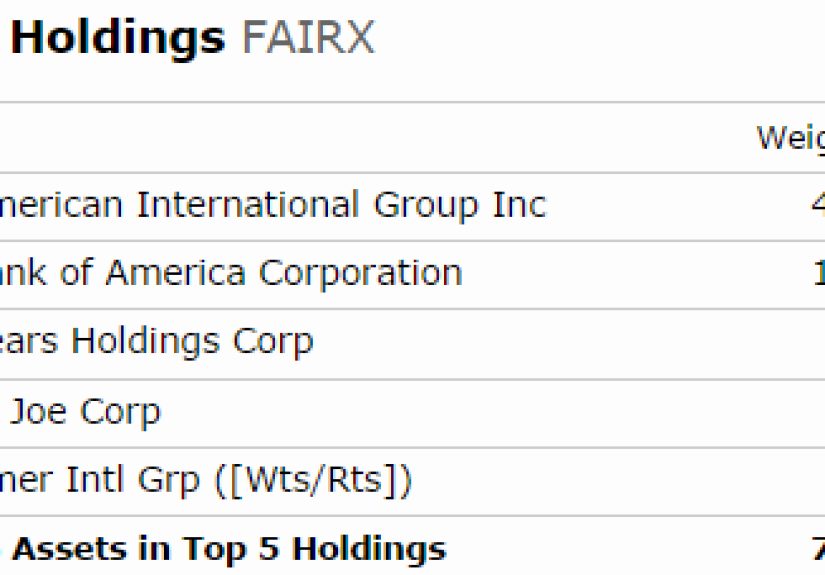
Over time, the feast-or-famine pattern became more extreme. At different points, Fairholme held huge stakes in companies like AIG, Bank of
America, Sears, Fannie Mae and Freddie Mac preferreds, and especially the St. Joe Company, a Florida real-estate play that eventually
dominated the portfolio. In more recent filings and analyses, Fairholme’s publicly reported equity portfolio has often been 70–80% in
St. Joe alone, with just a few other names filling out the rest.
From Top of the Charts to the Basement
The performance arc of Fairholme is a case study in how quickly a superstar can fall out of favor. After years of leading its category,
the fund later spent extended periods near the bottom of the performance rankings over 10- and 15-year windows. That doesn’t erase the strong
early years, but it does show how the timing of your investmentand your tolerance for deep, prolonged drawdownsmatters as much as the long-term
average.
It’s entirely possible for a fund to have an excellent record since inception and yet leave many real-world investors disappointed,
because they bought after a hot streak and sold during a slump. The gap between what the fund earns and what its investors earn is often
called the “behavior gap,” and high-volatility funds like Fairholme are especially prone to it.
None of this means Berkowitz suddenly forgot how to invest. Instead, it highlights the inherent risk of concentrating in complex,
controversial situations. Some of the big betslike post-crisis financialsworked brilliantly. Others, like certain retail and real estate
plays, have struggled for years. When a single name dominates your portfolio, those struggles become your investors’ struggles, too.
What the Fairholme Story Teaches About Concentrated Funds
The Upside: Conviction Can Create Outperformance
Concentrated funds appeal to investors for a reason: they give a skilled manager room to make meaningful, high-conviction bets.
When the analysis is right and the timing is decent, the results can be spectacular. Fairholme’s early years are a vivid demonstration
of what happens when a talented stock picker focuses on his best ideas while the benchmark stumbles.
Academic research has suggested that some active managers do add value, especially when they are truly active rather than hugging their
benchmarks. A concentrated portfolio is one way to express that difference. For investors who want to give an active manager a real chance
to outperform, owning a focused fund can make more sense than buying a closet indexer.
The Downside: Risk Is Not Just Volatility, It’s Experience
The flip side is that concentration amplifies not just returns but also the emotional experience of investing. Large drawdowns,
multi-year periods of underperformance, and headline-driven volatility are part of the package. Empirical work on concentrated portfolios
has found that these strategies can generate very large drawdowns and that robust, persistent alpha is hard to demonstrate once you adjust
for risk and survivorship bias.
In other words, you may get the roller coaster without a guaranteed upgrade in long-term returns. That doesn’t mean concentration is
irrational, but it does mean investors have to be honest with themselves about whether they can sit through the ride. Saying you can tolerate
a 50% drawdown is easy in theory. Watching half your capital evaporate in real time, while the S&P 500 is only modestly down, is a very
different experience.
Behavioral Lessons: Timing and Temperament Matter
The Fairholme saga also shows how investor behavior interacts with fund design. When a fund wins big awards and appears on every “top
manager” list, new money tends to rush in exactly when the upside from the earlier, courageous decisions has already been realized.
If that inflow coincides with a tougher environment for the fund’s style or specific holdings, latecomers may end up with poor results.
Ben Carlson, the author of the A Wealth of Common Sense blog, has long emphasized that the best strategy is the one you can actually stick with.
Fairholme is a prime example: the strategy may make sense on paper, but only investors with the right temperamentand a genuinely long
time horizoncan hope to capture the full feast without abandoning ship during the famine.
Should You Ever Invest in a Feast-or-Famine Fund?
So what does all of this mean for an everyday investor deciding between a low-cost index fund and a high-conviction manager like Fairholme?
When a Concentrated Fund Might Fit
- You understand the strategy. You know what the manager owns, how concentrated the portfolio is, and what could go wrong.
- You have a long horizon. We’re not talking about quarters or even a few years. Think in terms of 5–10+ years.
- You size it appropriately. A feast-or-famine fund might be a satellite holding, not the core of your retirement plan.
- You accept manager risk. You’re effectively betting on one person’s judgment. If that person loses their edge or
the strategy stops working, there is no built-in safety net.
When You’re Probably Better Off Avoiding It
- You check your account daily. Watching a concentrated fund’s price action day-to-day is a recipe for stress.
- You’ve sold in panic before. If you bailed on broad index funds in 2008 or 2020, a super-volatile strategy is unlikely to go better.
- You need predictable cash flows. Retirees drawing from their portfolios generally benefit more from stability than from heroic bets.
- You just want “set it and forget it.” Simple asset allocation with diversified index funds is usually a better match.
In short, a feast-or-famine fund like Fairholme can make sense as a deliberate, well-understood choice for a small slice of a portfolio,
but it’s a poor substitute for a broadly diversified core holding. You’re trading comfort for concentrationand you should only make that trade
if you truly know what you’re doing.
Investor Experiences: Living Through Feast and Famine
To really appreciate what “feast or famine” feels like, it helps to step into the shoes of a typical Fairholme investor over the years.
Imagine you discovered the fund around 2010. The headlines were glowing: Morningstar’s Fund Manager of the Decade, a decade-long record of
double-digit returns, and a contrarian approach that had sidestepped some of the worst market blowups. You read that the fund had risen strongly
while tech stocks were crashing in the early 2000s and had again shined coming out of the financial crisis. It felt like you’d finally found a
manager who “got it.”
You invest. At first, not much happens. The portfolio looks weirdbig stakes in an insurer still dealing with crisis baggage, a struggling
retailer with valuable real estate, a Florida land company you’ve barely heard ofbut the story is compelling. You tell yourself that volatility
is the price of outperformance. Besides, the manager has most of his own money in the fund, which feels reassuring.
Then the famine shows up. One of the big holdings stumbles. Another gets tangled in legal, regulatory, or operational issues. The stock prices
don’t just drift downthey lurch lower in double-digit chunks. The fund’s net asset value follows. While the S&P 500 is down a bit, your
concentrated fund is down a lot. Suddenly, what once felt like “conviction” now feels like “single-stock risk in disguise.”
You log into your account and see a 30–40% drawdown from the high. You start to second-guess everything: the manager, the strategy, your own
decision to invest. Financial media that once praised the fund now runs skeptical pieces about concentration risk and “fallen stars.”
Friends and colleagues ask why you didn’t just buy a simple index fund.
Some investors sell at this point. They lock in losses and move on, often into safer, more diversified vehicles. Others grit their teeth and stay,
believing that the underlying assets are still worth more than the market is giving them credit for. For these investors, the experience is not
just financialit’s emotional. They must reconcile their faith in the manager and strategy with the discomfort of being deeply out of step with
the benchmark.
Fast-forward a few more years, and the outcomes diverge. Some of Fairholme’s bets recover, rewarding those who stayed. Others remain stubbornly
disappointing. Investors who bought early and stayed through multiple cycles might still come out ahead of the market over the very long term.
Those who entered lateafter the awards and magazine coversand exited during the slump often have a very different story to tell.
The key lesson from these lived experiences is simple but powerful: your realized return is a combination of the fund’s strategy and your own
behavior. A feast-or-famine fund can be a powerful wealth-building tool for the rare investor who truly understands and accepts its risks.
For everyone else, it can become an expensive lesson in the perils of chasing past performance and underestimating how volatility feels in real time.
If you take anything practical away from the Fairholme story, let it be this: design a portfolio that matches your real emotional tolerance,
not your idealized, spreadsheet version of yourself. It’s better to own a “boring” mix of diversified funds you can hold through any environment
than a brilliant but stomach-churning strategy you abandon at exactly the wrong moment.
Conclusion: Common Sense from a Uncommon Fund
Feast-or-famine stories like Fairholme’s are not just about one manager or one mutual fundthey’re about the trade-offs embedded in concentrated,
high-conviction investing. Fairholme shows how a bold strategy can deliver both extraordinary success and painful setbacks, sometimes within just a
few years of each other.
The “wealth of common sense” in this tale is straightforward: know what you own, know why you own it, and be brutally honest about whether you can
live with the journey required to earn the potential reward. For most people, a diversified, low-cost approach will be the best long-term fit.
For a smaller group of investors with the right temperament, a feast-or-famine fund can play a carefully sized, clearly understood role alongside
more stable holdings.
Either way, Fairholme’s history is a useful reminder that in investing, as in life, there is no free lunchonly different menus of risk and reward.