Table of Contents >> Show >> Hide
- Before You Start: What Kind of Squirrel House Works Best?
- Tools and Materials
- How to Build a Squirrel House in 14 Steps
- Step 1: Choose the Right Design for Your Local Squirrels
- Step 2: Pick Solid, Untreated Wood
- Step 3: Plan Your Basic Dimensions
- Step 4: Cut the Front, Back, Sides, Floor, and Roof
- Step 5: Drill the Entrance Hole
- Step 6: Add Drainage and Ventilation
- Step 7: Rough Up the Interior Surface
- Step 8: Assemble the Box Tightly but Not Recklessly
- Step 9: Install a Hinged Side or Roof
- Step 10: Add Predator Protection
- Step 11: Put in Nesting Material
- Step 12: Choose a Good Tree and a Good Spot
- Step 13: Mount It at the Right Height and Direction
- Step 14: Inspect Seasonally and Respect Occupied Boxes
- Common Mistakes to Avoid
- What Happens After You Hang It?
- Experience and Real-World Lessons from Building a Squirrel House
- Conclusion
- SEO Tags
If your backyard squirrels have been treating your trees like luxury condos and your attic like an Airbnb, building a squirrel house can be a smart, humane upgrade. A well-made squirrel house, also called a squirrel nest box, gives tree squirrels a sheltered place to rest, raise young, and duck bad weather. It can also help draw their attention away from less welcome real estate, like your roofline, eaves, or chimney.
The trick is simple: don’t build a cute little “Pinterest cabin” that looks charming to humans but useless to wildlife. Build a practical box that matches how squirrels actually live. That means sturdy untreated wood, a roomy interior, a properly sized entrance, ventilation, drainage, safe mounting, and a location that makes sense in the real world. In other words, this is less “tiny house reveal” and more “functional woodland apartment.”
This guide walks you through 14 clear steps to build a squirrel house that is durable, humane, and genuinely useful. The main plan below is best for gray squirrels or fox squirrels, with notes on how to adjust the design for flying squirrels. By the end, you will have a backyard project that looks good, does good, and may even earn you the suspicious respect of the neighborhood squirrel patrol.
Before You Start: What Kind of Squirrel House Works Best?
For gray and fox squirrels, a proven nest box is fairly tall, roomy, and mounted on a mature tree. A practical target is a box around 20 to 24 inches tall with a floor roughly 8 to 10 inches wide and deep, plus a 3-inch entrance hole placed on the side near the tree trunk. That side placement helps the squirrel move in and out with a little more cover.
If you are building for flying squirrels, scale it down. A smaller floor, usually around 6 to 7 inches square, and a 1 1/2-inch entrance hole work better. Flying squirrels also tend to use boxes mounted in wooded areas and often prefer entrances facing away from prevailing winds.
Tools and Materials
- Untreated cedar, pine, cypress, or similar solid wood boards
- Screws or exterior-grade nails
- Drill and drill bits
- Jigsaw or circular saw
- Hole saw for the entrance opening
- Sandpaper or rasp
- Hinges for a clean-out door or roof
- Lag screws or a tree-friendly mounting method
- Optional predator guard or metal entrance plate
- Dry leaves or straw for bedding
How to Build a Squirrel House in 14 Steps
-
Step 1: Choose the Right Design for Your Local Squirrels
Start by deciding whether you are building for gray or fox squirrels, which are the most common backyard tree squirrels in many parts of the United States, or for flying squirrels, which need a smaller entrance and a slightly smaller box. If you are not sure, a gray squirrel-style box is the safer general choice for a typical suburban yard with mature trees.
-
Step 2: Pick Solid, Untreated Wood
Use untreated lumber. Cedar is a favorite because it holds up well outdoors, resists rot naturally, and lasts longer without chemical treatment. Pine and cypress also work. Skip pressure-treated lumber, particle board, and flimsy plywood. Squirrels chew. A lot. If your material is weak, overly processed, or full of chemicals, they may destroy it, avoid it, or both. That is not exactly the kind of customer satisfaction we want.
-
Step 3: Plan Your Basic Dimensions
For a gray or fox squirrel house, aim for an interior space large enough to feel secure but not cavernous. A box about 24 inches tall with a floor close to 8 by 10 inches or 10 by 11 inches is a good benchmark. For flying squirrels, reduce that to a box with a floor around 6 or 7 inches square and a shorter body. The point is not mathematical perfection. The point is a weatherproof cavity that feels like a real den.
-
Step 4: Cut the Front, Back, Sides, Floor, and Roof
Cut your wood pieces cleanly and label them before assembly. Make one side or the roof openable so you can inspect or clean the box later. Give the roof a slight slope and a little overhang, especially on the front, to help shed rain. This small detail makes a big difference over time. Water is undefeated, but you can at least make it work harder.
-
Step 5: Drill the Entrance Hole
For gray and fox squirrels, drill an entrance hole about 3 inches in diameter. For flying squirrels, keep it around 1 1/2 inches. If possible, position the entrance on the side panel nearest the tree trunk rather than right in the center of the front panel. That arrangement gives squirrels better access and a more sheltered feel.
-
Step 6: Add Drainage and Ventilation
Do not build a squirrel sauna. Drill drainage holes in the floor or clip the floor corners so moisture can escape. Add a few small ventilation holes near the top of the side walls, just under the roofline. Good airflow helps reduce dampness, overheating, and mold, especially in wet climates or hot summer weather.
-
Step 7: Rough Up the Interior Surface
Smooth lumber looks neat, but wildlife does not care about showroom finishes. Lightly roughen the inside wall below the entrance hole so young squirrels can climb to the opening more easily. Some builders also add a small interior block or strip of wood beneath the entrance as a foothold. Keep the outside simple, but make the inside useful.
-
Step 8: Assemble the Box Tightly but Not Recklessly
Fasten the panels together with screws for better long-term strength. Pre-drill pilot holes if your wood is prone to splitting. The box should feel solid, square, and snug, without large gaps that let in drafts or rain. Still, do not seal the box shut like a submarine. Wildlife housing needs breathability and maintenance access, not total lockdown.
-
Step 9: Install a Hinged Side or Roof
A hinged panel makes future cleaning and inspection easier. That matters more than people think. Nest boxes eventually collect old leaves, droppings, and debris. A side door or hinged roof lets you manage the box without dismantling it every few years. Secure the latch firmly so raccoons, wind, or ambitious squirrels do not turn it into a surprise skylight.
-
Step 10: Add Predator Protection
If raccoons, snakes, or heavy squirrel chewing are common in your area, add protection. A metal plate around the entrance hole can reduce gnawing. A predator guard or baffle on the mounting setup can discourage climbers. Keep the design practical. You want the house to be accessible to squirrels, not to every curious troublemaker in the zip code.
-
Step 11: Put in Nesting Material
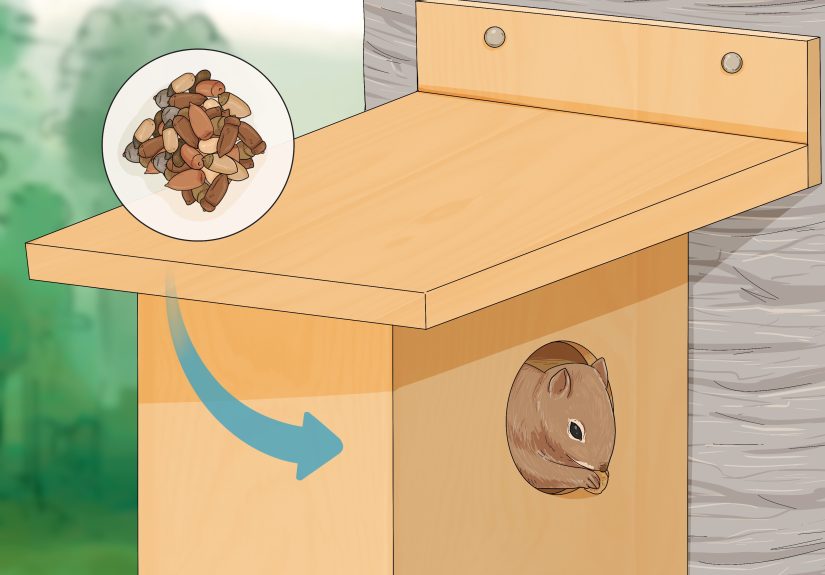
Before hanging the box, add dry leaves or straw. For gray or fox squirrels, many wildlife plans suggest filling the box partway, often about half full, to make it more inviting. Do not pack it tightly. Think “cozy starter kit,” not “overstuffed closet.” The squirrel will rearrange the material anyway, because interior decorating is apparently a universal impulse.
-
Step 12: Choose a Good Tree and a Good Spot
Mount the box on a mature tree, ideally one in or near habitat with nut-producing trees such as oak or hickory. For gray and fox squirrels, mature wooded areas and large backyard trees are ideal. If the goal is to draw squirrels away from your house, place the box in a safer tree-based location rather than right next to your roof. Avoid placing it where branches make predator access easy.
-
Step 13: Mount It at the Right Height and Direction
For gray or fox squirrels, many proven plans place the box roughly 18 to 30 feet high, though some state guidance also allows successful installation closer to 10 to 15 feet in appropriate trees. For flying squirrels, 10 to 26 feet is common. Face the entrance east or south when possible, or at least away from prevailing winter winds. Attach the box securely to the trunk, but use mounting hardware thoughtfully so the tree can continue to grow. If you use screws, check them over time and loosen as needed.
-
Step 14: Inspect Seasonally and Respect Occupied Boxes
Set the box out in fall if you can. Squirrels often use nest boxes heavily in winter, and females may also use them to raise young. That means you should avoid opening or cleaning a box when it may be occupied by babies. Gray squirrels may breed in winter and again in summer, and young may remain dependent for weeks. The safest approach is to inspect from outside first and clean only during a clearly vacant period. If you ever suspect a live nest with babies, do not relocate the animals casually. Humane wildlife groups consistently warn that trapping and moving squirrels can separate mothers from young and end badly for the animals.
Common Mistakes to Avoid
Making the Entrance Too Big
A giant hole may feel generous, but it can invite predators, weather, and species you did not intend to host. Match the opening to the squirrel species you are targeting.
Using Treated or Weak Materials
A squirrel house is not the place for questionable leftovers from the garage. Avoid chemically treated boards and cheap engineered scraps that swell, crumble, or get chewed apart.
Forgetting Drainage
If rain gets in and cannot get out, you have not built a wildlife shelter. You have built a damp box of regret.
Mounting It Too Low
Boxes placed too low are more vulnerable to predators, disturbance, and bad outcomes. Squirrels want height, cover, and quick access to trees.
Checking the Box Too Often
Once installed, resist the urge to peek inside every weekend. Wildlife housing works best when it feels undisturbed.
What Happens After You Hang It?
Do not expect instant occupancy. Sometimes squirrels investigate a new box for weeks before moving in. They may sniff the entrance, climb around the roof, sit on it like tiny landlords, and then vanish as if they are still comparing neighborhood options. That is normal. A good squirrel house is an invitation, not a guarantee.
If the location is right and the box is built well, use may increase in colder months. In some yards, squirrels adopt a box as a winter shelter first and later as a nesting site. You may also notice them carrying in extra leaves, which is basically their version of bringing home throw pillows.
Experience and Real-World Lessons from Building a Squirrel House
One of the most interesting things people learn after building a squirrel house is that the project is part woodworking and part patience training. The woodworking section is easy to understand: measure, cut, drill, screw, mount, done. The patience section is harder. Many backyard builders hang a fresh box on Saturday, stare at it all Sunday, and by Monday are deeply offended that no squirrel has moved in with a tiny suitcase. Wildlife does not work on human deadlines.
In real-world backyard settings, the most successful squirrel houses are usually the ones that look a little boring. They are not painted like cottages. They do not have decorative trim. They do not have cute signs that say “Nutflix & Chill.” They are simple, sturdy, dry, and mounted in the kind of tree a squirrel already trusts. That is a useful lesson for anyone building one for the first time: focus less on style and more on function.
Another common experience is discovering how much placement matters. A beautifully made box in the wrong tree may sit empty for months, while a plain box in a mature oak gets inspected within days. People often assume the build quality is the whole story, but squirrels care just as much about access to food, cover from predators, and protection from wind. In other words, location matters here almost as much as it does in real estate, except squirrels are harsher critics and never return your calls.
Builders also tend to notice that squirrels are excellent quality-control inspectors. If a roof rattles, they test it. If a corner gap lets in air, they find it. If the box is too exposed, they hesitate. If the bedding is wrong, they redecorate immediately. Watching that behavior can be surprisingly helpful. It turns the project from a simple DIY build into an ongoing observation of how wildlife actually uses a structure. You begin to notice details you might ignore otherwise, like how a box faces morning sun, how rain runs down a trunk, or how a nearby branch creates an easy predator route.
There is also a humane lesson built into the experience. A squirrel house is often most helpful when it is used as part of coexistence rather than control. Some homeowners build one because squirrels have been too interested in the attic, soffit, or chimney. In those cases, a nest box can be part of a better long-term strategy, especially when paired with sealing entry points only after you are certain no babies are inside. People who take the time to do this carefully often come away with a different view of the animals. The squirrel stops being “the pest” and becomes “the stubborn tenant I am trying to redirect without starting a neighborhood feud.”
Finally, there is the simple pleasure factor. Even when a squirrel house is not occupied right away, it changes how people look at their yard. They start paying attention to tree species, nesting seasons, and animal behavior in a more observant way. And when the box is finally used, the moment feels oddly satisfying, like getting approval from a tiny, furry building inspector. You built something practical, humane, and genuinely useful. That is a pretty good outcome for a weekend project that mostly begins with a board, a drill, and a squirrel problem that refuses to solve itself.
Conclusion
Building a squirrel house is not complicated, but doing it well means respecting both craftsmanship and wildlife behavior. Use untreated wood, build to sensible dimensions, include drainage and ventilation, mount the box in a mature tree, and avoid disturbing it during active nesting periods. The result is a safer, smarter shelter for squirrels and a more peaceful backyard for you. That is a rare DIY win where everybody gets the house they wanted.