Table of Contents >> Show >> Hide
- What Makes a Political Cartoon Work?
- How to Make a Political Cartoon: 14 Steps
- Step 1: Pick One Specific Issue
- Step 2: Decide What You Actually Think
- Step 3: Research Before You Roast
- Step 4: Identify the Real Target
- Step 5: Find the Central Angle
- Step 6: Choose a Symbol Readers Recognize
- Step 7: Use Exaggeration on Purpose
- Step 8: Add Analogy or Irony
- Step 9: Write a Caption That Pulls Its Weight
- Step 10: Sketch the Composition First
- Step 11: Cut Anything That Needs a Footnote
- Step 12: Use Labels Sparingly but Smartly
- Step 13: Test It for Clarity, Fairness, and Punch
- Step 14: Finish the Art and Publish With Confidence
- Common Mistakes Beginners Make
- A Simple Example of the Process
- Experience-Based Lessons From Making Political Cartoons
- Conclusion
- SEO Tags
Political cartoons are basically the espresso shots of opinion writing. A good one says a lot with very little: one image, a few words, and suddenly an entire policy debate is standing in your kitchen wearing clown shoes. That is the magic. A political cartoon does not try to explain everything. It picks a side, finds the sharpest visual angle, and lands the point before the reader has time to scroll away.
If you want to make one, you do not need to be a world-famous illustrator or the long-lost cousin of a newspaper legend. You need a strong idea, a clear opinion, and the discipline to simplify. The drawing matters, sure, but the thinking matters more. In fact, many beginner cartoons fail not because the art is weak, but because the message is foggy. So this guide walks you through the full process, from choosing an issue to drawing a cartoon people instantly understand.
What Makes a Political Cartoon Work?
Before jumping into the steps, it helps to understand what separates a political cartoon from a random funny doodle. Political cartoons usually comment on public issues, public figures, elections, laws, institutions, or social debates. They are built to persuade, critique, mock, expose, or challenge. In other words, they are visual arguments wearing a joke as a necktie.
The best ones often use a few classic tools: symbolism, exaggeration, labeling, analogy, irony, and satire. That sounds fancy, but you already know these ideas. A dove can stand for peace. A giant wallet can represent corporate influence. A politician drawn with an extra-long nose may hint at dishonesty. A sinking ship might symbolize a failing policy. None of that requires a gallery opening or a beret. It requires clarity.
That is also why context matters. If your audience cannot tell what issue you are addressing, the joke dies on the sidewalk. A political cartoon works best when the reader can recognize the topic, understand the target, and connect the visual metaphor fast. Think less “mysterious art puzzle” and more “smart visual punchline with a purpose.”
How to Make a Political Cartoon: 14 Steps
Step 1: Pick One Specific Issue
Do not start with “politics” as a giant cloudy blob. Start with one issue: student debt, campaign ads, road construction, immigration policy, public school funding, healthcare costs, voting laws, or city corruption. The more specific the topic, the easier it is to build a cartoon around it.
Beginners often make the mistake of trying to tackle everything wrong with society in a single frame. That is not a cartoon. That is a stress dream. Narrow the subject until you can explain it in one sentence.
Step 2: Decide What You Actually Think
A political cartoon needs a point of view. If your stance is mushy, the cartoon will also be mushy. Ask yourself: What exactly am I criticizing, supporting, or questioning? What frustrates me most about this issue? What hypocrisy, contradiction, or absurdity stands out?
You do not need to write a graduate thesis. You do need a clear takeaway. Try this formula: “I believe ___ because ___, and the most ridiculous part is ___.” That final blank often becomes the cartoon.
Step 3: Research Before You Roast
Yes, cartoons are funny. No, that does not give them permission to be sloppy. Before you draw, spend time checking the facts, the timeline, the policy details, and the language people are using around the issue. If your cartoon is based on a misunderstanding, readers will notice. And they will notice loudly.
Read a few credible reports, compare viewpoints, and make sure you understand the argument you are criticizing. A strong political cartoon simplifies reality, but it should not invent reality. That difference matters.
Step 4: Identify the Real Target
Ask yourself who or what your cartoon is really about. Is it a politician, a party, a law, a government agency, a corporation, a voting bloc, a media habit, or a public attitude? Be precise. Punching at a vague fog is not effective. Hitting the exact target is.
Also, aim your criticism at power, policy, behavior, or public choices rather than lazy stereotypes about identity. Good cartoons can be fierce without becoming cheap. If your joke depends on insulting a group instead of exposing a problem, the idea probably needs another lap around the track.
Step 5: Find the Central Angle
Now look for the one angle that makes the issue cartoon-worthy. Maybe the policy promises savings but costs more. Maybe a candidate calls for “freedom” while restricting choices. Maybe officials say everything is under control while the building behind them is literally on fire. That tension is the cartoon’s engine.
A useful trick is to finish the sentence: “This issue is like ___.” Maybe a budget plan is like rearranging deck chairs on a sinking ship. Maybe a campaign is like a circus. Maybe a broken law is like duct tape on a dam. Once you find the comparison, the drawing becomes much easier.
Step 6: Choose a Symbol Readers Recognize
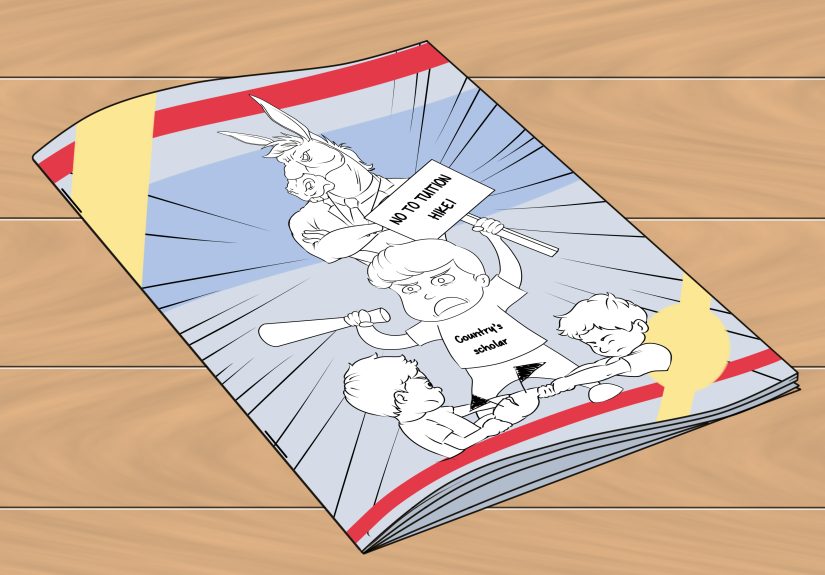
Political cartoons love symbols because symbols do a lot of work in a small space. Uncle Sam, a ballot box, a donkey, an elephant, scales of justice, a school bus, a money bag, a globe, a maze, a puppet string, a ticking clock, or a cracked bridge can all help deliver meaning fast.
The symbol should fit the issue and feel instantly readable. If you use a super-obscure metaphor that only three policy nerds and one exhausted civics teacher understand, you may have created a niche masterpiece, but not a broadly effective cartoon.
Step 7: Use Exaggeration on Purpose
Exaggeration is one of the oldest cartoon tools in the kit. You can exaggerate facial features, body language, size, props, or setting. A politician can be drawn tiny and frightened, or oversized and stomping around like a parade balloon with a microphone. A corporate lobby can become a literal giant hand reaching into government.
The key is intention. Exaggerate the feature that supports the message. Do not randomly stretch noses, ears, or eyebrows just because cartoons are “supposed” to be weird. Every distortion should help the argument.
Step 8: Add Analogy or Irony
This is where the cartoon begins to feel clever instead of merely loud. Analogy compares one situation to another. Irony shows the gap between what people say and what is actually happening. Both are gold mines.
For example, a city leader bragging about “transparency” while hiding inside a brick wall of documents is irony. A campaign portrayed as a reality TV elimination show is analogy. Either device can turn a dry issue into a memorable visual statement.
Step 9: Write a Caption That Pulls Its Weight
Some political cartoons work with no words. Many work better with a short caption, label, sign, or speech bubble. The trick is to use text like hot sauce: enough to wake things up, not so much that the whole plate becomes unreadable.
A strong caption can clarify the comparison, sharpen the joke, or add a second layer of meaning. Keep it short, natural, and conversational. If your caption reads like a policy memo that fell down a staircase, trim it.
Step 10: Sketch the Composition First
Before making the final drawing, do two or three quick thumbnail sketches. Decide where the main subject goes, where the eye lands first, and what details matter most. A political cartoon should usually have one dominant focal point, not twelve tiny arguments fighting in a parking lot.
Think in terms of visual hierarchy. What appears first? What supports it? What can be removed? Simpler composition usually means stronger communication.
Step 11: Cut Anything That Needs a Footnote
If the cartoon requires you to stand beside it explaining the joke for five minutes, the cartoon is not done. Remove extra props, background clutter, side characters, and overcomplicated references. Keep what serves the message. Cut what only serves your attachment to your original brilliant chaos.
Readers should understand the cartoon quickly, even if the deeper meaning unfolds after a second look. Immediate readability matters.
Step 12: Use Labels Sparingly but Smartly
Labels can save a good idea from becoming confusing. A suitcase labeled “Special Interests,” a leaking pipe labeled “Public Trust,” or a staircase labeled with policy milestones can make your meaning much clearer.
That said, if you label absolutely everything, the drawing starts to feel like a museum tour led by a nervous intern. Use labels where they clarify the symbol, not where they replace thinking.
Step 13: Test It for Clarity, Fairness, and Punch
Show your sketch to someone who follows the news but has not been living inside your brain all afternoon. Ask three questions: What issue is this about? What do you think my opinion is? What part confused you?
If they misunderstand the issue, your concept needs more clarity. If they understand the issue but not your point, your angle is weak. If they understand both and smirk immediately, congratulations, your cartoon has a pulse.
This is also the moment to check your ethics. Are you critiquing conduct, policy, or abuse of power, or are you just leaning on a tired stereotype? The best cartoons sting because they reveal something true, not because they swing wildly at whoever is nearby.
Step 14: Finish the Art and Publish With Confidence
Once the idea works, clean up the lines, strengthen the shapes, improve the contrast, and make sure the text is readable. Whether you ink traditionally or finish digitally, aim for crisp presentation. A muddy execution can bury a sharp idea.
Then publish it where it fits: a school paper, portfolio site, blog, newsletter, class project, zine, Instagram post, or opinion section. Political cartoons are meant to be seen and reacted to. If nobody sees the cartoon, it is just a private little revolution in your sketchbook.
Common Mistakes Beginners Make
The most common mistake is trying to say too much. A political cartoon is not a panel discussion. It is a distilled visual opinion. Another frequent problem is choosing a trendy topic without actually understanding it. Readers can sense borrowed outrage from a mile away.
Some artists also overdraw. They add too much background, too many symbols, too many speech bubbles, and too many side jokes. The result feels busy but not sharp. Others lean too hard on text and forget the image is supposed to do the heavy lifting. If your cartoon still works after removing half the words, you are probably getting warmer.
Finally, there is the cheap-shot problem. Shock is easy. Insight is harder. A strong political cartoon does not just insult. It exposes contradiction, hypocrisy, waste, injustice, confusion, or absurdity. That is what makes it memorable instead of disposable.
A Simple Example of the Process
Let’s say your issue is rising housing costs. Your opinion is that public officials keep offering tiny symbolic fixes while the real crisis grows. Your angle becomes: leaders are treating a wildfire with a water pistol.
Now the cartoon starts building itself. You draw a massive house-shaped fire labeled “Housing Crisis.” In the foreground, a smiling official holds a toy spray bottle labeled “Temporary Fix.” A short caption might read, “We’ve got this.” That is a political cartoon. One issue. One viewpoint. One visual argument. No lecture required.
Experience-Based Lessons From Making Political Cartoons
Once you have made a few political cartoons, you start learning things no checklist can fully teach. First, the funniest idea in your notebook is not always the strongest one. Sometimes the joke that makes you laugh hardest is too private, too inside-baseball, or too tangled to land with readers. The better cartoon is often the one that feels a little more obvious at first, because clarity beats cleverness when the goal is communication.
You also learn that timing changes everything. A cartoon drawn while an issue is fresh can feel electric. The exact same cartoon a week later might feel like leftovers in the back of the fridge: technically still there, emotionally disappointing. That does not mean every cartoon has to chase the news cycle at top speed, but it does mean relevance matters. The more current the issue, the more your audience brings their own knowledge into the image.
Another experience almost every cartoonist has is drawing too much in the first draft. You start with one senator, one podium, one flag, one giant contract, one angry voter, one television screen, one courthouse, one eagle, one protest sign, and somehow a tiny tax form floating in the corner like it pays rent. Then you step back and realize the cartoon looks like a garage sale sponsored by democracy. That is when editing becomes your best friend. Cutting half the objects usually doubles the impact.
There is also a real difference between mocking a person and exposing a contradiction. The first is easy and often forgettable. The second takes thought. Over time, you start noticing that the cartoons readers remember are the ones that turn a complicated issue into one clean image of hypocrisy, absurdity, or imbalance. In other words, people may chuckle at a silly face, but they remember the cartoon that reveals something true.
You will probably also discover that captions are sneaky little monsters. A caption can save a cartoon, but it can also smother it. Many beginners write captions that explain the entire argument because they are nervous the image will not be understood. Fair concern. Bad solution. The better move is to let the picture do most of the talking and let the caption deliver the wink, the twist, or the final jab.
And yes, not everyone will agree with you. That comes with the territory. Political cartoons invite reaction. Some readers will laugh, some will nod, and some will act like you personally insulted their favorite lawn chair. That does not automatically mean the cartoon failed. It means it entered public conversation, which is exactly what political cartoons are built to do. The real test is whether your work is informed, readable, and purposeful.
With experience, you stop asking, “Can I draw this perfectly?” and start asking, “Does this idea hit?” That shift changes everything. The cartoon becomes less about artistic ego and more about visual argument. And honestly, that is where the fun begins.
Conclusion
Learning how to make a political cartoon is really about learning how to think visually. You take a public issue, form a clear opinion, strip away the clutter, and turn the core idea into an image people can grasp in seconds. The best cartoons are not overloaded masterpieces. They are focused, opinionated, and smart enough to make readers laugh, wince, or mutter, “Okay, that was painfully accurate.”
So start small. Pick one issue. Find one angle. Use one strong symbol. Then sketch, revise, simplify, and sharpen. Your first political cartoon does not need to be legendary. It just needs to say something clearly. That is how cartoonists improve: one bold little visual argument at a time.