Table of Contents >> Show >> Hide
- What Is an Iron Golem (and Why You’d Want One)
- Before You Build: Materials Checklist
- How to Make an Iron Golem in Minecraft: 8 Steps
- Step 1: Mine (or otherwise obtain) enough iron
- Step 2: Smelt the iron into ingots
- Step 3: Craft 4 Iron Blocks
- Step 4: Get a pumpkin, then carve it
- Step 5: Choose a build spot and clear the “invisible blockers”
- Step 6: Place 2 iron blocks vertically (the spine)
- Step 7: Add the arms to form a “T”
- Step 8: Place the carved pumpkin (or Jack o’Lantern) last
- Troubleshooting: Why Isn’t My Iron Golem Spawning?
- Pro Tips: Making Your Iron Golem Actually Useful (Not Just a Vibe)
- Java vs. Bedrock Notes (Quick and Practical)
- FAQ: Iron Golem Questions Players Ask Every Single Day
- Player Experiences: What It’s Really Like to Build Your First Iron Golem (and Not Mess It Up)
- Conclusion
An Iron Golem is basically Minecraft’s version of a bouncer: huge, quiet, and extremely motivated to launch zombies into low orbit. If you’ve ever built a cozy base, turned around, and found a creeper doing that “I’m definitely not about to ruin your night” shufflecongrats, you’re ready for an Iron Golem.
In this guide, you’ll learn exactly how to make an Iron Golem in Minecraft in eight clear steps, plus the most common “why isn’t it working?!” fixes, pro tips for keeping your metal buddy where you want it, and a chunk of real-world (okay, real-player) experience so you can avoid the classic golem mishaps.
What Is an Iron Golem (and Why You’d Want One)
Iron Golems are powerful utility mobs that protect villagesand youby attacking many hostile mobs. They’re tough, they hit hard, and they can be a lifesaver during raids or when your base is getting “uninvited guests.” You can find them naturally in villages and sometimes trapped near pillager outposts, but building your own gives you a personal guard you can position exactly where you need it.
Before You Build: Materials Checklist
To craft an Iron Golem, you’ll need:
- 4 Iron Blocks (that’s 36 iron ingots total)
- 1 Carved Pumpkin or 1 Jack o’Lantern
- Shears (for carving the pumpkin)
- A clear building spot (more important than it sounds)
Quick math: Each iron block costs 9 ingots. Four blocks = 36 ingots. If you’re early game, this is the point where Minecraft gently suggests you become emotionally close to your nearest cave system.
How to Make an Iron Golem in Minecraft: 8 Steps
-
Step 1: Mine (or otherwise obtain) enough iron
Your goal is 36 iron ingots. The straightforward route is mining iron ore (or raw iron), then smelting it. If you’re a “villager trading is my cardio” player, you can also trade for iron ingots. Either way, count your ingots before you leave the crafting tablebecause nothing is sadder than having 3 iron blocks and a dream.
-
Step 2: Smelt the iron into ingots
Toss your iron ore/raw iron into a furnace with any fuel. When you’re done, you should have 36 ingots ready to become blocks. (Yes, you can smelt more. No, the golem will not be impressed by your “extra” ingots. It will, however, appreciate them later for healing.)
-
Step 3: Craft 4 Iron Blocks
Open a crafting table and fill the 3×3 grid with iron ingots to make one iron block. Repeat until you have four. This is where players learn the difference between “iron blocks” and “a pile of iron ingots that look block-ish if you squint.”
-
Step 4: Get a pumpkin, then carve it
Find or grow a pumpkin. Use shears on it to make a carved pumpkin. If you prefer a glow-up (literally), craft a carved pumpkin with a torch to make a Jack o’Lantern. Both work as the Iron Golem’s “head.”
Tip: If you place a normal pumpkin as the head by accident, you can still salvage the moment: in some situations, placing the pumpkin and then shearing it can trigger the spawn. When in doubt, carve it first.
-
Step 5: Choose a build spot and clear the “invisible blockers”
This is the step most “my golem won’t spawn” rants skip, and it matters a lot: the Iron Golem needs air in the right places. Clear a 3×3 area and remove anything that isn’t truly air where its arms would have spaceincluding tall grass, flowers, snow layers, and even water. Minecraft counts those as “not air,” and your golem will refuse to clock in.
Also give it room. Iron Golems are tall and wide; spawning them in a cramped corner can cause awkward “bonk” moments or even suffocation damage if solid blocks crowd their head space.
-
Step 6: Place 2 iron blocks vertically (the spine)
Put one iron block on the ground, then place a second iron block directly on top of it. You now have a 2-block-tall iron pillar. Congratulations: you’ve built the world’s tiniest modern-art sculpture.
-
Step 7: Add the arms to form a “T”
Place the remaining two iron blocks on opposite sides of the top block, creating a capital T. Make sure the spaces around the arms are still clear.
Orientation note: The “T” can be placed in different orientations, but the classic setup is: two blocks stacked, with one block on each side of the top block.
-
Step 8: Place the carved pumpkin (or Jack o’Lantern) last
Place the carved pumpkin or Jack o’Lantern on top of the center block. The head must be the final piece you place. If everything is clear and correct, your Iron Golem spawns instantlyalive, loyal, and ready to uppercut your problems into tomorrow.
Good news: A player-built Iron Golem won’t turn on you the way a village golem might if you’ve been mean to villagers. It’s basically your big metal roommate who only gets mad at monsters (and, occasionally, at chaos).
Troubleshooting: Why Isn’t My Iron Golem Spawning?
If your golem didn’t spawn, it’s almost always one of these:
- The head wasn’t placed last. Break the pumpkin, make sure the iron “T” is correct, then place the carved pumpkin again as the final block.
- Something is blocking the required air spaces. Remove tall grass, flowers, snow layers, carpets, water, or random blocks near the arms and around the base.
- You used the wrong “head.” Use a carved pumpkin or Jack o’Lantern. If you only have a regular pumpkin, carve it with shears first.
- The area is too cramped. Give it a little spacethink “tiny parking spot” vs “actual driveway.”
- You used iron ingots instead of iron blocks. If you placed ingots on the ground, that’s not a golem bodyit’s a shiny floor decoration.
Pro Tips: Making Your Iron Golem Actually Useful (Not Just a Vibe)
Heal it when it’s cracked
If your golem looks like it’s been through a rough breakup (visible cracks), you can heal it by using iron ingots on it. Keep a few ingots handy if your base gets regular nighttime visitors.
Keep it where you want it
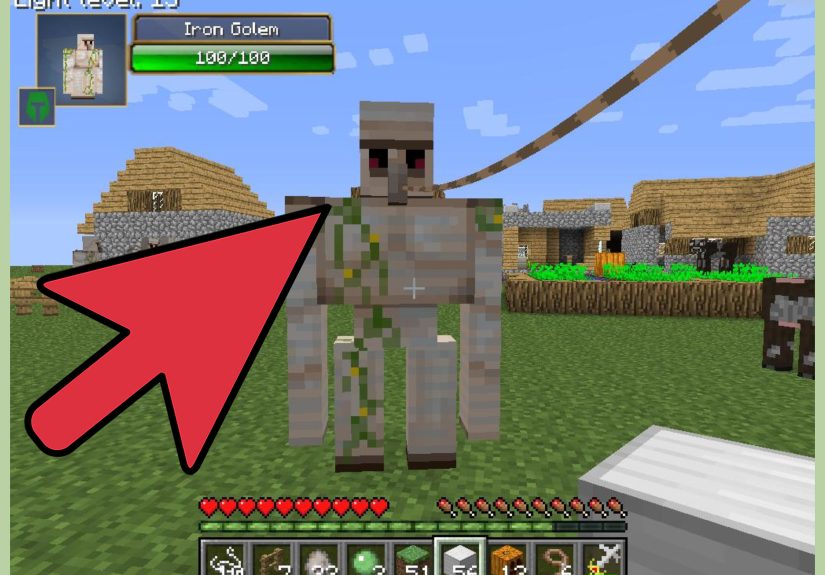
Iron Golems wander. If you want a dedicated guard at your gate, you can leash it and anchor it to a fence post. This is especially handy for protecting villagers, entrances, or your precious chest room you swear is “organized” (it isn’t).
Don’t rely on it to solve creepers
Iron Golems are great at punching zombies and skeletons. Creepers are… complicated. Even if your golem is winning, creepers can still explode near it, and that blast can wreck the area you were trying to protect. Consider lighting, walls, cats, or your own two paranoid eyeballs as part of the security plan.
Java vs. Bedrock Notes (Quick and Practical)
- Building method: The “4 iron blocks + carved pumpkin head” method is the core recipe across editions.
- Space matters everywhere: The “air spaces” rule is one of the biggest cross-edition pain points.
- Villager-spawned golems are a separate mechanic: Villages can generate golems naturally under certain conditions. That’s great for iron farming, but it’s not required for building one with blocks.
FAQ: Iron Golem Questions Players Ask Every Single Day
Can I build an Iron Golem inside my house?
You can, but you shouldn’t unless your “house” is basically a hangar. If it spawns too close to blocks at head level, it can take suffocation damage or get awkwardly stuck. Give it roomy ceilings and space to move.
Will my Iron Golem despawn?
Player-built utility mobs are generally meant to stick around. The bigger issue is not despawningit’s wandering off to start a personal crusade against a zombie you didn’t even know existed.
Can I automate building an Iron Golem?
You can get clever: the “head” can be placed in ways that allow automation (for example, via redstone-friendly tricks). For most players, though, manual building is faster than engineering a pumpkin delivery system. (But if you do it anyway, please know you’re the kind of person redstone tutorials are written for.)
Player Experiences: What It’s Really Like to Build Your First Iron Golem (and Not Mess It Up)
The first time most players try to make an Iron Golem, it’s a surprisingly emotional journey for a game about cubes. You start confident: “Four iron blocks, one carved pumpkin, easy.” Five minutes later, you’re pacing around a silent iron “T” like it owes you money. This is normal.
One of the most common experiences is learning that Minecraft is extremely literal about air. Players will clear obvious blocks but forget tall grass, a flower, or a thin snow layer. Then they place the carved pumpkin… and nothing happens. The immediate assumption is that the game changed or the recipe is wrong. The real culprit is usually something tiny you didn’t think counted as a block. The fix feels silly, but it’s also one of those “okay, now I truly understand Minecraft” moments.
Another classic story: building the golem too close to a wall because you wanted it to “guard the door.” The golem spawns, takes one step, and starts rubbing shoulders with your architecture like it’s trying to become one with the building. In tight spaces, golems can look clumsy, and they may take damage if their head area clips into solid blocks. Players who plan a little “guard platform” (open air, fence boundaries, good lighting) usually end up with a golem that’s both effective and pleasantly non-destructive to the décor.
Then there’s the magical moment when you realize a golem is not a stationary turretit’s a roaming, opinionated security guard. People place one by their crops, head to a cave, come back, and wonder why the farm feels less protected. The golem didn’t despawn; it wandered. Sometimes it followed a hostile mob path, sometimes it drifted toward villagers, and sometimes it just decided the scenic route was calling. This is where players discover the value of leashing a golem to a fence post or designing a “patrol area” using fences, walls, or landscaping that nudges it to stay near the places you actually care about.
A surprisingly common experience is using an Iron Golem as “raid insurance.” During a village raid, watching an Iron Golem charge in is equal parts comforting and chaotic. It can buy you time, thin out attackers, and reduce the pressure on villagersespecially if you’ve got multiple golems spaced around entry points. But players also learn quickly that golems aren’t perfect at target selection, and they can’t solve every threat. They’re fantastic muscle, not a strategy. Lighting, walls, and your own awareness still matter.
Finally, players tend to become weirdly attached to their first successful golem. You give it a “job” (front gate, villager market, mob-proof hallway), you notice when it’s cracked, and you start carrying iron ingots like you’re its mechanic. It’s one of those Minecraft friendships where the other side never speaks, never smiles, and still somehow makes your base feel safer. And when you build your second golem, you do it fasternot because the recipe changed, but because you learned the real secret: clear space, place the head last, and don’t trust decorative grass.
Conclusion
Building an Iron Golem is one of the most satisfying “I just leveled up as a Minecraft player” moments. Once you know the trick iron blocks in a T-shape, carved pumpkin last, and real air space around the armsit becomes a reliable way to add serious defense to your base or village. Craft one, give it room to work, heal it when it’s damaged, and you’ll have a dependable guardian that turns midnight mob problems into “not my problem anymore.”