Table of Contents >> Show >> Hide
- What Are Simultaneous Equations?
- What Is the Substitution Method?
- Why Use the Substitution Method?
- How to Solve Simultaneous Equations Using Substitution Method
- Example 1: A Simple Substitution Problem
- Example 2: When You Must Rearrange First
- Example 3: Substitution With Fractions
- How to Choose Which Variable to Substitute
- What Does the Answer Mean?
- Possible Outcomes When Solving Simultaneous Equations
- Common Mistakes to Avoid
- When Is Substitution Better Than Elimination?
- Real-Life Uses of Simultaneous Equations
- Word Problem Example Using Substitution
- Practice Problems
- Helpful Tips for Learning the Substitution Method
- Experiences and Practical Advice for Mastering the Substitution Method
- Conclusion
Solving simultaneous equations can feel a bit like trying to unlock a suitcase while the suitcase is also asking you why you brought algebra on vacation. But here is the good news: once you understand the substitution method, the whole process becomes much less mysterious. Instead of juggling two unknowns at the same time, you turn one equation into a helpful clue and use it to simplify the other.
The substitution method is one of the most reliable ways to solve a system of equations, especially when one equation is already solved for a variable or can be rearranged easily. It is clean, logical, and surprisingly satisfying once the pieces click into place. In this guide, you will learn what simultaneous equations are, how substitution works, when to use it, how to avoid common mistakes, and how to solve examples step by step.
What Are Simultaneous Equations?
Simultaneous equations are two or more equations that are true at the same time. In most beginner algebra problems, you are given two equations with two variables, usually x and y. Your job is to find the values of those variables that make both equations correct at once.
For example:
These equations are connected because they use the same variables. You are not looking for any random value of x or y. You are looking for the pair that satisfies both equations. That pair is called the solution of the system, and it is usually written as an ordered pair like (3, 5).
What Is the Substitution Method?
The substitution method is a way to solve simultaneous equations by replacing one variable with an equivalent expression from another equation. In plain English, you take what one equation tells you and plug it into the other equation.
Think of it like this: if one equation says y = x + 2, then anywhere you see y in the other equation, you can replace it with x + 2. You are not changing the value. You are simply swapping in an equal expression. Algebra approves. Your calculator remains calm.
Why Use the Substitution Method?
The substitution method is useful because it turns a two-variable problem into a one-variable problem. Once you have one equation with only one variable, you can solve it using regular algebra. Then you substitute that answer back into one of the original equations to find the second variable.
This method works especially well when:
- One equation is already solved for x or y.
- A variable has a coefficient of 1 or -1.
- You want an exact algebraic solution instead of a graph estimate.
- The equations are simple enough to rearrange without creating messy fractions.
Substitution is not always the fastest method for every system. Sometimes elimination is quicker. But substitution is excellent for building algebra confidence because every step has a clear purpose.
How to Solve Simultaneous Equations Using Substitution Method
The basic process has four main steps. Once you memorize these, most substitution problems follow the same rhythm.
Step 1: Solve One Equation for One Variable
Choose the equation that is easiest to rearrange. If one equation already says something like x = 2y – 3 or y = x + 4, use that one. Your future self will thank you.
Step 2: Substitute Into the Other Equation
Take the expression from Step 1 and plug it into the other equation. This should leave you with one equation and one variable.
Step 3: Solve for the First Variable
Now solve the single-variable equation. Use inverse operations, combine like terms, distribute carefully, and do not let negative signs sneak around like tiny algebra gremlins.
Step 4: Substitute Back to Find the Second Variable
Once you know one variable, plug it into either original equation to find the other variable. Then write your answer as an ordered pair.
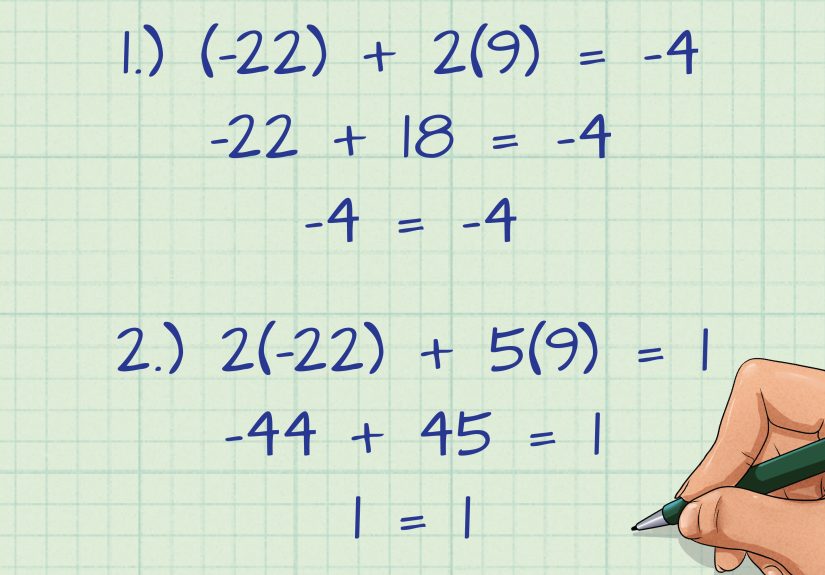
Step 5: Check Your Answer
This step is short but powerful. Substitute both values into both original equations. If both equations are true, your answer is correct.
Example 1: A Simple Substitution Problem
Solve the system:
The first equation is already solved for y, so we can substitute x + 2 for y in the second equation.
Now solve for x:
Now substitute x = 3 into the first equation:
The solution is:
Check it:
Both equations work, so the solution is correct.
Example 2: When You Must Rearrange First
Solve the system:
Neither equation is completely solved for a variable, but the first equation is easy to rearrange. Solve it for y:
Now substitute 10 – x for y in the second equation:
Be careful with the minus sign before the parentheses. It must apply to everything inside.
Now find y:
The solution is:
Example 3: Substitution With Fractions
Fractions are where students often start whispering, “Maybe graphing is my true calling.” But substitution still works if you move carefully.
Solve the system:
The second equation is already solved for y. Substitute 2x – 1 into the first equation:
Solve:
Now substitute x = 3 into y = 2x – 1:
The solution is:
This example shows why substitution can be efficient. Since one equation was already solved for y, the system practically rolled out the welcome mat.
How to Choose Which Variable to Substitute
A smart choice can make the substitution method easier. When solving simultaneous equations, look for the variable that can be isolated with the least amount of work. If one variable has a coefficient of 1, that is often the best option.
For example, in this system:
The first equation contains y with a coefficient of 1. Solve for y:
That is much easier than solving for x, which would create a fraction. Fractions are not evil, but they do tend to invite extra arithmetic mistakes to the party.
What Does the Answer Mean?
For two linear equations, the solution represents the point where the two lines intersect. If the solution is (3, 5), that means both lines pass through the point where x = 3 and y = 5.
When you solve by graphing, you see the intersection visually. When you solve by substitution, you find the same intersection algebraically. The destination is the same; substitution just uses fewer rulers and less graph paper.
Possible Outcomes When Solving Simultaneous Equations
Most beginner problems have one solution, but systems of equations can have three possible outcomes.
One Solution
The lines cross at exactly one point. This is the most common type of problem in algebra practice.
No Solution
The lines are parallel and never meet. During substitution, this often creates a false statement such as:
If the variables disappear and the statement is false, the system has no solution.
Infinitely Many Solutions
The two equations describe the same line. During substitution, this may create a true statement such as:
If the variables disappear and the statement is always true, the system has infinitely many solutions.
Common Mistakes to Avoid
Forgetting Parentheses
When substituting an expression, always use parentheses. If y = x – 4 and the other equation says 3y, write:
Do not write 3x – 4. That tiny missing distribution can ruin the whole answer faster than spilled coffee on homework.
Losing Negative Signs
Negative signs deserve respect. If you substitute into an expression like -y, and y = 10 – x, you must write:
Many incorrect answers are not caused by misunderstanding substitution. They are caused by one runaway minus sign.
Substituting Into the Same Equation
After solving one equation for a variable, substitute into the other equation, not back into the same one. Substituting into the same equation usually gives a true but useless statement, like asking a mirror for directions.
Not Checking the Final Answer
Checking takes less than a minute and catches many errors. Substitute your ordered pair into both equations. If one equation fails, go back and inspect your algebra.
When Is Substitution Better Than Elimination?
Substitution is usually better when one equation is already solved for a variable or when a variable can be isolated easily. Elimination is often better when both equations are in standard form and the coefficients line up nicely.
For example, substitution is convenient here:
Elimination may be more convenient here:
In the second system, the 3y and -3y terms cancel immediately if you add the equations. That is elimination waving enthusiastically from across the room.
Real-Life Uses of Simultaneous Equations
Simultaneous equations are not just classroom decorations. They appear in budgeting, business, science, engineering, cooking conversions, ticket sales, distance-rate-time problems, and comparison shopping. Any situation involving two unknown quantities and two relationships can often be modeled with a system of equations.
For example, suppose a school sells adult tickets and student tickets for a concert. If you know the total number of tickets sold and the total money collected, you can use simultaneous equations to find how many of each ticket type were sold. Substitution helps turn the word problem into a solvable algebra problem.
Word Problem Example Using Substitution
A movie theater sells adult tickets for $12 and child tickets for $8. A total of 20 tickets are sold, and the total revenue is $200. How many adult tickets and child tickets were sold?
Let:
Write the system:
Solve the first equation for c:
Substitute into the revenue equation:
Solve:
Now find c:
The theater sold 10 adult tickets and 10 child tickets. The answer checks because:
Practice Problems
Try these on your own before looking at the answers. Algebra grows stronger when you give it a little workout.
Problem 1
Answer: (3, 9)
Problem 2
Answer: (7, 5)
Problem 3
Answer: (3, 11)
Helpful Tips for Learning the Substitution Method
First, write every step. It may feel slower at first, but clear work prevents confusion. Algebra is not impressed by mental gymnastics when one small sign error can change everything.
Second, circle or highlight the expression you plan to substitute. If y = 2x + 3, mark 2x + 3 and replace every matching y in the other equation with that entire expression.
Third, keep your equal signs aligned. Organized work makes mistakes easier to spot. Messy algebra is like a messy closet: technically everything may be in there, but good luck finding your shoes.
Fourth, check your answer in both original equations, not in the rearranged version only. The original system is the official judge.
Experiences and Practical Advice for Mastering the Substitution Method
One of the biggest lessons students learn while practicing the substitution method is that algebra is often more about patience than raw talent. Many people assume they are “bad at math” because they get stuck halfway through a problem. In reality, they may simply be skipping steps, rushing signs, or choosing the harder variable to isolate. The substitution method rewards calm, organized thinking. It is less like sprinting and more like following a recipe. Skip the salt, forget the oven, or substitute sugar for flour, and yes, things get weird.
A helpful habit is to pause before starting and ask, “Which equation looks friendliest?” Friendly equations usually have a variable standing alone or nearly alone. For example, y = 4x – 7 is practically begging to be substituted. An equation like 6x – 5y = 19 can still be used, but it may create fractions or extra steps. Choosing the simpler path is not cheating. It is strategy.
Another experience many learners share is that substitution becomes much clearer when they say the logic out loud. For instance: “Since y equals x plus 2, I can replace y with x plus 2 in the other equation.” That sentence turns a symbolic move into a common-sense action. Students who explain each step often catch mistakes earlier because they are not just moving symbols around; they are understanding why each move is legal.
It also helps to treat parentheses like seat belts. Whenever you substitute an expression with more than one term, put it in parentheses first. Even if you think you do not need them, use them anyway. They protect the structure of the expression and make distribution clearer. This is especially important when the expression is multiplied by a coefficient or follows a negative sign. Many wrong answers come from writing -10 – x when the correct simplification should be -10 + x.
Practice also reveals that checking the answer is not optional busywork. It is the moment when the system either says, “Yes, you solved me,” or “Nice try, detective.” When both original equations are true, students gain confidence. When one fails, the check points them back toward the mistake. This feedback loop is one of the fastest ways to improve.
For teachers, tutors, and self-learners, word problems are a great way to make substitution feel useful. Ticket prices, phone plans, gym memberships, and mixture problems all show why simultaneous equations matter. Once students see that the method can solve real situations, it stops feeling like abstract symbol wrestling and starts feeling like a practical tool.
The best long-term advice is to practice with variety. Solve systems where one variable is already isolated, then try systems where you must rearrange first. Try problems with negative signs, fractions, and word problem setups. Over time, the substitution method becomes less of a procedure to memorize and more of a pattern you recognize. And once that happens, simultaneous equations lose much of their drama. They may still wear algebra costumes, but you will know exactly who they are.
Conclusion
The substitution method is a powerful and approachable way to solve simultaneous equations. By isolating one variable, substituting its expression into the other equation, solving for one unknown, and then substituting back, you can find the ordered pair that satisfies both equations. The method is especially useful when one equation is already solved for a variable or can be rearranged easily.
To get better, focus on clean steps, careful parentheses, accurate distribution, and checking your final answer. With practice, solving simultaneous equations using substitution becomes less intimidating and more like following a dependable algebra roadmap. No magic wand required, although a sharp pencil definitely helps.
Note: This publish-ready HTML includes only the body section, written in original wording and based on standard algebra teaching principles from reputable educational resources.