Table of Contents >> Show >> Hide
- Maury Island Does Half the Design Work
- What the Cabin Was Hiding Under All That Chaos
- The Best Renovation Move? Subtraction
- Materials That Tell the Story
- A Kitchen Wise Enough to Keep Its Good Mistakes
- Collected, Not Decorated
- The Porch, the Deck, and the Genius of In-Between Space
- What This Renovation Gets Right About Historic Cabins
- What It Feels Like to Spend Time in a Place Like This
- Final Thoughts
Some houses ask for a facelift. Others ask for an intervention, a strong cup of coffee, and a contractor who knows the difference between “original character” and “old weirdness.” This 1898 cabin on Maury Island belonged firmly to the second category. Tucked into Washington’s Puget Sound, on the quieter edge of Vashon-Maury, the former shipbuilder’s cottage had the sort of backstory designers dream about and the sort of accumulated remodel decisions they absolutely do not. Think peeling linoleum, pink plywood walls, dropped ceilings, aluminum windows, and enough stylistic confusion to make the house feel less “historic cabin” and more “yard sale inside a sandwich bag.”
What makes this renovation so compelling is that it did not try to turn the place into a polished stage set or a faux-rustic theme park. Instead, it treated the cabin like a real old house with a real life ahead of it. The result is layered, practical, weather-wise, and deeply rooted in place. It feels coastal without resorting to starfish clichés, historic without becoming precious, and luxurious in the best possible way: not because it is flashy, but because it knows exactly what kind of life it wants to support.
Maury Island Does Half the Design Work
Location matters, and Maury Island is not the kind of place that rewards overdesign. Connected to Vashon by a man-made isthmus and reached via ferry from the mainland, it still carries the slower rhythm that comes with geographic inconvenience. That is not a flaw. That is the feature. The landscape around Quartermaster Harbor encourages a certain humility: salt air, shifting light, beach walks, gray skies that can turn silver in an instant, and the kind of water views that make most people suddenly believe in sitting quietly for once.
Any renovation here has to answer a simple question: does the house belong to the island, or is it trying to impress it? The smartest move in this cabin was recognizing that the site already had the charisma. The renovation did not need to compete with the view. It needed to frame it, support it, and occasionally get out of the way. Hence the blue front door that nods to the water, the all-season porch turned sitting room, and the deck spaces that invite long, gloriously unproductive afternoons.
What the Cabin Was Hiding Under All That Chaos
The bones were worth saving. Beneath the layers of unfortunate updates was a late-19th-century shipbuilder’s cottage, paired with a second detached worker’s cottage. Over time, the buildings had been wrapped in enough later materials to mute their original personality. But old houses rarely lose themselves completely. They just get buried under other people’s “improvements.” And yes, that word deserves air quotes.
In this case, the renovation strategy was not to invent romance from scratch. It was to uncover it. The team gutted the roughly 1,900-square-foot house, stripped away the visual noise, and re-established a historic logic. Even the repositioned front door and added porch ended up aligning with archival imagery of the house from around 1910. That kind of accidental correctness is catnip for anyone who loves old buildings. It suggests the renovation was not imposing an identity; it was listening closely enough to rediscover one.
The Best Renovation Move? Subtraction
Plenty of remodels think bigger is smarter. This one understood that restraint is often the sharper tool. Historic-preservation guidance consistently emphasizes identifying character-defining features first, then making changes that protect the building’s visual identity. That principle reads clearly here. The renovation did not flatten the cabin into an anonymous open-plan box. It respected the odd angles, shifting planes, modest scale, and tactile materials that gave the place its peculiar charm in the first place.
That is the real trick in a considered cabin renovation: not preserving every last thing just because it is old, and not replacing everything just because it is inconvenient. A house from 1898 is not a relic in amber. It is a structure that has to handle weather, guests, wet dogs, muddy boots, and the occasional panicked search for a bottle opener. The smartest old-house work lives in that tension between dignity and usefulness.
National Park Service guidance on rehabilitation makes this point beautifully, even if not with beach-house charm. Preserve the features that define the building. Repair where possible. Add what modern life requires, but do it with discretion. Put simply: let the house keep its face, even while you help it get better knees.
Materials That Tell the Story
If this Maury Island renovation has a secret weapon, it is material honesty. Salvaged Douglas fir planks from Seattle’s Second Use create floors with depth, warmth, and just enough visual irregularity to remind you that perfection is overrated. Reclaimed wood does what new materials often cannot: it arrives with a patina and a sense of time already baked in. In a historic cabin, that matters. Crisp, factory-fresh surfaces can look strangely nervous in an old envelope, like they wore the wrong shoes to dinner.
The home’s cedar-paneled walls, painted a soft white, create continuity from room to room while still allowing texture to do the heavy lifting. It is a clever choice. White, in lesser hands, can sterilize. Here it acts more like sea fog: it softens edges, amplifies light, and lets antiques, books, textiles, and found objects stand forward. The rooms feel calm, but never blank.
Then there are the details that prevent the project from drifting into generic “nice cabin” territory: a circa-1920s tub, aged brass hardware, industrial nautical sconces, a round porthole-like mirror, a cleat used as a door pull and leash holder, and signal flags repurposed as bath drapery. This is how you do thematic design without becoming a themed restaurant. The nautical notes are specific, practical, and slightly salty. No one is shouting “Ahoy!” from the powder room, which is exactly why it works.
A Kitchen Wise Enough to Keep Its Good Mistakes
One of the most telling decisions in the house was to keep the 1950s kitchen cabinets. Renovation culture loves a dramatic before-and-after reveal, preferably involving a dumpster, three mood boards, and a sentence about “elevating the space.” This project took the more interesting route. The cabinets survived, were painted a gray-blue, fitted with brass hardware, and allowed to carry a nostalgic, slightly sea-captain mood. Even the Formica counters read less as compromise and more as continuity.
That decision says a lot. A thoughtful renovation does not sort every element into “historic treasure” or “trash.” Sometimes later additions have earned their place. Sometimes they tell part of the building’s actual life story. Preservation guidance often favors repair over wholesale replacement for exactly this reason. Old buildings are cumulative objects. Their value is not just in one pristine date of origin, but in the layers that reveal how people adapted them over time.
In practical terms, keeping the cabinets also preserves what cabins do best: casual living. A beach retreat should not make you nervous about making a sandwich. It should invite coffee, chowder, wet towels, and pie. Maybe not all at once, but the house seems game.
Collected, Not Decorated
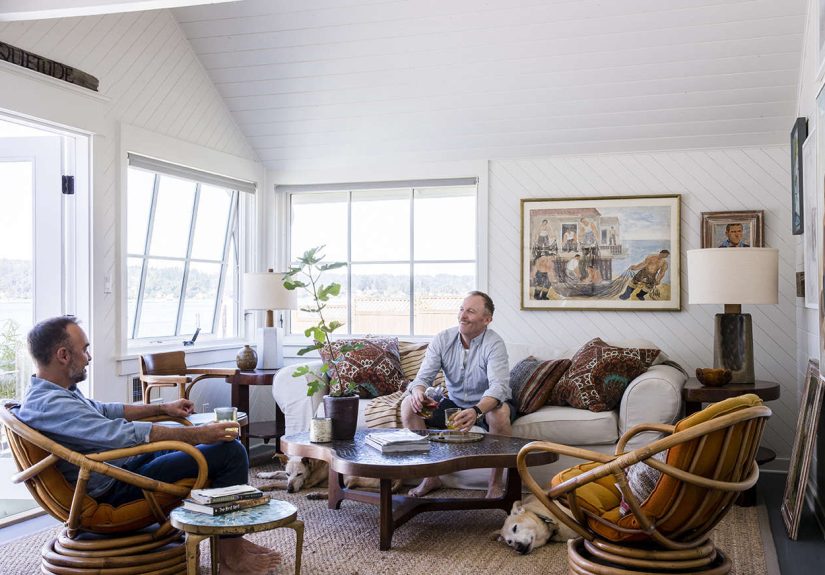
The living room, with its library wall and comfortably layered furnishings, is arguably the emotional center of the home. This is not minimalism. It is curation with pulse. Antiques, art, books, vintage finds, and beach-house informality coexist without fuss. The rooms look assembled over time, which is another way of saying they look believable.
That distinction matters in SEO terms and in life. Readers searching for historic cabin renovation ideas, Maury Island cabin design, or coastal cottage restoration are not usually looking for a sterile showroom. They want character. They want a house that tells the truth about wear, memory, family, weather, and the joy of making old things useful again.
The primary suite and bath follow the same logic. Nothing screams for attention, but everything contributes. The soaking tub feels found rather than ordered. The white-painted cedar and fir floors keep the spaces grounded. The textiles soften the edges. The effect is not fussy luxury. It is emotional luxury: the privilege of feeling instantly at ease.
The Porch, the Deck, and the Genius of In-Between Space
One of the loveliest moves in the project was enclosing the original front porch with a new window to create an all-season sitting area. This kind of adjustment is exactly what old houses respond to best when done with sensitivity. Rather than bolt on a flashy addition, the renovation improved how an existing threshold space worked. Preservation standards often encourage placing new work where it minimizes loss of historic material. Converting and refining a porch-zone can accomplish more than adding square footage ever could.
The deck system extends that same philosophy outdoors. On an island property, exterior living space is not decorative frosting; it is part of the house’s basic function. You want places to sit after a swim, watch weather move in, towel off the dog, dry out your socks, drink something cold, and pretend you are the sort of person who knows seabird species by sight. The deck does not merely expand use. It completes the social life of the cabin.
What This Renovation Gets Right About Historic Cabins
1. It preserves character without embalming the house.
Historic buildings need stewardship, not sainthood. This project keeps the irregularity, scale, and atmosphere of the original house while making it genuinely livable.
2. It uses salvage as substance, not decoration.
Reclaimed fir flooring and reused fixtures do more than add style points. They create continuity between the home’s age and its materials.
3. It respects context.
The house feels shaped by Maury Island, its maritime history, and its weather patterns. It does not ignore place in favor of trend.
4. It understands that comfort is a design principle.
Too many “beautiful” homes are secretly hostile to actual human behavior. This one feels built for gathering, lounging, reading, cooking, drying off, and coming back next weekend.
5. It proves that old houses do not need to become generic to feel current.
That may be the biggest lesson of all. You can modernize systems, improve flow, and add convenience without deleting the quirks that made the house worth saving.
What It Feels Like to Spend Time in a Place Like This
There is a particular pleasure to a renovated historic cabin that photographs can only partially explain. On screen, you notice the blue door, the painted paneling, the handsome floorboards, the books, the tub, the deck, the careful layers of texture. In person, the experience is more bodily than visual. You hear floorboards before you admire them. You notice how the house catches morning light and holds onto the smell of salt air. You understand immediately which chair is best for reading, which bench is best for removing wet shoes, and which corner mysteriously improves every cup of coffee by 20 percent.
Imagine arriving late on a Friday, ferry schedule still rattling in your head, groceries in the back seat, sweatshirt zipped to the chin because Puget Sound likes to remind people who is in charge. The cabin does not greet you like a luxury hotel. It does something better. It settles you. There is a place to drop the bag, hang the coat, leash the dog, kick off damp shoes, and exhale in a way city apartments rarely allow. The proportions of the rooms, the softness of the painted wood, and the visible history in the materials all work together to tell your nervous system that it can stand down now.
By Saturday morning, the renovation starts making emotional sense in a deeper way. The library wall is not just pretty; it invites lingering. The kitchen cabinets are not just preserved; they make breakfast feel unceremonious and easy. The porch-turned-sitting-room becomes the place where one person reads, another one stares at the water as if employed by clouds, and someone eventually says, “Should we do anything today?” with the full knowledge that “nothing much” is the desired answer.
The genius of a house like this is that it encourages ritual without forcing performance. You can cook, nap, host friends, towel off after a beach walk, or simply migrate with the light from one room to the next. The spaces are not oversized, so they encourage closeness. The materials are durable, so they reduce anxiety. The objects feel collected rather than precious, which means the house invites use instead of caution. No one is whispering around the coffee table. No one is afraid of the sofa. That, frankly, is elite design.
And then there is the weather. A restored island cabin earns its keep when the sky goes gray. On a windy afternoon, the all-season porch becomes a front-row seat to changing conditions. The deck waits for clearer moments, but the interior still offers enough mood and texture that bad weather feels atmospheric instead of disappointing. That may be the clearest marker of success. The house is not dependent on sunshine to be charming.
By Sunday, what lingers is not one dramatic gesture but a cumulative feeling: the sense that the renovation respected the life a coastal cabin should hold. It preserved history, yes, but it also preserved ease. It made room for family hangouts, quiet mornings, wet dogs, old books, second helpings, and the sort of afternoons that make leaving mildly offensive. In that sense, the Maury Island cabin is not just a successful renovation. It is a persuasive argument for doing less, choosing better, and allowing an old house to become fully itself again.
Final Thoughts
The renovation of this 1898 Maury Island cabin succeeds because it never confuses attention with care. It is careful, yes, but never stiff. Stylish, but not mannered. Rooted in preservation logic, yet unafraid of warmth, humor, and ordinary life. In a design culture still addicted to ripping everything out and calling it progress, that feels refreshing.
What emerges is a home that is shipshape in the truest sense: orderly, seaworthy, and ready for real use. It is refreshed, too, though not in the shallow way that word often suggests. This is not a cosmetic update. It is a considered restoration of mood, memory, and material intelligence. The cabin now feels the way a historic island retreat should feel: weathered in spirit, calm in palette, rich in detail, and generous in use. In other words, the kind of place that makes modern life shut up for a minute.