Table of Contents >> Show >> Hide
- What Was the Thylacine?
- The Last Known Footage: A Few Seconds That Refuse to Fade
- Was the Animal Really Named Benjamin?
- Why the Thylacine Disappeared
- The Timeline of a Vanishing Animal
- Why the Footage Still Captivates People
- What the Footage Reveals About the Thylacine
- The Thylacine as a Conservation Symbol
- Could the Thylacine Come Back?
- Lessons From the Last Known Thylacine Footage
- Experiences Related to Watching the Last Known Footage of a Living Thylacine
- Conclusion
Some videos feel like time machines. Others feel like warnings. The last known footage of a living thylacine somehow manages to be both. In a brief black-and-white clip, a striped, dog-like marsupial paces inside a zoo enclosure, glancing toward the camera with the calm irritation of an animal that did not ask to become a symbol. The film lasts only seconds, yet it carries the weight of an entire extinction.
The thylacine, better known as the Tasmanian tiger, was not a tiger at all. It was a carnivorous marsupial, a distant cousin in the broad Australian family of pouched mammals, with a wolfish head, a stiff tail, and dark stripes across its back and rump. It looked like nature had started designing a dog, changed its mind halfway through, and added a kangaroo-style pouch for good measure.
Today, the last known thylacine footage is more than a rare wildlife recording. It is a haunting piece of conservation history. It shows an animal that humans misunderstood, hunted, caged, filmed, and then lost. For anyone interested in extinct animals, archival film, wildlife conservation, or the strange emotional power of old footage, this small moving image remains unforgettable.
What Was the Thylacine?
The thylacine, scientifically known as Thylacinus cynocephalus, was the largest carnivorous marsupial of modern times. Its Greek-derived scientific name is often translated as “dog-headed pouched dog,” which sounds like a committee got stuck between biology and a very odd pet catalog.
Despite its popular names, the Tasmanian tiger and Tasmanian wolf, the animal was neither feline nor canine. It belonged to its own evolutionary branch and was the last modern member of the family Thylacinidae. Its resemblance to a wolf or dog is a classic example of convergent evolution, where unrelated animals develop similar body shapes because they fill similar ecological roles.
Thylacines once lived across mainland Australia, Tasmania, and New Guinea. By the time Europeans settled in Tasmania, however, the species had already vanished from the mainland and New Guinea. Tasmania became its final stronghold, a last island stage for an animal that had survived for thousands of years before humans gave it terrible reviews as a neighbor.
The Last Known Footage: A Few Seconds That Refuse to Fade
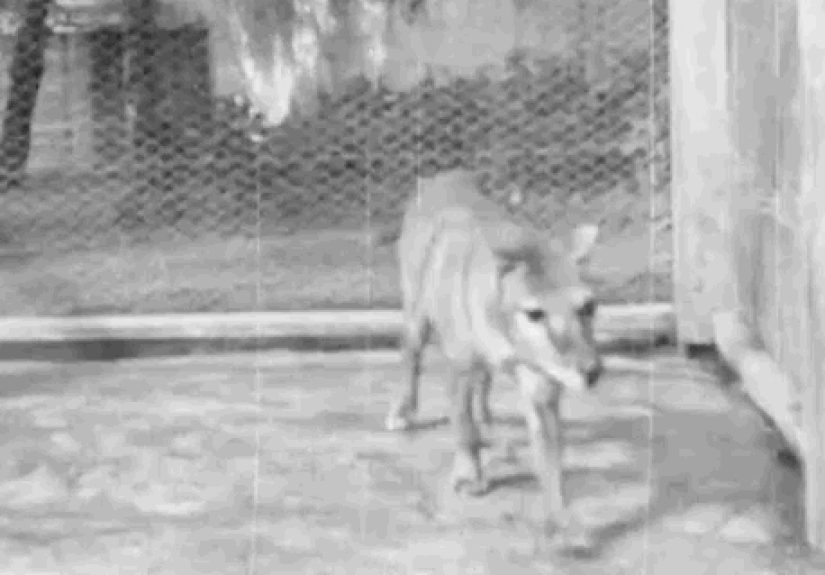
The best-known final footage of a living thylacine was filmed at Beaumaris Zoo in Hobart, Tasmania. The animal walks back and forth inside a bare enclosure, its striped hindquarters clearly visible. In one version, zookeepers rattle the fencing, apparently trying to encourage movement for the camera. It is a small detail, but it changes the mood. This was not a wilderness portrait. It was a staged zoo moment, made for human eyes.
The National Film and Sound Archive of Australia later digitized a 21-second clip from the 1935 travelogue Tasmania the Wonderland. That rediscovered footage is considered the last-known surviving moving image of the species. Fewer than a dozen source films of living thylacines are known to survive, totaling only a little more than three minutes. Every second matters because there are no new seconds coming.
Watching the thylacine move is different from seeing a museum specimen or a still photograph. A mounted skin can show shape. A skeleton can show structure. A film shows presence. The animal shifts its weight, turns its head, and moves with the uneasy rhythm of captivity. It becomes real in a way that a textbook image never quite achieves.
Was the Animal Really Named Benjamin?
For decades, the thylacine in the famous footage was popularly called Benjamin. The name became sticky, as names tend to do when they are attached to tragedy. “Benjamin the last Tasmanian tiger” sounds personal, memorable, and almost cinematic. The problem is that history is often less tidy than a nickname.
Researchers have challenged the Benjamin story, arguing that the name may have come from a later, unreliable account rather than zoo records. Some evidence also suggests that the last known thylacine in captivity may have been female, not male. In 2022, researchers associated with the Tasmanian Museum and Art Gallery announced that remains long thought lost had been identified, deepening the debate around the final animal’s identity.
For SEO readers searching “Benjamin thylacine,” the name is still useful because it is widely recognized. For accuracy, however, it is better to say that the animal in the last known thylacine footage is often called Benjamin in popular culture, while the actual name and sex remain historically disputed. That may be less catchy, but truth rarely worries about being good at headlines.
Why the Thylacine Disappeared
The extinction of the thylacine did not happen because of one single villain twirling a mustache in the Tasmanian fog. It was the result of several pressures piling up until the species had nowhere left to go.
Hunting and Bounty Programs
European settlers blamed thylacines for livestock losses, especially sheep. Although later research suggests feral dogs, poor farm management, and other factors likely played a major role, the thylacine became the convenient suspect. Bounty programs encouraged people to kill them. Thousands were trapped, shot, or poisoned.
The image of the thylacine as a sheep-killing menace was powerful, but not necessarily fair. Like many predators, it was judged less by evidence than by fear. Once an animal is branded a pest, public sympathy tends to exit quietly through the back door.
Habitat Loss and Human Expansion
As settlement expanded, thylacines lost habitat and access to prey. They were shy, mostly nocturnal animals that needed space. Instead, they found fences, guns, traps, dogs, and a growing human economy that saw wild predators as problems to be solved.
Disease and Small Population Stress
Some researchers have also discussed disease as a possible factor in the species’ decline. When a population is already shrinking, even moderate additional stress can become serious. Low numbers make recovery harder. Genetic diversity drops. Breeding opportunities shrink. A species can slide from rare to gone with frightening speed.
The Timeline of a Vanishing Animal
By the early 1900s, thylacines had become rare. The last confirmed shooting of a wild thylacine is widely placed in 1930. The last known captive thylacine died at Beaumaris Zoo in Hobart on September 7, 1936. Protection came only shortly before that death, a conservation response so late it feels like locking the barn after the barn has become a historical exhibit.
The species was officially declared extinct decades later, after no confirmed evidence of survival appeared. Reports of sightings continued, and they still appear from time to time. Tasmania’s wild landscapes are rugged enough to keep imaginations well-fed. Yet no confirmed photograph, specimen, DNA evidence, or verified track has proved that the thylacine survived into the present.
Why the Footage Still Captivates People
The last known footage of a living thylacine fascinates viewers because it sits in an uncomfortable space between ordinary and impossible. At first glance, it is simply an old zoo clip. The animal paces. The camera watches. Nothing dramatic happens. There is no chase, no roar, no cinematic sunset.
Then the context lands. This is not just an animal. This is one of the final moving images of a species humans erased. The quietness becomes devastating. The thylacine is not performing extinction. It is just existing, unaware that future generations will watch every step like evidence at a trial.
That is what makes the clip so powerful. It does not beg for emotion. It simply shows a living creature before the door closes.
What the Footage Reveals About the Thylacine
Even in a short clip, viewers can observe several traits that made the thylacine so distinctive. Its body is long and lean, with a stiff tail that seems to extend from the spine rather than hang like a dog’s tail. The dark stripes across the rear half of the body give it the “tiger” nickname, though the rest of the animal looks more wolf-like than cat-like.
The pacing behavior also reflects captivity. Many zoo animals walk repeated routes when confined, especially in small or unstimulating enclosures. The thylacine in the footage appears calm but restless. Its enclosure is plain, and by modern zoo standards, painfully inadequate. Today, wildlife facilities emphasize enrichment, habitat design, and animal welfare far more than early 20th-century zoos typically did.
The footage also reminds us how limited our visual record is. We do not have high-definition film of thylacines hunting, raising young, interacting in family groups, or moving through native Tasmanian habitat. The moving images that remain are all captive animals. Our final visual memory of the species is therefore filtered through cages.
The Thylacine as a Conservation Symbol
The thylacine has become one of the world’s most famous extinction icons, alongside the dodo and the passenger pigeon. Its story is especially painful because it disappeared in the age of photography and film. This was not an ancient fossil known only from bones. It was here recently enough to be recorded, named, displayed, and mourned.
In Australia, September 7 is observed as National Threatened Species Day, marking the death of the last known thylacine. The date turns one animal’s end into a reminder of many species still at risk. That is the most useful way to remember the thylacine: not only as a lost marvel, but as a warning label attached to the future.
Could the Thylacine Come Back?
Modern de-extinction efforts have brought the Tasmanian tiger back into headlines. Scientists have studied preserved specimens, thylacine DNA, and the possibility of using gene-editing technology to create a thylacine-like animal. The idea is thrilling, controversial, and scientifically complicated.
Supporters argue that de-extinction research could advance conservation tools and perhaps restore lost ecological roles. Critics counter that limited resources should focus on species still alive, especially those currently sliding toward the same fate. Both sides have a point. Bringing back a version of the thylacine would not erase the original extinction. At best, it would create a biological echo.
The last known thylacine footage matters in this debate because it keeps the animal from becoming an abstraction. We are not talking about a fantasy monster or a logo. We are talking about a real creature that breathed, blinked, paced, and vanished.
Lessons From the Last Known Thylacine Footage
First, extinction can happen in public.
The thylacine did not disappear in some unreachable prehistoric mist. It declined while people photographed it, wrote about it, debated it, and watched it in zoos. Visibility did not save it.
Second, bad reputations can kill wildlife.
The thylacine was treated as a livestock enemy, even though the evidence against it was often weak or exaggerated. When fear becomes policy, animals lose.
Third, conservation delayed is conservation denied.
Protection arrived too late to change the thylacine’s fate. The lesson is blunt: endangered species need action while enough individuals remain to recover.
Experiences Related to Watching the Last Known Footage of a Living Thylacine
Watching the last known footage of a living thylacine is a strangely intimate experience. The clip is short enough to watch while your coffee cools, but it lingers much longer than most modern videos designed to grab attention with music, captions, and dramatic zooms. There is no flashy editing. There is no narrator shouting, “You won’t believe what happens next!” Nothing happens next, and that is the point.
The first experience many viewers have is curiosity. The animal looks familiar and unfamiliar at the same time. Its head suggests a dog. Its stripes suggest a tiger. Its body has the lean awkwardness of a creature assembled from several different wildlife documentaries. You may find yourself leaning closer, trying to understand how it moved and what kind of personality it had. Was it nervous? Bored? Alert? Annoyed by the people rattling the fence? Quite possibly all of the above.
Then comes the second experience: discomfort. The enclosure looks small. The animal’s repeated pacing feels less like a natural behavior and more like a loop of confinement. Even if the clip was filmed according to the standards of its time, modern viewers cannot help seeing the sadness in it. This is not the thylacine in the Tasmanian bush, slipping through grass at dusk. This is the thylacine as an exhibit, trapped in the final chapter of its species’ story.
The third experience is grief, but it is a quiet kind. The footage does not show the animal dying. It does not show hunters or traps or habitat destruction. It simply shows a living thylacine when living thylacines were almost gone. That ordinary movement becomes heartbreaking because we know what the animal could not know. We watch with hindsight, which is useful for historians and terrible for the heart.
For writers, teachers, conservationists, and animal lovers, the footage offers a powerful teaching moment. It proves that extinction is not just a word in a science textbook. It is the absence that follows a real body, a real face, a real set of footprints. When students see the thylacine pacing in black and white, the past becomes less dusty. The animal stops being a trivia answer and becomes a witness.
There is also a humbling experience in realizing how little visual evidence remains. In a world where people record lunch from three angles, it is astonishing that an entire species survives on film for only a few minutes. The thylacine reminds us that documentation is fragile, memory is selective, and nature does not wait for humans to become wise. If we want future generations to know living animals as more than archival ghosts, we have to protect them while they are still inconvenient, expensive, wild, and alive.
Conclusion
The last known footage of a living thylacine is brief, silent, and unforgettable. It shows an animal that became famous only when it was already nearly gone. The striped marsupial pacing at Beaumaris Zoo is not merely a curiosity from old film history; it is a message from the edge of extinction.
The thylacine’s story combines science, myth, regret, and responsibility. It asks us to be more careful with the animals we misunderstand today. It reminds us that waiting too long can turn conservation into archaeology. And it proves that even 21 seconds of footage can carry a century of meaning.
The Tasmanian tiger is gone, but the lesson remains very much alive: a species should not have to become a ghost before humans decide it was worth saving.
Note: This HTML article was written in standard American English for web publishing and is based on verified historical, archival, and zoological information about the thylacine.