Table of Contents >> Show >> Hide
- What Is the “White Pyramid,” Exactly?
- The Person Inside: George W.P. Hunt, Arizona’s First Governor
- Why a Pyramid in the Sonoran Desert?
- A Closer Look: Materials, Design, and the Details People Miss
- Papago Park’s Backstory Makes the Pyramid Feel Even Weirder (In a Good Way)
- So… What’s Actually “Mysterious” About It?
- How to Visit Hunt’s Tomb Like a Pro (and Not Like a Villain in a Cautionary Tale)
- Turn It Into a Half-Day Adventure: What to Pair With the Pyramid
- Conclusion: A Small Pyramid With a Big Job
- Experiences: What It Feels Like to Visit the White Pyramid
Phoenix is a city that does not do “subtle.” The mountains pop like a postcard, the sunsets look aggressively Photoshopped, and even the cacti seem to be showing off. So when people hear there’s a white pyramid rising out of the red rocks in the middle of town, the natural response is: Sure. Of course there is.
And yet, the first time you spot itbright white, geometric, perched on a desert butteit still feels like a glitch in the simulation. This is Hunt’s Tomb, an Egyptian-inspired funerary monument in Papago Park that holds the remains of George W.P. Hunt, Arizona’s first state governor. It’s historical, oddly beautiful, and just mysterious enough to make you whisper, “Wait… why is this here?” even if you’re standing in a parking lot holding an iced coffee.
What Is the “White Pyramid,” Exactly?
The structure is a compact pyramid-shaped tomb on a hill inside Papago Park, near major Phoenix landmarks. It’s not a temple. It’s not a secret government bunker. It’s a funerary monumenta private resting place that also happens to be wildly public-facing because it’s visible from large parts of the park.
According to the National Register documentation, the pyramid is about 20 feet by 20 feet at the base and roughly 20 feet tall, built from concrete and faced with white ceramic tile. An iron door on the east side seals the entrance to the burial vault, and a surrounding wall and fence keep visitors on the outside where they belong (more on that in the etiquette sectionbecause yes, somebody always tests fences).
In other words: it’s a small pyramid with big “main character energy,” sitting above a landscape that’s all rust-colored rock, saguaro silhouettes, and wide-open sky. The contrast is what makes it feel so uncanny.
The Person Inside: George W.P. Hunt, Arizona’s First Governor
If Arizona had an origin story as a state (it does), George W.P. Hunt is one of the central characters. He was sworn in as Arizona’s first state governor in 1912 and ultimately served seven termsan unusually long run that made him one of the most recognizable political figures of early Arizona. Before that, he was deeply involved in the state’s formation, including serving as president of Arizona’s 1910 constitutional convention.
Hunt’s reputation was that of a populist reformer: a politician who leaned into “for the people” messaging before it became a slogan template. The plaque and historical accounts often connect his legacy to progressive-era causes and a willingness to challenge powerful interests. Even if you don’t memorize every term date, the vibe is clear: he was a builder of the state’s political identity, not just a name on a list.
And when he died on December 24, 1934, he was interred in the same pyramid that already held his wifemeaning this odd little structure is not just a curiosity, but a permanent “closing chapter” on one of Arizona’s foundational careers.
Why a Pyramid in the Sonoran Desert?
Here’s where the mystery gets funbecause “pyramid tomb in Arizona” is not a phrase most people expect to say out loud. The straightforward answer is that Egyptian-inspired funerary forms (pyramids, obelisks, and other motifs) were popular in the United States in the late 19th and early 20th centuries, and the National Register context explicitly ties Hunt’s Tomb to that broader trend. In Arizona, the pyramid is part of a small set of similar monuments that reflect this Egyptian influence.
The more human answer: people memorialize loved ones with symbols that feel eternal. A pyramid is basically architecture’s way of saying, “Time can’t mess with this.” It’s stable, minimal, and stubbornlike a desert mountain in miniature. For a prominent public figure and his family, a pyramid also communicates status without needing a single extra word.
There’s also an emotional layer: Hunt had the tomb created after his wife, Helen Duett Ellison Hunt, died in 1931. The monument wasn’t completed until 1932, according to the National Register documentationmeaning the pyramid is, at its core, a grief project that became a landmark.
A Closer Look: Materials, Design, and the Details People Miss
1) The White Tile “Glow”
The pyramid’s white ceramic tile isn’t just decorativeit’s the reason the monument reads as “mysterious” from a distance. In Phoenix light, white tile can look almost luminous, especially against darkening red buttes at sunrise or sunset. The effect is less “ancient Egypt” and more “minimalist chess piece placed on Mars,” but either way, it stops you in your tracks.
2) The Missing Tip
National Register notes describe the top promontory as missing, likely due to vandalism. That detail matters because our brains love complete shapes. A pyramid with a slightly “unfinished” peak feels oddlike a sentence with no period. It’s a small imperfection that adds to the monument’s unsettled, enigmatic look.
3) The Door, the Plaque, and the “Wait… Did That Say 1959?” Moment
The iron door holds a plaque describing Hunt and listing who is entombed inside. The National Register documentation also describes a plaque history that includes theft (a plaque was stolen in 1967) and replacement. One reason visitors linger here is that the text itself feels like a time capsuleformal, proud, and a little blunt.
And yes, some people notice what looks like a birth-year typo on the plaque wording documented in the National Register paperwork. It’s the kind of detail that makes you do a double-take and then spiral into a delightful ten-minute “how did this happen?” rabbit hole. That’s not paranormal mysteryit’s human bureaucracy, which is honestly the more believable genre.
4) The Fence Exists for a Reason
Almost immediately after the tomb was built, it became clear that protection was needed. The National Register narrative describes early concerns about vandalism and the installation of fencing, plus later efforts to improve access (paths, benches, and overlook features). Translation: this was always meant to be seen, but not touched.
Papago Park’s Backstory Makes the Pyramid Feel Even Weirder (In a Good Way)
Papago Park itself has a history worthy of its own documentary. In the early 1900s, the area was designated as Papago Saguaro National Monument (proclaimed in 1914). That status didn’t last; the monument was later abolished in 1930. Over time, the land shifted into the civic landscape of Phoenix and Tempe, becoming the park complex people know today.
That means Hunt’s Tomb sits in a place that has repeatedly changed meaning: from protected federal land to city parkland, from desert reserve to recreation hubnow surrounded by major attractions, trails, and everyday life. A pyramid on a hill can feel ancient, but it’s also very much part of modern Phoenix’s backyard.
So… What’s Actually “Mysterious” About It?
Let’s be honest: the “mystery” is mostly psychological, and that’s what makes it interesting. A pyramid carries cultural baggagepharaohs, tombs, eternity, secret chambers, and a thousand movies where someone ignores a warning sign. When you drop that symbol into a desert city park, your brain starts freelancing.
Add these ingredients and you get a perfect little urban legend factory:
- Unexpected form: A pyramid is not a normal Arizona grave marker.
- Isolation: It’s on a hill, separated from crowds, which makes it feel “set apart.”
- Access limits: The fence, the locked door, and the formal plaques create an aura of “something important is in there.”
- Big views: The overlook effect makes visitors linger, and lingering always invites storytelling.
- Time capsule energy: Early-20th-century language and commemorative style feel distanteven if the city skyline is right there.
The truth is less sensational and more compelling: it’s a monument shaped by grief, civic identity, and a design trend that reached all the way from national funerary fashion into Arizona’s desert. That’s not a conspiracy. That’s history doing its weird, wonderful thing.
How to Visit Hunt’s Tomb Like a Pro (and Not Like a Villain in a Cautionary Tale)
Timing and access
Papago Park is managed by the City of Phoenix and has posted hours for parking areas and trails. Trails are commonly listed as open early into the night (with trail hours extending later than some gated parking/roadway hours), so check current park guidance before you go. If you’re visiting in warm months, aim for early morning or later evening because Phoenix heat does not negotiate.
Bring the “desert basics”
Water, sun protection, and shoes with grip. The walk up is short, but the desert has a talent for turning “short” into “why do I feel like a rotisserie chicken?” if you underestimate the sun.
Respect the site
The pyramid is a tomb. Treat it like one. Don’t climb the fence, don’t try to be funny with the door, and don’t “test” the tile. The monument has a documented history of vandalism, which is exactly why the barriers exist.
Stay curious, not chaotic
Take photos, read the signage, enjoy the view, and let the place be what it is: a piece of Arizona history with a surprisingly cinematic silhouette. The best souvenir here is perspectiveliteral and historical.
Turn It Into a Half-Day Adventure: What to Pair With the Pyramid
One of the best things about Hunt’s Tomb is that it’s not a “whole day” commitment unless you want it to be. People often pair it with other Papago-area highlights:
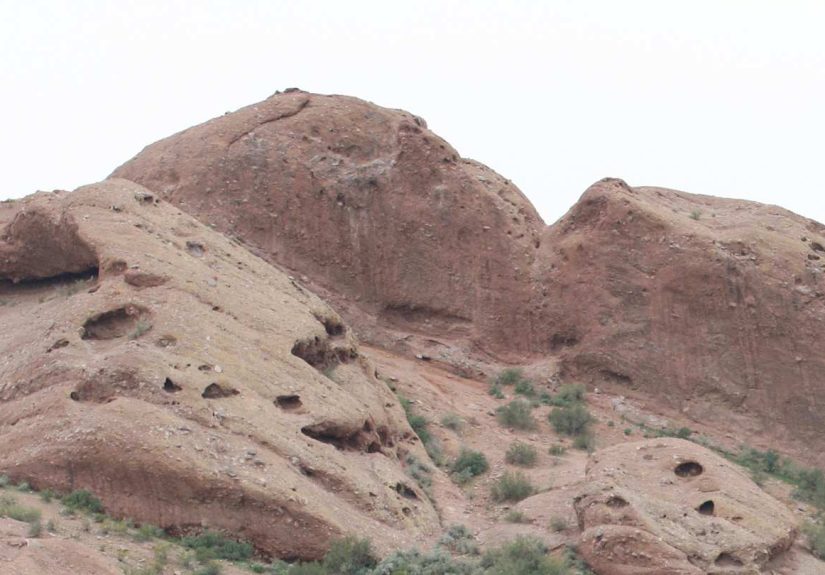
- Scenic geology: Papago’s red sandstone buttes and popular viewpoints make the area feel like a natural amphitheater.
- Culture and history: Nearby institutions in and around Papago Park explore Arizona’s regional story and how Phoenix became Phoenix.
- Family-friendly staples: The park’s proximity to major attractions makes it easy to build an itinerary without driving across town.
In other words, you can come for the “mysterious pyramid,” stay for the desert landscape, and leave with a much better understanding of how the city and the state grew up around places like this.
Conclusion: A Small Pyramid With a Big Job
Hunt’s Tomb does two things at once: it protects a private family story, and it broadcasts a public symbol. It’s a memorial to Arizona’s first governor, yesbut it’s also a reminder that the built environment is full of surprises. Sometimes history isn’t hidden in a museum. Sometimes it’s sitting on a hill, bright white against red rock, daring you to ask, “How did that get here?”
Go visit. Bring water. Bring curiosity. And when you see the pyramid glowing over the buttes, enjoy that brief moment where Phoenix feels like the set of a moviebecause for a few minutes, it kind of is.
Experiences: What It Feels Like to Visit the White Pyramid
The best way to understand why people call Hunt’s Tomb “mysterious” is to do the simplest thing possible: walk toward it. From a distance, it looks almost too cleanlike someone dropped a crisp geometric shape onto a desert painting. The red rock around it is rugged, wrinkled, and sunbaked. The pyramid is smooth, bright, and unapologetically symmetrical. That contrast is the first little jolt.
The walk up the hill is short, but it has that classic desert trick where the air feels light until you realize the sun is basically a high-powered lamp. You start noticing details you’d ignore in a cooler climate: the crunch of gravel, the faint resin smell of creosote, the way shadows tuck into the folds of the rock. If you go early, the light is gentle and the city is still stretching awake. If you go later, everything glowsmountains, skyline, even the dust in the air.
About halfway up, the pyramid stops being an object and starts being a presence. It’s not enormous, but it’s placed like something important: elevated, centered, and facing outward. That’s part of the experienceyour brain interprets “on a hill” as “significant,” because humans have been doing hilltop symbolism since we figured out hills exist. You can feel yourself slowing down, not because you’re winded (okay, maybe a little), but because the place has a quiet, formal vibe that makes you naturally lower your volume.
At the top, the view does its own kind of storytelling. You can turn in a slow circle and see the Salt River Valley spread outmountains in multiple directions, city blocks laid out like a grid, and the park’s rock formations rising like punctuation marks in the landscape. It’s the kind of overlook that makes people stop scrolling in their heads. Even if you came for a quick photo, you end up staying because the horizon is doing all the work.
Then there’s the strange intimacy of being close to a tomb that’s also a landmark. The fence draws a clear linethis is not a place for touching, climbing, or being clever. But you can still read, observe, and reflect. You notice the tile, the door, the commemorative language, and how confidently the monument declares a legacy. You might not know every detail of Hunt’s political career, but you feel the intention: someone wanted this to last, and they wanted it to be seen.
If you’re lucky with timing, you’ll see little micro-moments that make the whole trip feel personal: a couple taking one last photo before heading down, a solo visitor just standing silently at the overlook, a group of friends who get quieter than expected once they’re actually there. The pyramid has a way of shifting people into “museum voice,” even though you’re outdoors. That’s the respectful magic of it.
And when you walk back down, you realize the “mystery” wasn’t about secret chambers or hidden codes. It was about placement, symbolism, and the odd power of a shape that doesn’t belong in its surroundingsand therefore belongs in your memory. Hunt’s Tomb is not the biggest attraction in Phoenix. It’s not the flashiest. But it’s one of the most unexpectedly sticky: you leave, and later you catch yourself telling someone, “Ohby the way, there’s a white pyramid in Papago Park. And it’s real.”