Table of Contents >> Show >> Hide
- Why Would an Animal Lose Its Eyes?
- 1. Mexican Cavefish: The Celebrity of Eye-Loss Evolution
- 2. Texas Blind Salamander: The Ghost of the Edwards Aquifer
- 3. Olm: The Cave Dragon That Forgot About Daylight
- 4. Kauaʻi Cave Wolf Spider: The Eyeless Hunter of Lava Tubes
- 5. Kentucky Cave Shrimp: Transparent, Eyeless, and Hard to Spot
- 6. Mammoth Cave Crayfish: A Pale Crustacean Built for Darkness
- 7. Blind Cave Beetles: Tiny Predators With No Need for a View
- 8. Golden Moles: Mammals With Eyes Under Skin and Fur
- 9. Marsupial Moles: Australia’s Sand-Swimming Specialists
- 10. Blind Snakes: Reptiles That Navigate Like Living Shoelaces
- What These Animals Teach Us About Evolution
- Experience Section: What It Feels Like to Understand Eyeless Animals
- Conclusion
In the animal kingdom, eyes usually get top billing. Eagles spot prey from ridiculous heights, cats turn moonlight into mischief, and humans use vision to do everything from driving to judging whether the avocado is finally ready. But evolution is not sentimental. If an organ stops paying rent, nature may downsize it, remodel it, or quietly remove it from the floor plan.
That is exactly what happened to many animals living in caves, underground tunnels, aquifers, and dark sandy habitats. In places where sunlight never arrives, eyes can become expensive accessories. Building and maintaining eyes, visual nerves, and brain tissue takes energy. In darkness, that energy may be better spent on smell, touch, vibration detection, taste, hearing, or simply surviving another day when food is scarce.
These animals are not “failed” versions of their sighted relatives. They are specialists. Some have skin-covered eyes. Some have tiny vestigial eye spots. Some have no eyes at all. And many navigate their world with a confidence that would embarrass anyone trying to find the bathroom during a power outage.
Here are the top 10 animals that evolved to not need eyesand the strange, brilliant sensory upgrades that took vision’s place.
Why Would an Animal Lose Its Eyes?
Eye loss is especially common in animals that spend generations in permanent darkness. Caves and underground habitats remove the main reason eyes exist: light. When vision no longer provides a survival advantage, natural selection may favor traits that work better in darkness.
This does not mean animals lose eyes because they “don’t use them” during one lifetime. Evolution works across generations through inherited changes. In cavefish, for example, eye degeneration is linked to genetic and developmental changes. Some of those same changes may also improve other senses, such as smell, taste, or vibration detection. In other words, evolution does not just delete the flashlight; it often hands the animal a radar system.
Food scarcity also matters. Many cave ecosystems are low-energy environments where every calorie counts. If eyes and visual brain centers cost energy but offer no benefit, smaller or absent eyes can become an advantage. That is not laziness. That is biological budgeting.
1. Mexican Cavefish: The Celebrity of Eye-Loss Evolution
The Mexican cavefish, also known as the blind cave tetra, is one of the most famous examples of eye loss in evolution. Surface-dwelling Mexican tetras have normal eyes and silvery bodies, but cave populations of the same species can be pale, eyeless, and remarkably well adapted to darkness.
During development, cavefish embryos begin forming eyes, but those eyes later degenerate. Adult cavefish may appear to have no visible eyes at all. Instead of relying on sight, they use a sensitive lateral line system that detects tiny water movements. This lets them avoid obstacles, find food, and navigate caves like little underwater submarines with excellent sonar manners.
Scientists study Mexican cavefish because they show evolution in action. Different cave populations have lost eyes independently, which makes them a powerful example of convergent evolution. The same environmental problemtotal darknesscan push separate populations toward similar solutions.
Why They Do Not Need Eyes
In pitch-black cave pools, eyes cannot gather useful information. Mexican cavefish replaced vision with heightened sensitivity to water pressure, smell, taste, and touch. For them, bumping into rocks is not a lifestyle; it is a problem solved by better nonvisual senses.
2. Texas Blind Salamander: The Ghost of the Edwards Aquifer
The Texas blind salamander looks like something designed by a fantasy artist who had recently read a groundwater report. It is pale, delicate, aquatic, and fitted with red external gills that fan out behind its head. It lives in the Edwards Aquifer near San Marcos, Texas, where sunlight is not part of the neighborhood.
Although it has tiny eye remnants, they are covered by skin, leaving the animal functionally blind. Its head is broad and flattened, and its body is built for life in underwater caves. Instead of looking for prey, it senses movement in the water and hunts small crustaceans, snails, and other aquifer invertebrates.
This salamander is also endangered, which makes its strange beauty more than a curiosity. Its survival depends on clean groundwater. Pollution, water withdrawal, and habitat disturbance can harm the underground world it calls home.
Why They Do Not Need Eyes
In the Edwards Aquifer, darkness is permanent. The Texas blind salamander benefits more from touch, smell, and water-motion detection than from image-forming eyes. Its skin-covered eyes are evolutionary leftovers, like tiny windows in a house built underground.
3. Olm: The Cave Dragon That Forgot About Daylight
The olm is a blind cave salamander from Europe’s underground waters, often called the “human fish” because of its pale pinkish skin. It has a long, eel-like body, tiny limbs, external gills, and a face that looks calmly unimpressed by the entire concept of sunlight.
Olms live in subterranean streams and caves, where they may spend their entire lives in darkness. Their eyes are reduced and covered by skin. They are not completely helpless without vision; quite the opposite. Olms use smell, hearing, vibration sensitivity, and even electroreceptionthe ability to detect faint electrical signalsto understand their surroundings.
They are also famous for patience. Food can be rare in cave systems, and olms are known for slow metabolisms and long lives. If there were an Olympic event for waiting quietly in the dark, the olm would be a gold-medal threat.
Why They Do Not Need Eyes
The olm’s watery cave habitat makes vision nearly useless. Its other senses allow it to find prey, avoid danger, and move through underground streams without needing a visual map.
4. Kauaʻi Cave Wolf Spider: The Eyeless Hunter of Lava Tubes
Most wolf spiders are known for their excellent eyesight. The Kauaʻi cave wolf spider, however, took one look at that family tradition and said, “No thanks.” Actually, it did not look at anything, because this Hawaiian cave spider has no eyes at all.
Found only in lava tube caves on Kauaʻi, this rare spider is an obligate cave dweller, meaning it is fully adapted to life underground. It does not spin a web to catch prey. Instead, it hunts on the cave floor, detecting vibrations and chemical cues from insects and other cave invertebrates.
The loss of eyes is especially dramatic because wolf spiders typically have prominent eyes. In this species, the absence of eyes is so unusual that it stands out even among other cave-adapted spiders. It is a predator built for darkness, silence, and patience.
Why They Do Not Need Eyes
Lava tubes provide no useful light for visual hunting. The Kauaʻi cave wolf spider succeeds by sensing movement through touch and vibration, proving that being a wolf spider does not require wolf-like eyesight.
5. Kentucky Cave Shrimp: Transparent, Eyeless, and Hard to Spot
The Kentucky cave shrimp is a tiny crustacean found in underground streams around Mammoth Cave National Park. It has no eyes and no pigment, making it nearly transparent. If nature ever invented a living glass noodle with antennae, this shrimp would be a strong candidate.
Its body is specially adapted to life in subterranean water. Since it cannot rely on vision, it uses its antennules to taste, touch, and smell food. It feeds on organic material carried into cave streams by groundwater, which means the quality of water aboveground directly affects its survival belowground.
The Kentucky cave shrimp is endangered, and its fragile habitat makes it vulnerable to pollution. In a cave stream, even small changes in water chemistry can ripple through the ecosystem.
Why They Do Not Need Eyes
In dark groundwater, eyes would be decorative at best and wasteful at worst. The Kentucky cave shrimp survives with chemical and tactile senses that help it locate food in a world without light.
6. Mammoth Cave Crayfish: A Pale Crustacean Built for Darkness
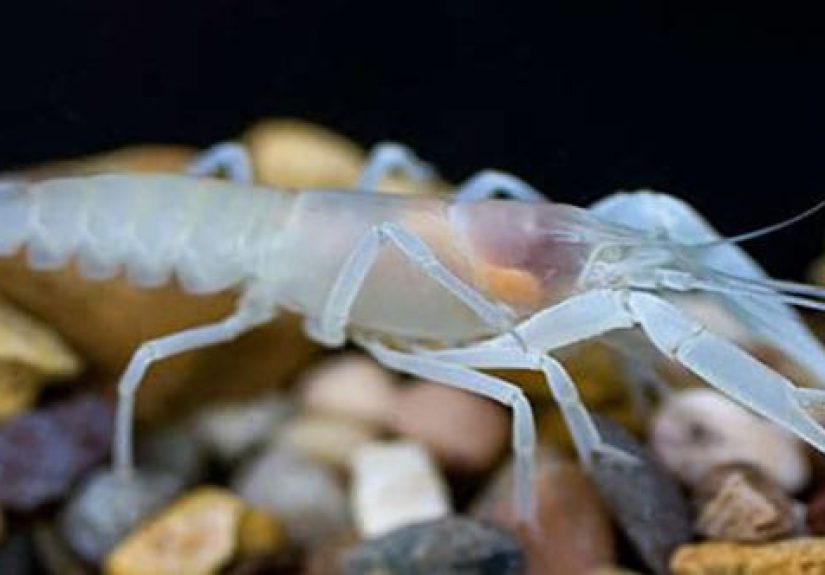
Mammoth Cave is famous for enormous passages, historic tours, and some of the most fascinating cave wildlife in North America. Among its underground residents are eyeless crayfish, pale crustaceans that have adapted to cave streams and pools.
Like other cave animals, these crayfish often lack pigmentation and have reduced or absent eyes. Their long antennae help them explore the environment by touch and chemical sensing. They can move along stream bottoms, hide under rocks, and search for food in conditions where a flashlight would be helpful for humans but completely irrelevant for them.
Cave crayfish also show how isolated underground habitats can shape evolution. Populations living in separate cave systems may develop unique traits over time, turning caves into natural laboratories of adaptation.
Why They Do Not Need Eyes
For crayfish living in dark cave water, antennae and chemical senses provide more useful information than vision. Eyes are not much help when the lights have been off for thousandsor even millionsof years.
7. Blind Cave Beetles: Tiny Predators With No Need for a View
Cave beetles may not get the fame of cavefish, but they are some of the most impressive eyeless animals on Earth. Many species are small, pale, long-legged, and fully adapted to life underground. Some are known only from one cave or a small cluster of caves.
At Mammoth Cave, tiny eyeless beetles live in dark passages and feed on cave invertebrates or cricket eggs. In Texas karst systems, species such as the Kretschmarr Cave mold beetle are described as eyeless and troglobitic, meaning they are adapted to underground life and live in total darkness.
For a beetle, losing eyes can be part of a larger cave-adapted package: reduced pigment, longer legs or antennae, slower metabolism, and heightened chemical sensitivity. It is not glamorous, but it works. Evolution does not care whether you look cute on a poster; it cares whether you find dinner.
Why They Do Not Need Eyes
Blind cave beetles hunt, feed, and reproduce in darkness. Touch, smell, and vibration cues matter more than sight, especially in narrow cave spaces where prey may be only a leg-length away.
8. Golden Moles: Mammals With Eyes Under Skin and Fur
Golden moles are not true moles, but they have mastered a similar underground lifestyle. These small African mammals spend much of their time burrowing through soil or sand. Their eyes are degenerate and covered by skin and fur, which makes vision basically unavailable.
That sounds inconvenient until you consider their job description. Golden moles push through soil with powerful forelimbs and leathery nose pads. In that environment, open eyes would be more liability than luxury. Dirt, sand, and grit are not exactly eye-friendly.
Golden moles rely heavily on touch and vibration. Some species can detect low-frequency vibrations traveling through sand, helping them locate prey such as insects and other invertebrates. When your world is underground, the ground itself becomes the message board.
Why They Do Not Need Eyes
Golden moles live where vision is limited and eye protection is essential. Covered eyes prevent damage while touch and vibration sensing help them hunt and navigate.
9. Marsupial Moles: Australia’s Sand-Swimming Specialists
Marsupial moles are among the strangest mammals alive. Native to Australian deserts, they do not tunnel like typical moles. Instead, they “swim” through loose sand, leaving little permanent tunnel behind. Their silky golden fur, wedge-shaped bodies, and powerful claws make them look almost mythical.
Their eyes are vestigial and functionally blind, lacking key structures needed for normal vision. The eyes are hidden under skin and fur, while the animal’s snout is protected by a tough shield that helps it push through abrasive sand.
Marsupial moles are a beautiful example of convergent evolution. They resemble golden moles and true moles, but they belong to a different mammal lineage. Similar environments created similar body plans: compact shape, digging limbs, reduced ears, and eyes that are no longer useful.
Why They Do Not Need Eyes
Sand-swimming leaves little room for delicate visual equipment. Marsupial moles evolved bodies that prioritize digging, protection, touch, and underground movement over sight.
10. Blind Snakes: Reptiles That Navigate Like Living Shoelaces
Blind snakes are small, burrowing reptiles that often look more like shiny worms than snakes. Many species have reduced eyes hidden beneath scales. These eyes may detect light and dark, but they do not provide detailed vision.
Blind snakes spend much of their lives underground or under leaf litter, where they feed on ants, termites, eggs, and larvae. Their smooth bodies help them move through soil, and their reduced eyes are protected from scratches and debris.
The Brahminy blindsnake, sometimes called the flowerpot snake, is one well-known example. It has spread widely around the world through soil and plant shipments. Despite its tiny size and worm-like appearance, it is a real snakejust one that decided high-definition vision was unnecessary for a life spent nosing through dirt.
Why They Do Not Need Eyes
Blind snakes live in tight, dark spaces where smell, touch, and chemical cues are more useful than sight. Reduced eyes under scales are safer and sufficient for detecting basic changes in light.
What These Animals Teach Us About Evolution
The most important lesson from eyeless animals is that evolution does not always mean adding features. Sometimes, evolution removes them. Losing eyes may sound like a downgrade, but in the right habitat it can be an upgrade.
These animals also show that evolution is practical. A cavefish does not need to admire the limestone walls. A blind snake does not need to read street signs. A golden mole does not need to appreciate a sunset while plowing face-first through sand. Their worlds are built from pressure, scent, vibration, temperature, chemical trails, and water movement.
Eye loss also happens repeatedly across unrelated groups. Fish, amphibians, crustaceans, spiders, beetles, reptiles, and mammals have all evolved reduced or absent eyes in dark habitats. That repeated pattern is convergent evolution: different lineages arriving at similar solutions because they face similar challenges.
Experience Section: What It Feels Like to Understand Eyeless Animals
Learning about animals that evolved to not need eyes changes the way you think about darkness. At first, darkness seems like emptiness. Humans tend to imagine a cave as a place where life is limited, silent, and half-broken. But when you study cave animals closely, darkness becomes less like an absence and more like a different language.
Imagine standing in a cave after the lights go out. At first, your brain panics a little. Your eyes search for edges, shapes, reflectionsanything. Then you notice how loud the world becomes. Water drips. Air moves. Your shoes shift against stone. The darkness is not empty at all; it is full of information you usually ignore because vision is so bossy.
That is the daily reality for eyeless animals. A Mexican cavefish does not “miss” the scenery. It reads ripples. A Texas blind salamander does not need to see a shrimp to hunt it; water movement gives the prey away. A cave spider can detect the tiny vibrations of another animal walking across rock. A golden mole may sense vibrations through sand like a message arriving through the floor.
For writers, educators, and nature lovers, these animals are a reminder not to judge survival by human standards. We often assume sight is the premium sense because it dominates our lives. We build screens, signs, maps, books, traffic lights, movies, and social media around vision. But evolution does not rank senses by human convenience. It ranks them by usefulness in a specific environment.
That makes eyeless animals surprisingly inspiring. They are not tragic creatures wandering around in biological darkness. They are highly tuned specialists. Their bodies say, “This is the world I live in, and I am built for it.” That lesson applies far beyond caves. Adaptation is not about having every possible tool. It is about having the right tools for the place you are in.
There is also a conservation lesson here. Many eyeless animals live in fragile habitats that are easy to damage and hard to repair. Cave streams depend on clean groundwater. Lava tubes can be disturbed by development. Karst systems can be polluted from the surface even when the animals themselves are hidden far below. The fact that we rarely see these creatures does not make them unimportant. In many cases, their presence tells us that an underground ecosystem is still healthy.
So the next time someone says eyes are essential, remember the cavefish, the olm, the eyeless spider, and the sand-swimming marsupial mole. Nature has written many survival manuals, and not all of them include a chapter on vision. Some are written in vibration, scent, pressure, and touch. You just have to learn how to read them.
Conclusion
Animals that evolved to not need eyes are some of the best examples of nature’s practical genius. In caves, aquifers, soil, and sand, sight may be useless, costly, or even risky. Over time, many species reduced or lost their eyes while sharpening other senses that better fit their environments.
From Mexican cavefish and Texas blind salamanders to Kauaʻi cave wolf spiders, golden moles, marsupial moles, and blind snakes, these animals prove that evolution is not about becoming more complicated for the sake of it. It is about becoming better matched to a particular world. Sometimes that world is bright and colorful. Sometimes it is dark, wet, silent, and hidden beneath our feet.
And in that hidden world, not having eyes is not a weakness. It is a masterpiece of adaptation.
Note: This article is written for web publication and synthesizes real biological information from reputable science, museum, wildlife, and conservation resources without adding unnecessary source-link elements inside the article body.