Table of Contents >> Show >> Hide
- Why the Commodore PET Was an Unlikely Hero
- How Satellite Tracking Actually Works
- What “Tracking Satellites With A Commodore PET” Looked Like in Practice
- Why This Was Harder Than It Sounds
- The Satellite Side of the Story Matters Too
- Why Retro Tracking Still Feels Fresh
- Experience Notes: What a Retro Satellite-Tracking Session Feels Like
- Conclusion
There are hobby projects, and then there are hobby projects that sound like they were invented during a glorious power outage at an engineering school. Tracking satellites with a Commodore PET belongs in that second category. On paper, it sounds absurd: take a late-1970s all-in-one computer with a tiny monochrome display, modest RAM, cassette storage, and the personality of a determined toaster, then ask it to predict orbital motion and help point antennas at fast-moving spacecraft. That is either ridiculous or wonderful. As it turns out, it is both.
The beauty of this story is not that a Commodore PET was the best tool for satellite tracking. It absolutely was not. The beauty is that it was good enough when paired with brainpower, persistence, and the kind of problem-solving attitude that looks at impossible timing, crude interfaces, and missing feedback loops and says, “Fine, we’ll make it work anyway.” That spirit is what makes Tracking Satellites With A Commodore PET more than a retro curiosity. It is a lesson in engineering under pressure, computing history, and the timeless joy of making old hardware do something gloriously ambitious.
Why the Commodore PET Was an Unlikely Hero
The Commodore PET arrived in 1977 as one of the first ready-to-use personal computers. It came fully assembled, used a MOS Technology 6502 processor running at roughly 1 MHz, and shipped in configurations that now sound adorably tiny, with 4 KB or 8 KB of memory in early models. It also used cassette storage, which was dependable in the same way a bicycle is dependable for crossing a continent: technically possible, but not exactly speedy. Still, the PET mattered because it packaged computing into an approachable machine for schools, homes, and hobbyists.
That matters for this story. The PET was not a lab-only device hidden behind institutional walls. It was the kind of machine curious people could actually touch, program, and press into service. In an era when mainframes still ruled serious number-crunching, the PET was part of the early wave that let individuals bring computation into a room full of radios, cables, soldering tools, and wild ideas.
And wild ideas were necessary. Satellite tracking is not a casual “press play and watch the sky” activity. Low-Earth-orbit satellites move quickly relative to a ground station. Their position changes constantly. If you want to communicate through one, or receive data from one, you need to know when it will appear, where it will rise, how high it will climb, and where it will vanish again. In plain English: you need timing, geometry, and a very cooperative antenna system.
How Satellite Tracking Actually Works
At the heart of modern satellite prediction is the orbital element set, often called a TLE, or Two-Line Element set. These compact lines of text describe a satellite’s orbit well enough for tracking software to estimate where it will be and when. Feed those elements, along with your station location, into the right mathematical model, and you can calculate when the satellite will be in view and where to point your antennas.
TLEs, SGP4, and the Math Behind the Magic
Here is the surprisingly elegant part: the sky chaos gets reduced to data and equations. TLEs specify the shape and orientation of an orbit at a given epoch, and tracking programs use models such as SGP4 to propagate that orbit forward in time. For amateur operators, that turns raw orbital data into the stuff that matters on the ground: acquisition of signal, loss of signal, maximum elevation, pass duration, azimuth, and elevation tables.
Of course, “elegant” is doing a lot of work there. The math may be elegant, but the implementation on a small 8-bit computer is where things get spicy. Orbital prediction is manageable on modern hardware because modern hardware laughs at the workload. A Commodore PET does not laugh. It squints, clears its throat, and asks whether you really need floating-point calculations today.
Azimuth, Elevation, and Doppler: The Unfriendly Trio
Tracking a satellite is not just about knowing that it is “up there somewhere.” Operators need angles. Azimuth tells you the compass direction. Elevation tells you how high above the horizon the satellite is, from 0 degrees on the horizon to 90 degrees overhead. Amateur satellite literature has long emphasized these numbers because the antenna has to follow the path of the spacecraft as it sweeps across the local sky.
Then there is Doppler shift, the frequency change caused by relative motion between the satellite and the observer. On amateur satellite links, especially on UHF downlinks, Doppler can be pronounced enough that operators must compensate during the pass. So even if your antenna is pointed correctly, your radio still has opinions.
This is why satellite work historically pushed hobbyists toward a blend of computing, radio, mechanics, and patience. The satellite does not care that your rotator is old, your code is fragile, or your notebook is full of crossed-out numbers. It is coming over the horizon on schedule, and you can either keep up or wave politely as it leaves.
What “Tracking Satellites With A Commodore PET” Looked Like in Practice
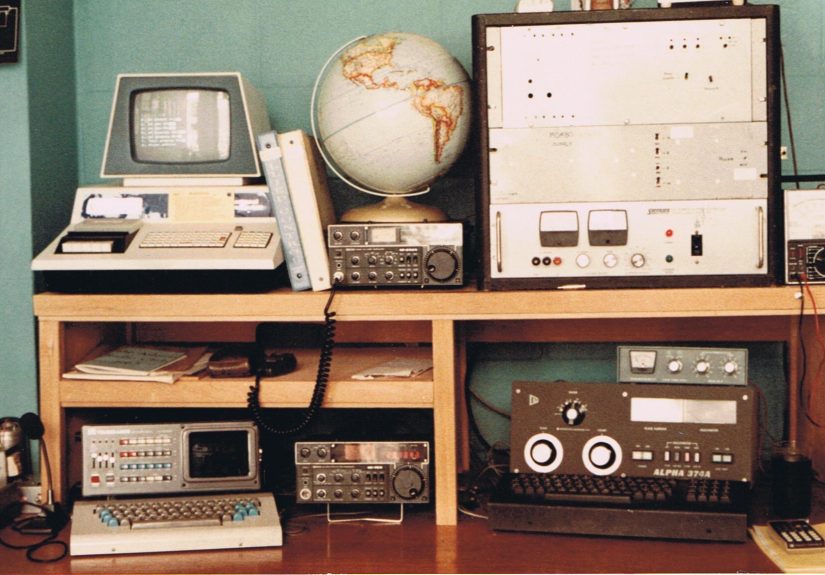
One of the best documented examples of this idea came from an amateur satellite station environment where a modified Commodore PET was used to help control antenna rotators and related rooftop equipment. The machine had been upgraded with more memory and outfitted with output registers so it could talk to hardware in the real world. That is when the PET stopped being just a computer and became part traffic cop, part orbital assistant, part mechanical coach.
From Text Screen to Rooftop Hardware
The PET did not simply display pretty orbital maps. There were no slick dashboards, no anti-aliased graphics, and certainly no touch interface. It drove hardware. In the documented setup, the computer interfaced with rotor-control systems and a serial transmitter to manage rooftop gear remotely. That included switching paths, handling auxiliary equipment, and controlling rotators in azimuth and elevation.
In other words, the PET was not just calculating where the satellite was. It was part of the effort to physically point antennas toward it. That makes this project feel impressively modern. Strip away the monochrome CRT and cassette loading, and the architecture sounds familiar: compute the pass, send commands to actuators, manage external peripherals, and keep the system stable enough that a real operator can use it under time pressure.
There was just one small issue. Okay, several. Boot time was slow, cassette loading was not exactly the height of convenience, and operators who merely wanted relay control did not love waiting for the PET to wake up. This led to a wonderfully sane design principle: keep manual control available. That choice deserves applause. Computer control is amazing right up until the computer decides to be a museum exhibit in real time.
The Open-Loop Gamble
One of the most fascinating engineering decisions in vintage satellite tracking was the willingness to accept imperfect feedback. In the documented PET-based setup, stable position feedback for the antenna system proved difficult and expensive. The result was an open-loop approach: instead of continuously verifying exact antenna position, the system relied on modeled motion, known rotor behavior, and reasonable assumptions about beamwidth.
That sounds reckless until you remember the operating context. For some amateur satellite work, especially with broader-beam antennas and carefully prepared passes, open-loop control can be good enough. Not luxurious. Not perfect. Good enough. And in engineering, “good enough” is often where actual progress lives. The project builder reportedly kept refining constants such as rotation speed, dead time, and acceleration. That is not glamorous work, but it is very real work, and it is exactly how a rough system becomes a usable one.
Why This Was Harder Than It Sounds
It is tempting to hear “the PET tracked satellites” and imagine the computer did everything. Not quite. A system like this depended on a chain of human effort. Someone had to obtain orbital data. Someone had to write or adapt the software. Someone had to understand the mechanical limits of the antenna setup. Someone had to deal with the practical nightmare of routing control signals between a shack and a roof. And someone absolutely had to troubleshoot when the whole arrangement behaved like a very expensive prank.
The PET’s limitations shaped every design choice. With small memory, text-only output, slow storage, and modest compute power, software had to be lean. Interfaces had to be purposeful. Calculations had to be efficient enough to finish before the satellite retired from active duty. Even simple conveniences we take for granted today, like automatic software updates or instant downloads of fresh orbital data, were nowhere to be found.
That is what makes the project so charming. Every success was earned. The machine was not magically powerful; the people around it were clever. The PET was a partner in the effort, but the real engine was the human willingness to bridge gaps between theory and hardware with duct-tape-level determination, minus the duct tape if the project lead was having a good week.
The Satellite Side of the Story Matters Too
Amateur satellite operations and direct satellite reception have long depended on pass prediction and antenna pointing. NOAA guidance for polar-orbiting systems, for example, describes how directional-antenna users need position information to determine azimuth and elevation and notes that prediction bulletins can be used by computer programs or even plotted by hand. That little phrase, “or hand plotted,” is almost poetic. It reminds us that there was a long bridge between pencil-and-paper tracking and full automation, and the PET sat squarely on that bridge.
Polar-orbiting satellites are especially instructive here. They whip around Earth in roughly 102 minutes per orbit, which means a ground station gets brief, valuable windows to work with them. Amateur satellite operators have historically used schedules, prediction tables, Yagis, azimuth/elevation rotators, and frequency correction strategies to squeeze useful contacts or data out of those short passes. A computer like the PET did not remove the challenge. It made the challenge slightly more survivable.
Why Retro Tracking Still Feels Fresh
Projects like this still resonate because they reveal a truth modern computing sometimes hides: raw speed is nice, but system design matters more. Give a contemporary laptop the job of tracking a satellite and it will do the calculations before you finish your coffee. Give a PET the same job and suddenly you must understand the problem. You think harder about orbital inputs, coordinate transforms, output timing, hardware interfaces, user workflow, and failure modes.
That makes Tracking Satellites With A Commodore PET more than nostalgia bait. It is a master class in constraints. It shows how early personal computers escaped the spreadsheet-and-games stereotype and became controllers, calculators, and scientific helpers. It also reminds modern makers that innovation often comes from combining ordinary tools in unreasonable ways.
The PET was never meant to be a glamorous mission-control workstation. Yet with upgraded memory, custom interfaces, careful programming, and some engineering stubbornness, it could help operators know where the bird was, where the antenna needed to go, and what had to happen next. That is the kind of technical romance that never goes out of style.
Experience Notes: What a Retro Satellite-Tracking Session Feels Like
Now for the part that rarely shows up in clean technical summaries: the experience. Tracking satellites with a vintage machine is not just an engineering task. It is a mood. The room feels different. A modern station is all efficient menus and instant updates. A retro station feels alive in a slower, more dramatic way. The computer hums. The monochrome screen glows like it knows secrets. Every command feels deliberate because every command has to be deliberate.
You do not casually fumble your way through a pass window on a Commodore PET. The machine encourages ceremony. First comes preparation: checking the time, loading software, confirming your station coordinates, making sure your data is current enough to be useful, and reviewing the expected pass. Then comes the hardware ritual. Antennas need to be checked. Rotators need to behave. Switches and relays need to be in the right state. Somewhere in the back of your mind is the knowledge that the satellite will not wait for you to finish being charmingly unprepared.
When the pass begins, everything tightens. A line of numbers on a screen suddenly becomes physical reality in the sky. Azimuth is no longer abstract. Elevation is no longer textbook vocabulary. They become motion, timing, and a kind of mechanical choreography. The antenna system starts to move, or the operator starts moving it, and you feel the weird thrill of cooperating with orbital physics from the ground.
Then there is the emotional texture of using old gear for a hard job. Every success feels larger. If the machine predicts the pass cleanly, if the rotator behaves, if the downlink appears where it should, it feels less like software functioning and more like a small victory over entropy. And when something fails, it fails in ways that are educational. A delay is no longer an abstract bug. It becomes a missed few degrees of pointing. A bad assumption in the model turns into fading signal. A sluggish startup becomes a lesson in operational workflow.
That is probably why stories like this stick. They are not just about old computers doing new tricks. They are about the intimacy between operator and machine. You become aware of every limit, every workaround, every clever compromise hidden inside the setup. In a retro satellite-tracking session, the computer is not invisible. It is a character in the story, with quirks, demands, and occasional diva behavior.
And yet, when the timing lines up and the system works, the whole room suddenly makes sense. The old computer, the math, the radios, the antennas, the sky above you, all of it locks together for a brief moment. That moment is the reward. Not because it is efficient, but because it is magnificent. A Commodore PET helping chase something in orbit is exactly the kind of improbable engineering joy that turns a technical project into a lifelong memory.
Conclusion
Tracking Satellites With A Commodore PET is the kind of story that makes vintage computing worth revisiting. It combines orbital mechanics, amateur radio, hardware hacking, software design, and retrocomputer grit into one unforgettable package. The PET was slow, limited, and hilariously underqualified by modern standards. But in the hands of determined builders, it became a real tracking aid and control system for a genuinely demanding application.
That is the deeper lesson. Innovation does not always come from perfect tools. Sometimes it comes from imperfect machines pushed far beyond what anyone expected. And sometimes, if you are very lucky, that machine has a monochrome screen, a 6502 chip, cassette storage, and enough stubborn charm to help you point a Yagi at the sky.