Table of Contents >> Show >> Hide
- The West Village Townhouse Vibe (And Why the Living Room Runs the Show)
- Architectural DNA: What You’re Working With
- Layout: From “Where Do We Put the Sofa?” to “This Actually Works”
- Furniture That Fits: Scale, Shape, and Soft Power
- Color, Texture, and Materials: Historic Bones, Modern Mood
- Lighting: The Thing That Makes Your Living Room Look Expensive (Even If Your Sofa Was On Sale)
- Rugs, Drapes, and Acoustics: Making “Townhouse Echo” Disappear
- Art and Objects: Gallery Energy Without the Museum Rules
- The TV Question: A Necessary Evil, Handled Gracefully
- Renovation Reality: Historic District Charm Comes With Rules
- Conclusion
The West Village is basically New York’s love letter to the idea that history can be charming, impractical, and wildly photogenic all at once.
You get cobblestone vibes, tree-lined blocks, and townhouses that look like they’ve been quietly judging your outfit since 1840.
And inside those townhouses? The living room (usually on the parlor floor) is the main character.
A West Village townhouse living room isn’t just where you sitit’s where you host, decompress, show off a fireplace you didn’t install,
and attempt to fit “real life” into a room originally designed for “formal calling hours and fainting politely.”
The good news: the bones are gorgeous. The challenge: the proportions can be… spirited.
Let’s turn that beautiful, long-and-narrow parlor into a space that feels timeless, livable, and unmistakably downtown.
The West Village Townhouse Vibe (And Why the Living Room Runs the Show)
West Village townhouses often come with a specific kind of interior drama: tall windows, decorative plasterwork, fireplaces, and a layout that says,
“I was built before TVs existed, and I would like to keep it that way.” The living room typically lives on the parlor floorthe level you reach via a stoop
because historically that was the “public” floor: where guests were received, conversations happened, and nobody ate dinner in athleisure.
Today, that same parlor floor is where you want your life to happen: lounging, entertaining, binge-watching, working-from-home,
and maybe pretending you read hardcovers (while your Kindle hides in a drawer).
The goal of great NYC townhouse living room design is to keep the historic charm while making the room behave like it’s in 2026.
Architectural DNA: What You’re Working With
1) The Parlor Floor: A Beautifully Elevated Puzzle
The classic townhouse layout puts the “best rooms” one level up. That means you often have:
a front parlor (more formal), a rear parlor (more intimate), and a circulation path that must remain functional unless you enjoy
shimmying sideways past your own sofa like you’re auditioning for a subway ad.
Translation: you’re designing a living room that’s equal parts showpiece and high-traffic runway.
That’s why parlor-floor planning is less about “pretty furniture” and more about layout strategy.
2) Historic Details: Fireplaces, Moldings, and Windows That Deserve Respect
Many West Village homes feature original (or carefully restored) elementsplaster crowns, deep casings, marble mantels, restored floors.
In a good renovation, those details don’t get erased; they get framed.
Think of them as the room’s black-tie outfit. Your job is to accessorize, not reinvent the tux.
If you’re lucky, your fireplace sits exactly where a seating group wants to gather.
If you’re normal-lucky, it’s slightly off-center and forces you into interior-design diplomacy (“Yes, the chair is angled. It’s… intentional.”).
3) The Long-and-Narrow Reality
Townhouse parlors can be deceptively tight once you account for stairs, entry halls, and circulation.
Even when a townhouse is 18–20 feet wide on paper, the usable living zone can feel closer to “cozy European boutique hotel” than “sprawling loft.”
The solution isn’t cramming in smaller furnitureit’s choosing the right shapes and placing them like you mean it.
Layout: From “Where Do We Put the Sofa?” to “This Actually Works”
Start With the Focal Point (And Pick One)
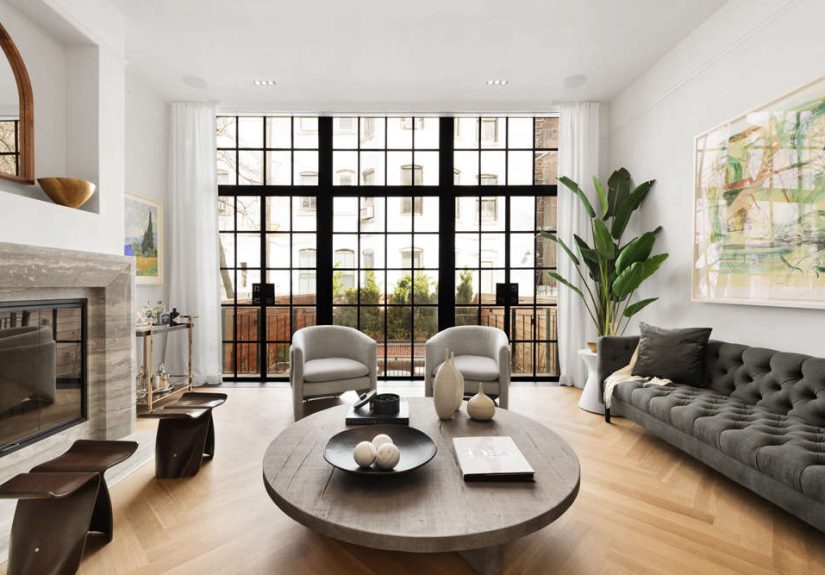
A West Village townhouse living room usually comes with a built-in focal point: a fireplace, a stunning window, a pier mirror, or an architectural moment
that would be rude to ignore. Decide what the room is “about,” then let everything else support it.
If you try to make the fireplace, the TV, and the view all the star at once, your furniture will start forming little protest unions.
Create Zones So the Room Doesn’t Feel Like a Hallway
Long rooms read best when they’re broken into clear “chapters.” A classic approach:
- Front zone: conversation + fireplace moment (two chairs + sofa, or sofa + swivel chairs).
- Mid zone: a breathing spaceconsole, gallery wall, or a slim writing desk.
- Rear zone: reading nook, library corner, or a second small seating group.
The trick is to make each zone feel complete (rug, lighting, purpose) while keeping sightlines open so the townhouse still feels airy.
Float Furniture (Yes, Even in a Narrow Room)
If you line everything against the walls, the room can feel like a waiting area. Floating your sofa a few inchesor even a full footoff the wall can make the space feel designed,
not merely “placed.” Use a slim console behind the sofa if you need an anchor (and a place to drop keys, mail, and your dreams of minimalism).
Use “Crosswise” Moves to Visually Widen the Space
In very narrow parlors, consider two shorter seating pieces placed widthwise rather than one long sofa hugging the wall.
This can trick the eye into reading the room as wider. It also creates a more social setupless “bowling alley,” more “conversation lounge.”
Keep Traffic Flow Non-Negotiable
The fastest way to make a townhouse living room feel stressful is to block the natural path from entry to stairs to the back of the floor.
Build your layout around a clear lane (even if it’s not perfectly symmetrical). When in doubt, test with painter’s tape on the floor.
If you can’t carry a laundry basket through without grazing a lamp, adjust.
Furniture That Fits: Scale, Shape, and Soft Power
Sofas: Generous, But Not Gargantuan
Townhouse living rooms love comfort, but they do not love bulky arms and deep, overstuffed silhouettes that eat your walkway alive.
Look for a sofa with a refined footprint: tighter arms, slightly raised legs, and a depth that lets humans sit upright without feeling like they’ve sunk into a cloud.
If you want a sectional, consider a compact L-shape or a modular system that can adapt to odd fireplaces and doorways.
Chairs: Swivels Are the West Village Peace Treaty
Swivel chairs are magic in a parlor room because they let one chair serve two purposes:
face the fireplace for conversation, then rotate toward the TV or window without rearranging the entire room like you’re moving day.
Add an ottoman or a small bench and suddenly you’ve got flexible seating for guests (or for your coat that “temporarily” lives there).
Tables: Round and Oval Pieces Soften the Rectangle
A long, rectangular room benefits from curved forms: an oval coffee table, a round side table, a soft-edged bench.
These shapes break up the geometry and make traffic flow smootherno one wants to hip-check a sharp corner in a townhouse that already has stairs for that.
Built-Ins: The Secret Ingredient for “Calm, Not Clutter”
West Village living rooms look their best when they feel collected, not chaotic.
Built-in shelving (or a well-designed storage wall) can hide the necessary messgames, cables, extra throwswhile displaying books and art like you meant to do that all along.
If you’re renovating, prioritize storage early. In a townhouse, hidden storage is basically a lifestyle upgrade.
Color, Texture, and Materials: Historic Bones, Modern Mood
Let the Architecture Lead
The easiest way to make a townhouse living room feel authentic is to treat architectural details like the headline.
If your room has plaster moldings and a marble mantel, you can keep walls relatively quiet (warm whites, creamy ivories, soft putty tones),
then bring depth through texture: linen drapes, wool rugs, velvet chairs, and aged wood.
Yes, You Can Use Color (And Still Be “Classic”)
West Village interiors often shine when they mix old-world structure with a confident paletterosy tones, deep blues, earthy greens, even saturated dining-room hues bleeding into calmer living areas.
The key is restraint and placement: choose one “statement” moment (a painted ceiling, a moody library corner, or richly colored upholstery)
and let everything else support it.
Patina Wins in a Townhouse
Highly glossy, showroom-perfect finishes can look slightly out of place in a historic townhouselike sneakers at a black-tie gala.
Instead, aim for materials that age well: unlacquered brass, naturally stained wood, stone with variation, woven textures, and vintage pieces that bring lived-in credibility.
Lighting: The Thing That Makes Your Living Room Look Expensive (Even If Your Sofa Was On Sale)
Use Layers: Ambient + Task + Accent
A single overhead light in a townhouse living room is a crime against ambiance.
The best setups layer lighting from the ceiling down: overhead for general brightness, sconces and picture lights to highlight architecture and art,
plus table and floor lamps for that cozy glow that makes everyone look like they slept eight hours.
Sconces Are Practically Made for Moldings
Townhouse walls often have beautiful detailspaneling, casings, nichesthat deserve gentle emphasis.
Wall sconces can frame a fireplace, flank a mirror, or illuminate a hallway edge without stealing floor space.
Bonus: they make the room feel intentional, not “I bought three lamps because the ceiling light hurt my feelings.”
Dimmers Are Not Optional
If you can dim it, dim it. Townhouse living is about shifting moodsmorning sun, afternoon guests, evening cocktails, late-night streaming.
Dimmers let the same room do all of that without you feeling like you live inside a surgical suite.
Rugs, Drapes, and Acoustics: Making “Townhouse Echo” Disappear
Tall ceilings and hard surfaces can create that classic townhouse soundtrack: footsteps, laughter, and the gentle reverb of your own thoughts.
Textiles fix it. Go bigger than you think on the rugideally large enough for the front legs of all main seating.
Add lined drapes (not just sheers) to soften the room and visually heighten windows.
Layer throws and pillows for comfort, but keep it edited: two textures per seat beats seven tiny cushions that nobody is allowed to touch.
Art and Objects: Gallery Energy Without the Museum Rules
West Village living rooms often nail the “collected” look by mixing eras: contemporary art against historic moldings, a modern coffee table under an antique mirror,
a vintage lamp beside a crisp, tailored sofa. The contrast is the point.
If your walls are tall (they often are), scale up your art. One large piece can calm a room more effectively than twelve small frames fighting for attention.
Mirrors are also a townhouse classicthey bounce light, make narrow rooms feel wider, and let you check your outfit on the way out.
(Or on the way to the kitchen. No judgment.)
The TV Question: A Necessary Evil, Handled Gracefully
In a brownstone living room or West Village parlor, the TV placement debate is practically a rite of passage.
A few solutions that don’t ruin your historic vibe:
- Opposite the sofa, not necessarily above the fireplace: better viewing angles, less visual dominance.
- Frame-style TV or concealed options: blends into art moments.
- Built-in cabinetry: hides components, organizes wires, keeps the room calm.
- “Designated TV zone” in the rear parlor: keep the front parlor more formal and social.
The goal: keep the living room feeling like a living room, not a Best Buy showroom with crown molding.
Renovation Reality: Historic District Charm Comes With Rules
Many West Village townhouses sit within historic districts, which can affect exterior changes (and sometimes broader renovation plans).
Even if your living room makeover is mostly interior design, bigger projectswindows, façade work, stoops, expansionsoften require professional guidance
and approvals. A good architect or preservation-savvy contractor is worth their weight in… well, Manhattan real estate.
Practical takeaway: design your living room with respect for the original architecture, and if you’re altering significant elements,
consult the right pros early so your dream parlor doesn’t become a paperwork saga.
Conclusion
A West Village townhouse living room is equal parts history lesson and daily-life stage set.
When you work with the architecturerather than wrestling it into a generic open-plan fantasyyou get something better:
a room with presence, warmth, and that unmistakable New York confidence.
Nail the layout, layer the lighting, respect the details, and you’ll end up with a space that feels timeless without feeling precious.
My West Village Townhouse Living Room Field Notes (Experience, ~)
I’ve walked into enough West Village living rooms to know there are two universal truths: the light is usually gorgeous,
and the “where do we put the couch?” question is always waiting in the doorway like it pays rent. The first time you tour a townhouse parlor,
you fall in love with the ceiling height and a fireplace mantel that looks like it has opinions. Then you try to imagine your actual life in there:
your dog, your friends, your streaming habits, your winter coats, your tendency to drop bags on chairs like they’re emotional support objects.
That’s when the romance meets the floor plan.
The most successful West Village townhouse living rooms I’ve seen aren’t the ones that look the most “done.”
They’re the ones that feel like the homeowners understood the room’s rhythm. In one parlor, the owners leaned into the long shape and created two zones:
a front conversation area anchored by the fireplace, and a back reading nook with built-ins and a lamp that made the whole corner feel like a tiny private club.
Nobody tried to force a giant sectional into a room that didn’t want one. Instead, they used a tailored sofa, two swivels, and an ottoman that worked overtime
footrest, extra seat, coffee table stand-in when the tray came out. It was flexible, and that flexibility is basically the secret handshake of townhouse living.
I’ve also seen the common mistakes. The biggest one is scaling down too much out of fear. People buy tiny rugs, delicate side tables,
and undersized art because they think “small room = small everything.” But townhouse parlors often have big vertical volume,
and the room starts looking like it borrowed furniture from a dollhouse. The fix is counterintuitive: go larger where it counts.
A properly sized rug stops the room from feeling like a corridor. One big piece of art calms the wall. Full-height drapes make the windows look grand,
and they help with that townhouse echo that turns every laugh into a mild concert.
Another very real West Village thing: the room’s quirks. Radiators that refuse to be ignored. A fireplace that’s slightly off-center.
Doorways that create awkward “no-furniture” zones. The best spaces treat quirks like design prompts. Put a slim console where a sofa can’t go.
Use a sculptural chair to make an odd corner feel intentional. If the fireplace isn’t centered, don’t fight for symmetry so hard you lose comfort;
balance it with art, a floor lamp, or a tall plant that looks like it belongs there. (In New York, plants are brave. Respect them.)
And finally: the entertaining reality. West Village living rooms are social by naturepeople come over, coats pile up, someone ends up perched on an ottoman,
and the conversation migrates toward the kitchen because that’s what humans do. The best living rooms plan for it.
They leave a clear path, offer a few flexible seats, and keep lighting warm enough that everyone looks like the main character in a very flattering indie film.
If your townhouse living room can handle a quiet Tuesday night and a crowded Friday gathering without breaking a sweat, you’ve done it right.