Table of Contents >> Show >> Hide
- Why Yoga Helps With Stress and Anxiety (Without the Woo-Woo)
- Breathwork for Anxiety: 5 Techniques That Actually Feel Calming
- 1) Diaphragmatic (Belly) Breathing: Your “Base Layer” Calm
- 2) Longer Exhale Breathing: The “Easy Button” for the Nervous System
- 3) Box Breathing (4–4–4–4): Calm Focus When Your Brain Won’t Sit Still
- 4) Alternate Nostril Breathing (Nadi Shodhana): Balance and “Mental Static” Relief
- 5) Cyclic Sighing (A Big Exhale Reset): Quick Mood Shift in 5 Minutes
- Yoga Poses for Stress Relief: A Calm Sequence You Can Repeat
- Meditation to Calm Anxiety: Small, Doable Practices
- Put It Together: Two Simple Routines (Choose Your Adventure)
- Common Questions (Because Your Brain Will Ask Them)
- Real-World Experiences: What Yoga for Stress Looks Like in Daily Life
- Conclusion: Calm Is a Skill (And You Can Practice It)
Stress has a way of showing up like an uninvited houseguest: it raids your fridge (hello, random snacking),
hogs the couch (tight shoulders), and turns your brain into a tab-hoarding browser. Anxiety can feel even
sneakierlike your body is bracing for something… even when nothing is actually happening.
The good news: you don’t need to “fix” your personality or become a levitating monk to feel better. Yoga for stress
is mostly about three practical toolsbreath, gentle poses, and simple meditationthat help your
nervous system shift from “GO GO GO” toward “okay… we’re safe.”
This guide breaks down what to do, why it works, and how to build a calming yoga routine you’ll actually usewhether
you’ve got 5 minutes in a parking lot or 20 minutes before bed. (Yes, yoga in pajamas counts. Pajamas are basically
your body’s way of saying, “I’m committed to relaxation.”)
Why Yoga Helps With Stress and Anxiety (Without the Woo-Woo)
When you’re stressed, your body often acts like there’s a tiger in the room: heart rate up, breath shallow, muscles
tight, thoughts racing. That’s the stress response. Yoga works from the opposite direction by stacking
signals of safetyslower breathing, steady attention, and gentle movementuntil your body gets the hint.
Yoga calms stress in three main ways
-
Breath cues your nervous system. Slower, steadier breathing (especially longer exhales) can encourage the
“rest and digest” side of your nervous system to take the wheel again. -
Movement drains “stuck” tension. Stress loves to live in shoulders, hips, jaw, and lower back. Gentle stretching
and supported poses give your body a safe off-ramp. -
Meditation trains attention. You’re not trying to stop thoughts. You’re learning to notice them without letting
them run the show like a chaotic DJ.
One more reality check: yoga is not a replacement for therapy or medical care if anxiety is intense or persistent.
But for many people, it’s a powerful support toollike adding shock absorbers to a bumpy road.
Breathwork for Anxiety: 5 Techniques That Actually Feel Calming
If you only do one thing from this article, do this: breathe more slowly than your stress. Most of us breathe
shallowly when anxious, which can make the body feel even more “on alert.” These breathing exercises for anxiety are
beginner-friendly and don’t require special flexibilityjust a willingness to pause.
1) Diaphragmatic (Belly) Breathing: Your “Base Layer” Calm
Best for: daily stress relief, pre-sleep, nervous stomach, tension headaches.
- Sit or lie down comfortably. Place one hand on your chest and one on your belly.
- Inhale through your nose for about 4 seconds. Let your belly expand first (like a balloon).
- Exhale slowly (nose or mouth) for about 6 seconds. Think “soften.”
- Repeat for 10 breaths.
Tip: If the inhale feels too big, make it smaller. Calm breathing is not a lung Olympics event.
2) Longer Exhale Breathing: The “Easy Button” for the Nervous System
Best for: racing thoughts, irritability, “I can’t settle down.”
- Inhale through the nose for 4.
- Exhale through the nose or pursed lips for 6–8.
- Repeat for 2–3 minutes.
The longer exhale is often the secret sauce. If your breath is a seesaw, the exhale is the side that says,
“We’re okay. No tiger.”
3) Box Breathing (4–4–4–4): Calm Focus When Your Brain Won’t Sit Still
Best for: work stress, pre-meeting nerves, test anxiety.
- Inhale for 4.
- Hold for 4 (gentle hold, no strain).
- Exhale for 4.
- Hold for 4.
- Repeat for 4 rounds.
Tip: If breath holds spike anxiety, skip the holds and do 4-in / 4-out instead. You’re the boss here.
4) Alternate Nostril Breathing (Nadi Shodhana): Balance and “Mental Static” Relief
Best for: overstimulation, scattered attention, afternoon stress.
- Sit tall. Use your right hand: thumb to close the right nostril, ring finger to close the left.
- Close the right nostril with your thumb. Inhale through the left.
- Close the left nostril with your ring finger. Exhale through the right.
- Inhale through the right.
- Close the right. Exhale through the left.
- That’s 1 round. Do 3–6 rounds slowly.
Safety note: Keep it gentle. If you feel dizzy, stop and return to normal breathing.
5) Cyclic Sighing (A Big Exhale Reset): Quick Mood Shift in 5 Minutes
Best for: acute stress spikes, “I need to reset right now.”
- Inhale normally through the nose.
- Top it off with a second, shorter inhale (like a little “sip” of air).
- Long, slow exhale through the mouth.
- Repeat at an easy pace for 2–5 minutes.
This one is surprisingly effective for many people because it emphasizes the exhaleyour built-in “downshift.”
Yoga Poses for Stress Relief: A Calm Sequence You Can Repeat
You don’t need fancy poses to get stress relief. For anxiety, the best yoga poses tend to be
grounding, supported, and slow. Think “nervous system lullaby,” not “Instagram acrobatics.”
Your 12–15 Minute Calming Yoga Routine
Use props if you can: a pillow, folded blanket, or a rolled towel. Props aren’t “cheating.”
They’re “being smarter than your stress.”
-
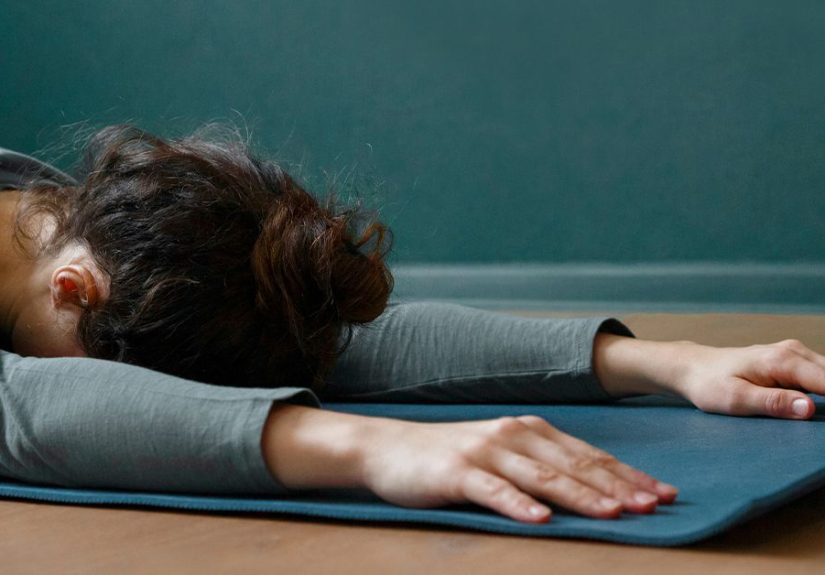
Child’s Pose (Balasana) 1–2 minutes
Kneel, fold forward, and rest your forehead. If knees are sensitive, place a pillow between thighs and calves,
or widen knees for more space. Breathe into the back ribs. -
Cat-Cow 1 minute
On hands and knees, inhale as you gently arch (cow), exhale as you round (cat). Go slow and let breath lead.
Stress loves rigidity; this is your “permission to move.” -
Thread the Needle 1 minute each side
Slide one arm under the other and rest the shoulder and side of the head down. Great for shoulder and upper-back tension.
Keep hips stacked over knees if possible. -
Seated Forward Fold (easy version) 1–2 minutes
Sit with legs comfortable (bent knees is fine). Fold forward with a long spine, resting forearms on thighs or a pillow.
This is not about touching your toes. It’s about softening your breath. -
Legs-Up-the-Wall (Viparita Karani) 3–5 minutes
Sit sideways near a wall, swing legs up, and lie back. Put a folded blanket under hips if it feels good, or keep hips on the floor.
This pose is a favorite in restorative yoga for stress because it’s effortless and calming. -
Reclined Bound Angle (Supta Baddha Konasana) 2 minutes
Bring soles of feet together and let knees open. Support knees with pillows or blocks so hips can relax.
One hand on belly, one on chest: breathe slow. -
Supine Twist 1 minute each side
Knees to chest, then let them fall to one side, arms wide. Keep it gentletwists should feel like wringing out tension, not wringing out your spine.
-
Savasana (Corpse Pose) 2 minutes
Lie flat, palms up. If your lower back is sensitive, put a pillow under knees.
Practice “doing nothing,” which is secretly a skill.
Pose tweaks for common stress hotspots
- Tight shoulders: Add Thread the Needle and gentle neck rolls (slow, no forcing).
- Jaw tension: In Savasana, relax tongue from the roof of the mouth; let teeth unclench.
- Hip stress: Support knees in reclined poses so hips aren’t fighting gravity.
- Restlessness: Extend Cat-Cow and shorten stillness poses at first.
Meditation to Calm Anxiety: Small, Doable Practices
Meditation for stress isn’t about emptying your mind. It’s about noticing what’s happening and giving yourself a little space.
Think: “I see you, anxious thoughts. You may sit in the back seat, but you’re not driving.”
1) One-Minute Breath Anchor
- Sit comfortably. Relax shoulders.
- Notice the breath at the nostrils or belly.
- When the mind wanders (it will), gently return to breath.
- Do this for 60 seconds. That’s it. You did meditation.
Why it works: You’re training attention like a puppy: kindly, repeatedly, without yelling.
2) Body Scan (3–5 minutes): Tension “Inventory” Without Judging It
- Lie down or sit back supported.
- Move attention from head to toes (or toes to head).
- When you find tension, soften the breath around it.
Many people don’t realize how much stress they’re holding until they scan. It’s like discovering your shoulders have been doing unpaid overtime.
3) Loving-Kindness (Metta): Gentleness for the Anxious Brain
If mindfulness feels too “quiet,” try repeating simple phrases (silently) for 2 minutes:
May I be safe. May I be calm. May I be healthy. May I live with ease.
This practice is especially helpful when anxiety comes with self-criticism. Stress is hard enough; you don’t need a mean inner narrator.
Important note: meditation isn’t always instantly soothing
Most people find mindfulness helpful over time, but a small number report uncomfortable effects (like increased anxiety).
If that happens, shorten the practice, keep eyes open, switch to gentle movement, or try guided meditation instead.
Put It Together: Two Simple Routines (Choose Your Adventure)
Routine A: The 8-Minute “Desk Reset” (stress relief at work)
- 1 minute: Longer-exhale breathing (4 in, 6 out).
- 2 minutes: Seated shoulder rolls + neck stretch (gentle).
- 2 minutes: Seated forward fold (supported on thighs).
- 2 minutes: Box breathing (skip holds if needed).
- 1 minute: One-minute breath anchor meditation.
This routine is great for “I can’t focus” days. It’s also discreetno one has to know you just did yoga next to your inbox.
Routine B: The 20-Minute “Evening Downshift” (yoga for anxiety + sleep)
- 3 minutes: Diaphragmatic breathing.
- 10–12 minutes: The calming pose sequence (Child’s Pose → Cat-Cow → Legs-Up-the-Wall → Supine Twist).
- 3–5 minutes: Body scan or loving-kindness.
If your brain tends to sprint at bedtime, this is your gentle “cool down lap.”
Common Questions (Because Your Brain Will Ask Them)
“What if I’m too anxious to sit still?”
Start with movement: Cat-Cow, slow standing forward fold, or a short walk. Then add 60 seconds of breathing.
Calm often arrives after you move, not before.
“How often should I do yoga for stress?”
Consistency beats intensity. Even 5 minutes most days can help. If you’re aiming for a habit, attach it to something you already do:
after brushing teeth, after lunch, before bed.
“Can yoga stop a panic attack?”
Some people find breathwork helps reduce the intensity. If panic is frequent or overwhelming, it’s worth talking to a licensed professional.
Yoga can support your overall resilience, but you deserve comprehensive care if symptoms are severe.
“Is there anyone who should be cautious?”
Yes. If you have medical conditions (especially blood pressure issues, glaucoma, certain spine problems, or pregnancy concerns),
avoid long inversions or strong breath holds without professional guidance. When in doubt, choose gentle breathing, supported poses,
and talk to a clinician.
Real-World Experiences: What Yoga for Stress Looks Like in Daily Life
People often imagine stress relief has to look sereneperfect candle, perfect silence, perfect person who never checks email after 6 p.m.
In real life, yoga for stress is messier and more relatable. It’s a tool you use in the middle of your normal day, not a personality makeover.
Here are common experiences many people report when they use breath, poses, and meditation to calm anxietyplus what tends to help most.
The “Deadline Spiral” Experience
A lot of people describe a familiar pattern: they sit down to work, feel behind, and then their body clamps downshoulders up, jaw tight,
breath shallow. The brain tries to solve stress by thinking faster, which usually makes it worse. In this scenario, the most helpful move is
often two minutes of longer-exhale breathing (4 in, 6–8 out). Once the breath slows, adding seated forward fold for
a minute can release neck tension. Many people notice that their focus comes back not because the workload changed, but because their body stopped
acting like the deadline was a threat to survival.
The “Sunday Scaries” Experience
That anxious, buzzy feeling before the week starts often comes with mental time travel: replaying last week and fast-forwarding to everything that
might go wrong. People who struggle with this frequently say restorative yoga poses help because they reduce stimulation. A short sequence
Child’s Pose, Supine Twist, and Legs-Up-the-Wallcombined with a 3-minute body scan can shift attention from “future problems” back to
“current body.” Many report sleeping better when they treat yoga like a transition ritual: “I’m done doing, now I’m allowed to rest.”
The “Social Anxiety Before an Event” Experience
Before parties, presentations, or even casual hangouts, people commonly describe chest tightness and a sense of dread. What often helps is a
predictable routinesomething the brain recognizes as safe. Box breathing (without holds, if holds feel stressful) plus a grounded posture
like a gentle forward fold can create a calm baseline. Some people also like loving-kindness phrases for this moment because it softens the inner critic
(“Don’t be awkward!”) into something more supportive (“I can handle this.”).
The “I’m Too Tired to Exercise” Experience
Stress can feel exhausting, and the idea of a workout can sound like punishment. That’s where gentle yoga shines. Many people are surprised
that 10 minutes of slow movement actually restores energyespecially when the fatigue is stress-related rather than “I ran a marathon” tired. A common go-to
is Cat-Cow for one minute, Thread the Needle for each side, then Reclined Bound Angle with belly breathing. People often describe it as “I didn’t do much,
but I feel more human.”
The “Meditation Makes Me More Anxious” Experience
This is real for some folkssilence can amplify thoughts. When that happens, people often do better with guided meditation, shorter practice
(60–90 seconds), or eyes-open mindfulness while focusing on a single physical anchor (like feeling feet on the floor). Another workaround is to meditate
after movement, not before. Many report that their mind settles more easily once the body has released some tension through poses.
What people tend to learn over time
A consistent theme: the goal isn’t to never feel stressed. It’s to recover faster. With practice, many people notice earlier warning signstight shoulders,
shallow breath, racing thoughtsand they use yoga sooner, before stress becomes a full-body takeover. In other words, yoga becomes less like an emergency
exit and more like routine maintenance. And honestly, routine maintenance is cheaper than burnout.