Table of Contents >> Show >> Hide
- 1) Snooty was a record-holderand a true longevity legend
- 2) He was born in 1948and his origin story is wonderfully unusual
- 3) Snooty moved to Bradenton as a baby and became a local icon
- 4) He greeted millions of visitors and became one of Florida’s best animal ambassadors
- 5) Snooty helped scientists learn more about manatees
- 6) He lived in a 60,000-gallon habitat and ate like a very polite lawn mower
- 7) Snooty wasn’t just a residenthe shared space with rehabilitation manatees
- 8) Manatee biology is way weirder (and cooler) than most people realize
- 9) His death in 2017 shocked Floridaand prompted hard changes
- 10) Snooty’s story still matters because manatee conservation is ongoing
- Conclusion: Why Snooty still captures hearts
- Related Experiences: Why Visiting Snooty Became a Core Memory (Extended Section)
If Florida had an unofficial king of gentle vibes, it was Snooty. For generations of museum visitors in Bradenton, he wasn’t just a manatee in a tankhe was the field-trip celebrity, the local legend, and the giant whiskered face of conservation education. Kids loved him. Adults loved him. Even people who showed up for “a quick museum stop” somehow left talking about Snooty like they’d just met a very chill, aquatic mayor.
In this article, we’ll explore 10 fascinating facts about Snooty the manateehis record-setting life, his role in science, and the legacy he left behind for Florida manatees. We’ll also clear up one important detail: headlines often called him the “world’s oldest manatee,” and during his lifetime he was widely recognized as the oldest manatee in human care. (That title has since evolved as new records were verified.)
1) Snooty was a record-holderand a true longevity legend
Snooty was celebrated for decades as the oldest known manatee in human care, and Guinness World Records officially recognized him as the oldest living manatee in captivity during his lifetime. He lived to age 69, which is extraordinary for a manatee and helped make him internationally famous.
That kind of longevity matters because manatees face serious risks in the wild, including boat strikes, cold stress, and habitat problems. Snooty’s long life gave researchers, caretakers, and educators a rare opportunity to observe manatee aging over many decades.
Why this is fascinating
Most animals become “old” and quietly disappear from public attention. Snooty did the opposite. The older he got, the bigger the birthday parties became. That’s not just agingthat’s branding.
2) He was born in 1948and his origin story is wonderfully unusual
Snooty was born on July 21, 1948, and his early life reads like a piece of Florida folklore. Museum history notes that he was born at the Miami Aquarium and Tackle Company, which operated on the Prins Valdemar, a Danish shipwreck repurposed into a floating attraction in Miami.
He was originally called “Baby Snoots,” and the nickname stuck in spirit even after he grew into a massive adult manatee. (Like calling a 1,000+ pound animal “Tiny.” Classic human behavior.)
Why this is fascinating
It’s hard to beat “born on a repurposed shipwreck aquarium” as a backstory. Snooty’s life started in a setting that sounds half maritime history, half old-Florida postcard.
3) Snooty moved to Bradenton as a baby and became a local icon
In 1949, “Baby Snoots” came to Bradenton for the DeSoto Celebration and later made his permanent home there. Over time, he became much more than an exhibit animalhe became part of the identity of Manatee County itself.
In 1979, county commissioners officially declared Snooty the mascot of Manatee County. That is a very Florida sentence, and also a very deserved honor.
Why this is fascinating
Most communities have mascots for sports teams. Bradenton had a real manatee with a fan base, birthday parties, and multigenerational name recognition.
4) He greeted millions of visitors and became one of Florida’s best animal ambassadors
According to The Bishop Museum of Science and Nature (formerly the South Florida Museum), Snooty greeted roughly two million visitors during his lifetime. He also reached fans online through the “Snooty Cam,” which let people check in on him from anywhere.
His popularity wasn’t just local nostalgia. Snooty helped people connect emotionally to manateesan animal many people might otherwise know only as a blurry shape near a boat ramp or a road sign warning boaters to slow down.
Example
For Snooty’s 65th birthday, the museum reported that more than 6,000 guests came to celebratethe largest crowd in the museum’s history at the time. That’s not just a birthday party; that’s a civic event with lettuce energy.
5) Snooty helped scientists learn more about manatees
Snooty wasn’t only a public favoritehe also contributed to research and education. The Bishop’s historical timeline notes that in 1985, a hydrophone placed in his tank revealed high-pitched squeaks (his vocalizations). In 1987, Snooty began training to help researchers study how well manatees hear at different frequencies.
That kind of work matters because better knowledge of manatee hearing and behavior can improve conservation strategies, habitat management, and public education. In other words, Snooty helped science while being charming, which is a rare and admirable dual career path.
Why this is fascinating
He wasn’t just “observed.” He actively became part of how researchers learned about manatees. Snooty was basically doing outreach and research before it was trendy.
6) He lived in a 60,000-gallon habitat and ate like a very polite lawn mower
Snooty moved into the Parker Manatee Habitat in 1993, and museum records highlight the 60,000-gallon exhibit as a major home for him. Guinness also described Snooty and his companions living in a 60,000-gallon aquarium facility.
And yes, he had the appetite to match his size. Guinness reported Snooty ate about 70–80 pounds of vegetables per day. That lines up with broader Florida manatee biology: manatees are herbivores (“sea cows”) and can consume a significant percentage of their body weight in vegetation daily.
Why this is fascinating
Snooty looked cuddly, but feeding a manatee is not a “sprinkle a little kibble” situation. It’s more “prepare produce like you’re catering for a vegetarian submarine.”
7) Snooty wasn’t just a residenthe shared space with rehabilitation manatees
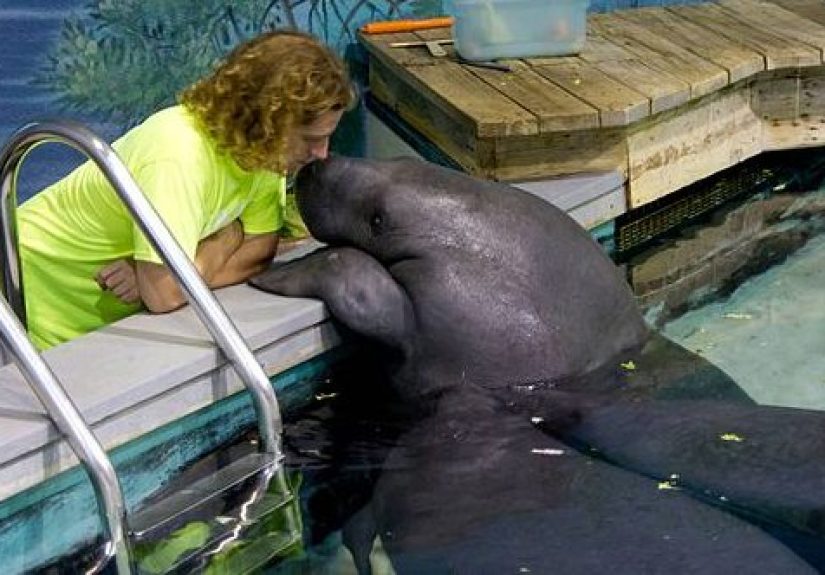
As the Parker Manatee Habitat joined the rescue and rehabilitation network, Snooty became the longtime resident ambassador among manatees that were being treated and eventually returned to the wild. The Bishop notes that he hosted 33 rehabilitating manatees during his life.
This is one of the most important parts of Snooty’s legacy. He wasn’t isolated as a symbol only; he was part of a facility connected to real rescue, rehabilitation, and release work.
Why this is fascinating
Snooty’s story is often told as a museum story, but it’s also a conservation infrastructure story. He helped keep public attention on a place doing hands-on manatee care.
8) Manatee biology is way weirder (and cooler) than most people realize
Part of Snooty’s appeal was that he made people curious about manatee anatomy and behavior. And once you start reading manatee facts, things get wonderfully strange in the best possible way.
Some standout Florida manatee facts that help explain Snooty’s world
- They’re huge: Florida manatees are typically around 9–10 feet long and roughly 1,000 pounds, though they can grow much larger.
- They’re herbivores: They spend hours grazing and can eat a substantial amount of aquatic vegetation daily.
- They can move faster than they look: Manatees can hit short bursts of about 15 mph.
- They have “grinding” teeth that are continuously replaced: Think conveyor-belt molars designed for a lifetime of chomping plants.
- They use whiskers and body hairs for sensing: Those bristles aren’t just decorativethey help with touch and detecting water movement.
- They can’t turn their heads sideways like most mammals: Manatees have six cervical vertebrae instead of the usual seven, so they turn more of their body to look behind them.
Snooty helped turn these facts from trivia into something memorable because visitors could actually see a manatee up close and connect science to a real individual.
9) His death in 2017 shocked Floridaand prompted hard changes
Snooty died on July 23, 2017, just days after his 69th birthday celebration. Museum statements and later reporting explained that he entered an underwater plumbing access area after a panel came off, became trapped, and drowned.
Later, The Bishop shared findings from a final report stating the accident was preventable. The report described breakdowns in record-keeping, communication, follow-through, and training, and the museum announced operational changes to address those failures.
Why this is fascinating (and heartbreaking)
Snooty’s death is part of his story because it changed how people think about animal care systems, accountability, and safety culture. His legacy is not only joy and nostalgiait also includes institutional learning.
10) Snooty’s story still matters because manatee conservation is ongoing
Snooty introduced millions of people to manatees, but the conservation story is far from over. Florida manatees still face serious threats, including watercraft collisions, habitat degradation, and cold stress. Agencies and conservation groups continue rescue, rehabilitation, and education work across the state.
That’s why Snooty remains relevant today: he gave the public a face (and a whiskered snout) for a species that still needs protection. He made people care firstand caring is often what gets conservation funded, supported, and defended.
A useful title clarification for modern readers
Many articles still call Snooty “the world’s oldest manatee,” which reflects how widely he was known and celebrated. Today, newer record verifications have updated the “oldest ever recorded” conversation, but Snooty’s place in manatee historyand in public memoryremains enormous.
Conclusion: Why Snooty still captures hearts
Snooty the manatee was a record-holder, a research helper, a museum superstar, and a conservation ambassador wrapped into one unforgettable animal. His life connected science, community, education, and pure wonder in a way few animal stories ever do. If you’re researching manatee facts, Florida wildlife history, or the legacy of the Bishop Museum in Bradenton, Snooty isn’t just a footnotehe’s the headline.
And maybe that’s the most fascinating fact of all: long after the birthday banners came down, Snooty still inspires people to learn about manatees, protect their habitats, and tell the next generation, “Wait until you hear about this legendary sea cow from Florida…”
Related Experiences: Why Visiting Snooty Became a Core Memory (Extended Section)
One reason Snooty’s story continues to spread online is that it was never just about a longevity record. It was about experience. People didn’t simply “view an exhibit.” They remember meeting Snooty. That difference matters, especially in wildlife education.
Public tributes and museum recollections over the years paint a remarkably consistent picture: visitors felt an emotional connection almost immediately. Parents who had visited as children returned with their own kids. Former students remembered school field trips decades later. Local photographers, volunteers, and longtime residents described Snooty as a familiar presence in the rhythm of Bradenton life. In a state full of flashy attractions, Snooty stood out by doing the oppositehe made people slow down.
That emotional connection also helped people remember the science. A child who might forget a textbook paragraph about aquatic mammals is much more likely to remember seeing a manatee surface for air, watching its whiskered snout move, or hearing a guide explain why manatees are called “sea cows.” Snooty turned abstract wildlife education into a sensory, memorable experience. That’s a huge win for conservation communication.
There’s also something powerful about how Snooty connected generations. Many animal celebrities come and go quickly through viral clips. Snooty’s popularity lasted for decades. Families built traditions around his birthday events. Museum staff and volunteers became storytellers, passing along facts and personal moments to visitors who later repeated them to friends. In that way, Snooty became part of Florida’s cultural memory as much as its natural history education.
Even the way people describe him is revealing. They rarely start with statistics. They mention his personality, his presence, the way he approached people, or how seeing him made them feel calm, curious, or unexpectedly joyful. That emotional language is exactly why animal ambassadors matter. They can motivate public interest in conservation in a way charts and policy briefs alone rarely can.
For writers, educators, and animal lovers, Snooty’s legacy offers a useful lesson: when people connect with one individual animal, they often become more open to caring about the whole species. A visit to see Snooty could lead to learning about boat-speed zones, warm-water habitats, rescue programs, and manatee-safe boating practices. That is a real conservation pathwayfrom affection to awareness to action.
So if you’re writing about Snooty, it’s worth remembering that the “fascinating facts” are only half the story. The other half is what those facts did: they helped build a community of people who cared. And in wildlife conservation, that kind of long-term public affection is not just touchingit’s strategic, powerful, and deeply important.