Table of Contents >> Show >> Hide
- Why Feet and Meters Matter in Everyday Life
- Method 1: Use the Exact Formula
- Method 2: Use Dimensional Analysis
- Method 3: Use a Quick Estimate or Conversion Chart
- Common Mistakes to Avoid
- Feet to Meters in Real-World Situations
- Which Conversion Method Should You Use?
- Practical Tips for Remembering the Conversion
- Conclusion
- Extra Experience and Practical Insights: Living With Feet-to-Meters Conversions
If you have ever stared at a measurement in feet and thought, “That is great, but my brain speaks meters now,” welcome to the club. Whether you are measuring a room, checking your height, reading a sports stat sheet, comparing hiking distances, or trying to understand how tall a rocket part is without feeling like you are doing courtroom math, converting feet to meters is one of those handy life skills that pops up more often than expected.
The good news is that this conversion is not complicated. In fact, once you know the basic relationship between the two units, you can move from feet to meters with the calm confidence of a person who definitely did not panic during middle school math. The exact conversion factor is simple: 1 foot = 0.3048 meter. From there, you have options. Some people want a precise formula. Others prefer a quick estimate. And some just want a conversion chart that does the heavy lifting while they sip coffee and pretend they were going to do the math themselves.
In this guide, we will walk through three easy ways to convert feet to meters, explain when each method works best, and share practical examples so the numbers stop looking mysterious and start looking useful. By the end, you will know how to convert measurements accurately, estimate them quickly, and avoid the classic mistake of mixing up feet, meters, and vibes.
Why Feet and Meters Matter in Everyday Life
Before we jump into the actual math, it helps to know why this conversion matters. In the United States, feet are part of the customary system, so they show up in home construction, road signs, real estate listings, and plenty of everyday conversations. Meters, meanwhile, are part of the metric system and are used widely in science, engineering, medicine, international business, education, and most countries around the world.
That means feet-to-meters conversion becomes important whenever you cross between systems. Maybe you are shopping for furniture from an international seller. Maybe you are reading a workout plan that lists track distances in meters. Maybe you are trying to understand how high 30,000 feet is in meters during a flight and would like to feel smarter than the seatback safety card. All of these are legitimate reasons.
Here is the core idea: feet measure length, and meters also measure length. They are describing the same thing, just using different yardsticks. Once you connect the two, the rest is just arithmetic.
Method 1: Use the Exact Formula
The Formula
The most accurate way to convert feet to meters is to use this formula:
meters = feet × 0.3048
That is the gold-standard method. If you need a precise answer, this is the one to use. It works for small measurements, large measurements, decimal values, and anything in between.
How It Works
Because one foot equals 0.3048 meter, every foot in your measurement gets multiplied by 0.3048. That tells you the same distance in metric form.
Examples
Example 1: Convert 6 feet to meters
6 × 0.3048 = 1.8288 meters
Example 2: Convert 10 feet to meters
10 × 0.3048 = 3.048 meters
Example 3: Convert 25.5 feet to meters
25.5 × 0.3048 = 7.7724 meters
This method is best when accuracy matters. If you are working on construction plans, academic homework, technical writing, or product dimensions, do not guess. Use the formula.
When to Round
In real life, you do not always need four decimal places. Here is a practical rule:
- For everyday use, round to two decimal places.
- For technical or scientific work, keep as many decimal places as your task requires.
- For quick conversation, one or two decimals is usually enough.
So, 6 feet could be written as 1.83 meters in most casual situations. Unless you are building a telescope or calibrating something expensive, that is usually plenty.
Method 2: Use Dimensional Analysis
What Dimensional Analysis Means
Now let us give the formula a slightly fancier outfit. Dimensional analysis sounds like something a professor says before assigning homework, but it is really just a smart way to set up conversions so the units cancel out correctly.
Instead of simply multiplying by 0.3048, you write the conversion as a fraction:
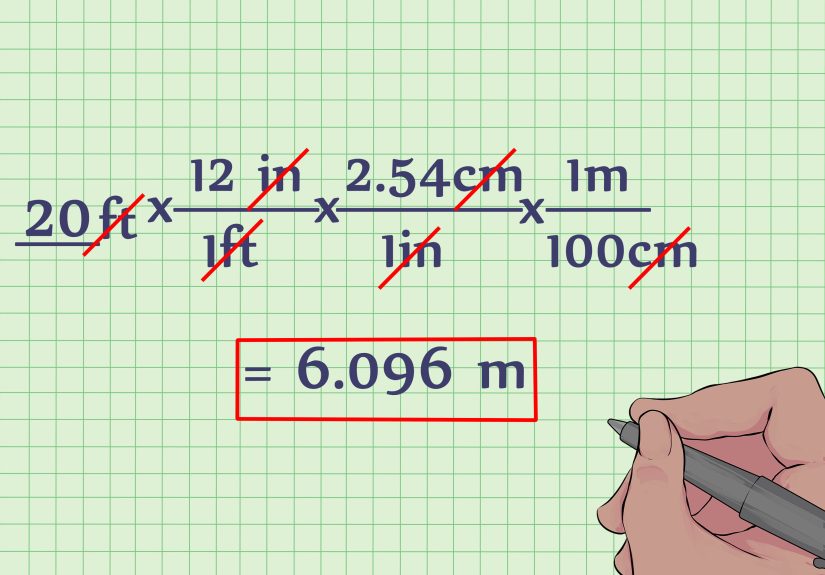
feet × (0.3048 meter / 1 foot)
The “foot” in the denominator cancels with the “feet” you started with, leaving you with meters. It is neat, logical, and surprisingly satisfying if you enjoy that kind of thing.
Example
Let us convert 18 feet to meters using dimensional analysis:
18 ft × (0.3048 m / 1 ft) = 5.4864 m
The feet cancel, and you are left with 5.4864 meters.
Why This Method Is Useful
This method shines in classrooms, science problems, and situations where you need to show your work clearly. It also helps reduce mistakes. If the units do not cancel properly, that is your signal that something is off.
Think of dimensional analysis as the conversion method for people who like receipts. It shows exactly how you got the answer, step by step, with less chance of wandering into nonsense territory.
Another Example
Convert 32.5 feet to meters
32.5 ft × (0.3048 m / 1 ft) = 9.906 m
That is a useful one because it helps show how aviation or large-scale measurements often get converted. Suddenly, 32.5 feet sounds less like “one awkwardly tall object” and more like 9.906 meters, which feels a bit more international.
Method 3: Use a Quick Estimate or Conversion Chart
When You Need Speed More Than Perfection
Sometimes you do not need a calculator. You just need a fast, reasonable estimate. Maybe you are shopping online, visualizing dimensions, or checking whether a listed ceiling height sounds normal or suitable for a giraffe.
A quick estimate works because 1 meter is about 3.28 feet, which means 1 foot is a little more than 0.3 meter. For mental math, many people round that to 0.3 meter per foot.
So the shortcut becomes:
meters ≈ feet × 0.3
Examples
8 feet
Exact: 8 × 0.3048 = 2.4384 m
Estimate: 8 × 0.3 = 2.4 m
20 feet
Exact: 20 × 0.3048 = 6.096 m
Estimate: 20 × 0.3 = 6.0 m
50 feet
Exact: 50 × 0.3048 = 15.24 m
Estimate: 50 × 0.3 = 15.0 m
The estimate is not exact, but it is close enough for everyday judgment calls. If you are planning a renovation or submitting engineering specs, use the exact formula. If you are deciding whether a bookshelf will overwhelm your apartment, the estimate is probably good enough.
Use a Mini Conversion Chart
Another fast option is to memorize or keep a small chart of common conversions:
- 1 ft = 0.3048 m
- 3 ft = 0.9144 m
- 5 ft = 1.524 m
- 6 ft = 1.8288 m
- 10 ft = 3.048 m
- 20 ft = 6.096 m
- 30 ft = 9.144 m
- 100 ft = 30.48 m
This is especially useful for repeated tasks. If you work in design, fitness, sports, or education, these common reference points can save time and spare your calculator from overtime.
Common Mistakes to Avoid
1. Using 0.3 as if It Were Exact
The shortcut is convenient, but it is only an estimate. Do not use it where precision matters. The exact factor is 0.3048, not 0.3.
2. Reversing the Conversion
Feet to meters means you multiply by 0.3048. Meters to feet is the opposite direction, so you would multiply by about 3.28084 instead. Swapping those can lead to answers that are wildly wrong and deeply unhelpful.
3. Forgetting the Unit
Always label your answer. A number without a unit is like a suitcase without a handle: technically still there, but much less useful.
4. Rounding Too Soon
If you are doing multi-step math, keep extra decimals until the end. Rounding too early can introduce small errors that stack up.
Feet to Meters in Real-World Situations
Height Conversions
Let us say someone is 5 feet 9 inches tall. First, convert the inches to feet:
9 inches = 9 ÷ 12 = 0.75 feet
So total height = 5.75 feet
Now convert to meters:
5.75 × 0.3048 = 1.7526 meters
Rounded, that is 1.75 meters.
Room Dimensions
If a room is 12 feet long, then:
12 × 0.3048 = 3.6576 meters
That is about 3.66 meters.
If the room is 12 ft by 10 ft, you now have a better metric sense of the space: roughly 3.66 m by 3.05 m.
Sports and Fitness
A basketball hoop is 10 feet high. In meters, that becomes:
10 × 0.3048 = 3.048 meters
This is one reason conversion skills are helpful when comparing sports facilities, track distances, and performance standards across countries.
Which Conversion Method Should You Use?
The best method depends on your goal:
- Use the exact formula when accuracy matters most.
- Use dimensional analysis when you need to show the process clearly or avoid unit mistakes.
- Use estimation or a chart when speed matters more than precision.
There is no single “best” method for every situation. There is only the best method for the moment. That is the beauty of basic unit conversion: once you understand the relationship, you can pick the tool that fits the job.
Practical Tips for Remembering the Conversion
- Remember that 0.3048 is the exact number for feet to meters.
- Think of 0.3 as the quick mental-math version.
- Memorize a few anchor points like 3 ft, 6 ft, and 10 ft.
- When in doubt, write the units and let them guide the math.
If you only remember one thing from this article, make it this: to convert feet to meters, multiply by 0.3048. That one little number does a lot of heavy lifting.
Conclusion
Converting feet to meters is one of those skills that looks small on paper but becomes surprisingly useful in real life. With the exact formula, you can get accurate results. With dimensional analysis, you can show your work like a pro. And with estimation or a conversion chart, you can move quickly when precision is not the main concern.
Whether you are measuring a room, translating your height, comparing product sizes, or trying to make sense of an international specification sheet that seems determined to test your patience, these three methods will help you get from feet to meters without drama. Well, without much drama. The calculator may still judge you, but quietly.
The next time you see a measurement in feet, you will not have to guess. You will know exactly what to do, which is more than can be said for most people standing in a hardware aisle on a Saturday afternoon.
Extra Experience and Practical Insights: Living With Feet-to-Meters Conversions
One of the most interesting things about converting feet to meters is that it starts as a math problem and quickly becomes a life skill. At first, most people only care because they have to finish homework, read a chart, or answer a question on a form. But after a while, the conversion begins to show up everywhere. You notice it in home improvement videos, travel guides, sports coverage, furniture listings, and even conversations about personal height. Suddenly, feet and meters are not abstract units anymore. They are just two ways of describing the same physical world.
A lot of people first encounter this issue when shopping online. A product may be listed as 6 feet tall on one site and 1.83 meters on another. If you do not know the relationship between the two, it is hard to picture what you are buying. That is how innocent purchases become unforgettable mistakes. A shelf that looked “moderately tall” on a screen can arrive and dominate the room like it is running for office. Being able to convert quickly helps you make better decisions before a box the size of a refrigerator lands on your doorstep.
Travel is another place where this conversion becomes surprisingly useful. Americans often think in feet, while much of the world uses meters. If you are reading about hiking trails, bridge heights, diving depths, or building clearances, knowing how to flip between the systems saves time and confusion. A sign that says 2 meters tall may not mean much at first glance, but if you know that is a little over 6.5 feet, you can instantly picture it. That kind of mental shortcut makes unfamiliar information feel a lot more familiar.
There is also something satisfying about understanding your own height in both systems. If someone says they are 6 feet tall, that sounds clear in the U.S. If another person says they are 1.83 meters, that sounds equally normal elsewhere. The actual person did not change, of course. Only the label did. That is part of what makes unit conversion so useful: it reminds us that measurements are tools for communication. The goal is not just to get a number. The goal is to make the number meaningful to whoever is reading it.
In work settings, this matters even more. A contractor, teacher, designer, coach, engineer, or writer may deal with audiences that expect different systems. Knowing how to convert feet to meters makes your communication clearer and more professional. It also reduces errors. Even a small misunderstanding in measurements can cause problems, from ordering the wrong materials to misreading space requirements. That is why the exact conversion factor is worth learning. It is a tiny detail that can prevent very large headaches.
Over time, many people develop a blended instinct. They use exact math when precision matters, rough estimates when speed matters, and familiar reference points when they just need a quick mental picture. That balance is probably the most practical lesson of all. You do not need to be a mathematician to convert feet to meters well. You just need one exact number, a few common examples, and the confidence to use whichever method fits the moment.