Table of Contents >> Show >> Hide
The holiday season is supposed to be the part of the work calendar where employers say, “We see you, we appreciate you, and no, this jellybean packet is not our final form.” But for a shocking number of workers, holiday bonuses are less “thank you for a year of effort” and more “please enjoy this deeply confusing object and try not to think too hard about what it says about your value here.”
That disconnect is what makes bad holiday bonuses so memorable. It is not just that the gift is cheap. It is that the gift somehow manages to be cheap, inconvenient, awkward, and emotionally insulting at the same time. A stale cookie is one thing. A stale cookie handed out after record profits, layoffs, frozen wages, and a speech about “family” is another thing entirely. Suddenly that cookie is no longer a snack. It is a metaphor.
This article rounds up 35 stories and types of so-bad-they’re-insulting holiday bonuses workers have shared, while also unpacking why these year-end fails hit such a nerve. Because the problem is rarely just the gift itself. The problem is what the gift reveals about workplace recognition, company culture, and whether leadership understands the difference between appreciation and accidental satire.
Why Bad Holiday Bonuses Sting More Than No Bonus at All
A bad holiday bonus lands differently than no bonus because it creates expectations first. Once a company announces a holiday gift, year-end reward, or employee appreciation surprise, workers naturally assume something useful, thoughtful, or at least mildly edible is coming. When the reveal turns out to be a broken QR code, a branded trinket, or a $5 coffee card that does not cover one actual coffee, the result is not gratitude. It is emotional whiplash.
That is especially true in years when employees have been overworked, underpaid, or told the company is “tight on budget” right before leadership finds enough money for a mandatory party, an inspirational speech, and 800 fleece vests with the logo embroidered the size of a billboard. Workers do not need a yacht. They do, however, appreciate being treated like grown adults instead of contestants in a game called Guess What HR Ordered in Bulk.
At its best, a holiday bonus reinforces employee appreciation and workplace recognition. At its worst, it becomes a tiny end-of-year summary of every larger frustration workers have been swallowing since January. That is why people remember these gifts for years. Not because they were small, but because they were weirdly, beautifully, aggressively tone-deaf.
35 Holiday “Bonuses” So Bad They Deserve Their Own Exit Interview
The edible offenses
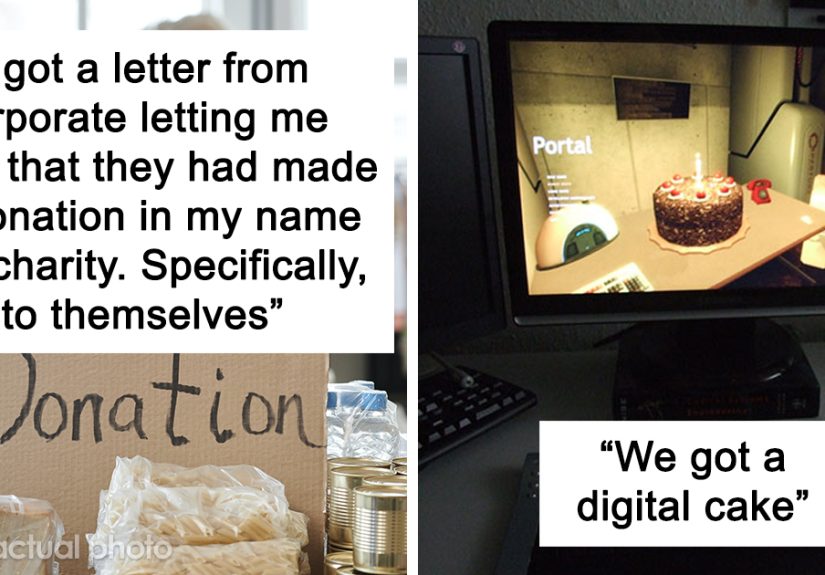
- A digital cake in an email. Not cake. Not even crumbs. Just a photo of cake, as if morale can be downloaded and eaten with your eyes.
- A single mini candy pack. The kind of “bonus” that says, “We wanted to thank you, but only with the snack equivalent of pocket lint.”
- One donut for an entire department. Office appreciation should not require slicing pastries like they are sacred artifacts.
- A holiday cookie with a company logo stamped on it. Because apparently the true gift was branding.
- A grocery-store fruitcake nobody wanted. Nothing says employee appreciation like passing along the cursed dessert every family has already rejected.
- Hot chocolate packets after a year of record profits. Cozy, sure. But also somehow a liquid reminder that raises remain fictional.
- A frozen turkey for workers without cars, ovens, or time. A gift that immediately becomes a logistics problem is not really a gift. It is an errand.
Cheap gifts that somehow got cheaper
- A $1 lottery ticket with a note saying, “We split it if you win.” Few things capture workplace chaos better than receiving a mathematically insignificant gift that also comes with terms and conditions.
- A $5 coffee card. In theory, a nice gesture. In practice, it buys half a latte and a full serving of resentment.
- A $10 coffee gift card handed out on layoff day. Nothing pairs with job insecurity quite like being told the company values you enough for seasonal caffeine.
- A gift card that was later deducted from the employee’s paycheck. That is not a bonus. That is a festive accounting trick.
- A coupon for 20% off at the manager’s friend’s furniture store. Peak holiday generosity: outsourcing appreciation to someone else’s retail markup.
- A “free” gift selection page with a broken checkout link. Even disappointment got delayed by web maintenance.
- A pen with your name taped on it using printer paper and Scotch tape. It is hard to decide what hurts more: the effort or the complete lack of it.
Company swag no one asked for
- A branded water bottle after wages were frozen. Hydration is great. So is rent.
- A company hoodie in the wrong size. Bonus points if it doubles as unpaid advertising every time you wear it in public.
- A speaker, mug, or tote bag with the logo on it. If the gift’s biggest fan is the marketing department, that is a clue.
- A calendar featuring the boss every month. Some holiday gifts say “thank you.” This one says, “Never stop thinking about management.”
- A stress ball during peak burnout season. A beautiful little foam sphere that quietly admits the workplace is the problem.
- A wellness journal instead of a year-end bonus. Translation: “Please process your disappointment privately, in bullet points.”
Gifts that were actually more work
- A sales book assigned as a holiday gift. Imagine opening your bonus and discovering homework wearing a festive hat.
- A mindfulness advent calendar filled with workplace exercises. Nothing says relaxation like 24 tiny tasks reminding you to breathe through corporate dysfunction.
- A mandatory “celebration” meeting on the weekend. It was not a party. It was unpaid attendance with holiday decorations.
- A year-end event advertised as a party that turned into speeches. Workers came for snacks and left with PowerPoint trauma.
- A training session branded as appreciation. If your holiday reward includes note-taking, somebody has misunderstood the assignment.
- An empty gift bag meant for employees to use for gifting others at work. That is less a present and more a dare.
Bonuses that cost employees money
- A mandatory holiday party with a ticket fee. Work is one of the few places where “thanks for all you do” can apparently end with “that’ll be $25.”
- The chance to buy tickets to the company party. A billionaire-level plot twist: employees paying for the privilege of pretending morale is high.
- “Pay to wear jeans” or “pay for comfy clothes” promos. Nothing captures late-stage office nonsense quite like monetizing fabric softness.
- A “bonus” day that required employees to cover their own shift later. It is amazing how quickly generosity evaporates when it comes with extra labor.
- A potluck where staff had to bring the food, decorate, and clean up. When the employees fund and run the party, management is not hosting anything.
The spectacularly tone-deaf category
- A bottle of wine for someone who does not drink. The gift itself was less insulting than the fact that nobody had paid enough attention to notice.
- A novelty wine glass with an aggressive slogan for a healthcare worker. A perfect blend of mismatch, cringe, and “who approved this?”
- Half-used perfume with a tester sticker still on it. Somewhere between regifted and possibly stolen is not where holiday gratitude should live.
- A speech announcing the company beat projections by millions, followed by no raises and no bonuses. Sometimes the worst bonus is not an object. It is a presentation.
- Nothing at all except a lecture about being grateful to have a job. The final boss of bad holiday bonuses is turning appreciation season into a guilt seminar.
What These Bad Holiday Bonuses Really Reveal
The funniest part of these stories is also the bleakest: many of them would have been avoided by one adult in leadership asking a single reasonable question, such as, “Would I personally want to receive this?” If the answer is “only under strange survival circumstances,” it is probably not a good holiday bonus.
Insulting holiday bonuses usually fail for one of four reasons. First, they are too small to feel meaningful in context. A candy packet might be harmless on its own, but it reads very differently after a brutal year. Second, they are impersonal. One-size-fits-all gifts often feel like procurement decisions, not appreciation. Third, they create extra inconvenience, embarrassment, or labor. And fourth, they reveal a gap between what leadership says and what leadership actually values.
That is why the best year-end bonus does not have to be flashy. It just has to be useful, fair, and sincere. Cash works. Extra paid time off works. A thoughtful note paired with something employees can actually choose for themselves works. Even a modest gesture can land well when it feels respectful. Workers can tell the difference between “this is what we could genuinely do” and “this is what we found in a storage closet.”
The Longer Experience: Why These Stories Feel So Familiar
What makes stories about bad holiday bonuses go viral every year is not just the comedy. It is the recognition. People read them and immediately think, Oh no, I had the scented-candle version of this. Or I once got praised in a companywide email and then asked to work through the break. Or, for the truly elite among us, I too have attended a holiday party that felt like a hostage situation with raffle prizes.
In a lot of workplaces, the year-end gift becomes a weird emotional summary of the whole year. If employees felt listened to, supported, and paid fairly, even a modest holiday gift can feel warm and thoughtful. But if they spent twelve months drowning in extra work, covering for vacant roles, hearing endless speeches about culture, and watching budgets mysteriously tighten only when frontline staff need something, then even the nicest-looking gift basket can arrive with a faint smell of insult.
That is why so many of these “bonus” stories carry the same mood. It is not just disappointment. It is the feeling of being misunderstood by the people who benefit from your work. Getting a digital cake is silly, yes, but it also suggests someone believed symbolism alone could replace substance. Getting a branded tumbler instead of meaningful recognition suggests the company is more comfortable promoting itself than rewarding the people keeping the place running. Getting a $10 coffee card during layoffs turns the whole thing into accidental dark comedy.
There is also something uniquely infuriating about gifts that create more effort for the employee. A turkey you have to transport. A party you have to pay to attend. A “reward” that is actually training. A gift portal that does not work. Appreciation should not require troubleshooting, assembling, storing, redeeming, or explaining to your spouse why your annual holiday bonus was apparently a lanyard and a motivational quote.
And yet, these stories are useful. They reveal that employee appreciation is not really about grand gestures. Most workers are not demanding a snow globe full of stock options. They want honesty, fairness, and signs that leadership notices reality. If the company had a hard year, people can handle that. What they cannot stand is fake generosity, performative gratitude, or gifts so disconnected from daily life that they feel like they were chosen by someone who has never met a worker and may, in fact, fear them.
The irony is that thoughtful appreciation is usually less complicated than bad appreciation. Give employees money if you can. Give them time if you cannot. Give them choice if money is limited. Write a specific thank-you note. Feed them actual food, not clip-art dessert. Do not charge them to celebrate. Do not disguise obligations as perks. Do not turn a gift into an advertisement for the company. And absolutely do not hand somebody a half-used perfume bottle unless your long-term strategy is to become a cautionary tale on the internet.
That is the enduring appeal of these awful holiday bonus stories. They are funny because they are absurd, but they also expose something real about work. Respect is often communicated through tiny decisions. So is disrespect. And at the end of the year, when people are exhausted, financially stretched, and hoping for some sign that their effort mattered, even a small gesture can echo loudly. A good one says, “We value you.” A bad one says, “Please enjoy this coupon and confusion.”
Conclusion
Bad holiday bonuses are rarely memorable because they are inexpensive. They are memorable because they feel revealing. They expose whether a company understands employee appreciation or just enjoys talking about it. The worst holiday bonuses are the ones that ask workers to laugh off disrespect, absorb inconvenience, or pretend a bad gift somehow counts as meaningful recognition.
If employers want to avoid ending up on the next viral list of insulting holiday bonuses, the formula is not complicated. Be honest. Be practical. Be personal when possible. And if the only available option is a digital cake, maybe just close the laptop and try again tomorrow.