Table of Contents >> Show >> Hide
- Before you type: three rules that make “no” feel nicer
- 7 easy ways to politely turn down a date online
- 1. The simple thanks-and-pass
- 2. The “no spark / not the connection” line
- 3. The “I’m not available for dating right now” truth
- 4. The “I’m keeping things in-app / not comfortable meeting” boundary
- 5. The “I’ve decided to see someone else” close-the-loop
- 6. The “friends only” option (use with caution)
- 7. The safety-first exit (when politeness isn’t the priority)
- What not to do (unless you love unnecessary sequels)
- Mini scripts for the most common online dating moments
- FAQ: polite online rejection, answered
- Closing thoughts: you can be kind and still be done
- Experiences people share: what it looks like in real messages
You matched, you chatted, you exchanged exactly three memes and one “haha” that was doing a lot of heavy lifting. Then the invite lands: “Want to grab drinks this weekend?” And your brain immediately opens 27 tabs: Be kind. Be clear. Don’t be mean. Don’t get trapped in a conversation that turns into a courtroom drama.
Here’s the good news: turning down a date online doesn’t have to be awkward, cruel, or a full-time job. The best approach is usually a short, respectful message that leaves no confusionplus a safety-first plan for the rare times someone reacts badly. Below are seven easy, copy-worthy ways to decline a date on a dating app (or anywhere online) without ghosting, over-explaining, or accidentally adopting a stray pen pal.
Before you type: three rules that make “no” feel nicer
1) Be clear (kindness loves clarity)
Vague answers (“Maybe later!” “We’ll see!”) can feel gentler in the moment, but they often create more disappointment later. Clarity is respectful because it lets the other person move on.
2) Keep it short (you’re not writing a breakup memoir)
A polite decline is not a debate prompt. A couple of sentences is plentyespecially if you haven’t met yet.
3) Use “I” language
“I don’t feel the connection I’m looking for” lands better than “You’re not my type.” “I” statements keep the message about your choice, not their worth.
7 easy ways to politely turn down a date online
1. The simple thanks-and-pass
Best for: early chats, low investment, you just know it’s not a match.
This is the digital equivalent of holding the door open and not making it weird.
- “Thanks for asking! I’m going to pass, but I hope you find what you’re looking for.”
- “I appreciate the invite, but I don’t think we’re a match. Wishing you the best.”
- “That’s kind of youI’m not interested in taking this further, but good luck out there.”
Why it works: it’s respectful, direct, and doesn’t leave a “maybe” hanging in the air like an unfinished sentence.
2. The “no spark / not the connection” line
Best for: you chatted a bit or met once, and you want gentle honesty without a full performance review.
- “You seem great, but I’m not feeling the kind of connection I’m looking for. Wishing you all the best.”
- “I enjoyed talking, but I don’t feel the chemistry to move forward. Take care.”
- “Thanks for the inviteI’m going to decline. I don’t think we’re the right fit.”
Pro tip: avoid “You’re nice, but…” because the brain tends to ignore everything before the but. (Yes, even in dating.)
3. The “I’m not available for dating right now” truth
Best for: when it’s accuratebusy season, personal stuff, you’re taking a break from apps, or you’ve realized you’re not ready.
Honesty is great, but only if it’s real. Don’t borrow this line like a library book you never return.
- “I’m taking a step back from dating right now, so I’m going to decline. Thanks for understanding.”
- “I’m focusing on some personal things and won’t be meeting up. Wishing you the best.”
- “I’ve realized I’m not in a place to date, so I’m going to pass on the invite.”
Why it works: it sets a boundary without inviting negotiation. Most reasonable people accept it immediately.
4. The “I’m keeping things in-app / not comfortable meeting” boundary
Best for: when someone pushes to move off the app fast, asks for personal details, or the vibe feels rushed.
You don’t need to justify your safety standards. You’re not a customer support ticket.
- “I’m not comfortable moving off the app or meeting up. I’m going to passtake care.”
- “I don’t share my number or meet until I feel comfortable, and I’m not there. Wishing you well.”
- “I’m going to decline. I’m looking for a different pace.”
Bonus: if they respond respectfully, great. If they respond with pressure or insults, you’ve just saved yourself time and emotional bandwidth.
5. The “I’ve decided to see someone else” close-the-loop
Best for: when you’ve been chatting for a while and want a clean ending (without turning it into a saga).
You don’t owe details. You’re not required to provide supporting documents, character witnesses, or a PowerPoint.
- “I wanted to be upfrontI’m going to pursue something else, so I’m going to decline the date. Wishing you the best.”
- “Thanks for the invite! I’m focusing on a different connection, so I’ll pass. Take care.”
- “I’m not going to meet up, but I appreciate your time and I hope you find a great match.”
6. The “friends only” option (use with caution)
Best for: only if you actually want to be friends and you’re prepared for them to say no (or disappear politely).
Offering friendship as a consolation prize can sting. But if you mean it, it can be a kind, clear alternative.
- “I’m not interested romantically, but I’d be open to being friends if that works for youno pressure either way.”
- “I don’t see this as a dating match, but I enjoy your conversation. If you’d rather not stay in touch, I understand.”
Watch for: if they accept “friends” but keep flirting, it’s okay to restate the boundary once and step away.
7. The safety-first exit (when politeness isn’t the priority)
Best for: harassment, threats, repeated boundary-pushing, sexual comments you didn’t invite, or any situation where you feel unsafe.
Most people can handle a respectful “no.” A small percentage can’tand for that group, your job is to protect your peace, not manage their emotions.
If you want to send a final line before you unmatch:
- “I’m not comfortable with this conversation. I’m ending contact. Please don’t message again.”
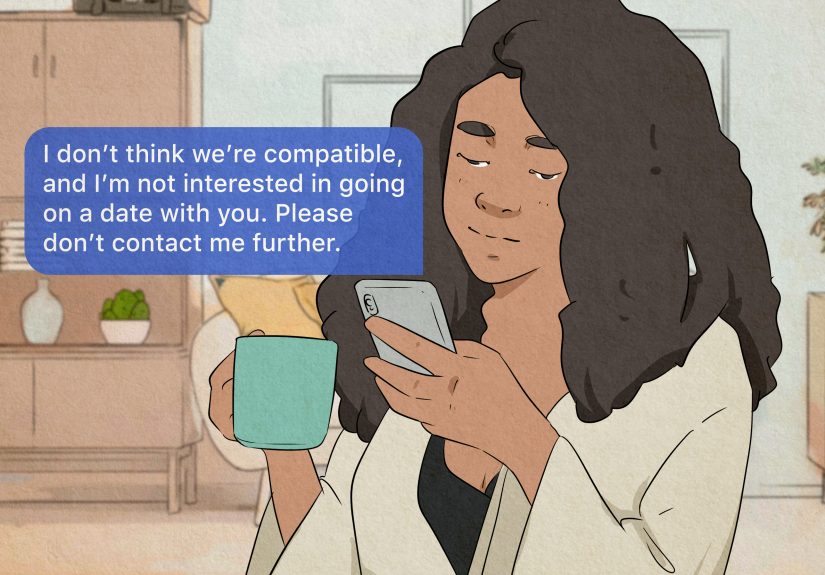
- “No. Do not contact me further.”
Then use the tools the platform gives you: unmatch, block, and report if needed. Save screenshots if the messages are threatening or abusive.
What not to do (unless you love unnecessary sequels)
- Don’t over-apologize. “Sorry” once is fine. A 12-part apology can sound like guilt or uncertainty.
- Don’t negotiate. “Convince me” energy attracts the wrong crowd.
- Don’t insult their profile. “Your fish photo haunts me” is funny in your group chat, not in their inbox.
- Don’t give false hope. If you say “maybe,” some people will hear “challenge accepted.”
Mini scripts for the most common online dating moments
When you haven’t met yet
- “Thanks for the invite, but I’m going to pass. Wishing you luck!”
- “I don’t think we’re the right match, so I’ll decline. Take care.”
When you went on one date
- “Thanks again for meeting up. I had a nice time, but I’m not feeling the connection I’m looking for. Wishing you the best.”
- “I appreciate your time, but I don’t want a second date. Take care.”
When they keep asking “Why?”
You can respond once, briefly, without opening the door to a debate.
- “I just don’t feel it, and I don’t want to lead you on. I wish you well.”
- “I’m not going to get into specifics, but I’m confident in my decision. Take care.”
When you feel guilty
A polite rejection is a kindness. It’s better than dragging things out or disappearing without explanation after making plans.
FAQ: polite online rejection, answered
Is it ever okay to ghost?
Ghosting can be hurtful in normal situations, especially after you’ve met. But if someone is disrespectful, aggressive, or makes you feel unsafe, you don’t owe them closure. Safety beats etiquette.
Should I give a reason?
If you’ve only exchanged a few messages, a reason usually isn’t necessary. If you’ve gone on a date, a simple reason (“not feeling the connection”) can be courteous. Skip hyper-specific critiquesnobody needs notes on their laugh.
Can I say I’m seeing someone else even if I’m not?
You can, but you don’t have to. A straightforward “I’m not interested” is enough. If you use “seeing someone else,” keep it short and don’t invent a fictional fiancé named Chad with a golden retriever.
What if they react badly?
End the conversation. Don’t argue. Use in-app safety features (block/report), and talk to someone you trust if you feel shaken. If threats are involved, save evidence and consider reporting through appropriate channels.
Closing thoughts: you can be kind and still be done
Turning down a date online is one of those tiny modern skills no one taught us in schoolright between “how to file taxes” and “why your Wi-Fi stops working the second you need it.” The goal isn’t to deliver a rejection so perfect it wins an award. The goal is to be respectful, clear, and safe.
Pick the script that fits the situation, keep it brief, and remember: a healthy boundary is not an insult. It’s just information.
Experiences people share: what it looks like in real messages
Because online dating happens in the wildwhere notifications strike at inconvenient times and “Hey” arrives with the confidence of a TED Talkmany people end up learning rejection etiquette the hard way. Here are a few common, very human scenarios (and what tends to work) drawn from patterns daters often describe.
The “Weekend Planner” who moves fast
You match on Tuesday. By Wednesday night, they’re proposing a three-hour dinner, a concert, and “maybe a sunrise hike.” That level of enthusiasm can be sweet, but it can also feel like being drafted into someone else’s calendar. In this case, the boundary script (“I’m looking for a different pace”) does two things: it’s honest and it tests how they handle limits. If they respond with “Totally understand,” you’ve met a grown-up. If they respond with “Wow, you’re stuck up,” you’ve met a walking red flag with a phone plan.
The “Why though?” negotiator
Some people treat a no like a starting offer. You decline politely and they reply, “But why? Just one drink.” Then “What if it’s coffee?” Then “Okay, what about a 20-minute walk?” This is where a short, firm repeat is your friend: “I’m not interested, and I’m not going to debate it.” The goal isn’t to persuade them; it’s to end the loop. If the questions continue, that’s your cue to unmatch or block. Your attention is not a renewable resource.
The “I hate small talk” speedrunner
They ask for your number immediately, want to move to another app, or push for personal details (“Where do you live exactly?”). Even if they claim it’s about “being real,” the safest approach is to keep communication on the platform until you feel comfortable. A calm line like “I don’t share my number yet” is enough. You’re not being paranoidyou’re being practical in a space where scammers and boundary-pushers exist.
The perfectly nice person you’re just not into
This is the one that triggers the most guilt. They’re polite. They use punctuation. They don’t ask for pictures of your feet. In other words: they’re fine. You’re simply not feeling it. Many people over-explain here (“I’m just so busy” “I’m working on myself” “Mercury is in retrograde”). But the cleanest experience for both sides is usually a gentle truth: “I’m not feeling the connection I’m looking for.” It’s short, it doesn’t attack their personality, and it closes the door without slamming it.
After a good first date that didn’t click
Sometimes the date is pleasantjust not yours. The mistake people often make is sending a warm “Let’s do it again!” text out of politeness and then panicking. A better move is a quick follow-up that matches reality: “Thanks againnice meeting you, but I don’t want to pursue this romantically.” It may feel uncomfortable for 30 seconds. It also prevents a week of awkward scheduling and emotional whiplash.
When rejection turns into rudeness
If someone responds to a polite no with insults, threats, or repeated messages, the “be nice” chapter is officially over. Most apps have built-in ways to block and report. Many people also find it helpful to screenshot the messages before taking action, especially if harassment escalates. The point is not to “win” the conversationit’s to exit it and protect your safety.
In all these situations, the best rejection scripts share the same DNA: kind, clear, and final. You can be a good person and still say no. In fact, being straightforward is often the most respectful thing you can dobecause it gives someone the chance to move on to a yes that actually fits.