Table of Contents >> Show >> Hide
- The Discovery in Förderstedt: When a Powerline Met Prehistory
- Who Were the Bell Beaker People?
- Why the Warrior Interpretation Matters
- Warrior, Hunter, or Elite Archer?
- What the Skeletons Can Tell Us
- The Burial Customs: Direction, Position, and Meaning
- What the Grave Goods Reveal About Status
- Why Organic Traces Are Archaeological Gold
- How This Discovery Changes the Bigger Picture
- Lessons From the Ancient Warriors of Förderstedt
- Experience-Based Reflections: Standing at the Edge of an Ancient Grave
- Conclusion
Every so often, archaeology serves up a discovery that feels like it walked straight out of an adventure novelminus the booby traps, glowing idols, and dramatic theme music. In Förderstedt, Saxony-Anhalt, Germany, archaeologists uncovered skeletal remains linked to the Bell Beaker culture, an ancient European society known for its distinctive pottery, long-distance connections, and burial customs that still keep researchers happily busy with measuring tape, brushes, and very muddy boots.
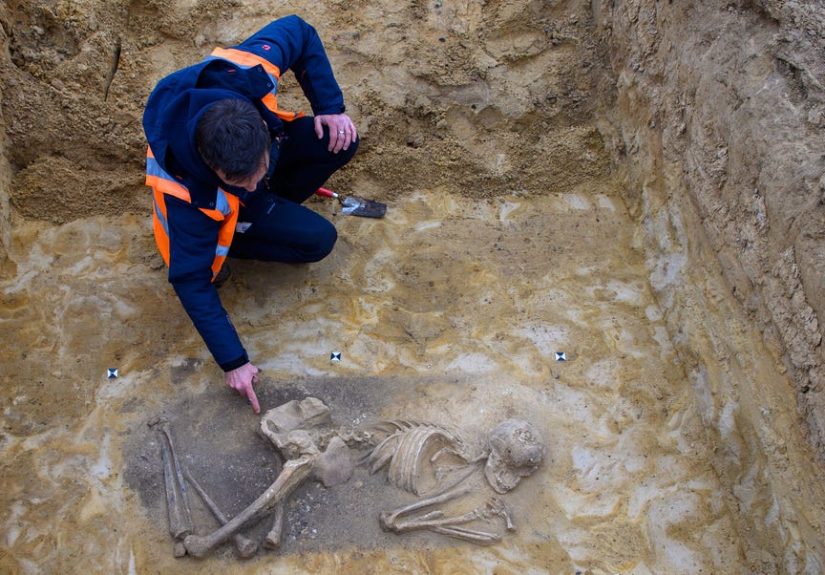
The discovery included graves dating to roughly 2500–2050 B.C., a period often called the Eneolithic or Copper Age. The site was found during archaeological work ahead of the SuedOstLink powerline project, proving once again that modern construction has a strange talent for bumping into ancient history. Instead of just soil and stone, the excavation revealed at least ten graves, including well-preserved burials with objects associated with archery: arrowheads, a stone wrist guard, ceramic vessels, and signs of a possible quiver that had long since decomposed.
For readers searching for ancient warrior skeletons, Bell Beaker culture, prehistoric archers, Copper Age graves, and archaeological discoveries in Europe, this find delivers a fascinating story. But it also asks a bigger question: were these people truly warriors, hunters, elite archers, or members of a society where weapons carried symbolic power as much as practical use? Archaeology rarely hands us a label written in permanent marker. Instead, it gives us cluesand invites us to do the careful detective work.
The Discovery in Förderstedt: When a Powerline Met Prehistory
The Förderstedt cemetery was uncovered along the planned route of the SuedOstLink, a major direct-current powerline project. Before such large infrastructure projects move forward, archaeological investigations are often required, especially in regions like Saxony-Anhalt, where the ground has been quietly storing human history for thousands of years.
Archaeologists from the State Office for Heritage Management and Archaeology of Saxony-Anhalt identified graves belonging to the Bell Beaker culture. Three particularly well-preserved burials were found at a depth of about two meters and appear to have been covered by a shared burial mound. The bodies were placed in a crouched position and oriented eastward, matching known Bell Beaker funerary customs.
One burial contained a bell-shaped ceramic vessel, likely used to hold food offerings for the deceased. Another included a red stone wrist guard measuring about 8 by 4 centimeters. This type of wrist guard, sometimes called a bracer, is commonly associated with archery because it can protect the forearm from the bowstring. A third burial contained two arrowheads near the back of the skeleton, placed within a discoloration in the soil. That discoloration may mark where an organic quiver once rested before time, moisture, and microbes politely ate the evidence.
Who Were the Bell Beaker People?
The Bell Beaker culture takes its name from its pottery: inverted bell-shaped vessels often decorated in horizontal bands. These vessels were not just prehistoric cups with good branding. They formed part of a broader cultural package that spread across wide parts of Europe during the late Neolithic and early Bronze Age.
Bell Beaker communities were not one single empire, tribe, or nation. They were more like a network of related traditions spread across different regions. Their material culture included pottery, copper daggers, wrist guards, arrowheads, ornaments, and distinctive burial practices. In some areas, Bell Beaker customs blended with local traditions. In others, ancient DNA studies suggest substantial migration and demographic change, especially in Britain.
This complexity matters. When we say “Bell Beaker culture,” we are not describing one uniform people with identical clothing, language, diet, or weekend plans. Archaeologists use the term to describe patterns in objects, graves, practices, and sometimes genetic ancestry. In other words, it is a cultural label built from evidencenot a passport.
Why the Warrior Interpretation Matters
The Förderstedt burials attracted attention because of their association with archery. Arrowheads and wrist guards are among the clearest objects that suggest a person may have used a bow. In Bell Beaker graves, such items can indicate martial identity, hunting skill, social status, or symbolic prestige.
That is where things get interesting. A wrist guard near the forearm may suggest practical archery equipment. But scholars have debated whether Bell Beaker wrist guards were always functional. Some may have been worn in ways that made them less useful as actual protection, raising the possibility that they served as symbols of identity, status, or ritual power. Think of them as the ancient equivalent of a ceremonial sword: impressive, meaningful, and not necessarily used every Tuesday.
The arrowheads in the third grave strengthen the idea that at least one person was buried with archery equipment. The possible quiver trace is especially valuable because organic materials rarely survive for thousands of years. Leather, wood, bark, and plant fibers usually vanish, leaving only stains, impressions, or changes in soil color. Archaeologists must then interpret these faint traces carefully, like reading a message written in disappearing ink by someone who lived 4,500 years ago.
Warrior, Hunter, or Elite Archer?
Calling the buried individuals “warriors” is exciting, but responsible archaeology keeps one foot on the brake. A bow can be a weapon of war. It can also be a hunting tool. In many societies, it can be both. A person buried with arrows might have defended a community, hunted deer, participated in ceremonies, or held a respected social identity tied to archery.
There is also the possibility that the objects were not everyday tools but funerary symbols. Grave goods do not always describe a person’s daily routine. A dagger in a grave does not prove someone spent every afternoon dueling neighbors. A vessel with food does not mean the person was a chef. Objects placed with the dead often reveal what the living community wanted to remember, honor, or project.
Still, the combination of arrowheads, a wrist guard, burial position, and Bell Beaker context makes the warrior or archer interpretation compelling. These were not random items tossed into the grave like someone cleaning out a prehistoric garage. They appear to have been placed deliberately, following traditions meaningful to the community.
What the Skeletons Can Tell Us
Skeletal remains are more than bones. To trained specialists, they are records of age, sex, health, movement, stress, injury, diet, and sometimes ancestry. The pelvis and skull can help estimate biological sex. Teeth can reveal childhood health and diet. Bone remodeling may show repeated physical activity. Trauma can suggest violence, accidents, or medical conditions.
In cases like Förderstedt, researchers may use radiocarbon dating, osteological analysis, stable isotope testing, and ancient DNA study if preservation conditions allow. Radiocarbon dating helps establish age. Isotopes can suggest what people ate and whether they grew up locally or moved during life. DNA can help explore ancestry and kinship. None of these methods is magic, despite what television crime dramas might suggest. Each requires careful sampling, ethical handling, and cautious interpretation.
Because human remains are irreplaceable, destructive testing must be limited and justified. Archaeologists increasingly rely on detailed photography, 3D scanning, CT imaging, and careful documentation before any sample is removed. The goal is to learn as much as possible while preserving the remains for future generations of researchers, who will almost certainly have better tools and probably better coffee.
The Burial Customs: Direction, Position, and Meaning
Bell Beaker burial customs often followed patterns based on body position and orientation. In Central European Bell Beaker contexts, men were commonly placed on the left side with the head toward the north, while women were often placed on the right side with the head toward the south. The face was generally turned eastward.
This eastward orientation may have had cosmological meaning, perhaps connected to sunrise, renewal, or beliefs about the journey after death. Archaeologists must be careful not to overstate the meaning, because the Bell Beaker people did not leave behind an instruction manual titled “Why We Pointed Everybody East.” But repeated patterns across burial sites suggest these choices were not accidental.
The graves also show that Bell Beaker communities invested thought in funerary practice. Even when grave goods were sparse, the placement of bodies and objects followed recognizable conventions. At Förderstedt, the shared burial mound may point to community memory, family identity, or social grouping. The dead were not simply disposed of; they were arranged, equipped, and remembered.
What the Grave Goods Reveal About Status
The objects found in the Förderstedt graves include ceramic vessels, arrowheads, and a wrist guard made of Gotland sandstone. The stone’s geological story is noteworthy because material associated with Gotland could have reached Central Germany through Ice Age glacial movement. Whether valued for appearance, availability, symbolism, or durability, the wrist guard stands out as more than a casual pebble with ambitions.
Across Bell Beaker contexts, certain objects appear repeatedly: beakers, daggers, wrist guards, ornaments, and archery equipment. These items may have marked identity, social standing, gender roles, or participation in long-distance exchange networks. Some burials are modest; others are richer. The variation hints that Bell Beaker societies were not flat and identical but had differences in status, role, and ritual importance.
The Förderstedt find adds another piece to this puzzle. A person buried with archery gear may have been remembered as skilled, powerful, protective, or prestigious. Whether that role was practical, symbolic, or both, it mattered enough to follow him into the grave.
Why Organic Traces Are Archaeological Gold
One of the most intriguing elements of the Förderstedt discovery is the possible trace of a quiver. Organic objects usually disappear unless preserved in unusual conditions such as extreme dryness, freezing, waterlogging, or mineralization. In ordinary soil, a leather or bark quiver would decay, leaving little behind.
That is why soil discoloration can be so important. A stain may preserve the outline or position of an object that no longer exists. It is not glamorous in the way gold jewelry is glamorous, but to archaeologists, a subtle soil stain can be thrilling. Yes, archaeologists can get excited about dirt. This is not a flaw in the profession; it is basically the job description.
If the discoloration near the arrowheads does represent a quiver, it gives researchers rare evidence of how archery equipment was arranged in the burial. It also supports the interpretation that the arrows were not random offerings but part of a larger equipment set.
How This Discovery Changes the Bigger Picture
The Förderstedt graves do not rewrite all of European prehistory by themselves. Archaeology is usually less “one discovery changes everything” and more “one discovery makes the spreadsheet more interesting.” But the find does add valuable detail to our understanding of Bell Beaker life, death, identity, and martial symbolism.
It reinforces the idea that archery was culturally significant among Bell Beaker communities. It also highlights how infrastructure archaeology can uncover major discoveries. Roads, railways, pipelines, and powerlines often require surveys that reveal buried settlements, cemeteries, and ritual landscapes. Modern development can threaten archaeological sites, but when managed responsibly, it can also bring hidden history into view.
The find also reminds us that “warrior” is not a simple label. A person can be a hunter, defender, ritual specialist, elite community member, and symbol of group identity all at once. Ancient people had complicated lives. They did not exist merely to fit neatly into our museum labels.
Lessons From the Ancient Warriors of Förderstedt
1. Weapons Can Be Practical and Symbolic
The bow was a tool of survival and conflict. But in Bell Beaker graves, archery equipment may also have represented identity, masculinity, status, ritual role, or ancestral memory. The same object can carry many meanings depending on context.
2. Burial Is a Message From the Living
Graves tell us about the dead, but they also tell us about the living people who created them. The placement of the body, the selection of objects, and the construction of a burial mound reveal community values.
3. Small Finds Can Carry Big Stories
An 8-by-4-centimeter wrist guard may look modest, but it can open discussions about warfare, hunting, trade, craftsmanship, and belief. Archaeology often works this way: the smallest object becomes the loudest witness.
4. Ancient Cultures Were Connected
The Bell Beaker phenomenon spread across large areas of Europe. Its pottery, burial traditions, metalwork, and symbols show that prehistoric communities were not isolated villages staring suspiciously at the horizon. They exchanged ideas, objects, technologies, and sometimes people.
Experience-Based Reflections: Standing at the Edge of an Ancient Grave
Imagine standing beside a freshly opened grave cut in a quiet field. The modern world is still nearby: survey flags, machinery, safety vests, the low hum of a construction project waiting its turn. Yet in the soil below, a person lies exactly where a community placed him roughly 4,500 years ago. That contrast is one of the most powerful experiences connected to archaeology. You are not just looking at “the past” as an abstract idea. You are looking at a decision made by human hands.
For anyone who has visited an archaeological site, a museum burial display, or even a reconstructed prehistoric village, the first lesson is humility. Ancient people were not primitive cardboard figures. They had technologies suited to their world, social rules, spiritual ideas, skilled craftspeople, and emotional lives. The Förderstedt warriorsor archers, or hunter-warriorswere part of a community that understood death through ritual. Someone chose the body’s position. Someone placed the vessel. Someone included the wrist guard or arrows. These were acts of care, memory, and meaning.
A discovery like this also changes how we experience ordinary landscapes. A field is not just a field. A construction corridor is not just a technical route. Beneath the surface may be graves, hearths, postholes, ditches, tools, and the faint stains of objects that disappeared thousands of years ago. Archaeology teaches us that landscapes have layers. The top layer belongs to us for now, but it is not the whole story.
There is also a strange emotional connection in seeing warrior equipment in a grave. A wrist guard suggests movement: the drawing of a bow, the release of a string, the snap of tension, the practiced rhythm of skill. Arrowheads suggest danger, hunting, protection, or prestige. Even if we cannot know the individual’s name, we can recognize the human body behind the artifacts. This was someone who lived in a world of weather, hunger, relationships, risk, and responsibility.
For writers, students, travelers, and history lovers, the best way to engage with such a discovery is to resist the urge to make it too simple. It is tempting to say, “They found ancient warriors,” and stop there. But the better story is richer: archaeologists found graves from a complex prehistoric culture; some individuals were buried with archery-related objects; those objects may reveal warfare, hunting, status, ritual identity, or all of the above. The mystery is not a weakness. It is the reason the discovery matters.
In the end, the Förderstedt burials offer an experience that good archaeology often provides: they make time feel thin. A person from the Copper Age, buried with objects his community considered important, becomes visible again. Not fully, not perfectly, but enough to remind us that history is not only written in books. Sometimes it waits underground, patient as stone, until a shovel, a brush, and a very attentive archaeologist bring it back into the light.
Conclusion
The discovery of skeletal remains linked to ancient Bell Beaker warriors in Förderstedt is more than a dramatic headline. It is a carefully documented archaeological find that opens a window into Copper Age Europe, where burial rituals, archery equipment, pottery, and social identity were woven together in meaningful ways. The wrist guard, arrowheads, and possible quiver trace suggest that some individuals were remembered as archers, hunters, warriors, or elite figures whose roles mattered deeply to their community.
What makes the discovery especially compelling is its balance of evidence and mystery. We know enough to recognize the Bell Beaker context, the burial customs, and the significance of archery-related grave goods. Yet we do not know every detail of who these people were, what language they spoke, what battles they may have fought, or what songs were sung when they were buried. That unanswered space is not frustrating; it is the heartbeat of archaeology.
In the soil of Förderstedt, the ancient dead did not simply vanish. They left behind bones, tools, traces, and questions. And for modern readers, that is the real treasure: not a golden crown or a cursed relic, but a clearer, more human view of a world that existed thousands of years before oursand still has something to say.