Table of Contents >> Show >> Hide
- From Empty Field to “Prehistoric Eden”
- Late Upper Paleolithic: The First Visitors, Around 10,000 B.C.
- Mesolithic Campsites: Life in Tents and Firelight
- Neolithic Farmers: The First Fields in the Field
- Bronze Age Roundhouses and Metalworking
- The Late Bronze Age–Iron Age Fort
- Medieval Corn-Drying Kilns and the Long Tail of History
- Why This One Field Preserved 12,000 Years of History
- What This Field Tells Us About Human History
- From Trench to Subdivision: Living on Top of Deep Time
- Experiences and Lessons from a Field with 12,000 Years of History
Imagine buying a shiny new home and later finding out your backyard once hosted
hunter-gatherers, Neolithic farmers, Bronze Age metalworkers, Iron Age warriors, and
medieval grain dryers. That’s not the plot of a time-travel movieit’s exactly what
happened in Guardbridge, a village in Fife on Scotland’s east coast, when archaeologists
were called in to check a perfectly ordinary field before a housing development went
ahead.
What they expected: a quick look at a known fort on a low hill and then a green light
for the builders. What they actually found: evidence of human life stretching back to
around 10,000 B.C., representing almost every major period of Scottish prehistory in
one place. Nearly 12,000 years of history were stacked beneath the topsoil of a single
field, like a very muddy, very ancient layer cake.
From Empty Field to “Prehistoric Eden”
The story began in a very modern way. Fife Council required an archaeological
investigation before Persimmon Homes North Scotland could build more than 300 houses
near the River Eden. Developers brought in Guard Archaeology, a commercial firm that
routinely checks construction sites. At first, the team focused on ditches they already
knew were tied to an Iron Age–style fort overlooking the estuary.
Once they opened evaluation trenches, however, it became clear something much bigger was
going on. Beneath the ploughsoil, layer after layer of features appeared: scatters of
flint, hearths, pits full of burnt grain, postholes from roundhouses, defensive banks,
and medieval kilns. As the team dug deeperliterally and chronologicallythe timeline
kept stretching backwards until they had what one archaeologist described as “the whole
prehistory of Fife in one field.”
That’s why some reports now refer to the site as a kind of “Prehistoric Eden”a place
where people kept coming back, generation after generation, for thousands of years. The
appeal isn’t hard to understand: a sheltered slope above a rich estuary, access to
freshwater, fertile land for crops, and strategic views over the landscape. If you were
picking a long-term neighborhood in 10,000 B.C., this was prime real estate.
Late Upper Paleolithic: The First Visitors, Around 10,000 B.C.
At the very bottom of the archaeological sequence, the team uncovered a scatter of flint
pieces left behind by some of the earliest humans known in Scotland. These Late Upper
Paleolithic hunter-gatherers lived not long after the last Ice Age glaciers retreated.
They likely camped here seasonally while following migrating animals and exploiting
coastal resources.
Because these people were mobile, they didn’t leave stone foundations or permanent
buildings. Instead, archaeologists identify their presence through tool-making waste:
flakes, blades, and chips of flint and other stone. That debris field in Guardbridge is
a fossilized workshop floor, where someone sat and shaped their toolsmaybe while
watching the tides in the Eden estuary and wondering if the weather would cooperate.
Mesolithic Campsites: Life in Tents and Firelight
Above the earliest flint scatter, archaeologists found more evidence of hunter-gatherers
from the Mesolithic, or Middle Stone Age. One particularly evocative discovery was a
fire pit radiocarbon dated to roughly 4320–4051 B.C. Nearby, a pattern of burnt stone
tools formed a star-shaped spread. That layout closely matches the shape of a tent or
light shelter, where people sat around a central hearth with their tools and supplies
arranged around them.
It’s a rare moment where you can almost picture the scene: a few families tucked into a
temporary camp, drying fish or roasting meat, chipping new blades by firelight as the
wind off the estuary rattled the hides of their shelter. They would have had no idea
that farmers, metalworkers, and fort builders would one day reuse the same ground for
completely different purposes.
Neolithic Farmers: The First Fields in the Field
By the Neolithic period, people in Fife were no longer just passing throughthey were
farming. At Guardbridge, archaeologists uncovered pits filled with burnt cereal grains,
fragments of pottery, and heavy grinding stones called saddle querns. These finds point
to settled communities growing crops, grinding grain, and storing food nearby.
This mirrors a wider shift across Europe as societies transitioned from mobile
foraging to more permanent villages and fields. Sites such as Göbekli Tepe in modern
Turkey and early Neolithic settlements in southeastern Europe show how communities were
experimenting with agriculture and new forms of social organization around this time.
Guardbridge fits that same pattern on Scotland’s Atlantic fringeanother data point in
the story of how farming spread and reshaped human life.
Bronze Age Roundhouses and Metalworking
If you could walk across the Guardbridge field in the Bronze Age, you wouldn’t see an
empty meadowyou’d be strolling through a busy neighborhood of roundhouses. The
excavations revealed substantial circular houses, with postholes, hearths, and thick
layers of discarded pottery and animal bone. These weren’t overnight camps; they were
lived-in homes.
Even more impressive, the team uncovered evidence of on-site metalworking. Among the
finds were rare casting molds for a sword blade and a socketed gouge, a tool used in
woodworking. These suggest that some residents were skilled metalworkers producing tools
and weaponsa big step up from knapping flint in a tent.
Everyday life left its mark, too. In one house, archaeologists found evidence that
someone had been knapping flint in the porch area, probably taking advantage of natural
light and shelter. Animal bones pointed to mixed farming: cattle, sheep, and other
livestock raised alongside crops. If you ignore the lack of Wi-Fi, it starts to sound
surprisingly like a rural community today.
The Late Bronze Age–Iron Age Fort
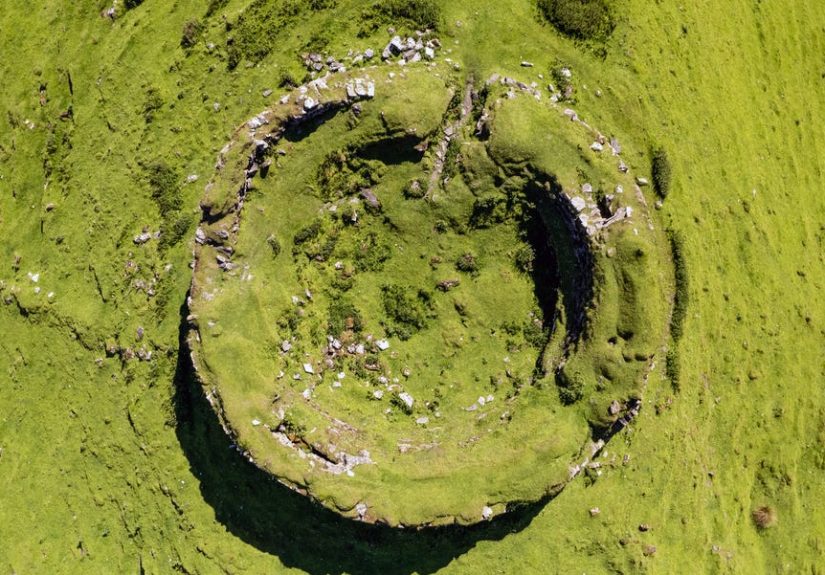
The most visually dramatic feature at Guardbridge is the multi-vallate fort: a defended
enclosure with multiple banks and ditches overlooking the Eden estuary. Initially
identified from aerial photographs, the fort turned out to be olderand longer-lived
than expected. Excavations showed it likely began in the Late Bronze Age and continued
in use well into the Iron Age.
Inside the fort, archaeologists found spindle whorls and loom weights, which tell us
that the inhabitants were weaving woolen cloth. Fragments of shale bracelets show they
also cared about personal adornment; fashion, it seems, has always mattered. Combined
with pottery, quern stones, and metalworking debris, the finds suggest a thriving
community that controlled a strategic vantage point and participated in regional trade.
The fort might have served as a local power centerpart defensive stronghold, part
status symbol, and part economic hub. It would have been a visible statement that this
landscape, already home to millennia of human activity, now belonged to a particular
group with the resources to build big earthworks.
Medieval Corn-Drying Kilns and the Long Tail of History
The Guardbridge timeline doesn’t stop with the Iron Age. Medieval farmers also left
their imprint in the form of corn-drying kilnsstone-lined structures used to dry grain
before milling. These kilns show that, even as political systems and religions changed,
the practical logic of the site stayed the same. It was still a good place to grow and
process food, just as it had been thousands of years earlier.
By the time we reach the Middle Ages, we’re looking at a landscape that had already
accumulated layer upon layer of human choices: where to camp, where to plant, where to
build, where to defend. The medieval farmers probably had no idea they were working on
top of Paleolithic campsites and Neolithic fieldsjust as modern homeowners often have
no idea what lies beneath their lawns.
Why This One Field Preserved 12,000 Years of History
So why did Guardbridge, of all places, end up with such a deep time-capsule beneath one
field? A few key factors likely worked together:
-
Location, location, location: The site sits on a gentle slope above
the Eden estuary, close to freshwater, marine resources, and fertile land. That
combination has been attractive for as long as humans have lived in Scotland. -
Continuity of use: People didn’t just visit once and move on. They
returned repeatedly over thousands of years, sometimes camping, sometimes farming,
sometimes fortifying. Each era added new features and artifacts. -
Gentle land use: For much of its history, the field was probably
pasture or lightly ploughed land. It wasn’t turned into a quarry or heavily
terraced, so the buried archaeology survived. -
Modern planning rules: Crucially, the archaeology survived long
enough to be discovered because modern planning laws required an excavation before
construction. Without that step, 12,000 years of history might have been erased by a
few weeks of bulldozer work.
Sites like Guardbridge also help archaeologists understand bigger patterns. When you
set this field’s story alongside long-term sites around the worldfrom early temple
complexes in Anatolia to submerged Stone Age hunting structures off the Baltic
coastyou start to see how often humans return to the same “good spots” over and over.
What This Field Tells Us About Human History
The Guardbridge excavations compress a sweeping story into a single patch of ground:
climate change after the Ice Age, the arrival of farming, the adoption of metal
technology, the rise of fortified sites, and the rhythms of medieval agriculture. It’s
a reminder that “history” isn’t just what’s written in chronicles or carved on
monuments. It’s also hidden in fire pits, grain fragments, half-broken bracelets, and
the charred remains of someone’s last dinner.
For archaeologists, the site offers a rare chance to study continuity and change in one
tightly defined place. Instead of comparing different sites scattered across a region,
they can track how the same slope above the Eden estuary was reused and reimagined time
after time. For the rest of us, it offers a more personal takeaway: wherever you’re
standing right now, there’s a good chance people have stood there before you, making
choices that shaped the ground under your feet.
From Trench to Subdivision: Living on Top of Deep Time
Today, new houses sit where roundhouses once stood and where Mesolithic hunters warmed
their hands over smoky fires. Most residents will never see the flints, querns, loom
weights, or sword molds that once lay beneath their driveways. But thanks to the
excavations, those objects have been documented, studied, and preserved in archives and
museums instead of being ground into rubble.
It’s an odd but charming thought: kids racing scooters down the sidewalk above a former
Bronze Age metalworking area; someone grilling in the backyard roughly where an Iron
Age weaver once spun yarn; a family streaming movies in a living room that overlaps a
Neolithic field. Deep time and everyday life are quite literally sharing the same
address.
Experiences and Lessons from a Field with 12,000 Years of History
Reading about Guardbridge is fascinating, but what does it feel like to actually be on
a site like this? Archaeologists who’ve worked in similar multi-period landscapes often
talk about a strange sense of vertigonot from heights, but from time. You’re standing
in one spot, but every trowel scrape jumps hundreds or thousands of years.
One day you might be carefully cleaning a medieval kiln, picking out fragments of
charcoal and burnt grain while imagining the smell of drying barley. The next, you’re
in the same trench but deeper, revealing a Mesolithic hearth. The soil color changes,
the shape of the feature shifts, and suddenly you’re dealing with people who had never
seen metal, pottery, or a domesticated cow. You’re still kneeling in the same field,
but your mental “neighbors” have completely changed.
That layered experience reshapes how archaeologists think about place. It stops being
just “a field near a village” and starts feeling like a long-term partnership between
people and landscape. You see how different communities made use of the same basic
advantagesgood water, good views, decent soilbut expressed them in completely
different ways. Hunters pitched tents. Farmers dug storage pits. Metalworkers built
furnaces. Fort builders threw up banks and ditches. Medieval peasants added kilns.
Modern developers, in turn, brought in survey stakes, drainage pipes, and show homes.
Visiting a site like this as a non-archaeologist can be equally powerful, even if most
of the evidence is gone once construction begins. Many excavation teams now produce
public booklets, interpretation panels, or online summaries so local residents know
what was found under their streets. Reading those materials, then walking the finished
neighborhood, can be strangely moving. It’s hard not to picture the Bronze Age
roundhouses while passing a row of modern semidetached homes, or to imagine a Mesolithic
campfire where the playground swings now stand.
There are some practical lessons here, too:
-
If you’re buying a new-build home: Ask whether archaeology was done
on the site. You might discover your cul-de-sac sits on top of something remarkable. -
If you’re a local history buff: Look for excavation reports or
summaries from planning-related digs in your area. They’re often freely available and
can completely change how you see familiar streets. -
If you travel: When you visit castles, museums, or heritage sites,
pay attention to nearby “ordinary” fields. As Guardbridge shows, a plain pasture can
hide as much history as a famous monument.
On a deeper level, standing on a site with 12,000 years of occupation tends to shrink
your personal timeline in the best possible way. Daily annoyances feel smaller when you
remember that people here have worried about weather, harvests, safety, and family for
hundreds of generations. You may not share their tools or technology, but you share the
same instinct to choose promising places and call them home.
In the end, that’s the quiet magic of this one field in Fife. It proves that history
isn’t just a string of dates; it’s a long, ongoing conversation between people and the
land beneath their feet. Sometimes, if we’re lucky, we get to listen in.