Table of Contents >> Show >> Hide
- What you’ll get from this guide
- What are Areaware Balancing Blocks?
- Design details that make them more than “pretty blocks”
- Materials, finish, and what’s actually in the box
- How to play (or “how to stop them from falling every 12 seconds”)
- Why they work as both decor and a “brain reset”
- Who are these for?
- Care tips and longevity
- Buying notes: availability and what to watch for
- Wrap-up: the point of a toy that looks like art
- Real-World Experiences with Areaware Balancing Blocks
- SEO Tags
Some toys come with instructions. Some decor comes with rules. Areaware Balancing Blocks show up, kick both of those ideas out of the room, and then politely balance on the doorframe just to prove they can.
At first glance, they look like smooth, faceted “wood stones” that wandered out of a modern art museum and decided to live on your coffee table. Five minutes later, you’re hunched over them like a tiny engineer, whispering “Please… just one more millimeter,” while a leaning tower of oak threatens to become an interpretive piece called Gravity Wins Again.
What you’ll get from this guide
- What Balancing Blocks are (and why they’re weirdly addictive)
- Materials, colors, and what “tumbled paint” actually means
- How to build sculptures that look impossible (without breaking your spirit)
- Why they work as both a toy and a grown-up desk reset
- Care tips, gifting ideas, and what to know about availability
What are Areaware Balancing Blocks?
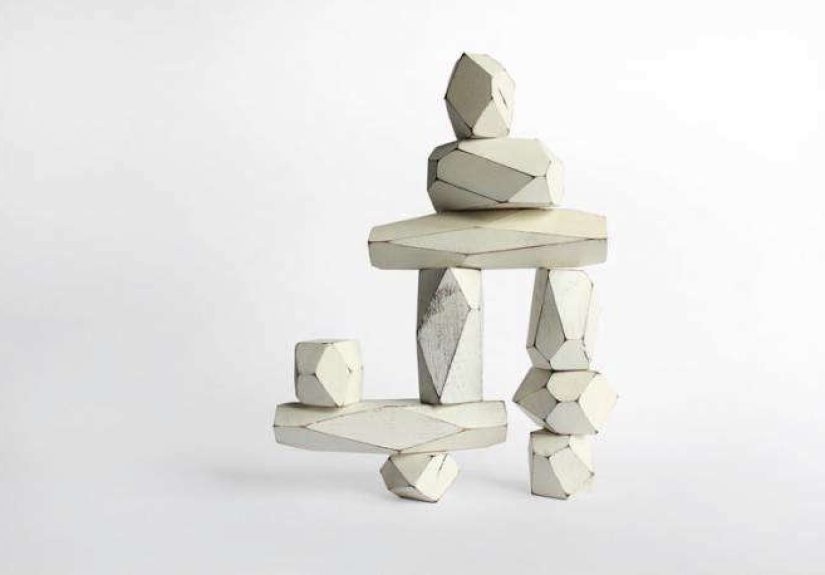
Areaware Balancing Blocks are a set of ten solid wood blocks designed to be stacked, tilted, cantilevered, and generally coaxed into sculptures that look like they shouldn’t be standing. The shapes are multi-facetedthink “river rock meets geometry class”which gives you a surprising number of edges and planes to balance against.
The set is associated with Fort Standard (a Brooklyn-based design studio), and it’s often described as a modern twist on classic building blocks: less “alphabet tower,” more “tiny Stonehenge you made during a conference call.”
They’re frequently sold as a play object, a desk toy, and a sculptural decor piecewhich sounds like marketing until you try them and realize they genuinely pull triple duty.
Design details that make them more than “pretty blocks”
1) Facets = more balancing options
Traditional blocks are basically a rectangular agreement with physics: flat side on flat side, done. Balancing Blocks are a negotiation. Their angled faces create many potential contact pointssome stable, some hilariously unstableso every new piece is a small puzzle. That’s the whole fun: you’re not just stacking; you’re composing.
2) “Stone-sized” is the sweet spot
They’re large enough to feel satisfying in your hands (not fiddly), but small enough to build on a shelf, a coffee table, or the one clear corner of your desk you’re protecting like a national park.
3) They look finishedeven when you’re “done” for the day
A lot of toys need to be put away. These can stay out. Even a half-built stack has that “gallery pedestal” vibeespecially in the quieter colorways. If your home style leans modern, Scandinavian, or “I buy candles that look like fruit,” they fit right in.
Materials, finish, and what’s actually in the box
What they’re made of
Most listings describe the set as solid oak (sometimes described as reclaimed/reused oak by certain retailers). The blocks are finished with a water-based paint often described as non-toxic, and they’re typically packaged with a cotton drawstring bag for storage.
Size and packaging
You’ll commonly see a measurement around 6 × 2 × 1.5 inches referenced for the blocks or the set (depending on the seller’s formatting), while some shops list box dimensions closer to 6 × 3 × 8 inches. In real-life terms: they’re substantial enough to feel “object-y,” not toy-ish.
Colorways you’ll see most often
The most common options are Ocean, Desert, White, and a Multi (sometimes labeled “Modern Multi” depending on the catalog or reseller). The paint is often described as “tumbled,” which means the finish looks slightly softenedless like glossy craft paint, more like color that’s been lived-in.
How to play (or “how to stop them from falling every 12 seconds”)
Start with three: base, bridge, crown
If you begin with all ten blocks, your first sculpture may end as a dramatic clatter and a long stare into the middle distance. Instead, start with three:
- Base: pick the widest-feeling block and find a stable face.
- Bridge: place a second block so it’s slightly off-center.
- Crown: add a third block as a small “cap” to lock the balance.
Once you get that first “it’s holding!” moment, you’ll understand why people call these satisfying.
Use micro-movements, not force
The trick is to slide and rotate by tiny amountsthink millimeters, not inches. When a structure wobbles, your instinct is to press down. Try adjusting sideways instead. You’re looking for a center of mass that lands inside the footprint of the block underneath.
Try three classic builds
- The Cantilever: one block extends out like a diving board, balanced by a heavier block behind it.
- The Arch: two “legs” with a flatter block bridging acrosssimple, dramatic, and photo-friendly.
- The Totem: stack upward with alternating angles, like a modern cairn you made without stealing rocks from nature.
Why they work as both decor and a “brain reset”
A surprisingly mindful object
Balancing objects forces you to slow down. You can’t rush it without punishment (gravity is a strict manager). That makes them a low-key, screen-free “reset” you can do in two minutes between tasks.
Open-ended play isn’t just for kids
Educational organizations have long pointed out that block play supports problem-solving, experimentation, and early math concepts like symmetry, measurement, balance, and spatial reasoning. The same logic applies here, just with nicer aesthetics and fewer cartoon animals printed on the sides.
They invite conversation
Put them on a shelf and someone will eventually pick one up and ask, “What is this?” That question is basically an invitation to play. It’s also an invitation for you to say, “Oh these? I’m an artist,” which is a lie you can tell with your whole chest if your sculpture hasn’t collapsed today.
Who are these for?
Design lovers and “coffee-table object” collectors
If you like objects that look intentionalthings that can sit next to books and ceramics without screaming “toy aisle”these are an easy yes.
Parents who want play that doesn’t feel disposable
Kids can absolutely use these as building blocks (with the usual common-sense supervision depending on age), but the real win is that they don’t become clutter you’re embarrassed to leave out.
Office workers, students, and anyone who needs a tactile break
They’re the opposite of doomscrolling. Your hands do something, your eyes focus, your brain gets a tiny vacation.
Care tips and longevity
- Cleaning: Wipe with a soft, damp cloth; skip harsh cleaners.
- Storage: Use the drawstring bag if you want them contained and portable (also helpful if you have a cat who thinks physics is a personal challenge).
- Display: Keep away from high-moisture areas if you want the wood and finish to stay looking crisp.
Buying notes: availability and what to watch for
Balancing Blocks are often sold through Areaware, Fort Standard/FS Objects, and a range of design retailers. As of early 2026, multiple news and retail outlets reported that Areaware plans to close on May 1, 2026, citing industry pressuresmeaning certain items may be harder to find directly over time, while remaining stock may continue through other retailers or the designer’s own storefronts.
Practical tip: if you see the colorway you want, don’t assume it will be restocked forever. Design favorites have a habit of turning into “Wait, why is this suddenly on resale sites for triple?” overnight.
Wrap-up: the point of a toy that looks like art
Areaware Balancing Blocks land in a rare sweet spot: they’re playful without being childish, sculptural without being precious, and calming without requiring incense or a life coach. They make a great gift, a better desk companion, and an excellent reminder that your brain likes solving little problemsso long as those problems come in solid oak and don’t email you back.
Real-World Experiences with Areaware Balancing Blocks
Because these blocks are open-ended, people tend to “use” them in surprisingly different ways. Here are a few realistic, common experiences (and what they feel like), drawn from how design objects like this are typically used in homes, studios, and offices.
The two-minute desk break that actually works
A lot of desk toys are basically guilt with a cute face: you spin it once, feel nothing, then wonder why you bought it. Balancing Blocks tend to earn their space because you can walk up, move three pieces, and get an immediate sense of progress. The micro-focus requiredfinding a stable plane, adjusting a tilt, testing a cantileverforces your attention into the present. People often describe this as a “reset” because it’s just complicated enough to interrupt stress, but not so complicated that it becomes another task.
“We made one rule: you can’t fix it if it falls”
In group settings, Balancing Blocks naturally become a tiny social game. One person builds, another person adds, and everyone else offers unhelpful commentary like, “That’s definitely stable,” which is famously the last thing said before a collapse. A fun rule that often emerges is no repairs: if your piece causes the whole structure to fall, you start a new build. It keeps things light, encourages experimentation, and makes the “failure” part funny instead of annoying.
Kids play, adults curate (then secretly play too)
In family homes, these often start as a kid-friendly building challengestacking, making towers, creating “castles” that lean, rebuilding after collapses. But because the shapes are sculptural, adults frequently end up styling the last build on a shelf “temporarily,” which somehow becomes a semi-permanent display. Then the cycle repeats: someone takes them down to play, someone else makes a new sculpture, and the house gets a new little art object that just happens to be interactive.
The “I’m not creative” moment… followed by a photo
One of the most common experiences with design-forward building objects is the surprise of making something that looks intentional. People who don’t think of themselves as creative often start by copying a simple stacked totem, then accidentally discover a dramatic cantilever. The result looks like a miniature modern monumentbalanced, angular, a little daring. That’s usually when phones come out. It’s not about proving anything; it’s just genuinely satisfying to create a small sculpture that looks like it should have a tiny placard next to it.
Mindfulness without the performance
Some folks want “mindful” activities but don’t want the ceremony. Balancing Blocks fit that mood. You don’t have to journal. You don’t have to chant. You just have to pay attention to weight and balance. The feeling is similar to stacking stonesexcept you’re not disturbing outdoor spaces, and you can do it at your kitchen table while pasta boils. The calm comes from the feedback loop: small adjustments, immediate results, quiet focus. Even when it falls, it’s more “welp” than “ugh,” because rebuilding is the point.
Decor styling that doesn’t feel fake
In design and content work (or just people who love a good shelf moment), these blocks often become “props” that don’t feel like propsbecause they’re functional. You can style them next to books, planters, or framed photos, then actually use them when someone’s waiting for coffee to brew. That mixvisual interest plus real interactionis why they tend to stick around instead of getting donated during the next “declutter weekend.”