Table of Contents >> Show >> Hide
- What Are Assisted Pullups (and Why They Work)?
- Benefits of Assisted Pullups
- How to Choose Your Assistance Method
- Form Checklist: Make Your Reps Count
- 8 Exercises to Try (Assisted Pullups + Progression Builders)
- How to Program Assisted Pullups (Without Overthinking It)
- Common Mistakes (and Quick Fixes)
- Safety Notes and Smart Modifications
- Wrap-Up: Your First Pull-Up Is a Process (But a Very Doable One)
- Experiences: What Assisted Pull-Up Progress Often Feels Like (About )
Pull-ups are the “open the pickle jar” of the gym world: everyone respects them, many fear them, and a few people somehow do them while talking. If you’re not in that last group yet, you’re in excellent company. Assisted pullups are the friendly on-rampgiving you the same movement pattern, the same key muscles, and the same confidence boost, just with training wheels you can gradually remove.
This guide breaks down what assisted pullups are, why they work, and how to use them to build a real, unassisted pull-up. Then you’ll get 8 exercises (including assisted pull-up variations and smart “supporting cast” moves) you can plug into your workouts right awaywithout turning every set into a bar-swinging audition tape.
What Are Assisted Pullups (and Why They Work)?
Assisted pullups are any pull-up variation that reduces how much of your body weight you must lift. That assistance can come from a machine, resistance bands, a partner, or even choosing a pulling angle that’s easier (like an inverted row). The goal is simple: practice the same pulling mechanics you’ll use in a strict pull-up while staying in a rep range that lets you learn good form and build strength.
Pull-ups are a compound exercise, meaning they involve multiple joints and large muscle groups at onceespecially your lats (big back muscles), mid-back, biceps, forearms, and the stabilizers around your shoulder blades. Your core also matters more than people expect: a stable torso makes your pull stronger and keeps you from swinging like a human pendulum.
Benefits of Assisted Pullups
1) Build pull-up strength without “zero-rep frustration”
If you can’t do a strict pull-up yet, the hardest part is that you don’t get enough quality practice. Assisted pullups let you train the movement for multiple reps, multiple sets, and multiple weeksso your body actually adapts instead of just being repeatedly surprised by gravity.
2) Practice proper form while you still have the bandwidth
When a movement is too hard, form tends to go on vacation. Assistance lets you focus on fundamentalsshoulder position, smooth tempo, full range of motionbefore you add more load by reducing help.
3) Improve grip and upper-body endurance
Assisted reps still require you to hang, squeeze, and control your body. Over time, your grip, forearms, and upper-body endurance catch upoften faster than you expect.
4) Strengthen the muscles that support posture and shoulder health
Balanced pulling strength supports the muscles that help keep shoulders from rounding forward. Plus, learning to set your shoulder blades (“down and back,” not shrugged) can make a big difference in comfort and control.
5) A clear progression path that’s easy to measure
With bands or machines, progression is straightforward: slightly less assistance, slightly cleaner reps, slightly more control. Small wins stack quicklyand small wins are dangerously motivating.
How to Choose Your Assistance Method
- Band-assisted pullups: Affordable, portable, and great for progressionjust remember bands can give more help at the bottom and less near the top.
- Assisted pull-up machine: Very consistent and beginner-friendly. You can precisely dial assistance up or down, which makes tracking progress easy.
- Partner assistance: Useful when done lightly and consistently, but it’s harder to quantify exactly how much help you’re getting.
- Angle-based assistance (inverted rows): Not a pull-up, but an excellent stepping-stone that builds similar muscles and scapular control.
Form Checklist: Make Your Reps Count
Set your shoulders before you pull
Start from a dead hang, then gently “pack” your shoulders: think shoulder blades sliding down (away from your ears) and slightly back. This turns on the upper-back stabilizers and puts you in a stronger position to pull.
Brace like you’re about to be lightly poked in the ribs
Pull-ups are a full-body movement. Keep ribs down, glutes lightly engaged, and avoid wild swinging. A little body English is fine; a full-body “kipping opera” is not the goal here.
Drive elbows down, not “chin up”
A helpful cue is to pull your elbows toward your back pockets. It keeps the focus on lats and mid-back rather than turning the pull-up into a biceps-only negotiation with the bar.
Control the lowering
The eccentric (lowering) phase builds strength and teaches control. Lower yourself smoothly until arms are close to straight (without collapsing into the shoulders).
8 Exercises to Try (Assisted Pullups + Progression Builders)
1) Band-Assisted Pull-Up
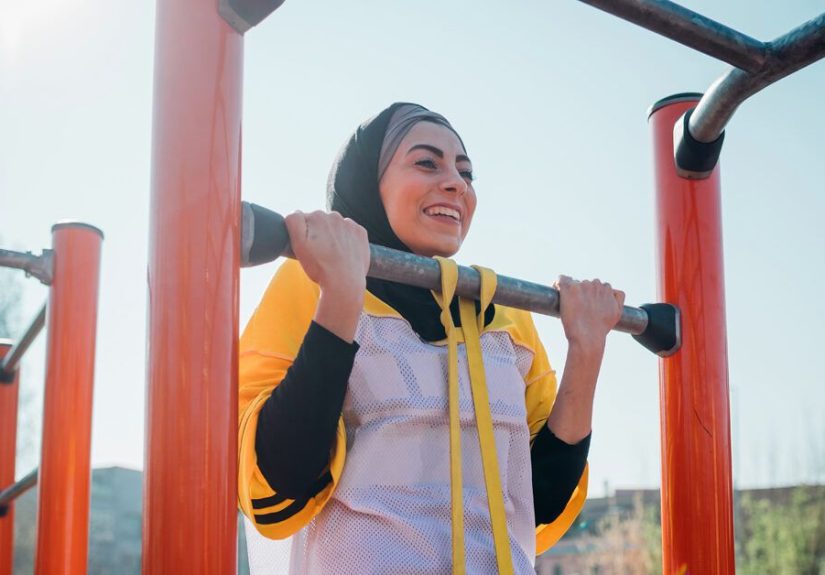
Loop a resistance band over the bar and secure it. Place one foot (or knee) into the band. Hang with a shoulder-width grip, set your shoulders, brace your core, and pull until your chin reaches the bar. Lower with control.
- Sets/Reps: 3–5 sets of 4–8 reps
- Make it easier: Use a thicker band or two bands
- Make it harder: Use a thinner band; pause 1–2 seconds at the top
- Common fix: If you swing, squeeze glutes and point toes slightly forward
2) Assisted Pull-Up Machine
Select an assistance level (more assistance = easier). Kneel on the pad, grip the handles or bar, and start from straight arms. Pack your shoulders, pull up smoothly, pause briefly, then lower under control.
- Sets/Reps: 3–4 sets of 6–10 reps
- Progression idea: Reduce assistance by the smallest available increment every 1–2 weeks
- Common fix: Don’t bounce off the padslow reps teach real strength
3) Partner-Assisted Pull-Up (Light Ankle Support)
Use a sturdy box to start in a dead hang. Your partner lightly supports one ankle or foot as you pull. The key is “just enough help to move well,” not a full-on forklift simulation.
- Sets/Reps: 3–4 sets of 3–6 reps
- Best use: When you want pull-up-specific practice but don’t have bands or a machine
- Common fix: Keep assistance consistent (same partner, same light touch) for tracking
4) Negative (Eccentric) Pull-Up
Step or jump to the top position (chin over bar). Then lower as slowly as you canaim for 3–8 secondsuntil arms are straight. Reset. This is one rep.
- Sets/Reps: 3–5 sets of 2–5 reps
- Tempo target: 5 seconds down is a great benchmark
- Common fix: If you drop fast at the bottom, shorten the range and build control gradually
5) Isometric Chin-Over-Bar Hold
Get to the top position using a box. Hold with chin over the bar for 10–30 seconds. Keep shoulders packed and avoid shrugging. Think “tall chest, calm face.”
- Sets/Reps: 3–5 holds
- Progression: Add time or add a second hold mid-range (halfway down)
- Common fix: If neck strains, stop trying to “craning-bird” your chin overkeep a neutral head
6) Scapular Pull-Up (Straight-Arm Pull-Up)
Hang from the bar with straight arms. Without bending your elbows, pull your shoulder blades down and slightly back so your body rises a small amount. Pause briefly, then return to the hang with control. This trains the first (often missing) part of a strong pull-up.
- Sets/Reps: 3 sets of 6–12 reps
- Focus: Smooth movement, zero elbow bend
- Common fix: If shoulders creep toward ears, think “long neck” and “shoulders in back pockets”
7) Lat Pulldown (Pull-Up Pattern Practice)
Lat pulldowns let you load the same general pulling muscles with a stable path. Sit tall, brace, pull the bar toward upper chest while keeping shoulders down, then return slowly. Choose a grip you can controlneutral and shoulder-width often feel friendly.
- Sets/Reps: 3–4 sets of 8–12 reps
- Technique cue: Elbows down and back; avoid leaning way back to “cheat”
- Common fix: If you feel it only in biceps, lighten the load and slow the tempo
8) Inverted Row (Bodyweight Row Progression)
Set a bar at about waist height (or use rings/TRX). Keep your body in a straight line, pull your chest toward the bar, pause, then lower slowly. Adjust difficulty by changing your foot position: the more horizontal your body, the harder it gets.
- Sets/Reps: 3–5 sets of 6–12 reps
- Make it easier: Bend knees and keep feet closer
- Make it harder: Straight legs, heels out; elevate feet
- Common fix: If hips sag, squeeze glutes and keep ribs down
How to Program Assisted Pullups (Without Overthinking It)
For most people, training pull-up progress 2–3 times per week works well. Keep total weekly volume consistent, and progress one variable at a time: either fewer assistance, more reps, more sets, slower tempo, or longer holds.
A simple 2-day weekly plan
- Day A (Skill + Strength): Scapular pull-ups (3×8), assisted pull-ups (4×5–8), lat pulldown (3×10)
- Day B (Control + Volume): Negative pull-ups (4×3), inverted rows (4×8–12), chin-over-bar holds (3×15–25s)
Progression example (band or machine)
If you can do 4 sets of 8 with good form, reduce assistance slightly next week and aim for 4 sets of 6–7. Build back up to 8s again, then reduce assistance again. It’s basically a video game: beat the level, unlock a slightly harder level, repeatminus the loot boxes.
Common Mistakes (and Quick Fixes)
Half reps
If you only move in the middle range, you miss strength where it mattersespecially at the bottom. Fix: lower to near-straight arms and start each rep with a shoulder set.
Shrugging at the start
Starting with shoulders up by your ears can stress the joints and reduce pulling power. Fix: practice scapular pull-ups and “shoulder packing” before your main sets.
Turning it into a swing set
Momentum steals work from the muscles you’re trying to train. Fix: squeeze glutes, brace core, and pause for one second at the bottom before the next rep.
Using too much assistance forever
Assistance is a tool, not a life sentence. Fix: track your assistance level and make tiny reductions regularlyeven if it means fewer reps for a bit.
Safety Notes and Smart Modifications
You should feel your back and arms working, but you shouldn’t feel sharp pain in your shoulder or elbow. If something feels “pinchy,” reduce range of motion, lighten assistance, and prioritize scapular control work (scapular pull-ups, light rows, and tempo pulldowns). If pain persists or you have a history of shoulder issues, get guidance from a qualified clinician or coach.
Also: if you’re doing lat pulldowns, avoid behind-the-neck pulling. It’s a common way to make your shoulders annoyed at you for the rest of the week.
Wrap-Up: Your First Pull-Up Is a Process (But a Very Doable One)
Assisted pullups let you train the movement pattern consistently, build strength where you need it, and refine technique before you go fully unassisted. Pick one primary assisted pull-up style (band or machine), pair it with control builders (negatives, holds, scapular reps), and progress the assistance down over time. Your future self will thank youprobably mid-rep, slightly out of breath, but grateful.
Experiences: What Assisted Pull-Up Progress Often Feels Like (About )
In the beginning, the pull-up bar can feel like it was installed purely for hanging laundrybecause surely no one is meant to move upward from it, right? Many people start with a dead hang that lasts about five seconds before their grip votes “no” and their shoulders creep upward like they’re trying to hide inside a hoodie. That’s normal. The first “win” often isn’t a full repit’s learning how to set the shoulders down and back and realizing, “Oh… I can actually control this position.”
Bands are usually the first “aha” moment. The early sets might feel bouncy, like the band is a helpful trampoline that occasionally tries to launch your foot into the next zip code. After a few sessions, people start to notice the pattern: the bottom feels easier, but the top still demands effort. That top-end challenge becomes a built-in coach. You’ll hear a lot of internal dialogue up there: “Chin over the bar. Elbows down. Don’t shrug. Okay, maybe shrug a tiny bitbut not like that.”
The assisted pull-up machine has its own personality. It’s wonderfully consistent and also mildly humbling because the assistance number doesn’t lie. The good news is that it makes progress obvious. Plenty of folks remember the first time they reduce assistance by a small amount and still complete clean repssuddenly it feels like the gym handed them a tiny trophy. The “bad” news is that on tired days, the machine is equally honest. That’s when good programming saves you: you keep the form crisp, take a little more help if needed, and you still leave having practiced the skill.
Negatives tend to feel heroic and slightly dramatic. You start at the top (which feels like victory), then you lower slowly… and time stretches. Five seconds can feel like a full movie trailer. People often notice that negatives build a different kind of confidence: you learn you can control your bodyweight, even if you can’t yet lift all of it from the bottom. The moment you can lower smoothly without dropping at the end is a quiet milestoneno cheering, just a satisfied “Yep. That was real.”
Scapular pull-ups are the sneaky MVP. At first they seem too small to matterlike you’re paying rent with pennies. But after a few weeks, they’re the difference between feeling stable and feeling like your shoulders are doing interpretive dance. People who stick with them often report that their assisted pull-ups suddenly look cleaner: less shrugging, less swinging, more “pulling” and less “surviving.”
And then there’s the day you try an unassisted rep “just to see.” Sometimes nothing happens (rude). Sometimes you get halfway (exciting). And sometimes, unexpectedly, your chin clears the bar and you immediately pretend it was easy, like, “Oh that? Yeah, I do those.” That’s the payoff of assisted work: the strength, skill, and confidence stack slowlythen show up all at once when you least expect it. Keep your reps honest, reduce assistance gradually, and treat every clean rep as a brick in the foundation. The first strict pull-up isn’t magicit’s math, patience, and a little bit of grit (plus maybe a band that occasionally tries to fling your shoe into orbit).