Table of Contents >> Show >> Hide
- What “organized” actually means (so you don’t aim for perfection and quit)
- Step 1: Build a “paper pipeline” with 4 simple zones
- Step 2: Set up a command center that doesn’t take over your house
- Step 3: The 3-minute daily paper routine (the secret sauce)
- Student systems that actually work (by age and personality)
- What to keep, what to toss, and how to stop feeling guilty about it
- Digitize school papers without turning it into a second job
- Handle sensitive papers safely: keep, file, and shred
- The weekly reset: 15 minutes that saves your sanity
- Common problems (and fixes that don’t require superpowers)
- A realistic weekend setup plan (so you can start now)
- Conclusion: Paper doesn’t have to run your school year
- Experiences from real life: what back-to-school paper organization looks like at home (and why it works)
Back-to-school season has a special talent: it turns your kitchen counter into a paper-themed escape room.
Permission slips, bus notes, syllabi, “urgent” reminders (printed in 64-point font), and artwork that looks
suspiciously like your dogeverything arrives at once, usually crumpled, and always at the exact moment you’re
trying to leave the house.
The goal of back to school paper organization isn’t to create a museum of every worksheet your child
has ever breathed near. It’s to build a system that makes papers easy to process, easy to find, and
easy to release into the recycling bin with confidence. Let’s set up a paper flow that works for real life:
busy mornings, tired evenings, and that one kid who treats backpacks like black holes.
What “organized” actually means (so you don’t aim for perfection and quit)
A good paper system does three things:
- Captures incoming school paperwork (so it stops migrating across your home).
- Sorts it into a few clear categories (so you can act fast).
- Stores what matters (so you can find it later without negotiating with a pile).
If your system requires a label maker, a color-coded spreadsheet, and a full moon, it’s not a systemit’s a hobby.
Aim for something that takes minutes a day and one weekly reset.
Step 1: Build a “paper pipeline” with 4 simple zones
Before you buy containers, decide where papers go the minute they enter your house. The simplest approach is a
pipeline: papers move through predictable zones instead of camping out on every surface.
Zone A: The Inbox (aka the Paper Landing Pad)
Choose one spot for all incoming papers: a tray, a bin, a standing file, or a basket near the entry,
kitchen, or wherever backpacks naturally explode. This is where everything lands before you sort it.
The key is consistencynot cuteness.
Zone B: Action (things you must do)
Action papers include anything you need to sign, pay, RSVP, return, or calendar. These are the papers that
quietly ruin your week if they disappear.
Zone C: Reference (things you might need to look up)
Think schedules, supply lists, classroom info, sports calendars, contact sheets, and school-year handouts you’ll
revisit. These should be stored in a way you can grab quicklylike a labeled folder or section in a binder.
Zone D: Archive or Memory (keep forever / keep for feelings)
This is where report cards, special certificates, and “keeper” work goes. Limit the space, and you’ll naturally
limit the volumebecause storage boundaries are the closest thing we have to magic.
Everything else? Recycle or shred. (And yes, there will be a moment of guilt. That’s normal. It passes.
Usually right after you find your counter again.)
Step 2: Set up a command center that doesn’t take over your house
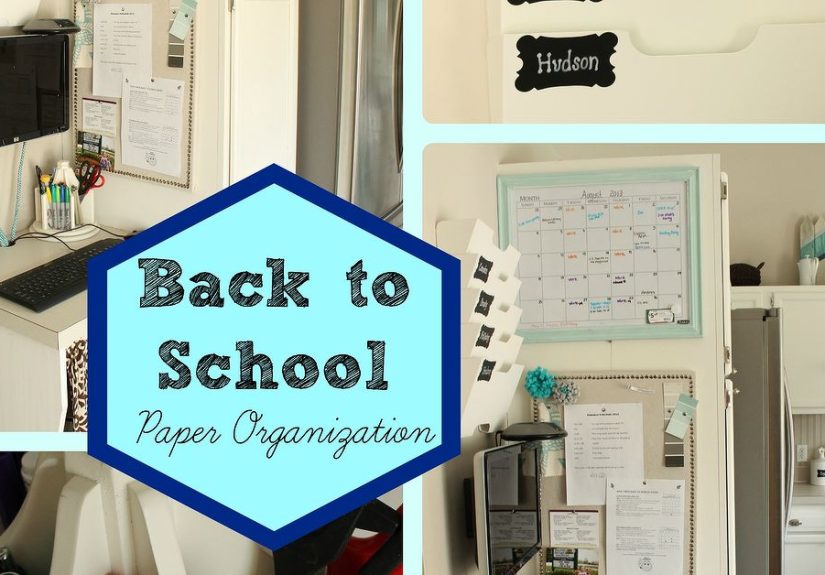
A family command center is just a dedicated hub for school paperwork and schedules. It can be a small wall,
a corner of the kitchen, a section of a mudroom, or even inside a cabinet. The best command center is the one
you’ll actually use when you’re half-awake and holding a travel mug like it’s life support.
Option 1: The clipboard wall (simple and weirdly satisfying)
Hanging clipboards turns paper piles into visible “inboxes/outboxes.” You can label by person (one clipboard per
kid) or by category (Sign & Return, To Pay, To File, To Read). It’s fast, it’s cheap, and it makes you feel like
a competent adult even if your sock drawer says otherwise.
Option 2: The standing file station (desk-friendly)
A standing file with tabbed dividers is great if you want everything upright and easy to flip through. Use
categories like “School Calendar,” “Lunch,” “Sports,” “Music,” and “Medical Forms.” Keep a pen, a highlighter,
and sticky notes right there so “later” doesn’t turn into “never.”
Option 3: The hidden command center (for people who dislike visual clutter)
If paper stresses you out visually, hide it: a cabinet shelf, a drawer, or a slim organizer inside a pantry.
The trick is to keep it accessible. If you have to move three appliances to find the permission slip, the paper wins.
What to include (keep it minimal)
- One inbox tray or bin
- One “Sign & Return” spot (folder, sleeve, or clipboard)
- A calendar system (wall calendar or shared digital calendar)
- A few labeled folders or dividers
- Pen + marker + small stapler (optional, but satisfying)
Step 3: The 3-minute daily paper routine (the secret sauce)
Most school paper chaos isn’t caused by volumeit’s caused by delayed decisions. A quick daily routine
prevents the “I’ll deal with it later” stack from turning into a cardboard mountain range.
Do this right after school (or right after dinnerpick one and stick with it)
- Empty backpacks completely. No papers should live in backpacks overnight unless they’re going back tomorrow.
- Sort fast: Action, Reference, Memory, Recycle/Shred.
- Handle Action immediately: sign it, photograph it if needed, put it in the “Return” pocket/folder.
- Reset the backpack: return-ready papers go in the correct folder so the morning doesn’t become a scavenger hunt.
If your child is old enough, make them part of the routine. It’s not punishmentit’s life skills.
(Also, it’s how you avoid becoming the household “paper receptionist” forever.)
Student systems that actually work (by age and personality)
Elementary school: The “take-home folder” is your MVP
For younger kids, keep it simple: a sturdy two-pocket folder that travels to and from school daily.
One side is “Bring Home,” the other is “Return to School.” Add a clear label and you’ve just reduced
80% of the daily paper drama.
If the school provides a folder system, use it exactly as intended. If they don’t, set one up yourself,
and keep it near the backpack “launch pad” (the spot by the door where school essentials live).
Middle school: One binder (or a few) + dividers + a weekly clean-out
Middle school introduces multiple teachers, multiple subjects, and multiple chances to lose the one paper
that counts. A binder system works well hereeither one all-in-one binder with dividers or smaller binders
per subject. Color-coding by subject can help students grab what they need faster.
Add a “miscellaneous” pocket for papers that don’t yet have a home. Then schedule a weekly binder reset
(Friday afternoon or Sunday evening) to file, toss, and straighten. Five minutes beats a semester-long paper jam.
High school: Less paper, higher stakes
High school students may have fewer handouts, but more important documents: syllabi, grading policies,
lab guidelines, and long-term project sheets. Encourage a “keep the master, toss the duplicates” approach.
A single “Syllabi & Policies” section (paper or digital) is a lifesaver when someone asks, “Wait, when is that due?”
Teacher tip you can steal: predictable routines beat fancy supplies
Organization improves when students know exactly where papers go every time. The more consistent the routine,
the less brainpower it takeswhich matters a lot on busy school mornings.
What to keep, what to toss, and how to stop feeling guilty about it
If you keep everything, you’ll find nothing. If you toss everything, you’ll regret the one sweet note.
The sweet spot is keeping a curated “highlight reel.”
Keep (usually)
- Report cards and progress reports
- End-of-year summaries, standardized testing summaries (if applicable)
- Special awards or certificates
- A few meaningful writing samples (early handwriting is fun to look back on)
- One or two standout art pieces per month (not per day)
Toss or recycle (usually)
- Daily worksheets once reviewed
- Duplicate notices (schools love sending the same flyer in multiple formats)
- Old calendars once the month is over
- Random half-pages that appear to be receipts for… something
The “Display, Digitize, Donate-to-the-Recycling-Bin” strategy for artwork
Kids’ art is emotional clutter: you love it, but you can’t store a decade of glittery construction paper without
eventually needing a second home. Try a simple rhythm:
- Display: pick a few pieces to hang on a wall or fridge for a limited time.
- Digitize: take a clear photo or scan the best pieces.
- Keep a small “memory box”: one bin per child, one folder per grade.
- Let go of the rest: keep the memory, not the entire paper trail.
Digitize school papers without turning it into a second job
Going partially digital can reduce paper piles dramaticallyespecially for keepsakes and reference papers.
You don’t need a high-end setup. A phone scanning app works for most families, and it’s fast enough to use
in real life (which is the only kind of fast that matters).
What’s worth scanning?
- Artwork you want to remember but don’t want to store
- Certificates and award sheets
- Classroom info sheets you’ll need (teacher contact, schedules)
- Medical forms or paperwork you might need again
If you want a scanner, choose based on your “paper personality”
If you’re scanning stacks (receipts, multi-page forms, big school packets), a sheet-fed document scanner is efficient.
If you’re scanning delicate keepsakes or odd-sized items, a flatbed scanner can be better. If you just need occasional
scans, your phone may be enough.
A folder naming system that won’t make you hate your life
Try this structure:
- School Papers
- 2025-2026
- Alex
- Reference (Schedules, Contacts)
- Keepsakes (Artwork, Awards)
- Medical/Support (Forms, Plans)
Keep it boring. Boring systems are sustainable systems.
Handle sensitive papers safely: keep, file, and shred
School papers sometimes include personal information: addresses, phone numbers, medical details, student IDs,
and financial info. When you no longer need those documents, don’t just toss them in the trash.
Shredding documents that contain personal or financial information helps protect your family from identity theft.
Quick rules
- Keep what you’ll need again (official records, important forms, ongoing agreements).
- File what’s current but not urgent (annual forms, policy sheets, contact lists).
- Shred what you don’t need anymore if it contains personal details (old forms, outdated info sheets).
No shredder? Many communities run shredding events. Also: future you will be grateful you didn’t keep three copies of last year’s emergency contact form.
The weekly reset: 15 minutes that saves your sanity
Pick one day (Sunday evening is popular) and do a quick reset:
- Empty the inbox completely.
- Confirm all “Action” items are handled (signed/paid/calendar).
- File current reference papers into labeled folders.
- Choose 1–3 keepsakes for the archive; photograph the rest if you want.
- Recycle and shred what you don’t need.
This is also a great time to do a 2-minute backpack sweep. You will find: snack wrappers, mystery pencils,
and at least one paper that looks like it survived a hurricane. Celebrate the small wins.
Common problems (and fixes that don’t require superpowers)
“My kid forgets to hand me papers.”
Put the inbox where backpacks land and make “paper dump” part of the arrival routine. A visual cue helps:
a sign, a bright bin, or a “Drop Papers Here” label that’s impossible to ignore.
“We have multiple kids and everything blends together.”
Give each child a color and a category. For example: one folder per child for “Action/Return,” and one shared
section for household reference. Color-coding is especially helpful when you’re moving fast.
“My student loses papers inside the binder.”
Add a single “staging pocket” (front pocket or one labeled divider) where papers go temporarily.
Then schedule the weekly binder reset to file papers into the correct section.
“We’re dealing with executive function challenges.”
Simplify categories. Fewer steps wins. Use bigger labels, fewer folders, and predictable routines.
A short checklist by the door (Backpack, Folder, Lunch, Instrument, Sports Gear) can reduce daily friction.
A realistic weekend setup plan (so you can start now)
If you want to get organized before school ramps up, here’s a simple plan that fits into one weekend:
- Pick your inbox spot (tray/bin/standing file).
- Create one “Action” holder (Sign & Return folder/clipboard).
- Set up one reference folder labeled “School Year Info.”
- Start one archive (one hanging folder or one binder section per child).
- Choose your weekly reset time and put it on the calendar.
Done. You don’t need to buy a cart, build a wall unit, or rename your pantry “The Administrative Wing.”
You just need a flow you’ll keep using.
Conclusion: Paper doesn’t have to run your school year
Back-to-school paperwork will never disappear completely (schools really love a flyer), but your stress can.
When you set up an inbox, create clear categories, and do a quick daily sort, you stop playing “Where did that paper go?”
and start feeling like the school year is manageable.
Remember: the best system is the one you’ll maintain on a tired Tuesday night. Keep it simple, keep it visible,
and give yourself permission to recycle the guilt along with the worksheets.
Experiences from real life: what back-to-school paper organization looks like at home (and why it works)
One family with two elementary kids tried to “keep everything” for the first month of schoolevery spelling list,
every math sheet, every drawing of a rainbow that may or may not have been inspired by a snack wrapper. By mid-September,
they had a pile so tall it was basically a new piece of furniture. The breakthrough wasn’t buying a fancy filing cabinet.
It was creating a single landing zone near the kitchen where backpacks already landed, plus one bright
“Sign & Return” folder that lived in plain sight. Each afternoon, papers went into the inbox immediately.
After dinner, they did a three-minute sort: anything that needed a signature got signed right then, anything informational
got photographed if necessary and filed into a “School Year Info” folder, and the rest got recycled. The kids actually
liked being the “paper deliverers” because it felt like a joband because it came with a tiny privilege: they got to choose
which one artwork piece went on the fridge “gallery” for the week. The parents noticed the biggest benefit wasn’t just less
clutter; it was fewer last-minute surprises. Permission slips stopped appearing at 7:42 a.m. like jump scares.
Another experience that comes up a lot is the middle-school binder meltdown. A seventh grader started the year with
good intentions: new binder, crisp dividers, a pencil pouch that smelled like fresh plastic and hope. Two weeks later,
the binder looked like it had been through a wind tunnel. The fix wasn’t stricter naggingit was changing the system to match
real behavior. Instead of expecting every paper to be filed perfectly every day, the family added one “staging pocket”
labeled “FILE LATER.” That pocket gave papers a safe temporary home. Then, on Sunday evenings, they did a five-minute “binder reset”
while music played in the background. Papers got moved from the staging pocket into subject sections, completed work got tossed,
and anything important got clipped to the front for Monday. The student didn’t become magically organized overnight, but missing
assignments dropped because papers stopped vanishing.
For high schoolers, the paper issue often isn’t volumeit’s importance. One parent described it perfectly: “We only get a few papers,
but each one feels like it controls our destiny.” Think syllabi, lab contracts, and policy sheets. Their solution was to create a
single “Syllabi & Policies” folder at home plus a digital backup. When a syllabus came home, it got photographed and saved into a
clearly named school-year folder. The paper version went into the home folder, not into a backpack vortex. When deadlines came up,
nobody had to rely on memory (which, in a busy household, is basically a prank). The parent said the best part was the calm:
fewer frantic searches, more “Oh yeah, it’s right here.”
And then there’s artworkthe emotional paper category. A caregiver who hated tossing anything found peace with a “highlight reel”
approach. They used a simple rhythm: display a few pieces, take photos of the favorites, and keep a single folder per grade for
the most meaningful work. At the end of the year, they had a slim, intentional collection instead of a mountain. The child still felt
celebrated (“My art got saved!”) and the home stayed functional (“We can see the dining table again!”). The biggest lesson from these
experiences is consistent: paper organization succeeds when the routine is easier than the mess. When your system fits
how your family already moves through the day, you don’t need motivationyou just need momentum.