Table of Contents >> Show >> Hide
- A Chair That Starts With a Cube and Ends With a Double Take
- What Is the Cube Chair (+Subtraction, Upside-Down)?
- The Meaning of “Subtraction” in the Design
- Why the Upside-Down Orientation Matters
- RO/LU and the Architecture of Everyday Objects
- Material Matters: Why Plywood Works So Well
- How the Cube Chair Functions in a Real Room
- Why Designers Still Care About Cube Chairs
- Buying, Collecting, and Appreciating the Cube Chair
- Design Lessons From Cube Chair (+Subtraction, Upside-Down)
- Experience Section: Living With the Idea of a Cube Chair
- Conclusion: A Small Chair With Big Architectural Energy
Note: This publication-ready HTML body is written in original American English, with factual design context synthesized from reputable design, art, furniture, architecture, and interiors references.
A Chair That Starts With a Cube and Ends With a Double Take
The Cube Chair (+Subtraction, Upside-Down) is not the kind of chair that politely waits in the corner hoping someone notices its upholstery. It is the kind of chair that walks into the room geometrically, raises one plywood eyebrow, and says, “Actually, I’m better when flipped over.” Designed by RO/LU, the Minneapolis-based art and design studio known for treating furniture like a small architectural event, this 2010 piece turns a simple cube-like form into a surprisingly rich conversation about subtraction, perspective, and usefulness.
At first glance, the chair seems almost stubbornly plain: plywood, angles, a squared-off body, and a cushion that does not beg for attention. But the magic is in the edit. The “subtraction” in the title points to the removal of material, the creation of voids, and the way negative space can become as important as the solid parts. The “upside-down” part is even better. The chair was originally intended to be viewed and used right-side-up, but the designers discovered that it became more compelling when inverted. That is not a mistake; that is design doing jazz.
For anyone interested in modern furniture design, sculptural seating, plywood lounge chairs, or objects that make guests ask, “Wait, is that supposed to be like that?”, the Cube Chair is worth studying. It is part chair, part sculpture, part architectural model, and part visual joke with excellent posture.
What Is the Cube Chair (+Subtraction, Upside-Down)?
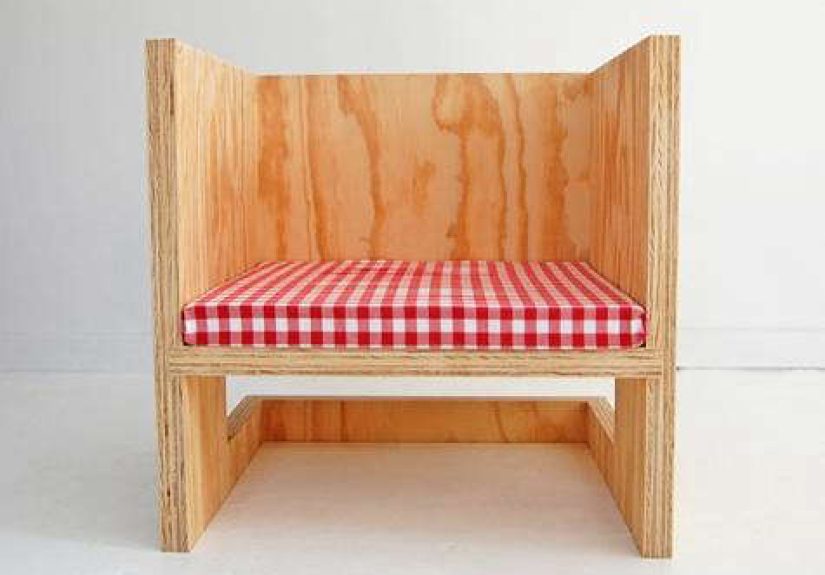
The Cube Chair (+Subtraction, Upside-Down) is a handmade plywood lounge chair by RO/LU, created in the United States around 2010. It belongs to a family of RO/LU cube-based furniture pieces that explore basic geometry, architectural influence, and modular form. The chair has been associated with Patrick Parrish Gallery and design-focused product listings, where it was described as a piece that reveals a perfect square when viewed directly from the front.
That detail matters. Many chairs are designed around comfort first and visual composition second. This chair does both, but it asks the viewer to slow down and look. From one angle, it may appear like a compact plywood seat. From another, it becomes a study in squares, spans, cutouts, and volume. The chair does not hide its construction. It lets the plywood planes do the talking, and frankly, they are more articulate than half the furniture in a big-box showroom.
The Key Design Facts
The chair is commonly described as handmade from plywood, with a low, architectural profile. Its proportions sit close to the language of a cube without becoming a plain box. The related Cube Chair (+Subtraction) design has been noted for using a thick cushion and for drawing inspiration from architect R.M. Schindler, whose furniture often blurred the line between chair and miniature building. RO/LU’s upside-down version pushes that idea further by making orientation part of the design story.
In simpler terms: this is a chair that makes geometry useful. It is not “just a cube,” and it is not “just a chair.” It is a seat that asks what happens when you remove a span, flip a form, and allow the leftover space to become the main character.
The Meaning of “Subtraction” in the Design
Subtraction in design is the art of taking away until the object becomes clearer, stronger, or more interesting. It is not minimalism for people who forgot to finish decorating. It is intentional removal. In the case of the RO/LU Cube Chair, subtraction creates openings, changes the silhouette, and gives the object a visual rhythm. The missing parts are not empty; they are active.
Think of a sculptor carving stone. The final shape depends as much on what is removed as what remains. The same idea applies to furniture. A chair can be made lighter, stranger, more elegant, or more architectural by removing a section of material. The void can frame the floor, shape the shadow, and alter how the eye reads the object. In this chair, subtraction gives the cube a sense of movement. It becomes less like a storage box and more like an idea you can sit on.
Negative Space: The Chair’s Secret Ingredient
Negative space is the open area around or within an object. In interiors, it helps rooms breathe. In furniture, it can make a heavy form feel balanced. With the Cube Chair (+Subtraction, Upside-Down), the cutaway areas are not accidental gaps; they are part of the chair’s identity. They allow light to pass through, create graphic shapes, and make the plywood planes feel deliberate rather than bulky.
This is why the chair works especially well in visually quiet spaces. Put it in a room filled with twenty competing patterns, twelve throw pillows, and a lamp shaped like a flamingo wearing sunglasses, and the chair may lose its voice. Give it breathing room, however, and it becomes a focal point. It rewards attention without shouting for it.
Why the Upside-Down Orientation Matters
The phrase “upside-down” could sound like a gimmick, but here it is central to the experience. The designers reportedly found that the chair was best viewed and used inverted from its original orientation. That discovery is charming because it reveals a design process open to surprise. Instead of forcing the object to obey the first sketch, RO/LU allowed the object to speak back.
In furniture design, orientation is usually fixed. A dining chair has legs down, seat in the middle, back up. Nobody flips a Windsor chair and says, “Now it’s ready.” The Cube Chair breaks that expectation. By turning the object over, the relationship between seat, frame, void, and square changes. The chair becomes more visually resolved, and the front-facing square becomes a defining feature.
A Chair With a Sense of Humor
The upside-down concept also gives the chair personality. It feels like a quiet joke told by someone who reads architectural theory for fun. The humor is not slapstick; it is conceptual. The chair suggests that the “right” way to use an object may not be obvious at first. Sometimes good design comes from testing, flipping, rotating, and admitting that the object had a better idea than the designer.
That is one of the reasons this piece feels fresh years after its creation. It does not rely on trend colors, novelty materials, or decorative excess. Its appeal comes from a clever shift in perspective. The chair looks simple, but the thinking behind it is anything but lazy.
RO/LU and the Architecture of Everyday Objects
RO/LU began as a landscape-focused practice in Minneapolis and evolved into a studio working across furniture, art, performance, writing, public projects, and design experiments. That background is important because the Cube Chair does not feel like a product dreamed up only for a catalog. It feels like an architectural study translated into domestic scale.
Landscape design teaches attention to space, circulation, proportion, and the way people move through environments. RO/LU brought that sensitivity indoors. Their furniture often looks purposefully direct, sometimes unfinished in the best possible way, and deeply interested in the relationship between objects and surroundings. A RO/LU chair is not merely something placed in a room; it changes how the room is read.
The R.M. Schindler Connection
The related Cube Chair (+Subtraction) has been described as drawing inspiration from a classic chair by R.M. Schindler, the Austrian-American architect associated with California modernism. Schindler’s furniture often treated chairs, tables, and built-ins as extensions of architecture. Instead of separating a house from its furnishings, he considered furniture a smaller version of spatial design.
That influence makes sense here. The Cube Chair is not soft, decorative, or traditionally cozy in the overstuffed recliner sense. It is composed of planes and volumes. It has the honesty of plywood and the confidence of a small building. If Schindler’s work helped establish the idea that furniture could be architectural, RO/LU’s Cube Chair updates that idea with a contemporary wink.
Material Matters: Why Plywood Works So Well
Plywood is not always glamorous. It does not arrive wearing a velvet cape. But in modern furniture design, plywood can be incredibly expressive. It is strong, relatively stable, workable, and visually honest. Its layered edges reveal how it is made, giving the material a graphic quality that suits geometric furniture.
For the Cube Chair (+Subtraction, Upside-Down), plywood supports the design concept beautifully. The flat planes emphasize the cube-like structure, while the cutaway areas show the material’s thickness and edge condition. Unlike highly polished luxury seating that tries to erase all evidence of construction, this chair lets construction become part of the aesthetic.
Warm Minimalism, Not Cold Minimalism
The warmth of plywood also keeps the chair from feeling too severe. A pure white cube might feel clinical. A metal version might seem industrial. Plywood gives the chair a human touch. It feels made, not manufactured into anonymity. That handmade quality is important because the piece sits somewhere between design object and functional artwork.
The cushion, where included in related versions, also helps. It softens the geometry without ruining it. The result is not a marshmallow pretending to be modern furniture. It is a crisp structure with just enough comfort to remind you that, yes, chairs are still supposed to be sat in.
How the Cube Chair Functions in a Real Room
Let us be honest: not every sculptural chair wants to be useful. Some designer chairs appear to have been created mainly to punish the lower back of anyone brave enough to appreciate art too physically. The Cube Chair, however, has a clearer practical side. Its lounge-like proportions and cushion-friendly form make it suitable for living rooms, studios, galleries, reading corners, and design-forward interiors.
Because it has a compact footprint, it can work as an accent chair rather than a full seating system. It is especially effective in rooms with clean lines, natural materials, concrete floors, white walls, or other modern elements. Pairing it with a low table, a simple floor lamp, and a textured rug can create a corner that feels intentional without trying too hard.
Best Interior Styles for the Chair
The Cube Chair (+Subtraction, Upside-Down) fits naturally into minimalist, modernist, Japandi, industrial, gallery-style, and art-filled interiors. It can also create contrast in warmer spaces, especially when surrounded by linen, wool, handmade ceramics, or natural wood tones. The key is to let the chair keep its sculptural presence.
It may not be the best match for a room overflowing with ornate traditional furniture. That does not mean it cannot work there, but it needs careful styling. Place it near a modern artwork or simple side table to build a bridge between old and new. Otherwise, it may look like a geometry student wandered into a Victorian parlor and got lost.
Why Designers Still Care About Cube Chairs
Cube-based furniture continues to fascinate designers because the cube is one of the simplest forms in visual language. It is stable, recognizable, and endlessly adaptable. A cube can become a stool, table, shelf, ottoman, storage block, or chair. But simplicity also creates a challenge: how do you make a cube interesting without decorating it into confusion?
RO/LU’s answer is subtraction and inversion. Instead of adding ornament, they remove material. Instead of relying on surface treatment, they change orientation. Instead of disguising the form, they sharpen it. This is a useful lesson for anyone interested in design: complexity does not always come from adding more. Sometimes it comes from making one strong move and trusting it.
The Chair as a Teaching Tool
For students of furniture design, architecture, or interiors, this chair is a compact case study. It demonstrates how proportion, void, material, and perspective can transform a basic shape. It also shows that design development is not always linear. A finished idea may appear only after the object is built, tested, flipped, and reconsidered.
That lesson applies beyond furniture. Websites, rooms, logos, essays, and even daily routines often improve through subtraction. Remove the unnecessary. Flip the assumption. Look again from the front. If a perfect square appears, congratulations: the chair has taught you something.
Buying, Collecting, and Appreciating the Cube Chair
The Cube Chair (+Subtraction, Upside-Down) is not a mass-market lounge chair stacked in a warehouse by the thousand. It belongs more to the world of collectible design, gallery furniture, and limited handmade objects. Earlier product listings placed it in the high-design furniture category, with pricing that reflected its handmade production and design pedigree.
Collectors often value objects like this because they capture a specific moment in a studio’s thinking. The year 2010 was a period when independent design studios were increasingly blurring the borders between furniture, art, and architecture. RO/LU’s work fits that movement well. The chair is functional, but it is also conceptual. It can be used, displayed, discussed, and occasionally stared at while holding coffee and pretending to understand every nuance of spatial theory.
What to Look For in Similar Designs
If you are inspired by this chair but not hunting for the exact collectible piece, look for furniture with clear geometric structure, honest materials, visible construction, and thoughtful negative space. A good cube chair should not feel like a wooden crate with ambition issues. It should have proportion, comfort, and a reason for every cutout.
Also consider scale. Cube-like chairs can feel heavy if they are too large for the room. Measure carefully, especially seat height, width, depth, and circulation space around the piece. A sculptural chair needs air around it. Cramming it between a bookshelf and a laundry basket is technically possible, but so is wearing formal shoes to mow the lawn. Possible does not mean wise.
Design Lessons From Cube Chair (+Subtraction, Upside-Down)
The first lesson is that restraint can be dramatic. The Cube Chair does not need carved details, bright upholstery, or decorative legs. Its drama comes from form. The second lesson is that negative space can do real visual work. The empty portions shape the chair’s identity as much as the plywood panels do.
The third lesson is that orientation is a design decision. Flipping the chair changes how it functions and how it communicates. This is especially relevant in an age where modular furniture, flexible interiors, and multipurpose objects are more valuable than ever. A chair that invites a second look also invites a second use.
The final lesson is that humor belongs in serious design. The title itself feels like a small equation: cube chair plus subtraction, upside-down. It sounds mathematical, but the result is playful. The chair reminds us that intelligent design does not have to be stiff. It can be clever, warm, and slightly mischievous.
Experience Section: Living With the Idea of a Cube Chair
Imagine encountering the Cube Chair (+Subtraction, Upside-Down) in a quiet gallery or a thoughtfully arranged living room. Your first reaction may be confusion. Is it a chair? A table? A small architectural model that escaped from a studio desk? Then you notice the cushion, the angle, the cutaway, and the square that appears from the front. Slowly, the object resolves itself. That moment of recognition is part of the pleasure.
Sitting near a chair like this changes how you look at other furniture. Ordinary chairs suddenly seem very eager to explain themselves. Four legs, backrest, seat: yes, thank you, we understand. The Cube Chair is different because it withholds a little information. It asks you to participate. You walk around it. You crouch slightly. You look through the negative space. You realize the voids are not decorative holes; they are part of the composition.
In a home setting, the experience would be even more interesting. During the day, natural light could pass through the cutouts and create changing shadows on the floor. In the evening, a nearby lamp might turn the chair into a sharper silhouette. Guests would probably notice it immediately, which is useful if your social strategy involves owning one object that starts conversations so you do not have to open with weather updates.
The chair also encourages a different kind of comfort. It is not about sinking into upholstery and disappearing for three episodes of a show you claim you are “only casually watching.” It is about supported, intentional sitting. The geometry makes you aware of your body in space. That can be refreshing in a world full of furniture designed to swallow people whole.
As a design experience, the most memorable part is the inversion. Knowing that the chair works best upside-down gives the object a backstory. It suggests experimentation, humility, and discovery. Many creative projects improve when we allow them to change direction. A draft becomes better after cutting paragraphs. A room becomes better after removing one unnecessary table. A chair becomes better after being flipped over. The Cube Chair makes that lesson physical.
There is also something satisfying about its honesty. The plywood does not pretend to be marble. The form does not pretend to be traditional. The chair does not apologize for looking like a thought experiment with a cushion. That confidence is rare. It makes the piece feel useful not only as seating, but as a reminder that design can be clear without being boring.
If you were styling it at home, the best approach would be restraint. Give it a blank wall, a soft rug, and maybe one excellent side table. Do not bury it under a blanket, three novelty pillows, and a tray of scented candles named after emotional states. Let the square, the subtraction, and the upside-down logic breathe. The chair already has enough personality; it does not need backup dancers.
Conclusion: A Small Chair With Big Architectural Energy
The Cube Chair (+Subtraction, Upside-Down) is a compact but powerful example of how furniture can move beyond basic function. RO/LU used plywood, geometry, negative space, and a surprising orientation shift to create a chair that feels sculptural, architectural, and quietly funny. It is not merely a place to sit; it is a lesson in seeing.
Its appeal comes from the tension between simplicity and complexity. The cube is simple. The subtraction complicates it. The upside-down orientation makes it memorable. The handmade plywood construction keeps it grounded. Together, these elements create a piece that belongs in conversations about modern furniture design, collectible seating, and the art of making less do more.
For designers, homeowners, collectors, and anyone who enjoys objects with a little brainpower baked in, this chair offers a useful reminder: sometimes the best design move is not adding another feature. Sometimes it is removing a span, flipping the object, and discovering that the better answer was hiding underneath all along.