Table of Contents >> Show >> Hide
- What Happened, Exactly?
- Why the Internet Couldn’t Look Away
- Why Drawing One Face Fifty Ways Is So Hard
- What Made Sam Skinner’s Version Better Than a Basic Trend Post
- The Bigger Art Story Behind the Viral Moment
- Specific Examples of Why Certain Styles Were Tough
- What Artists and Content Creators Can Learn From It
- Why This Challenge Still Feels Fresh
- Related Experiences: What a 50-Style Self-Portrait Challenge Teaches You
- Conclusion
Some people doodle when they are bored. Some people sketch one decent face, lean back, and call it a productive afternoon. And then there are artists like Sam Skinner, who looked at the internet’s cartoon style challenge and apparently thought, “Sure, I’ll do fifty.” Not five. Not ten. Fifty. Because moderation is for people who enjoy free time.
The result was a viral self-portrait series that did more than collect likes. It showed what happens when talent meets patience, practice, and a slightly unreasonable commitment to line work. Skinner’s project turned a playful online challenge into a mini masterclass in observation, stylization, and character design. It was fun to look at, sure, but it also offered a sharp lesson in how cartoon styles really work.
This is why the project landed so well online and why it still holds up: underneath the colorful nostalgia, there is serious craft. A self-portrait in fifty cartoon styles is not just fan art with a caffeine addiction. It is an exercise in identity, visual translation, and artistic flexibility.
What Happened, Exactly?
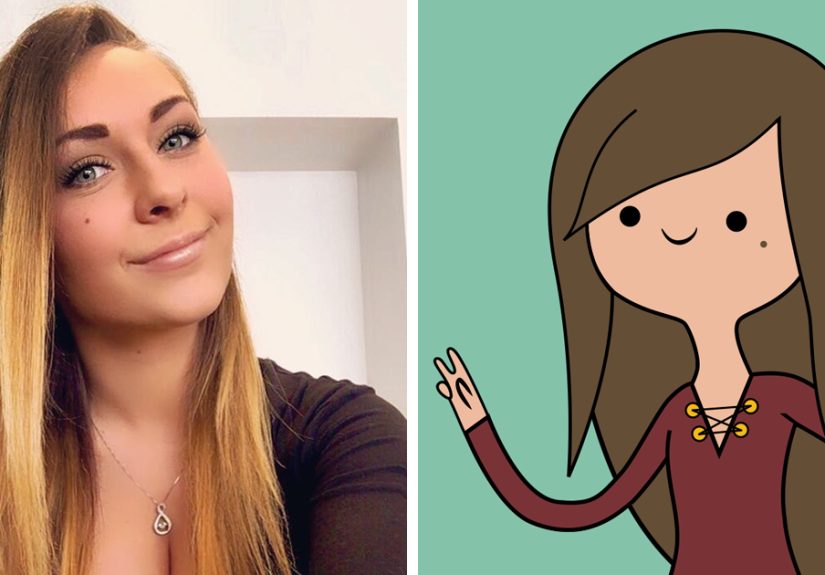
Sam Skinner, a 24-year-old student at the University of Missouri–Kansas City at the time, spent about a year completing a self-portrait series in 50 popular cartoon styles. The project grew out of the broader #StyleChallenge, a social-media art trend that encouraged artists to redraw themselves or their characters through the visual logic of famous animated worlds. Skinner reportedly began with a list close to 100 options, then trimmed it to 50 and worked through them over time while improving her digital technique.
That long timeline matters. This was not one of those “I made this in an afternoon and accidentally broke the internet” stories. The charm of Skinner’s work came from watching discipline show up on the page. Across the set, viewers could see both consistency and evolution: the same core face appearing again and again, while every version obeyed a different visual rulebook.
The styles reportedly pulled inspiration from favorites like The Simpsons, Kim Possible, Scooby-Doo, Garfield, Bob’s Burgers, Justice League, Phineas and Ferb, and more. Skinner also noted that some of the hardest styles to tackle were associated with Tim Burton, Gorillaz, and Archer. That lineup alone tells you this was not a one-note gimmick. These worlds do not agree on proportions, shadows, line confidence, or personality cues. Each style asks the artist to think differently.
Why the Internet Couldn’t Look Away
At first glance, the appeal seems obvious: nostalgia. People love seeing familiar cartoon languages remixed with a real person. It scratches the same itch as cosplay, fan casting, and those “Which animated universe would you belong in?” quizzes that somehow consume an entire lunch break. But the stronger reason the series worked is that viewers could instantly recognize whether each version felt right.
That is the genius of a cartoon style challenge. Audiences may not know the technical vocabulary behind stylization, but they know when something feels off. If a Simpsons-inspired face looks too realistic, or a Burton-inspired version is not eerie enough, the illusion breaks. Skinner’s portraits stood out because so many of them passed the vibe test. That is harder than it sounds.
Cartoons rely on exaggeration, simplification, and visual shorthand. They are not trying to duplicate reality; they are trying to communicate a character quickly and memorably. When an artist can preserve a subject’s identity while translating it into wildly different cartoon systems, it feels a little like visual magic. The person remains the same, but the code changes.
Why Drawing One Face Fifty Ways Is So Hard
1. You have to preserve likeness without copying reality
A self-portrait challenge is already difficult because faces are slippery. Change the eyes too much and the person disappears. Keep everything too literal and the style disappears. The artist has to find the exact balance point where identity survives stylization. That balancing act is the whole game.
2. Every cartoon style has its own anatomy rules
Some cartoon universes use round, soft geometry. Others lean on sharp angles, heavy eyelids, tiny mouths, or oversized foreheads. A style challenge is really a crash course in shape language. Character design educators often emphasize abstract shapes, silhouette, staging, and visual association because these are the bones of appeal. Skinner’s project worked because she was not merely swapping hairstyles or color palettes. She was adapting the structure underneath.
3. Line quality does a shocking amount of work
Ask ten artists what makes a style distinct and at least seven of them will start talking about line. Thick lines can feel bold and graphic. Thin lines can feel delicate or modern. Smooth contours create a different energy than jittery or angular marks. In some styles, shadows are minimal and decorative. In others, shadow shapes practically become part of the character’s personality. Skinner herself reportedly treated the project as a way to practice digital line work, and that focus shows up in the final effect.
4. Stylization still depends on fundamentals
This is the part beginners hate, because it means there is no shortcut hidden behind the word “cartoon.” Even highly stylized drawing depends on understanding structure, gesture, proportion, and form. If the pose is stiff or the head construction is weak, style alone cannot save it. Good stylization is not the opposite of fundamentals; it is fundamentals wearing better shoes.
What Made Sam Skinner’s Version Better Than a Basic Trend Post
The difference between a passing social-media challenge and a memorable piece of visual storytelling usually comes down to intent. Skinner reportedly said she used the challenge to better understand graphic and digital design and to prepare for creating original characters for a potential webcomic. That goal matters because it turns imitation into study.
There is a huge difference between copying a look and investigating how a look is built. When an artist studies multiple cartoon styles back-to-back, patterns start to emerge. You begin to notice where shadows usually fall, how fabric hangs on different bodies, how one franchise simplifies noses while another makes them a defining feature, and how emotion can be pushed with almost no detail at all. That kind of practice is less about fandom and more about fluency.
It also helps that Skinner did not hide the learning process. By spending roughly a year on the series, she could actually see her skills improving from one piece to the next. That gives the project a satisfying honesty. It is polished enough to impress, but not so polished that it feels airbrushed into lifelessness. You can sense a real artist thinking through problems, solving them, and getting better in public.
The Bigger Art Story Behind the Viral Moment
It is tempting to treat a challenge like this as pure internet fluff, but the idea behind it is older than social media. Self-portraiture has long been one of art’s favorite proving grounds. Artists return to their own faces because the subject is always available, always personal, and strangely difficult to capture. A self-portrait is never just about resemblance. It is also about identity, performance, and the version of the self an artist chooses to show.
That is one reason the cartoon challenge feels richer than a standard redraw. It places the self inside multiple visual identities. One face becomes many possible selves: sweeter, sharper, funnier, moodier, stranger, cleaner, more chaotic. In a weirdly modern way, that mirrors everyday life online. People already present different versions of themselves across platforms, communities, and moods. Skinner’s project just made that idea visible through animation language.
There is also something deeply educational about switching styles over and over. Art schools and professional character-design courses often stress appealing shapes, silhouette clarity, gesture, and personality-driven decisions. A project like this forces all of those principles into the open. You cannot fake clarity when the challenge itself is comparison.
Specific Examples of Why Certain Styles Were Tough
Tim Burton-inspired work is difficult because it is not merely “spooky.” It depends on stretched proportions, theatrical shadow, and a very specific blend of whimsy and unease. Push too hard and it becomes parody. Not hard enough, and it just looks like someone skipped sleep for finals week.
Archer-style design asks for sleek confidence. The faces are more grounded, the angles more controlled, and the rendering more deliberate. It has less room for loose cartoon shorthand, which means the artist must be precise without becoming stiff.
Gorillaz-inspired imagery can be especially tricky because it mixes graphic boldness with attitude. The success of the style is not just in the facial construction. It is in the cool factor, the silhouette, the rhythm, the sense that the character has already judged you and maybe your playlist too.
These examples highlight why Skinner’s challenge resonated. She was not picking fifty flavors of the same vanilla cone. She was jumping between entirely different visual philosophies.
What Artists and Content Creators Can Learn From It
First, constraints are underrated. A fixed subject with changing style rules is a powerful way to improve. It strips away the panic of “What should I draw?” and replaces it with a better question: “How else can this be seen?” That is where creative growth usually lives.
Second, repetition is not the enemy of originality. In fact, repetition is often how originality is built. By redrawing the same self over and over, an artist starts to notice what features feel essential and which ones are flexible. That awareness becomes the foundation of an original style later.
Third, internet-friendly content does not have to be artistically shallow. Skinner’s project was shareable because it was visually immediate, but it stayed memorable because it had substance. That is a useful lesson for bloggers, illustrators, and creators of any kind: the sweet spot is where entertainment and craft stop pretending they are enemies.
Why This Challenge Still Feels Fresh
The web is crowded with trend pieces that explode for a weekend and vanish like socks in a dryer. This one stuck because it delivered on both novelty and execution. The title makes you click, but the artwork makes you stay. Even years later, the concept still feels smart because it taps into something timeless: people love seeing identity translated through style.
And maybe that is the secret. At its heart, this was not just a cartoon challenge. It was a portrait of artistic curiosity. Skinner used a familiar internet format to ask a surprisingly rich question: how many ways can one person be seen without ever stopping being themselves?
Apparently, at least fifty.
Related Experiences: What a 50-Style Self-Portrait Challenge Teaches You
Projects like this tend to look glamorous from the outside. You see the finished grid, you admire the clean presentation, and you imagine the artist breezing through each panel like a wizard with a tablet. The actual experience is usually much messier, funnier, and more human.
First comes overconfidence. The artist says, “I love cartoons. I can totally do this.” Then comes version number three, where the head shape looks right but the eyes belong to a completely different universe and the mouth has wandered off to start its own career. This is the moment the challenge becomes real.
Then comes the detective phase. Every style demands research. You stop looking at cartoons the way a casual fan does and start looking like a visual forensic analyst. Why do these characters feel bouncy? Why do these faces read instantly? Why does one show rely on tiny pupils and another depend on strong cheek shapes? Suddenly, watching animation feels less like relaxing and more like reverse-engineering a secret language.
There is also the very weird experience of drawing yourself so many times that your own face starts to feel abstract. At first you are drawing you. Then you are drawing “the eyebrow shape that makes the likeness survive.” Then you are drawing “the nose that can be reduced into three marks without collapsing into a potato.” It sounds ridiculous, but it is also one of the fastest ways to understand what makes a portrait recognizable.
Another major experience is emotional whiplash. Some versions come together beautifully, and you feel unstoppable. Others fight you like a shopping cart with one bad wheel. One style will click in twenty minutes; the next will sit there looking mildly haunted for two hours. That inconsistency can be frustrating, but it is incredibly educational. It teaches you that difficulty is not failure. Sometimes a style is just asking for a tool you have not fully sharpened yet.
There is also a quiet confidence that grows through repetition. Around version fifteen or twenty, many artists stop panicking. They begin to trust the process. They thumbnail more efficiently, simplify faster, and make stronger decisions about shapes and shadows. By the end, the project is no longer just about cartoon styles. It becomes proof that improvement is visible when you stay with something long enough.
And finally, there is the joy factor. That matters. A challenge like this is work, but it is playful work. It lets artists borrow the grammar of beloved shows while still keeping their own identity at the center. It invites nostalgia without becoming stale. It rewards patience, but it also leaves room for humor, experimentation, and the occasional happy accident.
That may be why viewers connect with these projects so strongly. They are seeing more than technical skill. They are seeing curiosity in action. They are watching an artist test how flexible style can be, how durable identity can be, and how much personality can survive translation. In the end, the best version of a challenge like this is not “Look what I copied.” It is “Look what I learned.”
That is exactly what makes a 50-style self-portrait challenge unforgettable. It is part tribute, part training camp, part personality test, and part visual love letter to animation itself. Yes, it is impressive. Yes, it is internet gold. But it is also a reminder that great art often begins with a playful question and a person stubborn enough to answer it fifty different ways.