Table of Contents >> Show >> Hide
- Why Investors Buy Gold in the First Place
- What Gold Is Good At (and What It’s Terrible At)
- Ways to Invest in Gold (From “Shiny” to “Spreadsheet”)
- Taxes and Costs: The Part Nobody Puts in the Ad
- So… Should You Buy Gold?
- How Much Gold Is Reasonable?
- A Smart Buyer’s Checklist Before You Purchase Gold
- Final Verdict
- Investor Experiences and Real-World Scenarios (Extended 500-Word Section)
- SEO Metadata (JSON)
Gold has a way of showing up in every investing conversation right when things get weird. Inflation rises, markets wobble, headlines get dramatic, and suddenly everyone becomes an amateur precious-metals philosopher. If you’ve ever wondered whether gold deserves a place in your portfolioor whether it’s just shiny panic-buyingthis guide is for you.
The short answer: gold can be a useful investment for some people, but it is usually best as a supporting actor, not the star of your financial life. It can help diversify a portfolio and may hold up differently than stocks and bonds during certain periods. But it also has real drawbacks: no income, price swings, fees, taxes, and plenty of “gold guru” sales pitches that should set off your internal smoke alarm.
Let’s break down what gold is good for, what it’s not, the smartest ways to buy it, and how to decide whether you should own any.
Why Investors Buy Gold in the First Place
Gold is not just jewelry or pirate treasure. In modern portfolios, investors usually buy gold for a few practical reasons:
1) Diversification
Gold often behaves differently than stocks and bonds. That doesn’t mean it always rises when stocks fall (it doesn’t), but it may provide diversification because it is driven by different forcesreal interest rates, currency trends, central bank demand, investor sentiment, and geopolitical risk.
2) Inflation and Currency Concerns
Many investors view gold as a long-term hedge against inflation or currency weakness. The important phrase here is long-term. Gold is not a magical anti-inflation button that works every month. There can be long stretches when inflation is high and gold is underwhelming, or inflation cools and gold still rises.
3) Crisis Psychology
Gold has a “safe haven” reputation. During market stress, some investors prefer assets they perceive as tangible and globally recognized. That psychological role mattersmarkets are run by humans, not spreadsheets alone.
4) Portfolio Insurance Mindset
Some people buy gold not because they expect it to outperform stocks over 20 years, but because they want something in the portfolio that may behave differently when everything else feels like a group project gone wrong.
What Gold Is Good At (and What It’s Terrible At)
What Gold Can Do Well
- Provide diversification in a broader portfolio.
- Offer liquidity through ETFs and major bullion products.
- Serve as a store-of-value asset over long periods for some investors.
- Reduce concentration risk if your portfolio is heavily stock-only.
What Gold Does Poorly
- Generate income: Gold does not pay dividends or interest.
- Compound on its own: There’s no cash flow to reinvest.
- Stay calm all the time: Gold can be volatile.
- Stay cheap to own physically: Storage, insurance, and dealer spreads can eat returns.
In other words, gold is more like an insurance-like asset than a productive business. That doesn’t make it bad. It just means you should judge it differently than stocks, bonds, or real estate.
Ways to Invest in Gold (From “Shiny” to “Spreadsheet”)
1) Physical Gold (Coins and Bars)
This is the classic route: bullion coins or bars. Many investors like the tangibility. You can hold it, store it, and feel very prepared for any movie plot.
Pros:
- Tangible ownership
- No fund manager risk
- No brokerage account required (in many cases)
Cons:
- Dealer markups and bid-ask spreads
- Storage and insurance costs
- Counterfeit and verification concerns
- Potential liquidity friction versus selling an ETF
- No SIPC protection because physical metals are not registered securities
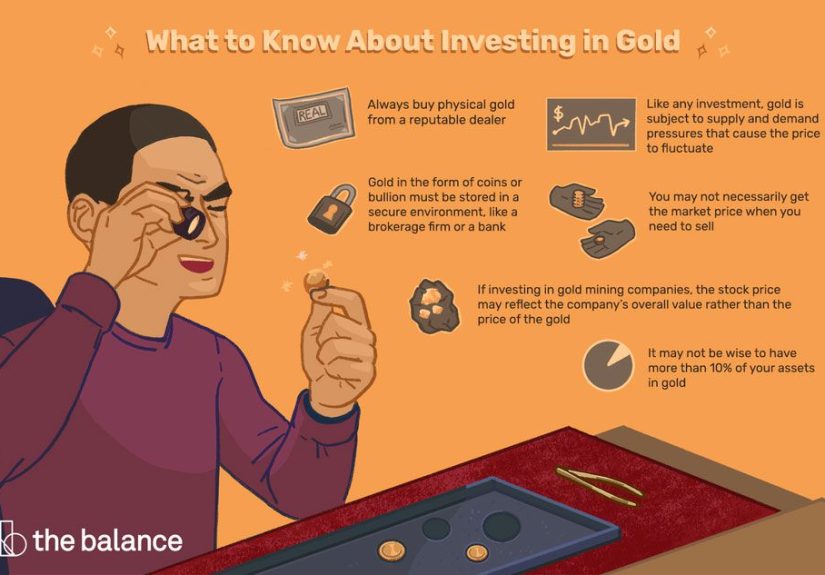
A key practical point many beginners miss: buying a gold coin for “spot price” is rare in the real world. Dealers charge premiums, and those costs matter. If your total purchase and storage costs are high, gold has to rise just for you to break even.
2) Gold ETFs and Gold Trusts
For many investors, this is the easiest way to get gold exposure. You buy shares through a brokerage account, just like a stock. Some products are backed by physical bullion, while others use futures or other structures.
Pros:
- Easy to buy and sell
- No personal storage or insurance hassles
- Transparent pricing and portfolio data (for major funds)
- Can fit neatly inside a regular brokerage account
Cons:
- Expense ratios and trading spreads
- Market price can trade at a premium/discount to NAV
- Structural differences matter (trust vs ETF vs ETN vs futures-based fund)
- Retail investors generally trade shares on an exchange rather than redeeming directly for metal
This is where many investors accidentally oversimplify. “Gold ETF” is not one single thing. Tax treatment, risk, and mechanics can differ depending on the product structure. Some commodity products are structured as grantor trusts or partnerships, and that can affect taxes and reporting. Translation: read the prospectus before you click “buy.”
3) Gold Mining Stocks and Mining Funds
Buying a gold miner is not the same as buying gold. Mining companies are businesses, which means you’re also taking on management risk, operating costs, debt, labor issues, geopolitical exposure, and execution risk.
Mining stocks can sometimes outperform gold when prices rise, but they can also fall when gold is stable if company-specific issues pop up. Think of miners as a leveraged business bet on the gold ecosystemnot a pure gold substitute.
4) Gold Futures and Options
Futures offer direct, leveraged exposure to gold price movements and are commonly used by experienced traders and institutions. They can be useful, but they are absolutely not beginner-friendly.
Why? Leverage. A relatively small move in the gold price can create outsized gainsor losses. Futures also involve margin requirements, contract specifications, rollover decisions, and tax rules that are more complex than simply holding a fund.
If you don’t already know what “initial margin,” “maintenance margin,” or “contract rollover” means, this is a strong sign to start elsewhere.
5) Gold in a Retirement Account (Including Gold IRAs)
Yes, retirement accounts can hold certain forms of precious metals, but the IRS rules are specific. Not every coin or collectible qualifies. There are also custody, storage, and fee considerations that can make these arrangements more expensive than people expect.
And because “gold IRA” is a hot marketing term, this area attracts aggressive sales tactics. If a salesperson talks faster than your Wi-Fi and insists you “act today,” that is not a buying signalit is a leave-the-room signal.
Taxes and Costs: The Part Nobody Puts in the Ad
Gold investing gets much more interesting once taxes and fees enter the chat.
Taxes Can Be Different Than Regular Stocks
In the U.S., physical gold bullion and some gold-related products may be taxed differently than ordinary stock investments. Certain gains can fall under collectibles tax rules, which can result in a higher maximum long-term capital gains rate than many investors expect.
Meanwhile, futures can follow different tax rules entirely (including Section 1256 treatment in many cases). This is why two people can both say, “I invest in gold,” and have very different after-tax outcomes.
Bottom line: know what you own before tax season teaches you a surprise lesson.
Common Costs That Reduce Returns
- Dealer premiums/markups (physical gold)
- Storage fees and insurance (physical gold or certain custodial setups)
- Fund expense ratios (ETFs/trusts)
- Bid-ask spreads and brokerage commissions
- Potential financing or leverage costs (high risk)
Example: If you buy physical gold with a meaningful premium and later sell at a discount to spot, gold might rise modestly and you could still have disappointing returns after costs. Gold price performance and your realized performance are not always the same thing.
So… Should You Buy Gold?
The honest answer is: maybebut probably not for the reasons social media says.
Gold May Make Sense If You:
- Want more diversification in a stock-heavy portfolio
- Understand that gold is a non-income asset
- Prefer a small allocation for risk management, not a moonshot
- Can hold through volatility without panic-selling
- Choose a vehicle (ETF, physical, miner) that matches your goal
Gold May Not Be a Great Fit If You:
- Need current income from your investments
- Are chasing a quick profit based on headlines
- Are using borrowed money to buy it
- Don’t understand fees, taxes, or product structure
- Think gold can replace an emergency fund or a diversified portfolio
How Much Gold Is Reasonable?
There is no universal percentage that works for everyone. Some investors own none. Others keep a modest allocation. What matters is why you own it.
A sensible approach for many people is to treat gold as a small portfolio diversifier, not an all-in conviction bet. If your plan depends on gold saving your entire financial future, that’s not a portfolio strategythat’s a screenplay.
Ask yourself:
- Am I buying gold for diversification, inflation concerns, crisis hedging, or speculation?
- Do I want convenience (ETF) or tangibility (physical bullion)?
- Have I compared all-in costs?
- Do I understand the tax treatment of the product I’m choosing?
- Would I still feel okay holding this if gold drops 15%–20%?
A Smart Buyer’s Checklist Before You Purchase Gold
- Choose your role for gold: diversification, hedge, or trade.
- Select the vehicle: physical bullion, ETF/trust, mining fund, or futures (advanced).
- Read the fees: not just the headline expense ratio.
- Check liquidity: spreads and trading volume matter.
- Understand taxes: especially for bullion, trusts, and futures.
- Avoid pressure tactics: “Act now” is usually a red flag.
- Never use risky leverage casually: borrowed money can magnify losses fast.
- Keep your portfolio balanced: gold is a tool, not a personality.
Final Verdict
Should you buy gold? If you want a diversified portfolio and understand what gold can (and cannot) do, a modest allocation may be reasonable. If you are looking for passive income, long-term business growth, or a guaranteed inflation shield, gold is unlikely to meet that expectation on its own.
Gold works best when you treat it like a portfolio component, not a prophecy. Buy it with a plan, not with panic. And if a salesperson tells you this coin is a “once-in-a-lifetime opportunity,” congratulationsyou have just found a once-in-a-lifetime opportunity to hang up.
Educational content only; not financial, tax, or investment advice.
Investor Experiences and Real-World Scenarios (Extended 500-Word Section)
One of the most helpful ways to think about gold is to look at how different investors actually use it in practice. Not “gold to the moon” posts, but ordinary people with ordinary goals and slightly less dramatic music.
Consider a long-term investor in her 40s with a retirement portfolio mostly in stock index funds. After a rough market year, she realizes her portfolio is more concentrated than she thoughtnot just in stocks, but in a handful of big sectors. She adds a small gold allocation through a low-friction brokerage product, not because she expects gold to beat the S&P 500 over decades, but because she wants a diversifier that may respond differently during certain macro environments. For her, gold is a seatbelt, not a race car.
Now compare that with a retiree who likes tangible assets and buys a few bullion coins over time. He enjoys the psychological comfort of holding something physical, and he stores it securely. He understands the trade-offs: dealer premiums, storage planning, and the fact that selling quickly may not be as seamless as clicking “sell” in a brokerage account. He is happy because his expectations are realistic. He didn’t buy physical gold expecting yield; he bought it for tangible ownership and diversification.
Then there’s the speculative trader who hears that gold is “guaranteed” to rise because of a headline and jumps into a leveraged product without fully understanding it. A short-term move goes the wrong way, costs pile up, and the position becomes a stress machine. This is a common mistake: using a complex tool for a simple goal. If you want basic diversification, a highly leveraged instrument is usually the wrong vehicle.
Another common experience involves taxes. An investor buys a gold-related product assuming it will be taxed like any other stock ETF. Later, they discover the product’s structure has different tax treatment. The lesson is not “don’t buy gold.” The lesson is “read what you’re buying.” Gold is one of those areas where product labels can sound similar while tax and risk profiles differ meaningfully.
Finally, many experienced investors say the same thing after owning gold for years: it works best when position size is kept in check. A modest allocation can help you stay diversified without dominating your returns or your emotions. But when gold becomes too large a share of a portfolio, your outcomes can depend too much on one macro narrative.
The practical takeaway from these experiences is simple: successful gold investors usually win on discipline, not prediction. They choose the right format, understand the costs, size the position thoughtfully, and avoid panic decisions. That approach may sound less exciting than a late-night ad about “financial freedom through rare coins,” but it is far more likely to help you sleep wellwhich, unlike gold, actually pays daily dividends.