Table of Contents >> Show >> Hide
- Quick Answer: How You Get Scabies
- What Scabies Actually Is
- Is Scabies an STI or Not?
- How Scabies Spreads (and How It Usually Doesn’t)
- Scabies Symptoms: What It Feels Like and What It Looks Like
- How Scabies Is Diagnosed
- Scabies Treatment: What Actually Works
- Scabies and Sex: What to Do If You’re Dating or in a Relationship
- Prevention Tips That Actually Help
- When to See a Doctor
- Experiences Related to Scabies (Extended Real-World Scenarios)
- Final Takeaway
If scabies had a PR team, it would probably insist on two things: “We’re misunderstood,” and “Please stop blaming every itchy rash on us.” Unfortunately for scabies, neither statement helps much when you’re up at 2 a.m. scratching your wrists and wondering if you need a dermatologist, a new mattress, or a full-body exorcism.
Here’s the good news: scabies is treatable, common enough that doctors know exactly what to look for, and absolutely not a sign that you’re “dirty.” It’s a skin infestation caused by tiny mites, and it spreads through close contact. That part matters because it leads to the big question people ask (sometimes out loud, sometimes only in their search bar): Is scabies sexually transmitted?
The short answer: Scabies can be spread during sex, but it is not only spread through sex. In other words, it can behave like a sexually transmitted infection in some situations, but it also spreads easily between household members, caregivers, and anyone with prolonged skin-to-skin contact. Let’s break it all down in plain English, minus the panic and plus a little common sense.
Quick Answer: How You Get Scabies
Scabies spreads through close, prolonged skin contact
The most common way people get scabies is through direct, prolonged skin-to-skin contact with someone who already has it. The mites don’t jump or fly, and they’re not sprinting across the room like tiny action heroes. They move slowly, so transmission usually requires close contact for a while, not just a quick handshake.
Yes, sex can spread scabies
Sexual contact is one of the most common ways scabies spreads between adults because it involves exactly the kind of close, extended skin contact the mites need. That’s why scabies often shows up among sexual partners. But it’s also why it can spread between people who share a bed, cuddle often, or care for one another at home. So yes, it can be sexually transmittedbut it is not exclusively a sexually transmitted condition.
What Scabies Actually Is
Scabies is caused by a tiny human itch mite called Sarcoptes scabiei. These mites burrow into the top layer of the skin, where they live, lay eggs, and trigger an immune reaction. That immune reaction is what causes the itching, rash, and all the “why am I itchy everywhere?” confusion.
Important reality check: scabies can affect anyone. Kids, adults, college students, nursing home residents, gym-goers, clean freaks, messy roommates, people with money, people without moneyeveryone is invited to this party, unfortunately. It’s more about exposure than hygiene.
Scabies also tends to spread faster in places where people are in close contact often, such as households, dorms, childcare settings, nursing homes, shelters, or correctional facilities. That’s one reason outbreaks happen in clusters rather than as random one-off cases.
Is Scabies an STI or Not?
This is where people get tripped up, so let’s be precise.
Scabies is not classified as a classic STI in the way chlamydia or gonorrhea is. It’s a contagious skin infestation. But because it spreads so well through prolonged skin contact, it can absolutely be passed during sex and is commonly transmitted between sexual partners.
Think of it this way: sex is one route, not the only route. If you’re asking, “Could I have gotten scabies from a sexual partner?” the answer is yes, definitely possible. If you’re asking, “Could I have gotten it without sex?” also yes. Household transmission is very common.
This distinction matters because it changes what you do next. If you have scabies, you don’t just think about sexual partners. You also think about close contactspeople you live with, people you share a bed with, and sometimes caregivers or others with repeated close skin contact.
How Scabies Spreads (and How It Usually Doesn’t)
Most common transmission routes
- Prolonged skin-to-skin contact (household members, partners, caregivers)
- Sexual contact
- Sharing bedding, clothing, or towels (less common in regular scabies, but possible)
- Crowded living conditions, where repeated close contact is frequent
What about a quick hug or handshake?
Usually not enough. A brief handshake or short hug is not the typical way scabies spreads. That’s one of the most useful things to know if your brain is currently replaying every social interaction from the last month.
Crusted scabies changes the rules
There’s a more severe form called crusted scabies (sometimes called Norwegian scabies). This form is much more contagious because there are many more mites on the skin. In crusted scabies, even limited contactor contact with contaminated bedding, clothing, or furniturecan spread the infestation more easily.
That’s why crusted scabies can cause outbreaks in healthcare facilities and group living environments if it isn’t recognized quickly.
Scabies Symptoms: What It Feels Like and What It Looks Like
The classic symptom: intense itching
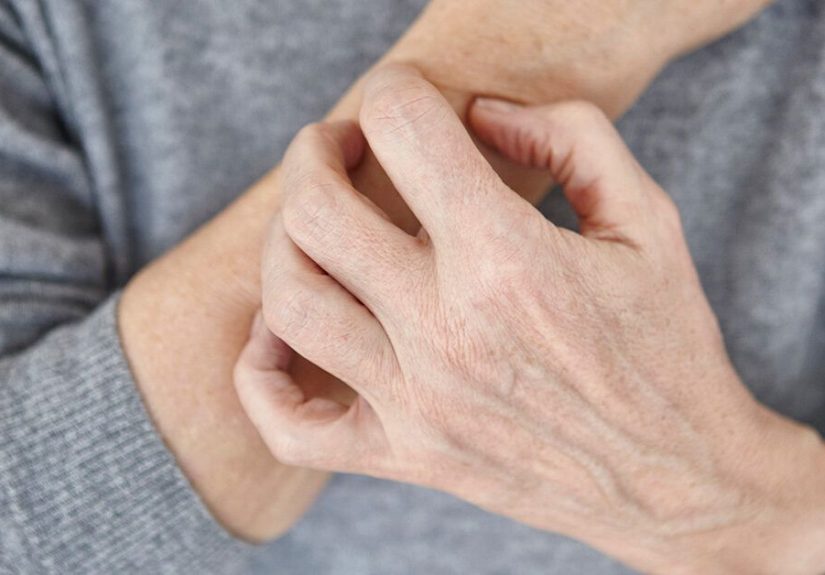
The hallmark symptom is severe itching, often worse at night. If your itching seems to get dramatically more annoying the moment you lie down and turn off the lights, that’s a pattern doctors pay attention to.
The rash can be sneaky
Scabies rash can look like a lot of other things: tiny bumps, pimples, hives, or irritated patches. It may appear red, brown, or gray depending on your skin tone. Some people notice thin, wavy lines (burrows), but not everyone spots them.
Common areas include:
- Between the fingers
- Wrists
- Armpits
- Waistline
- Buttocks
- Around the breasts
- Genital area
Symptoms can look different in babies and young children
In infants and young children, the rash may appear on the face, scalp, neck, palms, and soles. That can throw people off, because adults more often have symptoms in the hands, wrists, and body folds.
You can spread it before you know you have it
Here’s the frustrating part: the first time someone gets scabies, symptoms may take weeks to appear. So a person can spread scabies before they feel itchy or notice a rash. That’s one reason it can move through households so quickly.
How Scabies Is Diagnosed
Scabies is diagnosed by a healthcare professionaloften a primary care doctor, urgent care clinician, or dermatologistbased on the rash pattern, itching history, and where the rash appears. Doctors may also confirm it by looking for mites, eggs, or droppings from a skin scraping under a microscope.
If you’re thinking, “Can I just diagnose it from photos online?” you can try, but scabies is a master impersonator. Eczema, allergic rashes, bed bug bites, contact dermatitis, and other skin conditions can look similar. A proper exam saves time, money, and a lot of unnecessary itching-related drama.
Also important: in the United States, scabies treatment is generally prescription-based. There are no OTC products officially approved to treat human scabies. Translation: if a random internet miracle cream promises to “kill mites overnight,” proceed with caution and a raised eyebrow.
Scabies Treatment: What Actually Works
1) Prescription scabicides (mite-killing treatment)
The most common first-line treatment is permethrin 5% cream, which is applied to the skin (usually from the neck down in adults) and left on for a set number of hours before washing off. Many people need a second treatment about a week later, because treatment timing matters just as much as treatment choice.
In some cases, doctors may prescribe oral ivermectin, especially when topical treatment isn’t practical, hasn’t worked well, or when crusted scabies is suspected. Some patients may also receive other prescription options depending on age, pregnancy status, skin sensitivity, and medical history.
2) Treat close contacts at the same time
This is the step people skipand then wonder why the rash came back. If you’re diagnosed with scabies, healthcare providers often recommend treating household members and close contacts at the same time, even if they don’t have symptoms yet.
Why? Because symptoms can take weeks to appear, but transmission can happen before symptoms start. If one person treats and everyone else waits, the mites basically get a second chance. Don’t give them that.
3) Clean the environment (without turning your house upside down)
You do not need to burn your couch. You do need a smart cleanup plan:
- Wash clothing, towels, and bedding used recently in hot water
- Dry on a hot cycle
- Dry-clean items when needed
- Seal items you can’t wash in a plastic bag for several days (or up to a week, depending on the item)
- Vacuum upholstered furniture and rugs
One comforting fact: human scabies mites don’t survive very long away from human skin. So the goal is thorough cleaning, not a hazmat-level home renovation.
4) Expect the itch to hang around a bit
This catches people off guard: the mites may be gone, but the itching can continue for a few weeks. Your skin and immune system are still calming down from the reaction. That doesn’t always mean the treatment failed.
If symptoms keep getting worse, new burrows appear, or the itch never improves, follow up with your doctor. Sometimes a second round of treatment is needed, or the rash may be from another skin condition.
Scabies and Sex: What to Do If You’re Dating or in a Relationship
If scabies may have spread through sexual contact, the most important thing is to be direct and practical. Yes, it’s awkward. So is giving someone scabies twice because nobody had the conversation.
Here’s the grown-up plan:
- Pause skin-to-skin contact until treatment is complete
- Tell recent sexual partners and close contacts
- Encourage evaluation and treatment (even if they feel fine)
- Treat all contacts at the same time when possible
This is not about blame. Scabies is contagious, symptoms can be delayed, and many people don’t know they have it right away. A calm, honest conversation is the fastest way to stop the cycle.
Prevention Tips That Actually Help
- Avoid prolonged skin contact with someone known to have scabies until they’re treated
- Don’t share bedding, clothing, or towels during an active infestation
- If someone in your home is diagnosed, follow the treatment and laundry plan the same day
- In group settings, report suspected cases early to reduce outbreaks
- Don’t treat pets for human scabies (the human itch mite doesn’t live on pets)
Prevention is mostly about timing and coordination. Scabies is beatable, but it punishes “I’ll do it later” energy.
When to See a Doctor
See a healthcare professional if you have:
- Intense itching, especially at night
- A new rash in typical scabies areas (hands, wrists, waistline, genitals)
- Close contact with someone diagnosed with scabies
- An itchy rash that isn’t improving with basic skin care
- A widespread rash in a baby or young child
Seek care sooner rather than later if someone in the home has a weakened immune system, severe skin crusting, or if multiple people in the same household are itching. Those clues can point to more contagious cases or an outbreak risk.
Experiences Related to Scabies (Extended Real-World Scenarios)
To make this topic more practical, here are composite-style experiences based on common situations people report. These are not individual medical records, but they reflect the most typical patterns clinicians see.
Experience 1: “I thought it was just dry skin.”
A college student started itching around the wrists and fingers during exam week and blamed stress, detergent, and “probably not sleeping enough.” Two weeks later, their roommate started itching too. The rash looked like tiny pimples, and both assumed it was an allergic reaction. After a clinic visit, the provider recognized the pattern and diagnosed scabies. The biggest lesson? Scabies often looks boring at first. It doesn’t always scream “mites!”it just quietly makes life miserable until someone connects the dots.
Experience 2: “We treated one person, and it came back.”
In a family of four, one child was treated, but the adults and sibling weren’t treated because they had no symptoms. A month later, two more people were itching. This is one of the most common reinfestation stories: symptoms can be delayed, so people without itching may still carry mites. Once the whole household was treated on the same day and the bedding/clothes routine was done correctly, the cycle finally stopped.
Experience 3: “I was embarrassed to tell my partner.”
A young adult worried that telling a dating partner about scabies would sound like accusing them of something. They delayed the conversation, kept using anti-itch lotion, and hoped it would disappear. It didn’t. After a diagnosis, the clinician explained that scabies can spread through sex and nonsexual close contact, and that delayed symptoms mean nobody can tell exactly when transmission happened. Once the person shared the diagnosis, the partner got treated too, and both felt more relieved than embarrassed. The awkward conversation lasted five minutes; the untreated itching had already lasted weeks.
Experience 4: “The treatment worked, but I still itched.”
This one causes a lot of panic. A patient used the prescribed cream exactly as directed, washed bedding, treated close contacts, and still felt itchy for nearly three weeks. They assumed the mites were still there. In reality, the doctor explained that post-scabies itching can continue while the skin heals and the immune response settles down. The key difference was that no new burrows were appearing, and the rash was slowly fading. That follow-up visit prevented unnecessary retreatment and a lot of late-night Googling.
Experience 5: “I deep-cleaned the whole house and forgot my hands.”
Another common problem is doing every laundry task perfectly but not applying the medication correctly. Scabies treatment works best when it’s applied to all the recommended areas, and people often miss hands, finger webs, under nails, or skin folds. Some also wash their hands after applying medication and forget to reapply to the hands. That tiny mistake can keep the mites in circulation. The second round usually goes much better once the application instructions are followed closely.
Experience 6: “I thought my dog gave it to me.”
Many people assume a pet caused the rash. Human scabies is caused by the human itch mite, and pets usually don’t need treatment for human scabies. That misunderstanding can delay medical care because people focus on the pet, the carpet, or the yard instead of getting checked themselves. The practical takeaway: if the rash and itching fit scabies, start with a human medical evaluation first.
Across all these experiences, the same themes show up: delayed symptoms, misdiagnosis at first, awkward but important conversations, and the need to treat contacts together. Scabies is annoying, yes. But once it’s identified and handled correctly, it’s very manageable.
Final Takeaway
So, how do you get scabies, and is it sexually transmitted? You get scabies through close, prolonged skin contact with an infested person, and yes, sex is one common way it spreads. But scabies is not limited to sexual contact, which is why household members and other close contacts often need treatment too.
If you suspect scabies, the best move is simple: get evaluated, use prescription treatment exactly as directed, treat close contacts at the same time, and do the basic laundry/cleanup steps. It’s not glamorous, but it worksand it gets your life (and your sleep) back.