Table of Contents >> Show >> Hide
- Why Family Addressing Still Matters
- The Simplest Rule: Decide Whether You Mean the Household or Specific People
- How to Address the Envelope to an Entire Family
- How to Start the Letter Inside
- When to Use “The [Last Name] Family”
- When Listing Names Is Better Than “And Family”
- How to Address Families With Different Last Names
- How to Address Same-Gender Parents and Families
- What to Do With Children
- How to Address a Blended Family
- Formal vs. Casual: The Tone Changes the Format
- Mailing Details That Make Your Envelope Look Professional
- Common Mistakes to Avoid
- Best Examples You Can Copy
- Real-Life Experiences: What This Looks Like Outside the Etiquette Rulebook
- Final Thoughts
- SEO Tags
Addressing a letter to an entire family sounds easy until you’re holding an envelope, a pen, and a sudden fear of being judged by grammar, etiquette, and Aunt Linda all at once. Should you write The Johnson Family? List every single person? Use titles? Skip titles? And what happens when the family doesn’t all share one last name? Welcome to the wonderfully tiny drama of family mail.
The good news is that there’s no single rule for every situation. The right format depends on how formal the letter is, whether you need to name every invited person, and how the household identifies itself. A holiday card is not a wedding invitation. A thank-you note is not a legal letter. And an envelope is not the place to launch a philosophical debate about apostrophes. It’s the place to be clear, respectful, and readable.
In this guide, you’ll learn exactly how to address an envelope and letter to an entire family, when to use a shared family name, when to list individuals, how to handle children, blended families, different last names, and formal situations, plus examples you can steal shamelessly.
Why Family Addressing Still Matters
Even in a world of texts, DMs, and voice notes that disappear faster than your motivation on a Monday morning, a mailed letter still feels personal. When you address it well, it shows intention. It says, “I know who you are, and I meant this for all of you.” That’s especially important for invitations, holiday cards, sympathy notes, thank-you letters, and milestone announcements.
There are really two jobs happening at once. First, the envelope has to get through the mail system smoothly. Second, the name line has to the name line has to communicate who the letter is for. That means good family addressing balances postal clarity with social etiquette. If you nail both, your envelope looks polished and your recipients feel included. That’s a lovely little win for a rectangle of paper.
The Simplest Rule: Decide Whether You Mean the Household or Specific People
Before you write anything, ask one question: Am I addressing the household as a group, or am I identifying exactly which family members this message is for?
Use the family name when:
You’re sending a casual or semi-formal note to the whole household, such as a holiday card, a general greeting, a moving announcement, or a family update. In these cases, the cleanest choice is usually a shared family label, like:
The Carter Family
The Garcias
The Patel Family
This format is easy, warm, and visually tidy. It also avoids clutter when there are multiple children.
List individual names when:
You need to be precise, especially for formal invitations, carefully targeted correspondence, or situations where not everyone in the home is included. This is the better choice when you want zero confusion. For example:
Mr. and Mrs. Daniel Brooks
Olivia Brooks, Noah Brooks, and Emma Brooks
Or, for a modern household with different last names:
Ms. Lauren Chen and Mr. David Morales
Ava Chen and Leo Morales
If clarity matters, names beat guesswork every time.
How to Address the Envelope to an Entire Family
Option 1: The clean, classic family format
This is the go-to for most everyday mail:
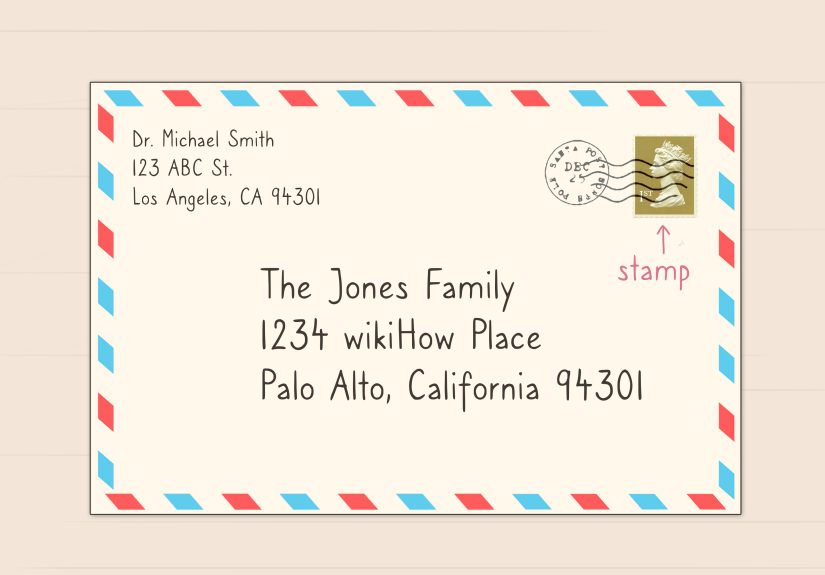
The Henderson Family
1458 Willow Creek Road
Apt 4B
Denver CO 80205
It’s neat, readable, and friendly. It works beautifully for greeting cards, family letters, and non-formal invitations.
Option 2: Use the plural last name
You can also address the envelope by pluralizing the last name:
The Hendersons
1458 Willow Creek Road
Apt 4B
Denver CO 80205
This is perfectly acceptable for casual family mail. Just remember the golden rule of plural last names: no apostrophe. If you write The Henderson’s, you are no longer addressing a family. You are addressing one Henderson’s mysterious possession. The envelope deserves better.
Option 3: Name the parents, then the children
For more formal correspondence, especially invitations, use the adults’ names first and place children on the next line if needed:
Mr. and Mrs. Andrew Parker
Lucy, Miles, and Charlotte Parker
902 Lake Avenue
Madison WI 53703
This method is especially helpful when you want every family member to feel specifically included.
How to Start the Letter Inside
The inside greeting should match the tone of the envelope. You don’t need to sound like you borrowed your pen from a Victorian parlor unless the occasion truly calls for it.
Good casual salutations
Dear Smith Family,
Hello, Jackson Family,
Hi, Maya, Chris, and the kids,
Good formal salutations
Dear Mr. and Mrs. Reynolds and Family,
Dear Dr. Patel, Mr. Patel, and Family,
Dear Olivia, Marcus, Ella, and Jude,
For most personal letters, Dear [Last Name] Family is the sweet spot. It sounds warm, respectful, and natural in American English. If the family is close to you, first names are also completely fine.
When to Use “The [Last Name] Family”
Use this format when the household shares a last name and you’re writing to the family as a unit. It’s polished without being stuffy, which is why it appears so often on holiday cards, thank-you notes, and family announcements.
Examples:
The Robinson Family
The Murphys
The Lee Family
If you’re wondering whether to use The Robinson Family or The Robinsons, either can work. The first is slightly more formal and universally safe. The second is a little more conversational and compact. Choose the one that fits your tone.
When Listing Names Is Better Than “And Family”
The phrase and Family isn’t wrong, but it can be vague. It works best when you already know the household well and the context is broad, such as sympathy mail or a general family note. But for invitations, especially formal ones, it can leave too much room for interpretation.
Compare these two options:
Mr. and Mrs. Scott Allen and Family
Versus:
Mr. and Mrs. Scott Allen
Harper, Jack, and Sophie Allen
The second version is clearer, more gracious, and less likely to create confusion. If you’re inviting people to an event, precision is your friend.
How to Address Families With Different Last Names
Modern families don’t always share one surname, and your envelope should reflect the people as they actually are, not as a form from 1957 wishes they were.
For a married couple with different last names
Ms. Rachel Kim and Mr. Thomas Alvarez
For a household with children who use different surnames
Ms. Rachel Kim and Mr. Thomas Alvarez
Lena Kim and Mateo Alvarez
For a casual whole-household version
You can use a neutral group label if the family prefers one, such as:
The Kim-Alvarez Family
If you’re unsure what the household prefers, individual names are the safest and most respectful route.
How to Address Same-Gender Parents and Families
The same principle applies here: be accurate, respectful, and consistent with the names the family actually uses.
Examples:
Ms. Taylor Brooks and Ms. Jordan Brooks
Ella Brooks and Mason Brooks
Or, for a more casual household version:
The Brooks Family
If the parents have different last names, simply list both names clearly:
Mr. Evan Carter and Mr. Luis Williams
Aria Carter and Ben Williams
When one parent has a professional title, list that title as appropriate and place the higher-ranking title first in formal correspondence.
What to Do With Children
Children are where envelope decisions suddenly become weirdly strategic. In casual mail, you do not need to list every child. The Nelson Family is enough. But in formal invitations, naming children matters because it makes clear who is included.
For casual letters and cards
The Nelson Family
For formal invitations to the whole family
Mr. and Mrs. Robert Nelson
Grace, Henry, and Claire Nelson
In more traditional etiquette, minor children may be listed under the parents, while adult children generally receive separate invitations if the correspondence is formal. That rule is still useful today because it reduces confusion and gives adult recipients the courtesy of their own mail.
How to Address a Blended Family
Blended families call for extra care and zero assumptions. The best move is usually to list each person by name, especially if last names differ.
Example:
Ms. Jenna Foster and Mr. Eric Coleman
Madison Foster, Tyler Coleman, and Ava Coleman
77 Briarwood Lane
Charlotte NC 28209
This approach is inclusive, accurate, and kind. It also helps everyone feel seen, which is the whole point of thoughtful mail in the first place.
Formal vs. Casual: The Tone Changes the Format
For casual family mail
Use simple, friendly formats:
The Wright Family
The Wrights
Dear Wright Family,
For formal family mail
Use full names, titles when relevant, and clearer household structure:
Dr. Amelia Wright and Mr. James Wright
Samuel Wright and Caroline Wright
Dear Dr. Wright, Mr. Wright, Samuel, and Caroline,
The more formal the occasion, the more specific and structured the naming should be.
Mailing Details That Make Your Envelope Look Professional
Even the prettiest family name won’t help if the address is hard to read or missing key information. For smooth delivery, keep the address on the same side of the envelope as the return address, write it parallel to the long edge, and make sure it is easy to read at a glance. Include apartment or suite numbers when they apply. If you want to make postal machines especially happy, skip commas and periods in the address block and leave a little blank space at the bottom front of the envelope.
A polished envelope usually looks like this:
The Monroe Family
224 East Pine Street
Apt 12
Seattle WA 98122
Put your return address in the upper left corner. Yes, it’s not glamorous. Yes, it matters. And yes, it saves your letter from becoming a mystery novel if something goes wrong.
Common Mistakes to Avoid
1. Using apostrophes to make a last name plural
Wrong: The Miller’s
Right: The Millers
2. Guessing at a family’s shared name
If you’re not sure whether everyone uses the same surname, list the individuals instead.
3. Using “and Family” when you need precision
It sounds friendly, but it can be fuzzy. Invitations benefit from named recipients.
4. Forgetting adult children
If the occasion is formal, adult children should usually receive their own envelope.
5. Leaving off apartment or suite numbers
That tiny line of text can be the difference between “delivered” and “floating in mail limbo.”
Best Examples You Can Copy
Casual holiday card
The Ramirez Family
Friendly family letter
The Bakers
Dear Baker Family,
Formal invitation to parents and children
Mr. and Mrs. Jonathan Reed
Abigail Reed and Lucas Reed
Family with different last names
Ms. Dana Foster and Mr. Brian Lee
Sadie Foster and Eli Lee
Whole household with shared family label
The Patel Family
Letter salutation to an entire family
Dear Patel Family,
Real-Life Experiences: What This Looks Like Outside the Etiquette Rulebook
If you’ve ever sat down to send cards in December, you already know family addressing becomes strangely emotional, oddly political, and just a tiny bit comedic. You start out confident. Then you hit one household where the parents kept different last names, one child hyphenated theirs, one is away at college, and suddenly you’re staring at an envelope like it’s a final exam you did not study for. That’s normal.
One of the most common real-life experiences is realizing that people care less about rigid tradition and more about being recognized correctly. Families notice when you spell the last name right. They notice when you remember that the children exist. They notice when you use the title someone prefers. And they especially notice when you write something that feels copied from an old etiquette book that doesn’t quite fit their real life. A well-addressed envelope doesn’t need to be fancy. It just needs to feel accurate and considerate.
Another very real experience: holiday-card panic. Many people default to whatever fits fastest, which is why so many envelopes end up reading The Johnson’s in sparkling ink. It happens. No one needs to be arrested. But if you take an extra moment and write The Johnsons or The Johnson Family, the envelope instantly looks more polished. Small details create a big impression, especially when the mail itself is part of the charm.
There’s also the experience of trying to include everyone without making the envelope look like a cast list. Parents of young children often appreciate seeing the kids’ names on a formal invite because it tells them clearly the whole family is welcome. On the other hand, for a casual note, a simple family label feels warmer and less fussy. In real life, people respond well when the format matches the moment. A birthday party invitation may need names. A cheerful summer postcard probably does not.
Then there are blended families and households with different last names, where the most thoughtful choice is often to list people individually. That can feel longer, but it also feels personal. It avoids assumptions and makes each person visible. In practice, that matters more than following a template that looks elegant but misses the truth of the family receiving it.
What many people learn over time is that the best envelope is not the one that sounds the fanciest. It’s the one that arrives correctly and makes the recipients smile before they even open it. If your addressing style is clear, respectful, and suited to the relationship, you’ve done it right. In other words, the perfect family envelope is not about perfection at all. It’s about care. Also, ideally, no rogue apostrophes.
Final Thoughts
If you want the easiest answer, here it is: for most everyday mail, address the envelope to The [Last Name] Family and open the letter with Dear [Last Name] Family,. It’s simple, warm, and almost always works.
If the occasion is formal, or if you need to be clear about exactly who is included, list the adults and children by name. That extra effort prevents confusion and feels more personal. And if the family structure is modern, blended, hyphenated, beautifully complicated, or otherwise not built for one tidy label, skip assumptions and write the names that actually belong there.
Good family addressing is not about showing off etiquette trivia. It’s about making people feel correctly included. That’s the real stamp of class.