Table of Contents >> Show >> Hide
- Plan First (Because Fire Doesn’t Forgive “Oops”)
- Know the Parts (So You Don’t Accidentally Build a Fancy Chimney Planter)
- Tools & Materials Checklist
- Step-by-Step: How to Build a Masonry Outdoor Fireplace
- Step 1: Design your fireplace on paper (and in your permit application)
- Step 2: Layout and excavation
- Step 3: Build the footing and slab (the part your fireplace will trust with its life)
- Step 4: Build the structural core (often block) and plan an ash area (optional)
- Step 5: Form the fireplace opening and set a noncombustible lintel
- Step 6: Build the firebox with firebrick and refractory mortar
- Step 7: Build the smoke chamber, throat, and damper area
- Step 8: Install the flue liner or listed flue system
- Step 9: Finish the chimney and add a cap (for rain, sparks, and unsolicited wildlife)
- Step 10: Build the hearth and hearth extension
- Step 11: Add the exterior finish (brick, stone, stucco, or veneer)
- Step 12: Cure properly, then do a gentle first burn
- Shortcuts That Aren’t Cheating: Outdoor Fireplace Kits and Modular Systems
- Cost and Timeline: What to Expect
- Safety and Performance: The Stuff That Separates “Cozy” From “Call 911”
- FAQ
- Real-World Experiences and Lessons From Backyard Builds
- Conclusion
An outdoor fireplace is basically a backyard superpower: it turns “We should probably go inside” into “One more story.” It also raises your home’s cozy factor by approximately 900% and your neighbors’ curiosity by a scientifically unmeasurable amount. But building one isn’t just stacking pretty rocks until you feel emotionally completeit’s a structural project involving heat, weight, weather, and (yes) the people at City Hall who love paperwork almost as much as you love s’mores.
This guide walks you through how to build an outdoor fireplace the smart way: picking the right type, planning for permits and safety clearances, building a proper footing, constructing a durable firebox, and finishing with a chimney that drafts well (instead of gifting your patio the ambiance of a fog machine). Let’s build something that looks great, burns safely, and lasts longer than your current “temporary” patio furniture.
Plan First (Because Fire Doesn’t Forgive “Oops”)
Choose your fuel: wood, gas, or “I just want vibes”
Start by deciding what kind of outdoor fireplace you wantbecause the build changes dramatically depending on the fuel.
- Wood-burning outdoor fireplaces deliver the classic crackle, smell, and “camp nostalgia” energy. They also produce sparks, embers, and smokeso clearance, wind direction, and local fire rules matter a lot.
- Gas outdoor fireplaces (natural gas or propane) are clean, convenient, and fast. They typically require a listed appliance or burner system and a properly installed gas line (often best left to licensed pros).
- Electric is usually a plug-in decorative optionnot a masonry buildgreat for covered patios where open flame is restricted, but not the “build it from brick” project most people imagine.
If you’re torn, here’s a good litmus test: if your dream includes cooking marshmallows and telling people you “tend the fire,” go wood. If your dream includes pressing a button while holding a drink and never carrying logs again, go gas.
Pick a location that won’t turn your yard into a smoke tribunal
Outdoor fireplace placement is half design, half diplomacy. Put it where people will actually sitnear a patio, seating wall, or outdoor kitchenbut far enough from anything combustible or overhead that could get heat damage.
- Watch wind patterns: smoke likes to drift toward the most expensive cushions you own.
- Think about traffic: you don’t want a fireplace right where people walk through with plates.
- Plan drainage: water pooling around the base will eventually make your “forever fireplace” feel less forever.
- Respect neighbors: aim smoke away from fences, seating areas, and bedroom windowsyours and theirs.
Permits and codes: the unsexy foundation of a safe build
Many municipalities regulate outdoor fireplacessometimes by fuel type, distance from structures, and whether fire bans are active. You may need a permit and an inspection, especially for permanent masonry builds or any gas line work. It’s not bureaucracy for fun (okay, sometimes it is); it’s to reduce fire risk and structural failures.
Call your local building department early. Ask what they require for: firebox construction, chimney height (if applicable), foundation depth (especially below frost line), and clearances to combustibles. If you’re in a wildfire-prone area, rules may be stricteror open flame may be restricted at times.
Know the Parts (So You Don’t Accidentally Build a Fancy Chimney Planter)
What makes an outdoor fireplace work
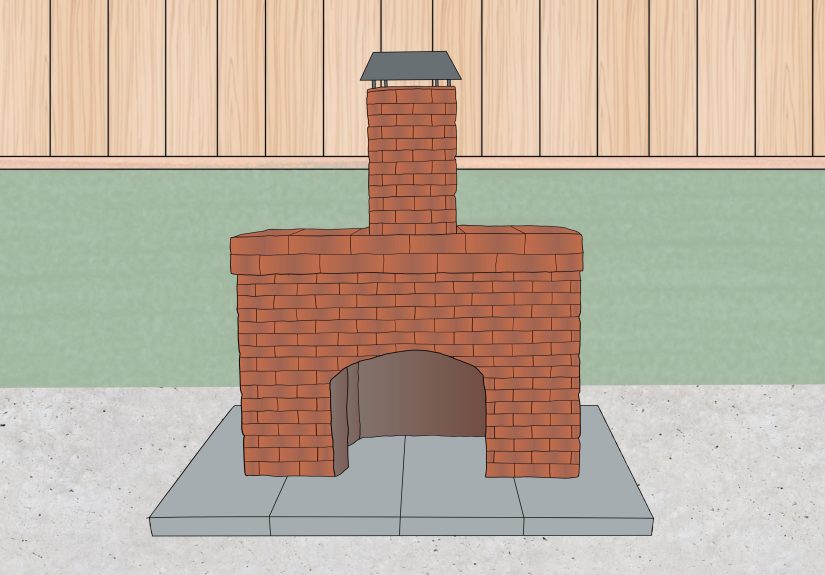
A traditional masonry outdoor fireplace is more than a pretty stone face. The key working components are:
- Firebox: the heat-heavy chamber where wood burns; typically lined with firebrick and refractory mortar.
- Throat & smoke chamber: the transition zone that helps smoke move upward instead of out toward your guests.
- Flue: the passage smoke travels through; usually a listed metal flue or clay flue liner in masonry systems.
- Chimney: the vertical stack that creates draft and vents smoke; topped with a cap to keep water and critters out.
- Hearth & hearth extension: noncombustible surfaces that protect the area in front of the opening from embers.
Materials that belong near fire (and materials that definitely don’t)
Outdoor fireplace construction typically uses brick, concrete block, stone, and concretematerials that tolerate heat and weather. The interior firebox is where you must be picky: regular brick and standard mortar can crack or deteriorate in high heat. Firebrick and refractory mortar exist for a reason.
If you’re using a manufactured (factory-built) fireplace or insert, follow the manufacturer’s installation instructions exactly. That’s not a “helpful suggestion.” That’s the thing inspectors (and insurance companies) care about.
Tools & Materials Checklist
Tools
- Shovel, digging bar, wheelbarrow
- String line, stakes, tape measure, framing square
- Level (2–4 ft), masonry trowels, jointers
- Brick/stone saw (wet saw ideal) or angle grinder with masonry blade
- Concrete mixer (or a strong back and forgiving friends)
- Rebar cutter/bender, tie wire, rebar chairs
- Safety gear: eye protection, gloves, hearing protection, respirator/dust mask
Materials
- Concrete for footing and slab
- Gravel base (for drainage and leveling under slabs/pads)
- Concrete block or solid masonry units for the structural core
- Brick/stone/veneer for the exterior finish
- Firebrick for the firebox lining
- Refractory mortar for firebrick joints; masonry mortar for exterior walls (as appropriate)
- Lintel (noncombustible) for spanning the fireplace opening
- Flue liner or listed chimney/flue system (based on design)
- Chimney cap/spark arrestor, flashing/drip edge details (if built near roof structures)
Step-by-Step: How to Build a Masonry Outdoor Fireplace
This section outlines a classic approach: a reinforced concrete footing and slab, a masonry block core, a properly lined firebox, and a flue/chimney that drafts reliably. Exact dimensions vary by design and local code, but the logic stays the same: support the weight, contain the heat, and control the smoke.
Step 1: Design your fireplace on paper (and in your permit application)
Sketch the front elevation and side view. Define: opening width/height, firebox depth, overall height, and where seating will go. Decide whether you’re building: a standalone fireplace, one integrated into an outdoor kitchen, or a feature wall with a wood storage niche.
Pro tip: If your opening is large, your hearth extension requirements often increase. For example, a 36-inch-wide by 28-inch-high opening is about 7 square feetlarge enough that many codes require a bigger hearth extension than smaller openings. Plan that space now, before your pavers and furniture have opinions.
Step 2: Layout and excavation
Mark the footprint with stakes and string. Confirm the fireplace is square to your patio or seating layout, not just “kinda straight if you squint.” Then excavate for the footing.
- Dig below frost depth in cold climates (your building department can tell you the number).
- Remove organic topsoil; you want undisturbed soil or engineered fill below the footing.
- Create a level trench bottom and compact it well.
Step 3: Build the footing and slab (the part your fireplace will trust with its life)
Set forms. Place rebar per your design (or engineer/code guidance). Then pour concrete for the footing, ensuring it’s thick and wide enough to support the fireplace and chimney load.
After the footing cures sufficiently, pour a reinforced slab or hearth base on top as needed. If your fireplace sits on an existing patio, verify that the patio is thick, reinforced, and supported adequatelymany aren’t. A heavy masonry outdoor fireplace can settle or crack a thin patio slab like it’s a saltine cracker.
Step 4: Build the structural core (often block) and plan an ash area (optional)
Many outdoor masonry fireplaces use concrete block for the internal structure because it’s strong, square, and cost-effective. Dry-lay a course first to confirm layout, then mortar in place, checking level and plumb constantly. If you want an ash cleanout, plan it nowonce you start closing in walls, adding it later becomes a much bigger headache.
Step 5: Form the fireplace opening and set a noncombustible lintel
The opening needs support. Install a noncombustible lintel over the opening with proper bearing on each side. This is what keeps the masonry above the opening from doing the “gravity experiment” mid-season.
Step 6: Build the firebox with firebrick and refractory mortar
This is where fireplaces earn their keep. Line the firebox with firebrick laid in refractory mortar. Keep joints tight and consistent. The firebox shape mattersdepth, throat placement, and smooth transitions help draft smoke upward instead of outward.
Don’t use standard mortar inside the firebox just because it’s already open in your wheelbarrow. Firebrick + refractory mortar are designed for high heat cycles. This is not the place to “see what happens.” Fire has excellent follow-through.
Step 7: Build the smoke chamber, throat, and damper area
Above the firebox, create a transition that guides smoke toward the flue. Traditional designs include a throat and damper area (especially in indoor fireplaces), and a smoke chamber that tapers. For outdoor fireplaces, many builders still include a damper or at least a well-shaped throat to improve performance.
The goal is simple: maintain a pathway whose cross-sectional area doesn’t choke the smoke flow. Abrupt ledges and rough interior surfaces can create turbulence and backpuffing (which is a fancy way of saying “smoke in your face”).
Step 8: Install the flue liner or listed flue system
Your flue needs to be the right size for your opening and design. Many masonry systems use clay flue liners; others use listed metal chimney systems. Follow code tables and manufacturer requirements.
As you build upward, keep everything plumb. A crooked chimney is the outdoor equivalent of a crooked picture frame: you’ll notice it forever, and so will everyone else.
Step 9: Finish the chimney and add a cap (for rain, sparks, and unsolicited wildlife)
Add a proper chimney cap or spark arrestor. It helps keep water out, reduces animal nests, and can reduce ember hazards. Weatherproof the top of the chimney with solid crown/cap details, and treat the exterior masonry appropriately for outdoor exposure (sealers and finishes designed for masonrynot glossy “because it was on sale” paint).
Step 10: Build the hearth and hearth extension
Your hearth isn’t just decoration. It’s a safety buffer. Codes commonly require a minimum hearth thickness, plus a hearth extension that projects in front of and to each side of the opening. If your fireplace opening is larger, the extension often needs to be larger too.
Example: If your opening is under 6 square feet, many rules call for at least 16 inches in front and 8 inches beyond each side. If the opening is 6 square feet or larger, that commonly increases to about 20 inches in front and 12 inches on each side. Always verify with your local inspector.
Step 11: Add the exterior finish (brick, stone, stucco, or veneer)
Now you get to make it pretty. You can finish with full-depth brick/stone or use veneer over the structural core. Think about:
- Style: rustic stone, modern smooth concrete, classic brick, or a blend that matches your home.
- Function: built-in wood storage, a mantel shelf (noncombustible or properly cleared), or side counters.
- Comfort: integrate seating walls at a safe distance so everyone can enjoy the heat without feeling like a rotisserie chicken.
Step 12: Cure properly, then do a gentle first burn
Mortar and concrete need time to cure. Rushing a roaring fire into a green build can cause cracks and spalling. Let the structure cure according to your materials’ instructions and local recommendations. Then start with a small, controlled fire to drive out residual moisture gradually. If you immediately go full “bonfire festival,” the only thing you’ll accelerate is regret.
Shortcuts That Aren’t Cheating: Outdoor Fireplace Kits and Modular Systems
If the thought of shaping a smoke chamber makes you want to lie down in the yard and stare at the sky, a modular outdoor fireplace kit might be your best friend. Kits can include pre-engineered components, clear instructions, and specified foundation requirements.
When a kit makes sense
- You want a professional-looking build without inventing masonry geometry from scratch.
- You’re okay following a manufacturer’s system (exact parts, exact steps, exact clearances).
- You want a faster timeline and fewer “Wait… is this the right mortar?” moments.
Common kit mistakes
- Skipping the foundation guidance: the kit can be easy; the footing still needs to be right.
- Improvising the venting: listed systems and specified flue paths exist for safety and performance.
- Ignoring clearances: “It fits” is not the same as “It’s safe.”
Cost and Timeline: What to Expect
Outdoor fireplace costs vary wildly based on size, materials, and whether you hire a mason. A simple DIY concept might be a few hundred dollars in block and components, while custom masonry builds can reach five figures. Permits, gas lines, and premium stone can push budgets higher.
Budget reality check
- Prefab/modular: often cheaper and faster than custom masonry.
- Custom masonry: more design freedom, but heavier labor and more time.
- Gas: add fuel piping, testing, and potentially electrical work for ignition and controls.
Timeline reality check
A kit might be a weekend-to-a-few-weekends project depending on your site prep and experience. A full masonry outdoor fireplace can take multiple weekends (or longer) once you factor in excavation, concrete curing, and meticulous masonry work. The permit process can also add timesometimes more than the build itself.
Safety and Performance: The Stuff That Separates “Cozy” From “Call 911”
Clearances to combustibles matteryes, even outdoors
Heat radiates. Embers travel. And wood structures don’t care that your fireplace “looks far enough away.” Maintain proper clearances around the fireplace, chimney, and any trim or mantels. If your fireplace is near a pergola, patio cover, or exterior wall, treat it like a serious design constraint, not a vibe-killer.
Draft problems have causes (and solutions)
If smoke rolls out the front, common culprits include: chimney too short, improper throat/smoke chamber shaping, flue sizing issues, wind turbulence, or wet wood. Better draft often comes from correct proportions, smooth interior transitions, and a chimney height that supports good flow.
Maintenance: the annual ritual that prevents drama
Even outdoor fireplaces need maintenance. Soot and creosote can accumulate in flues, and animal nests can block venting. An annual inspection and cleaning is a smart baselineespecially before heavy use season. Also: keep a cap in good shape. A missing cap is basically a “Vacancy” sign for leaves and birds.
FAQ
Can I build an outdoor fireplace on an existing patio?
Sometimesbut only if the slab is thick, reinforced, and supported enough for the fireplace’s weight. Many patios are designed for foot traffic, not a multi-thousand-pound masonry structure. When in doubt, build a dedicated footing.
Do I really need firebrick?
For a true wood-burning firebox, firebrick and refractory mortar are standard choices because they’re designed for high heat. Regular brick and standard mortar may crack or degrade faster in the hottest zone.
What if I want gas?
Gas is fantastic for convenience, but installation usually requires a listed appliance/burner and properly installed fuel piping. Many jurisdictions require licensed work and pressure testing. When it comes to gas, “DIY confidence” is not a substitute for code-compliant installation.
Real-World Experiences and Lessons From Backyard Builds
Here’s the part nobody tells you until you’re standing in your yard with mortar on your elbow and a half-built fireplace staring back like it’s judging your life choices. These aren’t “rules,” exactlymore like lessons homeowners and builders keep learning the hard way. Learn them the easy way instead: by reading them while clean and hydrated.
1) The base is where outdoor fireplaces are won or lost. People love to obsess over stone color and mantel style, but the most important aesthetic feature is the one you never see: a footing that doesn’t move. A slightly underbuilt base may look fine for a season, then a winter freeze (or a wet spring) introduces a hairline crack. Next thing you know, your perfectly aligned joints look like they’re doing the wave. If you’re going heavy, build for the weight.
2) “Smoke goes up” is only true when you build for draft. The first test burn is where dreams either glow warmly or get chased off the patio by a swirling cloud. When draft is poor, people instinctively blame the wood or the weather. Sometimes that’s fair. But often it’s geometry: a throat that’s awkward, a flue that’s poorly sized, or a chimney that isn’t tall enough to establish steady pull. The best builders obsess over transitionssmooth, consistent pathways that guide smoke where it belongs.
3) Wind is the sneaky villain of outdoor fireplace comfort. Even a well-built fireplace can struggle if it sits in a wind tunnel between the house and a fence line. That’s why placement matters as much as construction. Homeowners who are happiest tend to pick a site with natural wind breaks (landscaping, walls, elevation changes) or plan for them. If you’re on a wide-open lot, consider a seating wall, strategic planting, or orienting the opening away from prevailing winds.
4) Water is the long-term enemy, not flame. Firebrick can handle heat cycles, but repeated water intrusion can cause freeze-thaw damage, efflorescence, and premature cracking. People who get years of trouble-free use typically take caps, crowns, drip edges, and sealing seriously. If your chimney top collects water like a birdbath, the fireplace will age fast. A good cap and thoughtful detailing save you from “Why is my mortar turning to sand?” conversations later.
5) The “extras” are where outdoor fireplaces become outdoor rooms. After the fire works, the next leap is comfort: a bench at the right distance, a niche for wood, a spot for tools, lighting that doesn’t blind everyone, and surfaces that don’t melt when a hot poker touches them. One of the most common regrets is not planning for how people actually gather. When the seating is awkward, you’ll use the fireplace lesseven if it’s gorgeous.
6) The smartest builders know when to call a pro. There’s pride in DIY, and there’s wisdom in getting help. If you’re unsure about structural design, chimney/flue configuration, or anything involving gas, it’s normal (and responsible) to bring in a mason, inspector, or certified technician for guidance. The goal isn’t to prove you can do everything yourself. The goal is to end up with a safe backyard fireplace that you trust enough to useoften.
Conclusion
Building an outdoor fireplace is one of those projects that pays you back in moments: late-night conversations, crisp autumn dinners outside, and the simple luxury of warmth under open sky. Do it rightplan for permits, build a proper footing, use fire-safe materials in the firebox, and design the chimney and hearth for real-world safetyand you’ll end up with a centerpiece that looks intentional and performs beautifully.
And when it’s done? Keep it maintained, use dry wood, and remember: the best outdoor fireplaces don’t just make heat. They make people linger.