Table of Contents >> Show >> Hide
- 12 Steps to Conjugate Spanish Verbs in the Present Tense
- Step 1: Start with the infinitive (the dictionary form)
- Step 2: Know the subject pronouns (who is doing the action)
- Step 3: Split the verb into stem + ending
- Step 4: Learn the regular -ar endings first
- Step 5: Add the regular -er endings
- Step 6: Learn the regular -ir endings (they’re almost twins with -er)
- Step 7: Practice dropping subject pronouns (yes, Spanish does that)
- Step 8: Learn stem-changing verbs and the “boot” pattern
- Step 9: Master irregular yo forms and “GO” verbs
- Step 10: Memorize the big four irregulars: ser, estar, ir, and haber
- Step 11: Use the present tense for more than “right now”
- Step 12: Build a smart practice routine (not just a bigger notebook)
- Common Mistakes to Avoid When Conjugating Spanish Verbs
- Conclusion
- Experience Notes: What Learners Commonly Go Through (and How to Get Past It)
If Spanish verb conjugation feels like trying to assemble furniture with three missing screws and a mysterious extra bolt, take a breathyou’re not bad at Spanish, you’re just meeting the part of the language that carries a lot of information in one tiny word. The good news? Spanish present tense conjugation is learnable, predictable in many cases, and wildly useful in everyday conversation.
In this guide, you’ll learn a practical 12-step method for conjugating Spanish verbs in the present tense (also called the present indicative). We’ll cover regular -ar, -er, and -ir verbs, subject pronouns, stem-changing verbs, irregular yo forms, and the high-frequency irregulars like ser, estar, and ir. You’ll also get examples, memory tricks, and a real-world practice strategy you can actually stick with.
12 Steps to Conjugate Spanish Verbs in the Present Tense
Step 1: Start with the infinitive (the dictionary form)
Every Spanish verb starts life as an infinitive, which is the unconjugated base form: hablar (to speak), comer (to eat), vivir (to live). Infinitives always end in -ar, -er, or -ir.
Think of the infinitive as the “factory version” of the verb. Before you use it in a sentence, you usually need to customize it to match the subject: who is doing the action.
Quick examples:
- hablar → “to speak”
- comer → “to eat”
- vivir → “to live”
Step 2: Know the subject pronouns (who is doing the action)
Spanish conjugation changes based on the subject. That means you need to recognize the pronounseven if you don’t always say them out loud.
- yo = I
- tú = you (informal singular)
- usted = you (formal singular)
- él / ella = he / she
- nosotros / nosotras = we
- vosotros / vosotras = you all (informal, mainly Spain)
- ustedes = you all (used in Latin America; formal/informal depending on region)
- ellos / ellas = they
If you’re learning Spanish for Latin America, you’ll mostly use ustedes instead of vosotros. But it’s still smart to recognize vosotros in charts and study materials.
Step 3: Split the verb into stem + ending
Here’s the core rule: remove the infinitive ending and replace it with a new ending that matches the subject.
Example with hablar:
- Infinitive: hablar
- Stem: habl-
- Ending: -ar
Then you add a present tense ending to the stem: hablo, hablas, habla, etc.
This stem-plus-ending logic is the foundation of Spanish present tense conjugation. Even many irregular verbs are “partly regular” and still use familiar endings in some forms.
Step 4: Learn the regular -ar endings first
Regular -ar verbs are the easiest place to start. If a verb is regular, the stem stays the same and only the endings change.
Present tense endings for regular -ar verbs:
- yo -o
- tú -as
- él/ella/usted -a
- nosotros/nosotras -amos
- vosotros/vosotras -áis
- ellos/ellas/ustedes -an
Example: hablar (to speak)
- yo hablo
- tú hablas
- él/ella/usted habla
- nosotros hablamos
- vosotros habláis
- ellos/ustedes hablan
Once this pattern clicks, dozens of verbs follow the same structure: trabajar, estudiar, caminar, necesitar.
Step 5: Add the regular -er endings
Regular -er verbs work the same way: remove -er, then add present tense endings.
Present tense endings for regular -er verbs:
- yo -o
- tú -es
- él/ella/usted -e
- nosotros/nosotras -emos
- vosotros/vosotras -éis
- ellos/ellas/ustedes -en
Example: comer (to eat)
- yo como
- tú comes
- él/ella/usted come
- nosotros comemos
- vosotros coméis
- ellos/ustedes comen
Notice how similar this is to -ar verbs. Spanish is generous like that… sometimes.
Step 6: Learn the regular -ir endings (they’re almost twins with -er)
Regular -ir verbs are very close to -er verbs. The main difference is in the nosotros and vosotros forms.
Present tense endings for regular -ir verbs:
- yo -o
- tú -es
- él/ella/usted -e
- nosotros/nosotras -imos
- vosotros/vosotras -ís
- ellos/ellas/ustedes -en
Example: vivir (to live)
- yo vivo
- tú vives
- él/ella/usted vive
- nosotros vivimos
- vosotros vivís
- ellos/ustedes viven
Memory trick: -er and -ir are the same in most forms. Watch the we and you all (Spain) forms: -emos/-éis vs. -imos/-ís.
Step 7: Practice dropping subject pronouns (yes, Spanish does that)
In English, we usually need pronouns: “I speak,” “you eat,” “they live.” In Spanish, the verb ending often already tells you who the subject is, so the pronoun can be dropped.
That means these are both correct:
- Yo hablo español.
- Hablo español.
Same meaning: “I speak Spanish.” The -o ending already signals yo.
When to include the pronoun anyway:
- For emphasis: Yo no, pero ella sí. (Not me, but she does.)
- For clarity when the subject changes
- When you’re a beginner and trying not to panic (totally valid)
Step 8: Learn stem-changing verbs and the “boot” pattern
Now for the plot twist: some verbs keep the regular endings but change a vowel in the stem. These are called stem-changing verbs, and they usually follow the famous boot (or shoe) pattern.
That means the stem changes in all forms except nosotros and vosotros.
Most common present tense stem changes:
- e → ie (e.g., pensar, querer)
- o → ue (e.g., poder, volver)
- e → i (e.g., pedir, servir)
- Less common but real: u → ue (like jugar) and some i → ie patterns
Example: pensar (to think) e → ie
- yo pienso
- tú piensas
- él/ella/usted piensa
- nosotros pensamos ✅ (no stem change)
- vosotros pensáis ✅ (no stem change)
- ellos/ustedes piensan
If you remember one thing here, make it this: regular endings + changed stem (in the boot).
Step 9: Master irregular yo forms and “GO” verbs
Some verbs are sneaky only in the yo form. The rest of their conjugations may look regular or stem-changing, but yo does its own thing.
Common “GO” verbs (irregular yo forms ending in -go):
- tener → tengo
- salir → salgo
- poner → pongo
- hacer → hago
- decir → digo
- traer → traigo
Spelling changes in the yo form also happen, especially with verbs ending in -guir, -ger, or -gir:
- extinguir → extingo
- dirigir → dirijo
- escoger → escojo
Pro move: Learn irregulars in chunks. Don’t memorize one lonely verb at a time. Group them by pattern (GO verbs, -zco verbs, stem-changers) so your brain has a filing system.
Step 10: Memorize the big four irregulars: ser, estar, ir, and haber
These four verbs show up constantly, so you should learn them earlyeven if they break the rules. Think of them as “VIP verbs.”
Ser (to be)
- soy, eres, es, somos, sois, son
Estar (to be)
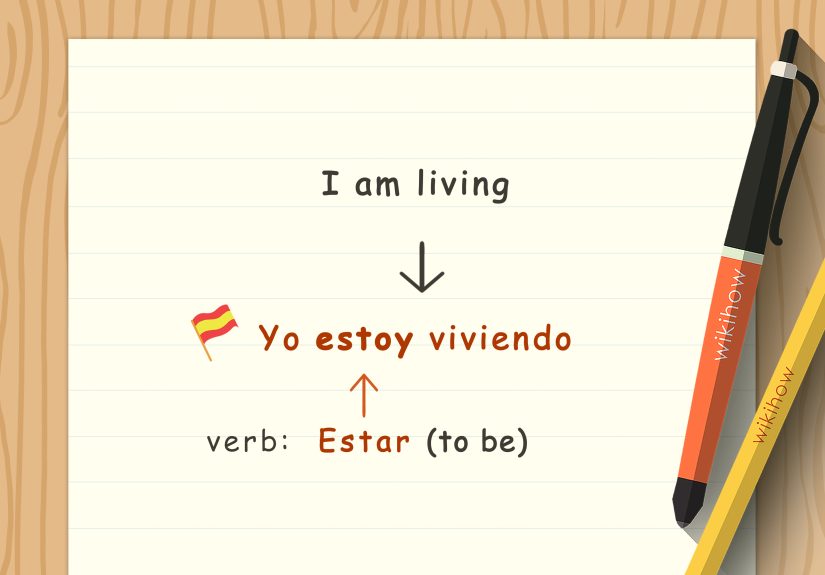
- estoy, estás, está, estamos, estáis, están
Ir (to go)
- voy, vas, va, vamos, vais, van
Haber (to have / there is-are in some uses)
- he, has, ha, hemos, habéis, han
- Special form: hay = there is / there are
If you’re a beginner, don’t get stuck trying to “understand” why these are irregular. Just use them a lot. Repetition wins.
Step 11: Use the present tense for more than “right now”
The Spanish present tense does more work than many learners expect. It can describe:
- Habitual actions: Trabajo en casa. (I work from home.)
- Things happening now: Limpio la cocina. (I’m cleaning the kitchen.)
- Near future: Salgo en media hora. (I leave in half an hour.)
- Facts and general truths: Uno más uno son dos.
- Some hypothetical “if” statements: Si llueve, me quedo.
- Ordering in restaurants/stores: Quiero un café.
This is why mastering the Spanish present tense is such a big milestone: once you can conjugate it, you can talk about everyday life, routines, plans, preferences, and basic conversations without waiting for “perfect grammar confidence.”
Step 12: Build a smart practice routine (not just a bigger notebook)
Conjugation gets easier when you practice in layers. Here’s a simple method that works:
1) Start with one regular verb from each group
Use hablar, comer, and vivir. Conjugate them until the endings feel automatic.
2) Add one stem-changer and one GO verb
Try pensar and tener. Say them out loud. Write them. Use them in short sentences.
3) Practice in context, not only in charts
Charts are useful, but sentences make the forms stick:
- Pienso en mi familia.
- Tengo clase mañana.
- Vamos al mercado.
4) Rotate skills
Use a mix of:
- Fill-in-the-blank drills
- Short writing prompts
- Speaking practice
- Conjugation quizzes
5) Keep a “problem verbs” list
Everyone has a few verbs that refuse to behave. Write them down and review them daily for 5 minutes. Tiny sessions beat giant cram marathons.
Common Mistakes to Avoid When Conjugating Spanish Verbs
- Mixing up -emos and -imos: That’s the classic -er/-ir mix-up.
- Forgetting the boot rule: If the stem changes in yo, tú, él/ella/usted, and ellos/ustedes, double-check nosotros.
- Using English word order too literally: Spanish often drops pronouns, and that’s normal.
- Confusing ser and estar: This is a long-term project, not a one-day challenge.
- Only memorizing charts: If you can fill a table but can’t say a sentence, add more real examples.
Conclusion
Learning how to conjugate Spanish verbs in the present tense is one of the most important steps in becoming conversational. Start with the regular patterns, learn the subject pronouns, and then layer in stem-changing verbs, irregular yo forms, and the high-frequency irregulars like ser, estar, and ir.
The secret is not “memorize everything perfectly.” The secret is consistent practice with the right patterns. Once your brain recognizes the logic behind Spanish present tense conjugation, you’ll stop seeing verbs as random forms and start seeing them as a system. And suddenly, Spanish gets a lot less scary.
So grab a handful of verbs, make a few messy sentences, and start talking. Even if your first sentence sounds like it was assembled by a very determined raccoon, you’re still doing it right.
Experience Notes: What Learners Commonly Go Through (and How to Get Past It)
One of the most common experiences learners have with Spanish present tense verbs is a weird combination of confidence and confusion. On day one, regular verbs feel great. You learn hablo, hablas, habla and think, “I got this.” Then stem-changing verbs show up, and suddenly pensar becomes pienso but not pensamos, and your brain files a formal complaint.
That reaction is completely normal. In fact, it usually means you’re learning correctly. Spanish conjugation is a pattern-based skill, not a memorization contest. Most learners improve when they stop trying to memorize giant tables all at once and instead focus on recognizing patterns quickly. For example, if you can spot “this is an -ar verb” or “this is a boot verb,” you’ve already solved half the problem.
Another common experience is knowing a form during practice but forgetting it in conversation. This happens because drills and real speech use different brain muscles. In a worksheet, you have time. In conversation, you need speed. The fix is simple: practice both. Do a short written drill, then immediately say five original sentences out loud using the same verb forms. That switch from paper to speech is where real progress happens.
Learners also tend to overuse subject pronouns at first, saying yo in every sentence like it’s being paid by the word. That’s okay. It’s a training-wheel phase. Over time, as you trust the endings more, you naturally start dropping pronouns in Spanish. A nice transition exercise is to write a sentence with the pronoun, then rewrite it without the pronoun. Example: Yo vivo en la ciudad → Vivo en la ciudad.
Pronunciation is another hidden challenge. Many students can conjugate correctly on paper but mumble the endings in speech, especially -amos, -emos, and -imos. If the endings blur together, listeners miss the subject. Reading conjugations aloud slowly helps a lot. It may feel a little dramatic, but clear pronunciation is part of conjugation practice too.
There’s also the “irregular verb panic” stage. Almost everyone hits a point where ser, estar, ir, haber, tener, and hacer all seem to collide in one sentence. The best strategy is to treat these as high-frequency tools, not grammar trivia. Use them every day in simple lines: Estoy cansado, Voy a clase, Tengo hambre, Hay un problema. Repetition turns chaos into instinct.
Finally, many learners notice a breakthrough after a few weeks: they stop translating every form into English. Instead of thinking “hablamos means ‘we speak,’” they just hear hablamos and understand it directly. That moment is huge. It means conjugation is no longer just a grammar topicit’s becoming part of your active language.
So if you feel clumsy with Spanish verbs right now, that’s not a sign to stop. It’s a sign you’re in the middle of the process. Keep practicing with regular verbs, revisit your stem-changers, rotate in your GO verbs, and use short real-life sentences. The learners who improve the fastest are rarely the ones who study the longest in one sitting. They’re the ones who practice a little, often, and keep going even when their notes look like a bilingual tornado hit the page.