Table of Contents >> Show >> Hide
- Why This Conversion Matters
- The Key Fact You Need Before Anything Else
- How to Convert Centimeters to Inches: 3 Steps
- Quick Conversion Examples You Can Use Right Away
- When to Use Division vs. Multiplication
- Common Mistakes to Avoid
- Real-Life Examples of Converting Centimeters to Inches
- How to Estimate Without a Calculator
- Centimeters to Inches for Height
- Why the 2.54 Factor Is So Useful
- Experiences Related to Converting Centimeters to Inches
- Conclusion
- SEO Tags
If you have ever stared at a product label, sewing pattern, school worksheet, luggage size chart, or online furniture listing and thought, “Cool, but what does 45 cm mean in inches?” welcome to the club. Centimeters are common in the metric system, while inches still rule plenty of everyday situations in the United States. The good news is that converting centimeters to inches is not hard, not mysterious, and definitely not a secret handed down by elite tape-measure wizards.
Once you know one simple relationship, you can convert almost anything quickly and accurately. This guide breaks the process into three easy steps, shows you where people usually trip up, and gives you real-life examples so the math actually sticks. By the end, you will be able to convert centimeters to inches without panic, drama, or excessive calculator abuse.
Why This Conversion Matters
Centimeters and inches both measure length, but they come from different systems. Centimeters belong to the metric system, which is built around powers of ten. Inches are part of the U.S. customary system most Americans still see on rulers, height charts, TV sizes, woodworking plans, and home improvement labels.
This means the conversion comes up all the time in real life. You might need it when buying a desk online, checking whether a suitcase meets airline size rules, comparing a phone screen protector, measuring fabric, or converting your height from centimeters into inches. Even when the numbers look harmless, a wrong conversion can turn “perfect fit” into “why does this shelf look like it lost a fight with my wall?”
The Key Fact You Need Before Anything Else
Here is the magic number:
1 inch = 2.54 centimeters
That single relationship is the whole engine behind the conversion. From there, you get the standard formula:
inches = centimeters ÷ 2.54
You may also see this written another way:
inches = centimeters × 0.3937
Both methods work. Dividing by 2.54 is usually the clearest because it directly uses the exact relationship. Multiplying by 0.3937 is handy for quick estimates, but it is a rounded decimal, so division by 2.54 is usually the better choice when accuracy matters.
How to Convert Centimeters to Inches: 3 Steps
Step 1: Write Down the Measurement in Centimeters
Start with the number you want to convert. This sounds obvious, but it helps to be clear about the unit before you touch the calculator. If your label says 30 cm, your starting value is 30. If it says 152.4 cm, your starting value is 152.4.
Double-check that you are working with centimeters, not millimeters or meters. That is a common mistake. Ten millimeters make one centimeter, and 100 centimeters make one meter. So if you mix those up, your answer will wander off into the wilderness.
Example starting values:
- 10 cm
- 25 cm
- 40.5 cm
- 170 cm
Step 2: Divide the Number by 2.54
Now take your centimeter value and divide it by 2.54. That gives you the measurement in inches.
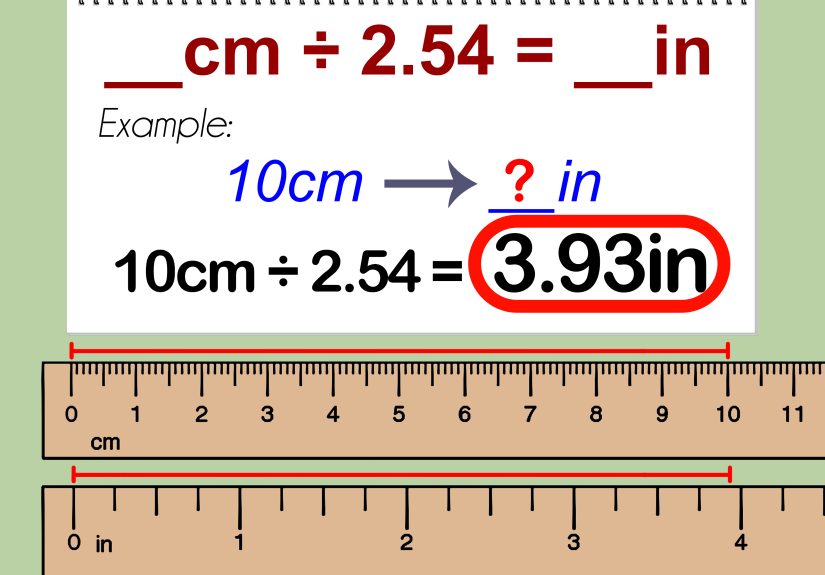
Formula: inches = cm ÷ 2.54
Let’s do a few examples:
- 10 cm ÷ 2.54 = 3.94 inches
- 25 cm ÷ 2.54 = 9.84 inches
- 40.5 cm ÷ 2.54 = 15.94 inches
- 170 cm ÷ 2.54 = 66.93 inches
If you prefer the multiplication version, you can also do this:
25 cm × 0.3937 = about 9.84 inches
Same idea, same destination, just a different road. One is the scenic route, one is the highway.
Step 3: Round the Answer If Needed
In many everyday situations, you do not need a long parade of decimals. Most of the time, rounding to two decimal places is enough. For quick shopping comparisons, one decimal place may even be fine.
Here is how that looks:
- 3.9370078 inches becomes 3.94 inches
- 15.9448819 inches becomes 15.94 inches
- 66.9291338 inches becomes 66.93 inches
If you are working on woodworking, engineering, tailoring, or another detail-sensitive task, use the level of precision the job requires. If you are trying to see whether a lamp fits on a side table, you probably do not need eleven decimal places. That is not measurement. That is showing off.
Quick Conversion Examples You Can Use Right Away
Sometimes seeing several examples makes the pattern click faster. Here are common centimeter-to-inch conversions:
- 1 cm = 0.39 inches
- 5 cm = 1.97 inches
- 10 cm = 3.94 inches
- 15 cm = 5.91 inches
- 20 cm = 7.87 inches
- 30 cm = 11.81 inches
- 50 cm = 19.69 inches
- 100 cm = 39.37 inches
Notice the pattern: the inch value is always smaller than the centimeter value because one inch is longer than one centimeter. If your converted answer comes out larger when it should be smaller, that is your cue to stop and interrogate your calculator.
When to Use Division vs. Multiplication
This is one of the biggest sources of confusion. People often remember the number 2.54, which is great, but then use it in the wrong direction.
Use this simple memory trick:
- Centimeters to inches: divide by 2.54
- Inches to centimeters: multiply by 2.54
Why? Because 1 inch contains 2.54 centimeters. So if you begin with centimeters and want the larger unit, inches, the number gets smaller. That means division makes sense.
Example:
30 cm ÷ 2.54 = 11.81 in
Reverse it:
11.81 in × 2.54 = about 30 cm
If the forward and reverse process bring you back to where you started, your conversion is probably solid.
Common Mistakes to Avoid
Mixing Up cm and mm
Millimeters are much smaller than centimeters. If you accidentally use mm as cm, your answer will be off by a factor of ten. That is how a slim notebook becomes a mythical giant slab.
Multiplying Instead of Dividing
If you multiply centimeters by 2.54 when you meant to find inches, your answer will be way too large. Always ask: am I going from centimeters to inches, or inches to centimeters?
Rounding Too Early
If you round the number in the middle of the calculation, small errors can grow. It is usually better to calculate first, then round at the end.
Forgetting the Unit
Never write down just the number. Write inches or in. Otherwise, future-you may rediscover the note and have no idea whether that 19.69 refers to a shelf width, your dog’s leap record, or a very aggressive pizza.
Real-Life Examples of Converting Centimeters to Inches
Example 1: Buying a Laptop Sleeve
You find a sleeve listed as 38 cm wide. Will it fit your laptop?
38 ÷ 2.54 = 14.96 inches
So the width is just under 15 inches.
Example 2: Measuring a Child’s Height
Your child measures 124 cm tall at a checkup.
124 ÷ 2.54 = 48.82 inches
That is about 4 feet 0.82 inches, or just under 4 feet 1 inch.
Example 3: Checking a Suitcase
Your carry-on is 55 cm tall.
55 ÷ 2.54 = 21.65 inches
That matters because many airline carry-on rules are listed in inches, not centimeters.
Example 4: Home Decor Shopping
A mirror is listed as 80 cm across.
80 ÷ 2.54 = 31.5 inches
Now you know whether it will look elegant above your console table or like it is preparing to dominate the entire entryway.
How to Estimate Without a Calculator
If you need a fast mental estimate, remember this shortcut:
1 cm is about 0.4 inches
This is not exact, but it is useful for rough comparisons.
For example:
- 20 cm is roughly 8 inches
- 50 cm is roughly 20 inches
- 100 cm is roughly 40 inches
This trick is helpful when you are shopping, browsing, or trying to decide whether something is tiny, medium, or “why is this bookshelf the size of a small canoe?”
For exact work, go back to the real formula: cm ÷ 2.54.
Centimeters to Inches for Height
People often convert height from centimeters into inches, especially when comparing international measurements. The first step is the same: divide by 2.54.
Example: 180 cm
180 ÷ 2.54 = 70.87 inches
If you want to express that in feet and inches, divide the inch result by 12:
- 70.87 ÷ 12 = 5 feet with 10.87 inches left over
So 180 cm is roughly 5 feet 11 inches.
Even if your main goal is inches, this extra step is useful because height is often spoken in feet and inches in the United States.
Why the 2.54 Factor Is So Useful
The beauty of this conversion factor is that it does not change. Once you memorize it, you can convert rulers, screen dimensions, package sizes, body measurements, and project specs with the same formula every time.
That consistency is what makes unit conversion much less scary than it first appears. You do not need a giant chart for every situation. You just need one dependable relationship and the confidence to use it correctly.
Experiences Related to Converting Centimeters to Inches
One of the funniest things about converting centimeters to inches is that most people do not realize how often they need the skill until real life starts ambushing them with measurements. It usually begins innocently. Maybe someone orders a piece of furniture online because the photo looks perfect. The listing says the side table is 45 cm tall. That sounds reasonable, elegant, and very grown-up. Then the package arrives, the table is assembled, and suddenly it is obvious that nobody actually pictured what 45 cm meant. Out comes the phone, the calculator app, and a humble lesson in unit conversion. Forty-five divided by 2.54 equals about 17.72 inches. Mystery solved. Mild embarrassment included at no extra charge.
Another common experience happens with travel. Luggage dimensions love to switch between centimeters and inches depending on the airline, the country, or the mood of the website designer. A traveler sees a carry-on limit of 22 inches, but their suitcase tag says 56 cm. Panic hovers nearby. A quick calculation shows that 56 cm is about 22.05 inches, which is close enough to make anyone start measuring wheels and handles with the seriousness of a NASA prelaunch team. In moments like that, knowing how to convert centimeters to inches does not feel like school math. It feels like a survival skill.
Parents run into this too, especially with kids’ height and clothing. A growth chart at a clinic may list a child at 132 cm, while family members in the United States want to know the height in inches or feet and inches. Converting 132 cm gives about 51.97 inches. That is easy enough, but it becomes even more satisfying when you can explain it quickly instead of staring at the number as if it personally offended you.
DIY projects are another arena where this conversion quietly saves the day. Someone watches a tutorial from another country, buys materials in an American hardware store, and suddenly has to switch between metric and customary units without losing the plot. A board that needs to be cut to 60 cm becomes 23.62 inches. A shelf depth of 30 cm becomes 11.81 inches. That kind of accuracy matters, because in home projects the gap between “custom built” and “crooked but emotionally meaningful” can be very small.
Even fashion and sewing bring their own conversion adventures. Patterns, waist measurements, sleeve lengths, and inseams are often listed in different systems depending on the brand. Converting centimeters to inches helps shoppers choose better sizes and helps sewists avoid unfortunate surprises. Nobody wants to spend an evening making something beautiful only to discover the measurements were interpreted with wild optimism.
What most of these experiences have in common is not complicated math. It is confidence. Once people understand that the process is simply centimeters divided by 2.54, the stress level drops fast. The number stops looking random. The ruler stops feeling like an enemy. And a small, oddly satisfying superpower appears: the ability to look at a measurement in centimeters and translate it into inches like it is no big deal. Because after a little practice, it really is no big deal.
Conclusion
Converting centimeters to inches is one of those practical skills that pays off far more often than expected. The process is simple: write down the centimeter value, divide by 2.54, and round your answer when appropriate. That is it. No complicated chart, no secret formula, no ritual involving a ruler under a full moon.
Whether you are shopping online, measuring height, planning a DIY project, or checking luggage dimensions, this conversion helps you move between metric and U.S. customary units with confidence. Memorize the key fact that 1 inch = 2.54 centimeters, and you will always have a reliable way to translate one system into the other.