Table of Contents >> Show >> Hide
- What Crunches Actually Do (and What They Don’t)
- Before You Start: A Quick Safety Checklist
- How to Do a Perfect Crunch (Step-by-Step)
- Form Cues That Make Crunches Feel 10x Better
- 10 Common Crunch Mistakes (and Quick Fixes)
- 1) Pulling your head/neck
- 2) Going too high (accidental sit-up)
- 3) Using momentum
- 4) Holding your breath
- 5) Cranking the elbows inward
- 6) Letting the lower back arch hard
- 7) Feet drifting or knees collapsing
- 8) Neck tension from staring at your knees
- 9) Too many reps, too soon
- 10) Treating crunches as your entire core program
- Crunch Variations (Beginner to “Spicy”)
- When Crunches Aren’t the Best Choice (and What to Do Instead)
- Programming: How Many Crunches Should You Do?
- Frequently Asked Questions
- Real-World Experiences: What Crunches Feel Like in Real Life (and How to Make Them Better)
- Conclusion
Crunches have a reputation problem. Some people swear they’re the fast lane to a stronger midsection. Others swear they’re the fast lane to a cranky neck.
The truth is less dramatic (sorry): crunches are a simple spinal-flexion exercise that can be effective when you do them with clean form, smart volume,
and a little respect for your spine.
This guide breaks down exactly how to do crunches the right way, the proper crunch form cues that keep your neck relaxed,
and a menu of crunch variations from beginner-friendly to “oh, hello there, abs.” We’ll also cover when crunches aren’t the best choice,
what to do instead, and how to program them without turning your core day into a thousand-rep tragedy.
What Crunches Actually Do (and What They Don’t)
A classic abdominal crunch is a short-range movement where your rib cage curls toward your pelvis. That’s it. Not a sit-up. Not a full
“touch your elbows to your knees and see your life flash before your eyes” moment. Done well, crunches emphasize the rectus abdominis
(the “six-pack” muscle), while your deeper core muscles help stabilize.
Muscles worked in a crunch
- Rectus abdominis: the main “crunching” muscle.
- Obliques: help stabilize (and work more in twisting variations).
- Transverse abdominis: your deep “corset” muscle that helps with bracing.
- Hip flexors: can jump in if you turn your crunch into a sit-up (not invited, but they show up anyway).
Crunches don’t “burn belly fat” by themselves
Crunches build strength and endurance in your abs, but they don’t pick where your body loses fat. If your goal is visible abs, think:
solid training + adequate protein + overall calorie balance + sleep. Crunches can be part of the planjust not the entire plan.
Before You Start: A Quick Safety Checklist
Most healthy people can do crunches safely with good technique. But some situations call for extra caution or a different exercise choice.
If any of these apply, consider checking in with a qualified healthcare professional or trainer first.
- Neck pain or headaches that flare up with ab work.
- Low back pain that worsens with bending/rounding.
- Pregnancy or postpartum concerns (especially diastasis recti considerations).
- History of disc issues or spine injuries.
Good news: even if crunches aren’t your thing, there are plenty of core exercises that build stability and strength (planks, dead bugs, bird dogs,
side planks, and more). Your core won’t get offended.
How to Do a Perfect Crunch (Step-by-Step)
1) Set up your starting position
- Lie on your back on a mat.
- Bend your knees and place your feet flat, about hip-width apart.
- Keep your spine neutral: not arched like a bridge, not smashed flat like a pancake.
-
Place your arms across your chest (easiest way to avoid neck pulling), or place fingertips lightly at your temples/above your ears.
Avoid interlocking fingers behind your head. - Tuck your chin slightly, like you’re gently holding a grape under it (not a bowling ball).
2) Brace and breathe
Tighten your midsection as if someone is about to poke you in the sides. Keep your shoulders down and relaxed.
Start the rep with an exhaleyour abs naturally contract more strongly when you breathe out.
3) Curl up (small range, big control)
Slowly lift your head and shoulder blades off the floor. Think “rib cage toward pelvis”, not “elbows to knees.”
Your lower back, tailbone, and feet should stay planted. At the top, pause for a beatthis is where your abs should feel like they’re doing the work,
not your neck.
4) Lower with control
Inhale as you slowly return to the floor, keeping tension in your abs. If your shoulders drop like you got unplugged, you’re moving too fast.
Controlled reps beat chaotic reps every time.
Recommended tempo
- Beginner: 2 seconds up → 1 second hold → 2 seconds down
- Intermediate: 3 seconds up → 1–2 seconds hold → 3 seconds down
Yes, slower feels harder. That’s not a bugit’s the feature.
Form Cues That Make Crunches Feel 10x Better
- “Sternum to belt buckle.” Helps you curl the torso instead of yanking the head forward.
- Keep space in the neck. Your neck rides along; it doesn’t lead the parade.
- Exhale to lift. If you hold your breath, your rep usually turns into a face-scrunching contest.
- Shoulder blades off, not a full sit-up. Crunches are a short-range moveembrace the small.
- Quality > quantity. Stop the set when form gets wobbly. Your abs don’t count “ugly reps” as bonus points.
10 Common Crunch Mistakes (and Quick Fixes)
1) Pulling your head/neck
What it looks like: elbows yank forward, chin dives, neck complains loudly.
Fix: cross arms over chest or keep fingertips light at temples. Lead with the chest, not the chin.
2) Going too high (accidental sit-up)
What it looks like: torso lifts way up; hip flexors take over.
Fix: aim for shoulder blades lifting off the matshort range, slow control.
3) Using momentum
What it looks like: rocking, bouncing, or “I swear my abs were involved.”
Fix: slow down, pause at the top, and make every rep look the same.
4) Holding your breath
What it looks like: stiff neck, tense jaw, and a rep that feels weirdly heavy.
Fix: exhale on the lift, inhale on the lower. If you can’t breathe smoothly, reduce reps or slow tempo.
5) Cranking the elbows inward
What it looks like: elbows collapse toward each other, shoulders shrug up.
Fix: keep elbows wide-ish and shoulders down. Think “open chest.”
6) Letting the lower back arch hard
What it looks like: big gap under the low back; ribs flare up.
Fix: keep your ribs “stacked” over your pelvis. Neutral is the goalavoid extreme arching or forcefully flattening.
7) Feet drifting or knees collapsing
What it looks like: feet shuffle, knees cave inward, stability disappears.
Fix: plant feet and keep knees comfortable and steady.
8) Neck tension from staring at your knees
What it looks like: chin tucked too hard; you’re basically trying to read your shoelaces.
Fix: gaze up and slightly forward; keep a gentle chin tuck, not a chin slam.
9) Too many reps, too soon
What it looks like: form falls apart around rep 18, but you keep going because numbers are “motivational.”
Fix: stop 1–3 reps before form breaks, add sets over time instead of chasing huge sets.
10) Treating crunches as your entire core program
What it looks like: hundreds of crunches, zero stability work, then surprise back fatigue.
Fix: pair crunches with anti-extension/anti-rotation core moves (planks, dead bugs, side planks, carries).
Crunch Variations (Beginner to “Spicy”)
Variety isn’t just for entertainmentit can help you shift emphasis, avoid overuse, and keep your core training balanced.
Choose variations based on your goals, equipment, and how your body feels.
Beginner-friendly variations
- Wall-foot crunch: place feet on a wall with hips/knees at ~90 degrees. Helps reduce leg involvement and keeps the setup stable.
- Hands-on-thighs crunch: slide hands up thighs slightly as you lift. Great for learning range and avoiding neck pulling.
- Short-range crunch: “one inch up, one inch down” with strict control. Perfect if full reps feel necky.
Classic upgrades
- Reach-through crunch: hands reach toward heels at the top (without yanking the neck). Adds a little extra contraction.
- Stability ball crunch: back supported on a Swiss ball for a larger, controlled range of motion. Keep neck neutral and don’t overextend.
- Decline curl-up/crunch: increases challenge by changing the angle. Start light on volume and keep reps slow.
“Lower-ab” emphasis moves (more hip control)
- Reverse crunch: curl pelvis up slightly by bringing knees toward chest. Keep it controlledno wild swinging.
- Double crunch: torso and knees move toward each other. Advanced and easy to cheatgo slow.
Oblique-focused variations
- Bicycle crunch: combines crunching + rotation. Keep your lower back stable and avoid rushing the “pedal.”
- Cross-body crunch: rotate slightly toward one knee (small rotation, no elbow-jabbing theatrics).
Gym-friendly options
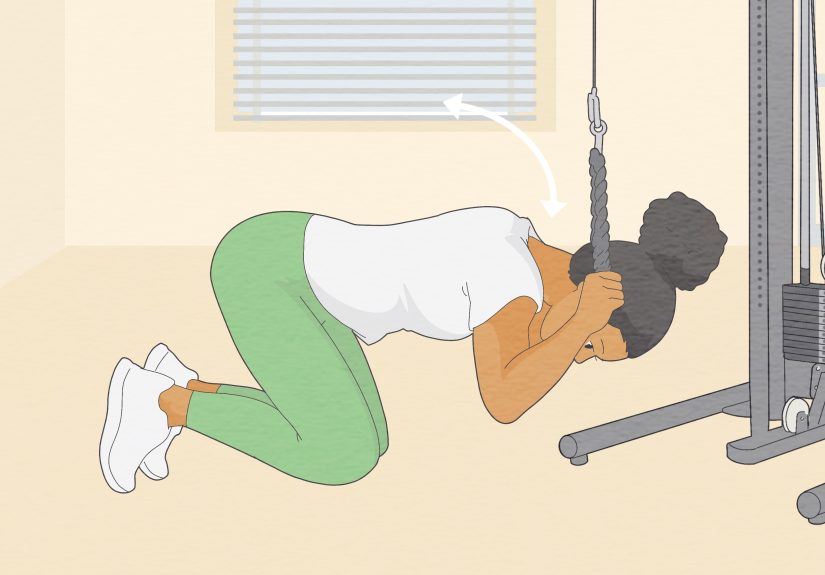
- Cable crunch: scalable resistance. Think “curl ribs toward hips,” not “fold yourself in half.”
- Captain’s chair knee raise/crunch: a hanging variation that challenges the trunk. Keep the movement controlled to avoid swinging.
When Crunches Aren’t the Best Choice (and What to Do Instead)
Crunches involve repeated spinal flexion. Many people tolerate that just fine, but some don’tespecially if flexion is a known pain trigger.
If crunches bother your back or neck, don’t force it. Switch the stimulus.
Better options if flexion feels cranky
- Modified curl-up (small, braced): a limited-range alternative that can feel friendlier for some backs.
- Dead bug: trains bracing and control while keeping the spine stable.
- Plank / side plank: trains anti-extension and anti-lateral flexion (core stability gold).
- Bird dog: builds coordination, trunk stiffness, and hip control.
If your goal is a strong, supportive core (for lifting, running, and daily life), stability and control matter as much as “ab burn.”
Think of crunches as one tool, not the entire toolbox.
Programming: How Many Crunches Should You Do?
The best rep range depends on your goal. Crunches can be trained for strength (harder reps, fewer of them) or endurance (more reps, longer sets).
Either way, keep form crisp and stop before your neck starts doing overtime.
For strength (harder reps)
- 2–3 sets of 8–12 slow reps
- 1–2 seconds pause at the top
- Progress by adding load (cable crunch, light plate on chest) or slowing tempo
For endurance (clean volume)
- 2–4 sets of 12–25 controlled reps
- Short rests (30–60 seconds)
- Progress by adding reps slowly or adding a second variation
How often?
For most people, 2–4 times per week is plenty for direct ab work, especially if you’re also squatting, hinging, carrying,
running, or doing sportsyour core is already contributing.
Sample quick core finishers
-
Beginner (6–8 minutes):
2 rounds 10 crunches (slow) + 8 dead bugs/side + 20–30s side plank/side -
Intermediate (10–12 minutes):
3 rounds 12 crunches (pause) + 10 reverse crunches + 30s plank -
Advanced (10 minutes):
4 rounds 10 cable crunches + 12 bicycle crunches (slow) + 20–30s hollow hold (as tolerated)
Frequently Asked Questions
Do crunches give you six-pack abs?
Crunches strengthen the muscles that can form visible abs. But visibility depends mostly on body fat levels, genetics, and overall training/nutrition.
So yes, crunches helpbut they’re not the “only ingredient.”
Crunches vs. sit-ups: what’s the difference?
Crunches are a short-range curl of the upper torso (shoulder blades lift). Sit-ups involve a larger range where your torso comes much more upright,
often increasing hip flexor involvement. If you want a crunch, do a crunchdon’t let it evolve into a sit-up mid-set like a Pokémon you didn’t ask for.
Should I press my lower back into the floor?
Aim for neutral control: don’t let your low back arch dramatically, and don’t forcefully smash it down with an extreme pelvic tuck.
A stable, comfortable position where your ribs stay “down” and your pelvis stays steady is usually the sweet spot.
Real-World Experiences: What Crunches Feel Like in Real Life (and How to Make Them Better)
Let’s talk about the part no one puts in the glossy “10-minute abs” videos: what crunches actually feel like when you’re a real human with
a job, a chair, and a neck that would like to keep living.
Experience #1: “Why do I feel this in my neck?”
This is the most common crunch complaint, and it usually happens for one of three reasons: you’re pulling on your head, you’re leading with your chin,
or you’re going too fast and letting momentum fling your upper body. The fix is boringbut it works. Cross your arms over your chest for a week.
Slow every rep down. Keep your chin gently tucked (think “long neck,” not “double chin audition”). The weird part? Once you stop yanking on your neck,
you’ll suddenly feel your abs doing the job they were hired for. Your neck will still be there afterward, and it will be noticeably less salty.
Experience #2: “Crunches feel too easy… until they don’t.”
Crunches can feel like nothing if you’re doing a big, bouncy movement with a short, sloppy contraction. Then you try a strict tempothree seconds up,
hold, three seconds downand it’s like your abs woke up and chose drama. That’s a good sign. A crunch isn’t a race; it’s a controlled squeeze.
If you want crunches to “work,” make them honest: slow, consistent reps with a brief pause at the top. The burn will arrive promptly. No shipping fees.
Experience #3: “My hip flexors are stealing the spotlight.”
If you notice tension at the front of your hips, there’s a decent chance your crunch turned into a sit-up. Try the wall-foot setup (feet on the wall,
hips and knees at 90 degrees). That stable position helps keep your lower body quiet and reduces the urge to recruit the hip flexors. Another trick:
focus on lifting only the shoulder blades, not your entire torso, and keep your ribs stacked over your pelvis. The movement gets smallerbut much more
targeted. Smaller isn’t “less effective.” Smaller is “more specific.”
Experience #4: “I can’t stop holding my breath.”
Most people don’t realize they’re doing it until they feel like they’re turning purple. Start every rep with a slow exhale through pursed lips.
You’ll often feel your core engage more strongly and your neck relax. If breathing and crunching at the same time feels like patting your head while
rubbing your stomach, you’re normal. Practice five slow reps where the only goal is smooth breathing. Strength loves patience.
Experience #5: “I’m bored. I need variety.”
Totally fair. Crunches can be a little “plain oatmeal.” The good news is you can keep the same basic pattern while changing the flavor:
reach-through crunches for a harder squeeze, stability ball crunches for a longer range, reverse crunches for pelvic control, bicycle crunches for
rotation, or cable crunches when you want progressive overload without doing 400 reps. Variety also helps you keep a balanced core routine:
pairing a flexion move (crunch) with stability moves (plank, dead bug, side plank) usually feels better long-term than living on crunches alone.
The most consistent “aha” moment people have with crunches is this: doing fewer reps with better form feels harder and works better.
When you stop chasing quantity and start chasing quality, crunches go from “meh” to “oh, that’s my abs.” And if your body still doesn’t love them?
That’s not failure. That’s useful information. Your core can get strong a dozen different waysand it doesn’t require suffering through an exercise your
spine hates just because it’s famous.