Table of Contents >> Show >> Hide
- First, Know What “By Hand” Really Means
- When Hand-Nailing Concrete Makes Sense
- Tools and Materials You Will Need
- Choose the Right Nail for the Job
- Step-by-Step: How to Drive Nails Into Concrete by Hand
- Common Problems and How to Fix Them
- Best Practices for Better Results
- When Nails Are the Wrong Answer
- Conclusion
- Real-World Experience and Practical Lessons From Hand-Nailing Into Concrete
Trying to drive nails into concrete by hand sounds a little like trying to toast bread with a flashlight: technically, something is happening, but not always the thing you hoped for. The good news is that this job can be done. The bad news is that you should not march up to a cured concrete slab with a regular nail and a cheerful attitude. Concrete is much less forgiving than wood, and it loves turning overconfidence into bent metal.
If you want clean results, the trick is not brute force. The trick is using the right nail, the right hammer, the right pilot hole, and the right expectations. In most real-world DIY situations, “driving nails into concrete by hand” actually means pre-drilling pilot holes in cured concrete, then driving hardened concrete or masonry nails with a hammer. That is the practical, repeatable method.
This guide walks you through the full process in plain American English, with no mystery, no macho nonsense, and no “just smack it harder” advice. You will learn what tools to use, which nails work best, how to avoid cracking the concrete, and when to stop fighting the slab and switch to a better fastener.
First, Know What “By Hand” Really Means
There is a big difference between nailing into wood and nailing into concrete. Wood fibers part and grip the nail. Concrete does not politely part. It resists, chips, and punishes the wrong fastener. That is why standard nails are not suitable here.
For cured concrete, brick, or masonry, you need hardened concrete nails or masonry nails. These nails are designed to resist bending and breaking, and many have fluted or grooved shanks that help them bite into hard material. Some masonry nails are also shaped to spin slightly as they are driven, which helps them go in more easily.
Also important: some masonry nails are commonly used in brick, mortar joints, concrete block, or even uncured concrete. Dense, fully cured concrete is a tougher customer. In that situation, pilot holes are not just helpful. They are often the difference between a neat installation and a miniature demolition project.
When Hand-Nailing Concrete Makes Sense
Hand-driven concrete nails are best for light-duty jobs where you need a quick mechanical hold and do not want to mess with larger anchors. Common examples include fastening a wood strip to a basement wall, attaching a light furring strip, pinning trim near masonry, or securing a small non-structural board to a slab.
They are not the best choice for every project. If you are installing a heavy bracket, shelving support, railing, security hardware, or anything structural, nails are usually the wrong answer. Concrete screws, hammer-set anchors, sleeve anchors, wedge anchors, or code-required anchor bolts are often better fits depending on the load and location.
In other words, nails are for the “hold this piece in place” category. They are not for the “trust your safety to this forever” category.
Tools and Materials You Will Need
1. Concrete nails or masonry nails
Use only hardened nails made for masonry. A common nail will bend, mushroom, or surrender emotionally before the concrete does. For indoor dry work, bright or lightly coated nails may be acceptable. For damp basements, exterior work, or areas with moisture concerns, choose corrosion-resistant options such as galvanized or stainless where appropriate.
2. Hammer drill and masonry bit
Yes, this is still part of “by hand” for practical DIY work. You are still driving the nail manually with a hammer, but the pilot hole should usually be drilled first. Use a masonry bit the same diameter as the nail or just slightly smaller, depending on the nail style and manufacturer guidance.
3. Framing hammer
A framing hammer is heavier than a typical household claw hammer, and that extra mass helps. You want controlled force, not frantic tapping that just annoys the slab.
4. Shop vacuum
Concrete dust loves to clog holes. A clogged hole means the nail stops short, the hammer swings get meaner, and your mood declines rapidly. Vacuuming is not optional if you want the nail to seat properly.
5. Safety gear
Wear safety glasses, hearing protection, a dust mask or respirator appropriate for the dust, and gloves. Concrete dust is not harmless, and brittle hardened nails can chip or snap. If you are new to masonry work, it is smart to get help from an experienced adult or hire a pro rather than improvising your way into a bad day.
Choose the Right Nail for the Job
Not all concrete nails are identical, and choosing the right one matters.
Fluted concrete nails are a popular choice for fastening wood to concrete. The flutes improve grip and help reduce slippage. Masonry nails may have grooved or square shanks and often work well in concrete, brick, and mortar. They are also commonly used for furring strips and similar light-duty fastening.
Length matters too. The nail needs enough embedment to hold, but not so much that you are trying to drive a spear into a parking garage. A good rule of thumb is to match the fastener to the material thickness and avoid overdoing the penetration. If you are fastening a thin strip, do not automatically buy the longest nail on the shelf just because it looks tough.
For wood touching concrete, use pressure-treated lumber or protect the wood appropriately. Concrete can wick moisture over time, and untreated wood sitting against masonry can become a slow-motion science experiment.
Step-by-Step: How to Drive Nails Into Concrete by Hand
Step 1: Mark the fastening locations
Position the board or material exactly where you want it. Mark the nail locations carefully. Double-check spacing and alignment before you drill anything. Concrete is not a forgiving material for “close enough.”
When possible, stay away from edges and corners. A good practical rule is to avoid drilling too close to the edge of the slab. If you can stay around 4 inches away from an edge, that usually reduces the chance of chipping or cracking. Thin slabs and corners deserve extra caution.
Step 2: Drill pilot holes through the wood first
If you are fastening a board to concrete, drill through the wood at each marked location. In many cases, you can continue drilling just enough to mark the concrete underneath. This helps keep everything aligned and prevents the classic DIY move of drilling perfect holes in exactly the wrong place.
Predrilling the wood also helps prevent splitting, especially if the board is narrow or the nail is near the end.
Step 3: Drill into the concrete
Remove the board if needed, then drill the pilot holes into the concrete with a hammer drill and masonry bit. Keep the drill perpendicular to the surface. Start slowly so the bit does not wander, then maintain light, steady pressure. Do not lean on the drill like you are trying to push the earth off its axis.
If the concrete is especially dense or you are worried about cracking, start with a smaller bit and step up gradually to the final size. This takes a little more time, but it can make the hole cleaner and reduce stress on the surface.
The pilot hole should generally be slightly smaller than the nail diameter or matched appropriately to the nail system you are using. Some pros also like the hole to be a little deeper than the nail’s embedment so dust and displaced material have somewhere to go. If you have a specific product package, follow its guidance first.
Step 4: Vacuum the holes thoroughly
This is the step people skip right before they say, “Why won’t this dumb nail go in?” Concrete dust packs into the hole and blocks the nail from seating. Vacuum each hole well. If needed, vacuum during drilling too. A clean hole gives the nail room to do its job.
Step 5: Reposition the board
Put the wood back in place and line the holes up carefully. If you want extra holding help on a wood-to-concrete application, a bead of construction adhesive along the bottom of the board can improve the bond. The adhesive does not replace the fastener, but it can add stability and reduce movement.
Step 6: Start the nail straight
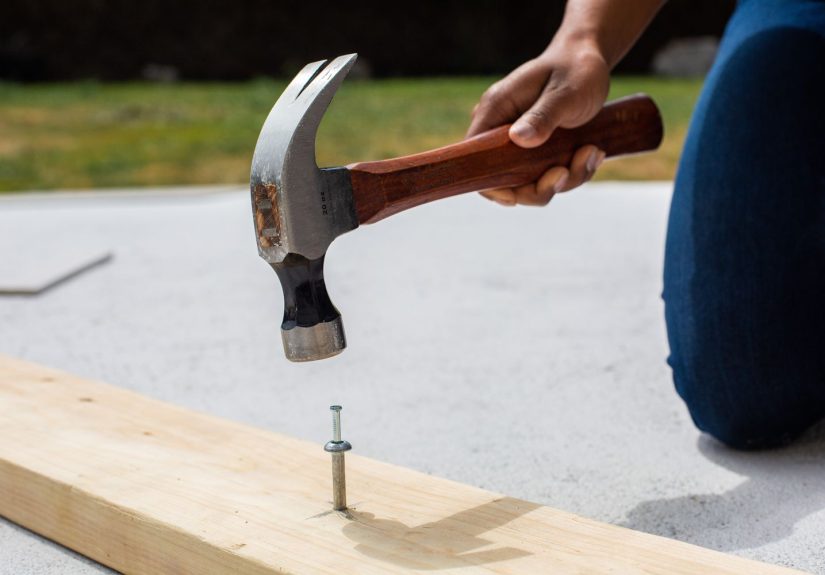
Place the nail in the pilot hole and give it a few light taps to start it. The goal is to keep it perfectly straight. Once the nail starts crooked, it rarely has a redemption arc.
Use short, controlled strikes at first. After the nail is established, switch to firmer blows with the framing hammer. Let the hammer weight do the work. Wild swinging usually produces bent nails, bruised thumbs, and new vocabulary.
Step 7: Drive the nail flush
Continue hammering until the nail head is flush with the wood or the mounted material. Do not keep pounding once it is seated. Overdriving can damage the wood, spall the concrete, or weaken the hold.
If the nail stops before it seats fully, do not keep hitting it like you are arguing with physics. Pull it out if possible, then deepen or slightly widen the hole, clean out the dust, and try again with a fresh nail if needed.
Common Problems and How to Fix Them
The nail bends
This usually means one of three things: the hole is too small, the concrete is too hard for that nail and depth, or the nail started at an angle. Replace the bent nail. Do not trust a bent nail to suddenly become honorable on the next swing.
The nail stops halfway
The hole may be too shallow or clogged with dust. Drill a little deeper, vacuum again, and retry. This is one of the most common issues in cured concrete.
The concrete chips around the hole
You may be too close to the edge, drilling too aggressively, or working with weak or brittle concrete. Move the fastener location if possible. If the area is load-sensitive, do not use a damaged hole as if nothing happened.
The board will not sit tight
Check whether dust, debris, or an uneven slab is holding the board off the surface. In some cases, adhesive plus the fastener helps. In others, the concrete itself may need minor leveling or a different fastening strategy.
Best Practices for Better Results
Use the right hammer. A framing hammer usually works better than a lightweight claw hammer for this job.
Keep the drill bit cool. Concrete drilling builds heat. Drill at a controlled speed and give the bit breaks if needed.
Stay square. Drill and hammer perpendicular to the surface for cleaner holes and straighter fastening.
Do not force success. If the nail resists after proper drilling and cleanup, switch to a better fastener instead of escalating into a one-person demolition show.
Match the environment. Damp basement? Think corrosion resistance. Outdoor project? Think weather. Contact with concrete and moisture changes the fastener conversation.
When Nails Are the Wrong Answer
Sometimes the smartest way to drive nails into concrete by hand is to decide not to.
Use concrete screws when you want better holding power and the option to remove the fastener later. They are often a great choice for brackets, electrical boxes, headers, and many wall-mounted applications.
Use nail-drive or hammer-set anchors when you have predrilled holes and want a light- to medium-duty wall-mount fastener. These are often used for conduit clips, signs, electrical boxes, and similar items.
Use sleeve anchors, wedge anchors, lag shields, or code-approved anchor bolts for heavier or structural situations. If the project involves safety, load-bearing framing, or local building code requirements, treat that as a real fastening design question, not a weekend shortcut.
That is not being overly cautious. That is being the person who does not have to redo the job later.
Conclusion
If you want to drive nails into concrete by hand successfully, remember this: concrete rewards preparation and punishes improvisation. Choose hardened concrete or masonry nails, pre-drill pilot holes, clean out the dust, stay away from edges, and use steady hammer blows instead of wishful thinking. For simple light-duty fastening, the method works well. For heavier loads or stubborn slabs, concrete screws or anchors are often the smarter move.
The biggest mistake is treating concrete like wood. It is not wood. It is the grumpy cousin of stone. Respect that, and your project will go much more smoothly.
Real-World Experience and Practical Lessons From Hand-Nailing Into Concrete
In real DIY projects, the most common surprise is how different one concrete surface feels from another. A basement slab, a poured garage floor, an old foundation wall, and a concrete block wall may all look like “concrete” to the eye, but they do not all respond the same way to a nail. One area may accept a properly drilled masonry nail with only a few solid hammer blows. Another area, just a foot away, may feel dense enough to reject every attempt like it has personal boundaries. That is why experienced installers rarely assume one successful hole guarantees the next five will behave.
Another real-world lesson is that dust management changes everything. People often assume the hammering is the hard part, but in practice, blocked holes cause more frustration than the hammer swings do. A pilot hole packed with concrete dust can make a correct nail feel too large, too stubborn, or completely impossible. The moment the hole is vacuumed thoroughly, the job suddenly feels normal again. It is not glamorous advice, but it is incredibly practical.
Many people also discover that hand-driving into concrete is less about strength and more about rhythm. Short, accurate strikes at the beginning matter more than dramatic swings. Once the nail is started straight, the process gets easier. If it starts crooked, everything gets worse in a hurry. That is one reason experienced DIYers tap lightly at first, then increase force only after the nail proves it is tracking correctly.
A common field experience is learning when to quit on a stubborn location. Beginners often think a difficult hole means they should simply hit harder. In reality, a nail that stops dead usually means the hole is dirty, too shallow, slightly off-size, or located in especially dense material. The smartest move is usually to pull the nail, re-drill, clean the hole, or relocate the fastener. Good installers do not confuse persistence with progress.
There is also a practical lesson in project selection. Hand-driven concrete nails are excellent for light fastening, especially when speed and simplicity matter. But once the project becomes load-bearing, moisture-prone, or code-sensitive, experienced people stop pretending a nail is the answer to everything. That is usually the point where concrete screws, anchors, or a different fastening system take over. Knowing when not to use a nail is part of mastering the job.
Finally, most people who have done this more than once come away with the same conclusion: the process is absolutely manageable, but only when you respect the material. Concrete does not care how motivated you are. It cares whether you chose the right fastener, drilled the right hole, wore the right safety gear, and used the right technique. Once you understand that, driving nails into concrete by hand stops feeling impossible and starts feeling like any other good DIY skill: a little noisy, a little dusty, and very satisfying when done right.