Table of Contents >> Show >> Hide
- What Are Domain and Range?
- How to Find the Domain and Range of a Function: 14 Steps
- Step 1: Identify What Kind of Function You Have
- Step 2: Remember the Basic Meaning of Domain
- Step 3: Remember the Basic Meaning of Range
- Step 4: Check for Denominators
- Step 5: Check for Square Roots and Even Roots
- Step 6: Check for Logarithms
- Step 7: Look at the Graph from Left to Right for Domain
- Step 8: Look at the Graph from Bottom to Top for Range
- Step 9: Use Ordered Pairs When Given a Relation
- Step 10: Understand Interval Notation
- Step 11: Analyze Quadratic Functions
- Step 12: Analyze Absolute Value Functions
- Step 13: Consider Real-World Restrictions
- Step 14: Verify Your Answer
- Common Domain and Range Examples
- Common Mistakes to Avoid
- Practical Experiences and Study Tips for Finding Domain and Range
- Conclusion
Finding the domain and range of a function can feel like being handed a math treasure map with half the landmarks written in invisible ink. The good news? Once you know what to look for, the process becomes surprisingly logical. The domain tells you what values are allowed to go into a function. The range tells you what values can come out. In other words, domain is the guest list, and range is what happens after everyone shows up to the party.
This guide breaks the topic into 14 clear steps, using practical examples, interval notation, graph reading, algebraic restrictions, and real-world thinking. Whether you are studying Algebra 1, Algebra 2, precalculus, or brushing up before a test, these steps will help you find the domain and range without turning your notebook into a crime scene of crossed-out numbers.
What Are Domain and Range?
The domain of a function is the complete set of input values, usually the possible x-values, that can be used without breaking the rules of mathematics. The range of a function is the complete set of output values, usually the possible y-values or f(x)-values, produced by those inputs.
For example, in the function f(x) = x + 2, you can plug in almost any real number for x. If x = 3, then f(3) = 5. If x = -10, then f(-10) = -8. Nothing explodes. No division by zero. No square root of a negative number. No math teacher dramatically sighing in the distance. So the domain is all real numbers, and the range is also all real numbers.
How to Find the Domain and Range of a Function: 14 Steps
Step 1: Identify What Kind of Function You Have
Before solving anything, look at the function type. Is it linear, quadratic, rational, radical, absolute value, exponential, logarithmic, or piecewise? Different functions have different “danger zones.” A linear function is usually relaxed and lets almost every real number in. A rational function may reject values that make the denominator zero. A square root function refuses inputs that make the inside negative. A logarithmic function only accepts positive arguments.
For example, f(x) = 2x - 5 is linear, so its domain is all real numbers. But g(x) = 1 / (x - 4) is rational, so x = 4 is not allowed because it creates division by zero.
Step 2: Remember the Basic Meaning of Domain
Ask this simple question: What x-values can I safely plug into the function? If an input leads to a real output, it belongs in the domain. If it causes an undefined expression, it must be excluded.
Common restrictions include dividing by zero, taking the square root of a negative number in real-number math, and taking the logarithm of zero or a negative number. If none of these problems appear, the domain is often all real numbers, written as (-∞, ∞).
Step 3: Remember the Basic Meaning of Range
To find the range, ask: What y-values can this function actually produce? This is often trickier than finding the domain because you are not just checking what goes in; you are studying what comes out.
For f(x) = x², the domain is all real numbers because any real number can be squared. However, the range is [0, ∞) because a square can never be negative. The smallest output is 0, and the graph rises forever.
Step 4: Check for Denominators
If the function has a fraction, focus on the denominator. The denominator can never equal zero. Set the denominator equal to zero, solve for x, and remove those values from the domain.
Example:
f(x) = 3 / (x + 2)
Set the denominator equal to zero:
x + 2 = 0
x = -2
So the domain is all real numbers except -2, written as:
(-∞, -2) ∪ (-2, ∞)
The excluded value often creates a vertical asymptote, which also helps when graphing the function.
Step 5: Check for Square Roots and Even Roots
When a function contains a square root, fourth root, sixth root, or any even root, the expression inside the radical must be greater than or equal to zero.
Example:
f(x) = √(x - 3)
Set the radicand greater than or equal to zero:
x - 3 ≥ 0
x ≥ 3
So the domain is:
[3, ∞)
The range is also [0, ∞) because square root outputs are never negative unless the function has a negative sign or vertical shift outside the radical.
Step 6: Check for Logarithms
For logarithmic functions, the expression inside the log must be positive. Not zero. Not negative. Positive only. Logarithms are picky guests.
Example:
f(x) = log(x + 5)
Set the inside greater than zero:
x + 5 > 0
x > -5
So the domain is:
(-5, ∞)
The range of a basic logarithmic function is usually all real numbers, or (-∞, ∞), because logarithmic graphs can rise and fall without a fixed upper or lower output limit.
Step 7: Look at the Graph from Left to Right for Domain
When finding domain from a graph, scan the graph horizontally. Ask: How far left and right does the graph go? The domain is the set of all x-values covered by the graph.
If the graph continues forever in both directions, the domain is (-∞, ∞). If it starts at x = 1 and continues right, the domain might be [1, ∞) or (1, ∞), depending on whether the endpoint is included.
A closed dot means the endpoint is included. An open circle means it is not included. Tiny circle, big consequences.
Step 8: Look at the Graph from Bottom to Top for Range
To find the range from a graph, scan vertically. Ask: How low and how high does the graph go? The range is the set of all y-values the graph reaches.
For an upward-opening parabola with a vertex at (2, -3), the lowest y-value is -3. The graph rises forever, so the range is:
[-3, ∞)
If the parabola opens downward and has a highest point at y = 6, the range is:
(-∞, 6]
Step 9: Use Ordered Pairs When Given a Relation
If you are given a set of ordered pairs, finding domain and range is beautifully direct. The domain is the set of all first coordinates. The range is the set of all second coordinates.
Example:
{(1, 4), (2, 5), (3, 4), (6, 8)}
Domain:
{1, 2, 3, 6}
Range:
{4, 5, 8}
Notice that 4 appears twice as an output, but you only list it once in the range. Math does not need duplicate guests on the same list.
Step 10: Understand Interval Notation
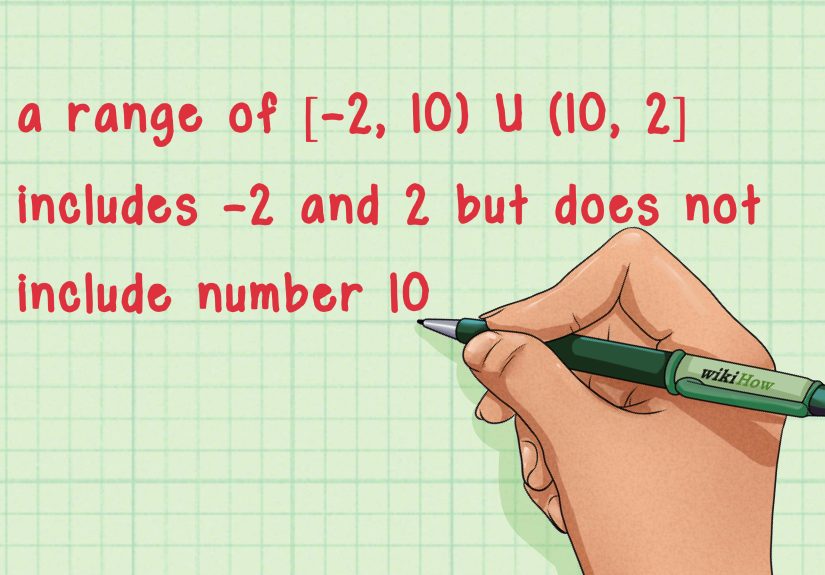
Interval notation is a compact way to write domain and range. Parentheses mean the endpoint is not included. Brackets mean the endpoint is included.
Examples:
(2, 7) means all values between 2 and 7, not including 2 or 7.
[2, 7] means all values from 2 through 7, including both endpoints.
(-∞, 5] means all values less than or equal to 5.
Infinity always uses parentheses because infinity is not a number you can actually reach. You can approach it forever, but you cannot put a bracket around it and claim ownership.
Step 11: Analyze Quadratic Functions
Quadratic functions usually have the form:
f(x) = ax² + bx + c
The domain of a quadratic function is almost always all real numbers. The range depends on the vertex and whether the parabola opens up or down.
Example:
f(x) = (x - 2)² + 1
The vertex is (2, 1). Since the squared term is positive, the parabola opens upward. The lowest output is 1, so the range is:
[1, ∞)
The domain is:
(-∞, ∞)
Step 12: Analyze Absolute Value Functions
An absolute value function often creates a V-shaped graph. The domain is usually all real numbers, but the range depends on the vertex and whether the V opens upward or downward.
Example:
f(x) = |x + 3| - 2
The vertex is (-3, -2). Since the absolute value is positive, the graph opens upward. The lowest y-value is -2, so the range is:
[-2, ∞)
The domain is:
(-∞, ∞)
Step 13: Consider Real-World Restrictions
Real-world problems often add restrictions that pure algebra does not show. For example, suppose a function models the cost of buying movie tickets:
C(t) = 12t
Algebraically, t could be any real number. But in real life, you cannot buy -3 tickets or 2.7 tickets. The domain may only include whole numbers such as 0, 1, 2, 3, and so on.
This is why context matters. A function about time, distance, age, money, or people may have a restricted domain even if the equation itself looks flexible.
Step 14: Verify Your Answer
After finding domain and range, test your answer. Plug in values near excluded points. Check endpoints. Look at the graph if one is available. Ask whether your range makes sense based on the shape of the function.
For example, if you say the range of f(x) = x² + 4 is all real numbers, test it. Can the function ever equal 0? No, because x² is never negative, and adding 4 keeps the output at least 4. The correct range is [4, ∞).
Common Domain and Range Examples
Example 1: Linear Function
f(x) = 4x - 9
A linear function has no denominator, radical, or logarithm. Any real number works as an input, and the outputs can also be any real number.
Domain: (-∞, ∞)
Range: (-∞, ∞)
Example 2: Rational Function
f(x) = 1 / (x - 6)
The denominator cannot equal zero, so x = 6 is excluded.
Domain: (-∞, 6) ∪ (6, ∞)
Range: (-∞, 0) ∪ (0, ∞)
The function can never output zero because the numerator is 1. No matter how hard it tries, zero remains out of reach.
Example 3: Square Root Function
f(x) = √(x + 1)
The inside of the square root must be nonnegative:
x + 1 ≥ 0
x ≥ -1
Domain: [-1, ∞)
Range: [0, ∞)
Example 4: Shifted Parabola
f(x) = -2(x + 1)² + 5
The parabola opens downward because the coefficient is negative. Its vertex is (-1, 5), so the maximum output is 5.
Domain: (-∞, ∞)
Range: (-∞, 5]
Common Mistakes to Avoid
Forgetting to Exclude Zero in the Denominator
This is one of the most common mistakes. If a value makes the denominator zero, it cannot be in the domain. Always check fractions carefully.
Confusing Domain with Range
Domain is about x-values. Range is about y-values. If you are looking left and right on a graph, you are thinking about domain. If you are looking up and down, you are thinking about range.
Ignoring Open and Closed Circles
On graphs, open circles mean the point is not included. Closed circles mean it is included. This affects whether you use parentheses or brackets in interval notation.
Assuming Every Function Has All Real Numbers as Its Domain
Many functions do, but not all. Rational, radical, and logarithmic functions often come with restrictions. Treat every function like it has paperwork to fill out before entering the domain club.
Practical Experiences and Study Tips for Finding Domain and Range
One of the best ways to master domain and range is to stop treating them as abstract vocabulary words and start treating them as questions about permission and possibility. Domain asks, “What inputs are allowed?” Range asks, “What outputs are possible?” That mindset makes the topic much easier to handle.
In real classroom experience, students often improve quickly once they build a checklist. First, they check for denominators. Second, they check for even roots. Third, they check for logarithms. Fourth, they look for real-world restrictions. Fifth, they use the graph to confirm the answer. This checklist works because it turns a confusing topic into a repeatable routine.
Another helpful experience is learning to graph simple parent functions. When you know the shape of y = x², y = √x, y = |x|, y = 1/x, and y = log(x), you can predict domain and range much faster. You do not need to draw a masterpiece. A quick sketch is enough. Your graph can look like it was drawn by a squirrel holding a pencil, as long as it shows the correct direction, endpoint, and general shape.
It also helps to say your reasoning out loud. For example: “The denominator cannot be zero, so I exclude x = 3.” Or: “The square root starts at zero and goes upward, so the range begins at zero.” Speaking the logic makes mistakes easier to catch. If the explanation sounds suspicious, the answer probably needs another look.
When practicing, do not only solve easy problems. Mix function types. Try one linear function, one quadratic, one rational function, one radical function, one absolute value function, and one graph-based question. This prevents your brain from going on autopilot. Domain and range are not just about memorizing answers; they are about recognizing patterns.
Another useful habit is testing numbers. If you think a value is excluded from the domain, plug it into the function and see what happens. If the denominator becomes zero, you were right to exclude it. If a square root becomes negative, that input does not belong in the real-number domain. Testing values makes the rule feel real instead of mysterious.
For range, pay close attention to minimum and maximum outputs. Quadratics and absolute value functions often have a turning point. That point is usually the key to the range. If the graph opens upward, the vertex gives the minimum. If it opens downward, the vertex gives the maximum. This one idea solves a huge number of problems.
Finally, remember that domain and range are not just school exercises. They appear in science, economics, engineering, computer programming, and everyday modeling. If a function describes the height of a ball, time cannot be negative in the real situation. If a function describes the number of people in a room, the input or output may need to be a whole number. Good math is not only correct on paper; it also makes sense in the real world.
Conclusion
Learning how to find the domain and range of a function is mostly about knowing where to look. Check the function type, watch for restrictions, understand graph behavior, and write your answer clearly in interval notation or set notation. Once you know the common patterns, domain and range become less like a math mystery and more like a neat little detective case where the clues are denominators, radicals, graphs, and endpoints.
The domain tells you which inputs are allowed. The range tells you which outputs are possible. Master those two ideas, and functions become much easier to understand, graph, compare, and use in real-world problems.
Note: This article synthesizes widely accepted instructional approaches used in reputable U.S. math education resources, including Khan Academy, OpenStax, Paul’s Online Math Notes, Math is Fun, LibreTexts, CK-12, Purplemath, Lumen Learning, MathBitsNotebook, and standard algebra curriculum references.