Table of Contents >> Show >> Hide
- Why Tennis Scoring Seems So Weird
- How to Keep Score for Tennis in 11 Steps
- Step 1: Understand the Three Layers: Points, Games, and Sets
- Step 2: Learn the Point Names: Love, 15, 30, 40, Game
- Step 3: Always Say the Server’s Score First
- Step 4: Use “All” When Scores Are Tied
- Step 5: Know What Deuce Means
- Step 6: Understand “Ad In” and “Ad Out”
- Step 7: Track Games to Win a Set
- Step 8: Learn the Standard 7-Point Tiebreak
- Step 9: Know the 10-Point Match Tiebreak
- Step 10: Keep Score Correctly in Doubles
- Step 11: Announce the Score Before Every Serve
- Simple Tennis Scoring Example
- Common Tennis Scoring Mistakes Beginners Make
- What Is No-Ad Scoring?
- How to Read a Tennis Scoreline
- Practical Tips for Keeping Score During a Real Match
- Extra Experience: What Keeping Score Teaches You on the Court
- Conclusion
Learning how to keep score for tennis can feel like trying to decode an ancient secret society handshake. One minute the score is “15-love,” the next it is “deuce,” and suddenly someone is shouting “ad out” like they are announcing a small weather emergency. The good news? Tennis scoring only sounds strange at first. Once you understand the pattern, it becomes logical, useful, and even fun.
This guide breaks tennis scoring into 11 simple steps, from points and games to sets, tiebreaks, doubles scoring, and common beginner mistakes. Whether you are playing your first weekend match, watching the US Open with friends, coaching a child, or trying not to embarrass yourself at the local park, this article will help you call the score with confidence.
Why Tennis Scoring Seems So Weird
Most sports count points in normal numbers. Tennis, apparently, looked at “1, 2, 3” and said, “Too easy. Let’s use love, 15, 30, 40, deuce, advantage, and a mysterious little monster called the tiebreak.” The traditional scoring system has old roots, and no single explanation for “love” or the 15-30-40 pattern is accepted by everyone. But you do not need a history degree to score a match. You only need to understand three building blocks: points make games, games make sets, and sets make a match.
How to Keep Score for Tennis in 11 Steps
Step 1: Understand the Three Layers: Points, Games, and Sets
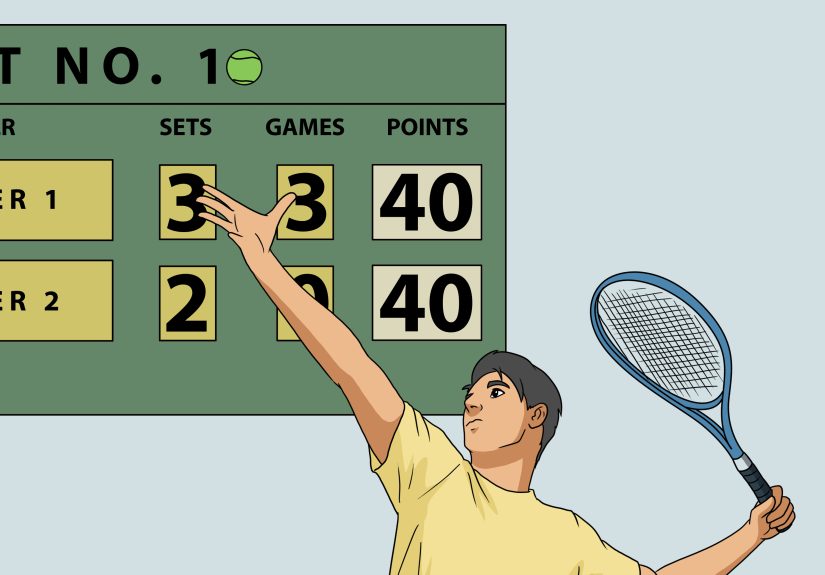
A tennis match is built like a sandwich. Points are the smallest layer. Win enough points, and you win a game. Win enough games, and you win a set. Win enough sets, and you win the match. In most recreational tennis, the first player or doubles team to win two sets wins the match. At the professional level, some men’s Grand Slam matches are best of five sets, meaning a player must win three sets.
Here is the basic structure:
- Point: One rally result, such as a winner, error, ace, double fault, or missed shot.
- Game: A collection of points. A player usually needs at least four points and a two-point lead to win.
- Set: A collection of games. A player usually needs six games and a two-game lead to win.
- Match: A collection of sets. Most matches are best of three sets.
Step 2: Learn the Point Names: Love, 15, 30, 40, Game
In a standard tennis game, points are not called zero, one, two, and three. They are called:
- 0 points: Love
- 1 point: 15
- 2 points: 30
- 3 points: 40
- 4 points: Game, if the player leads by at least two points
For example, if the server wins the first point, the score is 15-love. If the receiver wins the first point, the score is love-15. If each player has won two points, the score is 30-all. Not scary, right? Tennis just has fancy labels. It is basically counting with a monocle.
Step 3: Always Say the Server’s Score First
This is one of the most important rules in tennis scoring. The server’s score is always announced first. If you are serving and you have won two points while your opponent has won one, the score is 30-15. If your opponent has won two points and you have won one, the score is 15-30.
This rule prevents confusion because the same numbers can mean different things depending on who is serving. A score of 40-15 means the server is close to winning the game. A score of 15-40 means the server is in trouble and the receiver has a chance to break serve. In tennis, order matters. Think of it like putting socks on before shoes; technically, there are alternatives, but they make life harder.
Step 4: Use “All” When Scores Are Tied
When both players have the same point score in a game, you usually say “all.” For example:
- One point each is 15-all.
- Two points each is 30-all.
- Three points each is usually called deuce, not 40-all.
You also use “all” in the game score within a set. If both players have won two games, the set score is 2-all. If both have won five games, it is 5-all. This small habit keeps scoring clear and prevents the classic beginner moment where everyone stares at each other like the scoreboard just filed for bankruptcy.
Step 5: Know What Deuce Means
Deuce happens when both players reach 40, meaning each has won three points in the game. At deuce, one player must win two points in a row to win the game. The first point after deuce creates an advantage. The second point, if won by the same player, wins the game.
Example:
- The score is deuce.
- The server wins the next point: advantage server, often called ad in.
- The server wins the next point: game server.
If the server loses the point after gaining advantage, the score goes back to deuce. This can happen again and again, which is why some games feel longer than a family group chat about dinner plans.
Step 6: Understand “Ad In” and “Ad Out”
After deuce, the next point gives one side the advantage. If the server wins that point, the score is ad in, meaning advantage to the server. If the receiver wins that point, the score is ad out, meaning advantage to the receiver.
Here is the easy way to remember it:
- Ad in: The server has the advantage.
- Ad out: The receiver has the advantage.
If the player with advantage wins the next point, they win the game. If they lose it, the score returns to deuce. In casual play, people may simply say “your ad” or “my ad,” but using “ad in” and “ad out” is clearer, especially when playing with new partners or opponents.
Step 7: Track Games to Win a Set
Once a player wins a game, the game score resets to love-love, and players move on to the next game. The set score tracks how many games each player has won. A standard set is usually won by the first player to win six games, but they must lead by at least two games.
Common winning set scores include:
- 6-0: A dominant set, also known as “please check on your opponent emotionally.”
- 6-2: A comfortable set win.
- 6-4: A normal competitive set.
- 7-5: A close set where the winner led by two games.
- 7-6: A set decided by a tiebreak.
If the score reaches 5-5, one player must win two straight games to take the set 7-5. If the score reaches 6-6, most formats use a tiebreak to decide the set.
Step 8: Learn the Standard 7-Point Tiebreak
A tiebreak is played when the set reaches 6-6 in many standard formats. Unlike regular games, tiebreak points are counted with normal numbers: 1, 2, 3, 4, and so on. The first player to reach at least seven points with a two-point lead wins the tiebreak and the set.
For example:
- 7-3: Tiebreak over.
- 7-5: Tiebreak over.
- 7-6: Not over, because the winner must lead by two.
- 9-7: Tiebreak over.
The player who was next to serve starts the tiebreak with one serve from the right side, also called the deuce court. After that, players alternate every two points. Players also switch ends of the court after every six total points. If you forget which side to serve from, add the tiebreak points together. If the total is even, serve from the right side. If it is odd, serve from the left side.
Step 9: Know the 10-Point Match Tiebreak
Some leagues, junior matches, doubles formats, and recreational events use a 10-point match tiebreak instead of playing a full final set. In this format, the first player or team to reach at least 10 points with a two-point lead wins the match tiebreak and usually the match.
Examples of winning match tiebreak scores include 10-6, 10-8, 11-9, or 14-12. The key is the two-point margin. You cannot win 10-9. That would be too merciful, and tennis has a reputation to maintain.
At the Grand Slam level, deciding sets now use a 10-point tiebreak when the final set reaches 6-6. For everyday players, however, formats may vary. Always check the tournament, league, club, or team rules before the match begins.
Step 10: Keep Score Correctly in Doubles
Doubles scoring uses the same point system as singles: love, 15, 30, 40, deuce, advantage, and game. The difference is that there are four players, so serving and receiving order matter more.
In doubles, one player serves an entire game. The opposing team serves the next game, then the first server’s partner serves, then the other opponent serves. That four-person rotation continues through the set. Teams may choose a new serving order at the beginning of a new set, but once the order is set for that set, it should stay consistent.
The receiving team also chooses which player receives on the deuce side and which receives on the advantage side. That receiving order stays the same during the set. In casual doubles, most scoring confusion comes not from the numbers, but from someone asking, “Wait, was I supposed to serve?” right after hitting three warm-up serves. Write the order down if needed. Your future self will thank you.
Step 11: Announce the Score Before Every Serve
The easiest way to avoid tennis scoring arguments is to say the score clearly before every serve. The server should announce the score out loud before starting the next point. This helps both players agree on the score while there is still time to correct mistakes.
A good scoring rhythm sounds like this:
- “15-love.”
- “30-love.”
- “30-15.”
- “40-15.”
- “Game.”
At the start of each new game, also keep track of the set score. For example: “I’m serving, 3-2.” Then announce the point score: “Love-love.” Clear communication is not just polite; it protects the match from becoming a courtroom drama with rackets.
Simple Tennis Scoring Example
Let’s walk through one game. Imagine Alex is serving against Jordan.
- Alex wins the first point: 15-love.
- Jordan wins the next point: 15-all.
- Jordan wins again: 15-30.
- Alex wins the next point: 30-all.
- Alex wins again: 40-30.
- Jordan wins: deuce.
- Alex wins: ad in.
- Alex wins again: game Alex.
Notice that Alex did not win at 40-30 until taking the next point. Once the score reached deuce, Alex needed two points in a row: one for advantage and one for the game.
Common Tennis Scoring Mistakes Beginners Make
Calling the Receiver’s Score First
The server’s score always comes first. If you are serving and losing 15-40, do not call 40-15 just because you wish it were true. Tennis scoring is many things, but it is not a vision board.
Forgetting That Deuce Requires Two Points
At deuce, one point does not win the game in traditional scoring. One point gives advantage. The same player must win the next point to close the game.
Ending a Tiebreak Too Early
A standard tiebreak is not automatically over at 7 points unless the leader is ahead by two. A 7-6 tiebreak continues. So does a 10-9 match tiebreak. Keep playing until someone leads by two.
Not Confirming the Match Format
Some matches use no-ad scoring, short sets, or match tiebreaks instead of full final sets. Before the first serve, ask: “Are we playing regular scoring, best of three sets, with a 10-point tiebreak for the third?” That one sentence can save 20 minutes of confusion later.
What Is No-Ad Scoring?
No-ad scoring is a shortened format sometimes used in leagues, college tennis, juniors, doubles, or timed events. In no-ad scoring, when the game reaches deuce, the next point wins the game. There is no advantage point. The receiver often chooses which side to receive from, though rules can vary by event. In mixed doubles, some formats require the receiver to be the same gender as the server on the deciding point.
No-ad scoring makes matches faster and adds drama. One point at deuce decides the game, which is exciting unless you are the person double-faulting, in which case it is character-building.
How to Read a Tennis Scoreline
A completed tennis match score might look like this: 6-4, 3-6, 7-6(5). That means the winner took the first set 6-4, lost the second set 3-6, and won the third set in a tiebreak. The number in parentheses shows the losing player’s tiebreak score. So 7-6(5) means the tiebreak score was 7-5.
If you see 7-6(10), that usually means the tiebreak went longer, such as 12-10. In tennis reporting, scorelines can look intimidating, but they are just shorthand for the story of the match.
Practical Tips for Keeping Score During a Real Match
If you are new to tennis, keeping score while playing can be surprisingly hard. You are already thinking about footwork, grip, spin, wind, sun, and whether your backhand has decided to leave the country. Use these tips to stay organized:
- Say the score before every serve. Make it automatic.
- Repeat the set score at the start of each game. For example, “4-3, serving.”
- Use a court scoreboard if available. Change it immediately after each game.
- In doubles, confirm serving order early. Do not rely on memory alone.
- Ask calmly if there is a disagreement. Most scoring problems are honest mistakes, not international scandals.
Extra Experience: What Keeping Score Teaches You on the Court
Once you have played a few real matches, you learn that tennis scoring is not just bookkeeping. It changes how you think. A point at love-love feels casual, but a point at 30-40 feels like your racket suddenly weighs 40 pounds. That is the beauty of tennis: the score gives every rally a different emotional temperature.
One of the first lessons players learn is that not all points feel equal, even though they count the same on paper. At 40-love, you may swing freely. At deuce, you may suddenly aim three feet inside the lines and pray to the tennis gods. Good scorekeeping helps you recognize these pressure moments. When you know the score, you can choose smarter shots. At 15-40 on your serve, maybe that is not the ideal time to attempt the experimental drop shot you saw on TV. At 40-15, you might take a little more control and go for a strong first serve.
Keeping score also teaches momentum. In tennis, there is no game clock to rescue you. A player can be down 0-5 and still fight back. A deuce game can swing back and forth for 10 minutes. A tiebreak can turn because of one loose return or one brave second serve. When you track the score carefully, you begin to understand when momentum is shifting and when you need to slow down, breathe, and reset.
In doubles, scoring creates teamwork habits. Partners who communicate the score, serving order, and receiving sides usually look calmer and play better. A simple “30-all, stay solid” can help a team focus. A quick “ad out, big return here” can turn confusion into a plan. Doubles is already crowded enough with four players, two rackets per team, and at least one person saying “mine” too late. Clear scoring makes the chaos manageable.
For beginners, the best experience-based advice is to announce the score louder than you think you need to. Not in a dramatic stadium-announcer voice, unless you enjoy that sort of thing, but clearly enough that your opponent hears it. Most score disputes begin because someone mumbled “30-15” into their strings and the other player thought it was “15-30.” Speak up, confirm, and move on.
Another helpful habit is to connect the score with your serve routine. Before every point, pause, say the score, choose your target, bounce the ball, and serve. This rhythm keeps your mind from racing. It also gives your opponent a fair chance to correct the score before the point starts. Once the ball is in play, nobody wants to stop mid-rally because someone suddenly remembered a forehand from four points ago.
Finally, keeping score makes watching tennis more enjoyable. Once you understand deuce, break point, set point, and tiebreak pressure, a match becomes a story instead of a blur of yellow balls. You know why the crowd gets louder at 30-40. You understand why a player celebrates holding serve after five deuces. You can read a scoreline and imagine the battle behind it. That is when tennis stops feeling confusing and starts feeling brilliant.
Conclusion
Keeping score in tennis is much easier once you break it into 11 steps. Learn the point names, say the server’s score first, use “all” for ties, understand deuce and advantage, track games toward a set, and know how tiebreaks work. Add clear communication before every serve, and you will avoid most beginner scoring mistakes.
Tennis scoring may look odd from the outside, but it gives the sport much of its drama. Every deuce game becomes a mini-battle. Every tiebreak becomes a test of nerve. Every set score tells a story. Once you know how to keep score, you are not just counting points; you are reading the match.