Table of Contents >> Show >> Hide
- What You’ll Need Before You Even Touch the Starter
- Step 1: Do a 60-Second Safety Check (Yes, Really)
- Step 2: Mount Up and Learn the Controls Like a Pilot (But Less Dramatic)
- Step 3: Start the Engine the Right Way (No Mystery Rituals Required)
- Step 4: Roll Off Smoothly (The Secret Is “Less Drama”)
- Step 5: Shift Gears Without “Stomping” the Bike
- Step 6: Stop Like a Pro (Use Both Brakes and Stay Upright)
- Step 7: Turn Smoothly (Slow, Look, Lean, Roll)
- Step 8: Park, Shut Down, and “End the Ride” Properly
- Mistakes New Honda Wave 100 Riders Make (So You Don’t Have To)
- Quick FAQ
- Real-World Riding Experiences: What It Feels Like (and What People Learn Fast)
- Conclusion
The Honda Wave 100 is the kind of motorcycle that politely pretends it’s a scooter until you look down and realize,
“Ohthere are gears involved.” It’s an underbone/step-through bike that’s usually light, friendly, fuel-sippy,
and perfect for getting around without feeling like you’re wrestling a metallic rhinoceros.
The big difference for many new riders: most Wave-style bikes use a semi-automatic (clutchless) manual transmission.
You still shift gears with your foot, but you typically don’t pull a clutch lever with your hand.
That’s awesome… once you stop trying to squeeze a clutch that isn’t there.
This guide gives you a practical, safe way to learn in a parking lot and then take it to real streets.
(Quick note: laws vary by stateget properly licensed, insured, and trained.)
What You’ll Need Before You Even Touch the Starter
- Safety gear: DOT-approved helmet, eye protection, gloves, long sleeves/pants, and ankle-covering footwear.
- Practice space: flat, empty parking lot with zero drama (no traffic, no gravel patches, no surprise curbs).
- Bike basics: know where the ignition, kill switch, turn signals, horn, brakes, and shifter are.
If you’re new to riding, the smartest “upgrade” you can buy isn’t a louder exhaustit’s a beginner rider course.
You’ll learn fundamentals like braking, turning, and hazard response in a controlled environment.
Step 1: Do a 60-Second Safety Check (Yes, Really)
The Wave 100 is reliable, but physics doesn’t care about your reputation for being “pretty careful.”
Before every ride, do a quick inspectionespecially if the bike has been sitting.
Fast checklist (parking-lot friendly)
- Tires: look for low pressure, cracks, or anything lodged in the tread.
- Brakes: squeeze the front lever and press the rear brake (pedal or lever depending on your model). Confirm firm feel.
- Lights & signals: headlight, brake light, turn signals.
- Fluids: check engine oil level per your dipstick/sight glass method.
- Stands: side stand up and stable; the bike shouldn’t feel like it’s trying to nap mid-ride.
This step prevents the most annoying kind of ride: the one where you discover a problem at the exact moment you needed the bike
to behave like a bike.
Step 2: Mount Up and Learn the Controls Like a Pilot (But Less Dramatic)
Straddle the bike, keep it upright, and put both feet down. Sit comfortably and find neutral posture:
elbows relaxed, head up, eyes forward.
Control map (typical Wave 100 setup)
- Right hand: throttle + usually the front brake lever.
- Left hand: turn signals, horn, high/low beam (and often no clutch lever).
- Right foot: rear brake pedal (some versions use a left-hand rear brake lever instead).
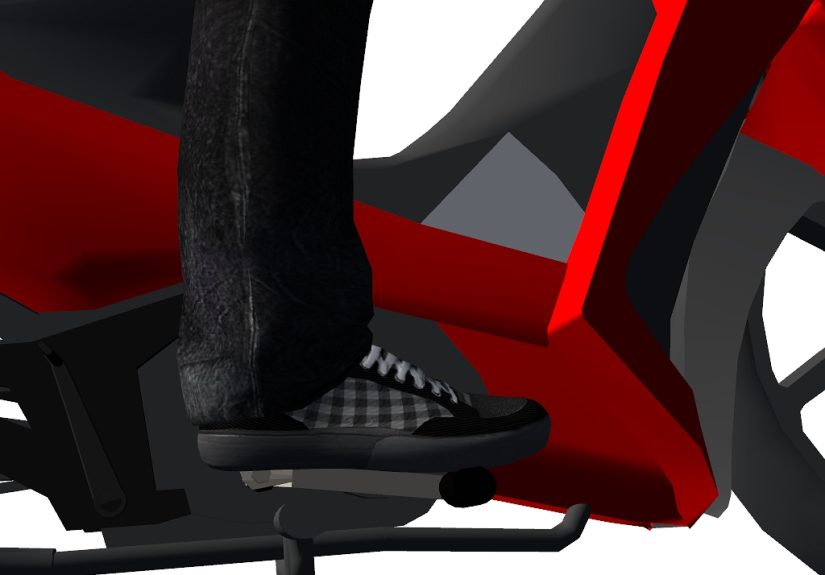
- Left foot: gear shifter (often heel-toe), with a rotary shift pattern on many underbones.
Important: The exact controls can vary by year/market. Look for the shift pattern diagram on the bike
(or your owner’s manual). Many Wave-type bikes use a rotary pattern like N–1–2–3–4–N, which means neutral can come back around after top gear.
Body positioning (the “don’t wobble” starter pack)
- Keep your knees lightly hugging the bike.
- Grip the bars gentlydeath-grip steering = accidental steering.
- Look far ahead, not down at the front fender like it owes you money.
Step 3: Start the Engine the Right Way (No Mystery Rituals Required)
Starting is easy when you do it in the correct orderand confusing when you freestyle it.
Use this sequence:
- Key ON.
- Kill switch to RUN (if equipped).
- Confirm neutral (neutral light on, and the bike rolls freely).
- Cold engine? Use the choke (carb models) or follow the cold-start instructions (fuel-injected models usually don’t need manual choke).
- Start: press the electric starter or use the kick starter (if equipped).
Let it idle for a short moment. While it warms, practice the “controls scan” againfront brake, rear brake, signals.
You’re building muscle memory so you don’t have to think about it later in traffic.
Step 4: Roll Off Smoothly (The Secret Is “Less Drama”)
Here’s where the semi-automatic design feels magical: you can usually start moving without a hand clutch.
But you still need a smooth throttle hand and a stable body.
How to move off in 1st gear
- Hold the rear brake (or keep the bike steady with both feet down).
- Click into 1st using the shifter. (On many Waves, you’ll press down or toe/heel depending on design.)
- Ease on the throttle like you’re turning up the volume on a podcast, not launching a rocket.
- Release the rear brake as the bike begins to pull forward.
If the bike lurches, you gave it too much throttle too fast. If it bogs, you didn’t give it enough.
Your goal is a smooth glide that makes you look like you’ve done this before (even if you haven’t).
Practice drill (5 minutes)
- Start → roll 30 feet → stop smoothly.
- Repeat until you can do it without wobbling or staring at your hands like they’re new accessories.
Step 5: Shift Gears Without “Stomping” the Bike
The Wave 100 usually shifts through four gears. Even without a hand clutch, you still need a rhythm:
roll off slightly, shift decisively, then roll back on.
Upshifting (1 → 2 → 3 → 4)
- Build a little speed in your current gear.
- Momentarily ease off the throttle (a small roll-off).
- Shift to the next gear with a firm, quick pressdon’t baby it, don’t karate-kick it.
- Roll back on the throttle smoothly.
Example training pace: In a lot, you might shift into 2nd at a neighborhood speed and into 3rd only if you have room.
Many small Honda manuals suggest fairly early shift points (low-to-mid speeds) to keep the engine happyfollow your own manual if you have it.
Downshifting (4 → 3 → 2 → 1)
- Slow down first using the brakes and closing the throttle.
- Ease off throttle, then shift down one gear at a time.
- Be gentle reapplying throttle so the bike doesn’t jerk.
New riders often downshift too late. A good rule: downshift as you slow, not after you’re already crawling.
You want the engine in a comfortable range so the bike feels stable and responsive.
Step 6: Stop Like a Pro (Use Both Brakes and Stay Upright)
Smooth stopping is the skill that quietly prevents chaos. On most motorcycles, the front brake provides strong stopping power,
and using both brakes helps control and stability.
Basic stop sequence
- Roll off the throttle.
- Apply both brakes progressively (not a grab, not a stomp).
- Keep your head and eyes upthe bike goes where you look.
- As you reach walking speed: straighten the bars, then put your left foot down first (common technique), keep right foot ready for rear brake.
- Select neutral if you’re stopping for more than a moment.
Common mistake
Braking hard while the handlebars are turned can destabilize you at low speed. Finish most of your braking
while the bike is upright, especially when you’re learning.
Step 7: Turn Smoothly (Slow, Look, Lean, Roll)
Turning is where beginners either level up… or get surprised by how quickly the curb arrives when you panic.
The safest approach is a simple four-part method taught in many rider handbooks:
slow down before the turn, look through it, lean the bike, then roll on gentle throttle.
Turning checklist
- Slow: reduce speed before the turn.
- Look: point your chin where you want to go (not at the pothole you want to avoid).
- Lean: let the bike lean naturally.
- Roll: maintain or gently add throttle through the turn for stability.
Parking-lot drills that actually work
- Big circles: ride a wide circle in 1st or 2nd, eyes up, smooth throttle.
- Figure eights: start large; shrink the pattern as your comfort grows.
- Stop-and-go turns: practice turning from a stop without wobbling.
If your turn feels shaky, it’s usually one of three things: you’re going too slow without enough stability,
you’re staring down, or you’re tense on the bars. Relax your shoulders. Your bike will thank you by not acting weird.
Step 8: Park, Shut Down, and “End the Ride” Properly
Parking is a tiny skill, but it prevents embarrassing moments like “why is my bike slowly falling over in front of the coffee shop?”
How to park safely
- Choose stable ground (avoid loose gravel, steep slopes, soft dirt).
- Come to a full stop and straighten the bars.
- Shift into neutral (or follow your model’s preferred parking gear guidance).
- Engine OFF with the key (and kill switch if you used it).
- Deploy the stand fully; gently lean the bike onto it to confirm stability.
Pro tip: after you put the stand down, do a tiny “stability test” with your hands still on the bars.
If it feels sketchy, reposition before you walk away like a movie star leaving an explosion behind.
Mistakes New Honda Wave 100 Riders Make (So You Don’t Have To)
1) Over-throttling at takeoff
Smooth starts come from patience, not power. Roll on gently, then add more once you’re stable.
2) Half-shifts
Be decisive with the shifter. A lazy press can land you between gears and create a “why isn’t it going?” moment.
3) Looking down
Your eyes steer. If you stare at your speedometer, you’ll drift like a shopping cart with one cursed wheel.
4) Braking late into the turn
Slow before you turn. You’ll feel more in control and the bike will feel more planted.
Quick FAQ
Is the Honda Wave 100 automatic or manual?
Most Wave-style bikes are semi-automatic: you shift gears with your foot, but typically don’t use a hand clutch lever.
Exact setup depends on the specific model and market, so confirm with your owner’s manual and the shift pattern label on the bike.
Should I practice on the street right away?
Start in a parking lot. When you can start, stop, shift to 2nd, and do controlled turns without panic, then move to quiet residential roads.
What’s the #1 skill to learn first?
Smooth starts and stops. Everything else is easier when you’re stable at low speed.
Real-World Riding Experiences: What It Feels Like (and What People Learn Fast)
The first thing many riders notice on a Honda Wave 100 is how “light” everything feels. The bike doesn’t demand a wrestling match.
It’s more like a cooperative dance partner: you point it, it goesespecially at city speeds. That said, the lightness can surprise you
at first. Small inputs matter. A little twitch of throttle or a quick jab at the bars can feel bigger than you expect, which is why
gentle hands and relaxed shoulders are the real secret sauce.
The next big “aha” moment is the clutchless shifting. Riders often describe the first day as a comedy of reflexes:
your left hand keeps reaching for a clutch lever that doesn’t exist, and your brain briefly believes it has been betrayed.
Then, almost suddenly, it clicks. You learn the rhythmease off throttle, shift, roll back onand it starts to feel smooth and natural.
People also tend to realize that the bike rewards decisive shifts. If you do a half-hearted press, the transmission might not fully
engage, and you get that awkward “neutral-ish” moment where the engine revs but the bike doesn’t move like you asked nicely.
The fix is simple: firm, clean shifts, and keep practicing until your foot stops overthinking.
Low-speed balance is another common learning curve. Many riders expect slow speed to be easier than faster speed.
But motorcycles (including underbones) often feel more stable with a little momentum. So at parking-lot speeds,
riders quickly learn to look up, keep the head level, and use tiny throttle adjustments for stability rather than trying to “coast” with
everything closed. A fun and surprisingly useful exercise is big circles and figure eights: at first, it feels wobbly;
then you start noticing that your eyes control your line. The moment you stop staring at the ground in front of the wheel,
your turns mysteriously improve. It’s not magicjust how balance and steering inputs work.
On real roads, Wave riders often appreciate how practical the bike is. The step-through frame makes frequent stops easy.
The upright posture helps with visibility. And because the bike is usually efficient and simple, riders tend to develop a calm,
“get-there” mindset instead of a “show-off” mindset. That calm is a safety feature you create yourself: smoother throttle, earlier braking,
and deliberate lane positioning. Riders also mention that in traffic, the most useful habit is scanning far aheadreading brake lights,
spotting gaps, and predicting what cars will do before they do it.
Finally, there’s a confidence arc that’s pretty consistent: Day 1 feels strange. Day 3 feels manageable.
After a couple of weeks of short rides, many people realize they’re no longer thinking about every single control input.
The bike becomes an extension of their intentions, not a puzzle. The key is staying humble while you build skill:
practice in low-risk places, ride within your comfort zone, and keep improving the fundamentalsbecause the fundamentals are what
save you when something unexpected happens.
Conclusion
Learning to ride a Honda Wave 100 is about mastering a few simple actionssmooth starts, clean shifts, progressive braking, and confident turns.
Take it one step at a time, practice in a safe area, wear real protective gear, and consider a certified training course.
Do that, and the Wave 100 becomes what it was meant to be: a practical, fun, low-stress ride that gets you where you’re going
without demanding your soul as a down payment.