Table of Contents >> Show >> Hide
- Know What Kind of De'Longhi Machine You Have
- Step 1: Set Up the Machine Properly
- Step 2: Make Espresso on a Manual De'Longhi Machine
- Step 3: Use a Bean-to-Cup De'Longhi Machine
- Step 4: Steam Milk Without Turning It Into Bubble Soup
- Step 5: Make the Drinks Most People Actually Want
- Step 6: Clean Your De'Longhi Espresso Machine Regularly
- Troubleshooting Common De'Longhi Espresso Problems
- Best Habits for Better Espresso Every Day
- Conclusion
- Real-World Experiences Using a De'Longhi Espresso Machine
- SEO Tags
If you just unboxed a De’Longhi espresso machine and are staring at it like it is a tiny chrome spaceship, relax. You are not the first person to wonder why there is a portafilter in one hand, a steam wand on the side, and a level of caffeine anticipation that borders on emotional instability. The good news is that most De’Longhi machines are designed to be beginner-friendly once you understand the rhythm: fill, heat, brew, steam, clean, repeat.
This guide explains how to use a De’Longhi espresso machine in plain English, with practical advice for both manual models and bean-to-cup machines. Whether you have a slim Dedica, a Stilosa, an ECP series machine, or a fully automatic Magnifica-style model, the core goal is the same: make espresso that tastes rich, balanced, and worth waking up for.
Know What Kind of De’Longhi Machine You Have
Before you press buttons with heroic confidence, identify your machine style. De’Longhi makes more than one kind of espresso machine, and each one works a little differently.
Manual espresso machines
These use a portafilter, filter baskets, and usually a steam wand. You grind or scoop the coffee yourself, tamp it, lock in the portafilter, and pull the shot. These models give you more control and more opportunities to feel like a barista on a home-improvement show.
Bean-to-cup or superautomatic machines
These grind beans inside the machine, brew automatically, and often steam milk with less effort. They are ideal for people who want espresso with fewer steps and less countertop drama.
If you are unsure, look for the clues. If your machine has a portafilter handle, it is manual. If it has a bean hopper on top and does most of the work itself, it is automatic.
Step 1: Set Up the Machine Properly
The first cup starts long before the first shot. A rushed setup is one of the easiest ways to create weak espresso, spluttering steam, or a machine that seems personally offended by your choices.
Wash the removable parts
Take out the water tank, drip tray, portafilter, and baskets. Rinse them with warm water and mild dish soap if the manual allows it, then dry thoroughly. This removes factory dust, packaging residue, and that mysterious “new appliance” smell nobody ordered with their espresso.
Fill the water tank with fresh, cold water
Use clean water every time you brew. Espresso is mostly water, so bad water equals bad coffee wearing a fancy crema hat. If your local water is very hard, consider filtered water that is still suitable for coffee machines. Distilled water is usually not the best choice because many machines perform better with some mineral content.
Prime the machine if needed
Many De’Longhi machines need to be primed during first use or after air gets into the system. If the machine hums or buzzes loudly but does not dispense water, run water through the hot water or steam path according to your model instructions. On many De’Longhi machines, this means placing a cup under the frother or steam wand, turning the machine on, and opening the steam valve until water flows steadily.
Let it heat up fully
Do not sprint from “power on” to “why is this shot sour?” Give the machine time to warm up. A properly heated machine, cup, and portafilter help espresso extract more evenly. On manual machines, it also helps to run a little hot water through the group head and portafilter before brewing. Think of it as a warm-up lap before the race.
Step 2: Make Espresso on a Manual De’Longhi Machine
If your machine uses a portafilter, this is where the fun begins. Also where the learning curve begins. The good news is that great espresso is less about mystical talent and more about repeatable habits.
Choose the right coffee
Use fresh coffee beans when possible, ideally roasted for espresso or medium to dark roast brewing. Pre-ground coffee can work, especially in pressurized baskets, but freshly ground coffee usually gives better aroma, crema, and flavor. Once you taste the difference, your supermarket brick coffee may start feeling like a bad breakup.
Grind fine, but not absurdly fine
Espresso needs a fine grind. Too coarse, and the shot gushes out fast and tastes thin or sour. Too fine, and the shot crawls, drips, or tastes bitter. Your first few attempts are really calibration rounds. That is normal. Coffee is not judging you. Not much, anyway.
Fill the basket correctly
Insert the single or double basket into the portafilter. Add your ground coffee, then level it so the bed is even. If your model includes a scoop, use it as a starting point, but adjust based on taste and flow. Too little coffee can cause a weak shot; too much can make the portafilter hard to lock in and may choke the machine.
Tamp evenly
Use the tamper to compress the grounds into a level puck. The goal is not to prove upper-body strength. The goal is a flat, even surface so water passes through the coffee bed consistently. Crooked tamping leads to uneven extraction, and uneven extraction leads to espresso that tastes like confusion.
Lock in the portafilter and brew
Place a prewarmed cup under the spouts. Lock the portafilter into the group head. Start the shot. Many home espresso guides use a rough target of about 25 to 30 seconds for a balanced double shot, but your machine and coffee may prefer a slightly different sweet spot. Watch the flow. Good espresso should start dark, then turn more golden as it runs, with a steady, syrupy stream rather than a chaotic splash-fest.
Use the programmed buttons if your model has them
Some De’Longhi machines let you program one- and two-shot button volumes. That feature is excellent once you find a shot size you like. In the beginning, however, pay attention to taste rather than worshipping the button like it is an all-knowing espresso oracle.
Can you use E.S.E. pods?
Some De’Longhi manual machines support E.S.E. pods with a compatible basket. These are convenient and cleaner than loose grounds, though often less flexible and a bit less satisfying for people who enjoy tweaking grind and dose. If convenience is your love language, pods can be a perfectly reasonable shortcut.
Step 3: Use a Bean-to-Cup De’Longhi Machine
Bean-to-cup models make life easier, but they still reward good habits.
Fill the bean hopper and water tank
Use fresh beans and enough water for the drinks you plan to make. Avoid oily beans if your model manual warns against them, since very oily beans can create buildup over time.
Start with the default grinder setting
De’Longhi machines are usually set to a reasonable middle-ground grinder setting from the factory. Start there before making changes. If espresso tastes weak and runs too quickly, go finer. If it drips very slowly or tastes harsh and overextracted, go a little coarser.
Adjust the grinder slowly
On De’Longhi bean-to-cup machines, grinder adjustments are usually meant to be made one notch at a time while the grinder is actually operating. That matters. Randomly twisting the dial while the grinder is idle is a fine way to create future regret.
Customize strength and volume
Most automatic machines let you choose drink strength, cup size, and sometimes temperature. Start with the default espresso setting, then adjust one variable at a time. If you change everything at once, you are not dialing in coffee anymore; you are performing espresso roulette.
Step 4: Steam Milk Without Turning It Into Bubble Soup
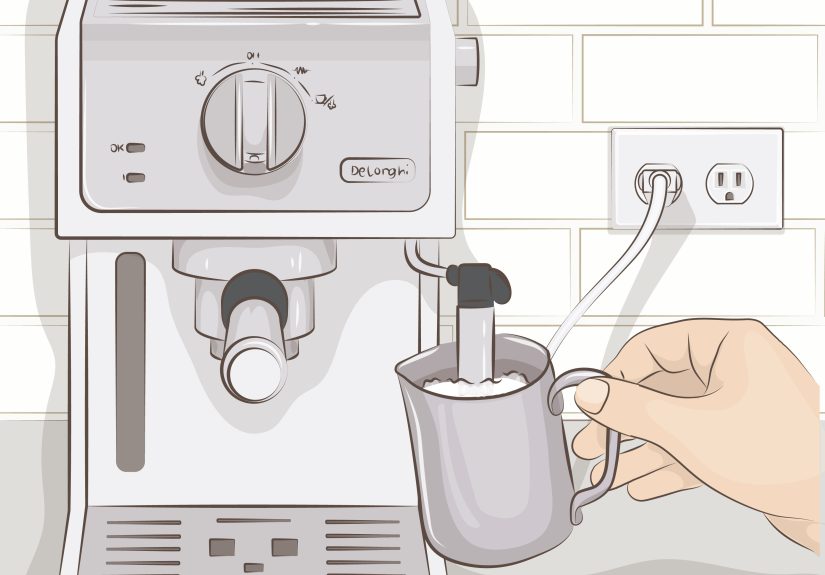
If your De’Longhi has a steam wand or milk frother, congratulations: lattes and cappuccinos are within reach. Also within reach are giant soap-bath bubbles if you steam carelessly. Let us avoid that.
Start with cold milk and a cold pitcher
Cold milk gives you more time to texture it properly. Whole milk is the easiest for beginners because it tends to foam smoothly, but other milks can work with practice.
Purge the wand first
Before steaming, briefly release steam to clear out condensation. That way you are using steam, not watery disappointment.
Stretch, then texture
Position the steam wand tip just below the milk surface to introduce air at the start. You want a controlled paper-tearing sound, not a demonic shriek. Once the milk expands slightly, lower the wand a touch deeper so the milk begins swirling in a vortex. This helps create silky microfoam instead of big, dry bubbles.
Stop before the milk gets scorched
Once the pitcher feels very hot and the milk is smooth and glossy, stop steaming. Tap the pitcher lightly on the counter to pop large bubbles, then swirl the milk. Good steamed milk should look shiny, creamy, and pourable, not stiff like shaving cream from a can.
Wipe and purge immediately
This step is non-negotiable. Wipe the steam wand with a damp cloth right away and purge it again. Dried milk inside a steam wand is not charming, artisanal, or harmless. It is just gross.
Step 5: Make the Drinks Most People Actually Want
Espresso
The purest test of your setup. Short, strong, and honest.
Americano
Pull a shot, then add hot water. This keeps the espresso flavor while making it less intense.
Cappuccino
Brew espresso and top it with steamed milk plus more foam. Think balanced, airy, and a little dramatic.
Latte
Brew espresso and add more steamed milk with a thinner layer of foam. Softer, creamier, and very forgiving for beginners.
Macchiato
A shot of espresso marked with a small amount of foam. Small drink, big attitude.
Step 6: Clean Your De’Longhi Espresso Machine Regularly
If you want better coffee and a longer-lasting machine, cleaning is part of the recipe. There is no glamorous way to say it. Old oils, milk residue, and scale do not improve with age.
After every use
- Knock out the coffee puck and rinse the portafilter and basket.
- Wipe and purge the steam wand.
- Empty the drip tray if needed.
- Refill the water tank with fresh water if it is running low.
Every week
- Wash removable parts thoroughly.
- Clean the shower area or brew path as your model allows.
- Wipe the machine exterior and cup tray.
Descale when the machine tells you to, or before scale becomes a personality trait
Mineral buildup affects flow, temperature, and taste. Many De’Longhi machines alert you when descaling is due, and the needed frequency depends heavily on water hardness. Use the descaling process recommended for your specific machine. Do not improvise with random internet chemistry experiments just because someone once met vinegar in a kitchen.
Troubleshooting Common De’Longhi Espresso Problems
The espresso runs too fast
Your grind is probably too coarse, your dose too small, or your tamp too light. Go a little finer and make sure the puck is even.
The espresso runs too slow
Your grind may be too fine, your basket overfilled, or the coffee too tightly packed. Adjust one thing at a time.
The machine buzzes but no water comes out
This often points to air in the system, especially after first setup or if the tank ran dry. Prime the machine through the steam or hot water function according to your model.
The milk has giant bubbles
You introduced too much air for too long. Next time, keep the wand near the surface only briefly, then sink it slightly to create a whirlpool.
The descale light stays on
Usually that means the full descaling and rinse cycle was not completed correctly, or the machine still needs the procedure finished according to the model instructions.
Best Habits for Better Espresso Every Day
The difference between random espresso and reliably good espresso often comes down to routine. Use fresh beans. Warm the machine. Keep your tools clean. Change only one variable at a time when dialing in. Taste the coffee before making dramatic pronouncements. And write down what works, because memory before caffeine is a known weak point in the human operating system.
Also, be patient with yourself. Even excellent home baristas go through a phase where they produce a shot that tastes like smoky courage followed by one that tastes like lemony regret. That is part of the process. Your De’Longhi is not trying to sabotage you. It is just asking for consistency.
Conclusion
Learning how to use a De’Longhi espresso machine is mostly about understanding your model, respecting the setup, and practicing the small details that shape flavor. Manual machines reward technique with control, while automatic models reward smart adjustments with convenience. Either way, great espresso comes from a simple formula: fresh water, good coffee, proper heating, steady extraction, and regular cleaning.
Once you have the basics down, your morning routine gets a lot more interesting. Suddenly, espresso is not just something you buy on the way to work. It is something you build, tweak, and actually enjoy making. And yes, that may eventually lead to opinions about crema, milk texture, and grinder settings that sound suspiciously barista-ish. Welcome. There are worse hobbies.
Real-World Experiences Using a De’Longhi Espresso Machine
One of the most common experiences people have with a De’Longhi espresso machine is the surprisingly fast shift from “I just want coffee” to “Why am I comparing shot times before breakfast?” The first few days often feel like a comedy sketch. You fill the tank, press a button, hear important machine noises, and expect instant coffee-shop magic. Instead, you may get a shot that pours too fast, milk that looks like bath foam, or a portafilter that somehow sprays espresso in a direction the cup did not agree to. That is not failure. That is initiation.
After a week or two, most users start noticing patterns. They realize the machine behaves better when it is fully warmed up. They notice that one coffee bean tastes smooth and chocolatey while another one tastes sharper and brighter. They discover that tiny changes in grind size matter more than they expected. On a bean-to-cup De’Longhi, the moment many people remember is the first time they adjust the grinder correctly and the espresso suddenly goes from flat and thin to rich and balanced. It feels oddly triumphant for something that happens before 8 a.m.
Milk drinks create their own learning curve. At first, steaming milk can feel like trying to train a small cloud with a metal wand. Beginners often either add too much air or stop too soon. But once the texture clicks, it really clicks. The pitcher starts making that gentle paper-tearing sound, the milk begins swirling like glossy paint, and your latte becomes less “homemade in a panic” and more “surprisingly café-like.” That improvement is one of the most satisfying parts of owning a De’Longhi. You can actually taste your skills improving.
Another common experience is that owners gradually become more particular in a good way. They start preheating cups. They stop using stale coffee. They empty the drip tray before it becomes a science project. They learn that cleaning the steam wand immediately saves future annoyance. In other words, the machine teaches good habits without giving a formal lecture about it.
There is also the convenience factor. People who move from daily coffee-shop runs to a De’Longhi at home often mention two things: saved money and better control. Want a stronger latte? Easy. Want a smaller cappuccino with more foam? Done. Want to make espresso in pajama pants without speaking to anyone? That may be the true luxury market. Over time, the machine becomes less of an appliance and more of a ritual tool. You are not just pressing buttons. You are building five or ten quiet minutes that belong entirely to you.
That is why De’Longhi machines remain so popular with home users. They let beginners start simple, but they also leave room to grow. Your first drink may be average. Your tenth may be genuinely good. Your fiftieth might make you wonder why you ever paid for a rushed latte in a paper cup. And that is the real experience of learning to use a De’Longhi espresso machine: not perfection on day one, but better coffee, more confidence, and a morning routine that gets a whole lot tastier.