Table of Contents >> Show >> Hide
- Who Was John Soane?
- Why John Soane Still Feels Modern
- The Buildings That Made the Legend
- Master of Space and Light: Soane’s Signature Design Moves
- The Collector Behind the Architect
- John Soane’s Influence on Later Architecture
- What Designers and Homeowners Can Still Learn from Soane
- An Experiential Reflection: What It Feels Like to Enter Soane’s World
- Conclusion
Some architects build walls. John Soane built moods. He built suspense. He built sunlight into ceilings as if it were a physical material you could specify on a drawing set right next to brick, stone, and plaster. That is why Sir John Soane remains one of the most fascinating figures in architectural history. He was technically a neoclassical architect, but that label barely captures the strange brilliance of his work. His buildings do not merely quote antiquity. They compress, bend, reflect, and dramatize it.
When people call John Soane a master of space and light, they are not reaching for a fancy art-school slogan. They are describing exactly what he did. He understood that architecture is not only about what a building looks like from the street. It is also about what it feels like to move through it, how a ceiling can seem to lift without shouting for attention, how a shaft of daylight can turn a quiet room into a stage set, and how a sequence of small spaces can feel bigger than a giant hall if the experience is choreographed well enough. In other words, Soane knew that great architecture is part engineering, part theater, and part magician’s trick.
More than two centuries later, his work still feels fresh. In an age that loves open plans, clean lines, museum-quality lighting, and “wow” interiors, Soane often seems less like a relic and more like the architect who got there early and politely left the lights on for everyone else.
Who Was John Soane?
From modest beginnings to architectural fame
John Soane was born in 1753 and did not arrive in the world draped in aristocratic privilege. His father was a builder, and Soane’s early path was shaped by practical craft as much as intellectual ambition. That combination mattered. He understood buildings from the ground up, not only as artistic ideals but as physical things that had to stand, function, and persuade. He trained under George Dance the Younger, later worked with Henry Holland, studied at the Royal Academy, and eventually traveled to Italy on a scholarship. That Italian journey was crucial. Rome, ruins, ancient forms, measured proportion, and the emotional power of classical architecture all sank deep into his imagination.
But Soane did not return home as a mere copy machine for the ancient world. He came back with something better: a restless mind. He absorbed classical ideas, then stripped them down, rearranged them, and turned them into something unmistakably personal. That is one reason his architecture can feel so modern. He borrowed from the past without being trapped by it. Plenty of architects admire history. Soane seems to have wrestled with it, won, and then redecorated the room.
A career built on invention, not imitation
Soane became one of the most inventive architects of his era. He served as architect to the Bank of England, taught at the Royal Academy, and published influential architectural books that helped spread his ideas. His reputation grew not because he repeated fashionable formulas, but because he kept testing what architecture could do. He was deeply interested in sequence, surprise, symbolic meaning, and the emotional impact of interiors. He was also one of those rare designers who could think as both a planner and a poet.
Why John Soane Still Feels Modern
He treated light like a design tool
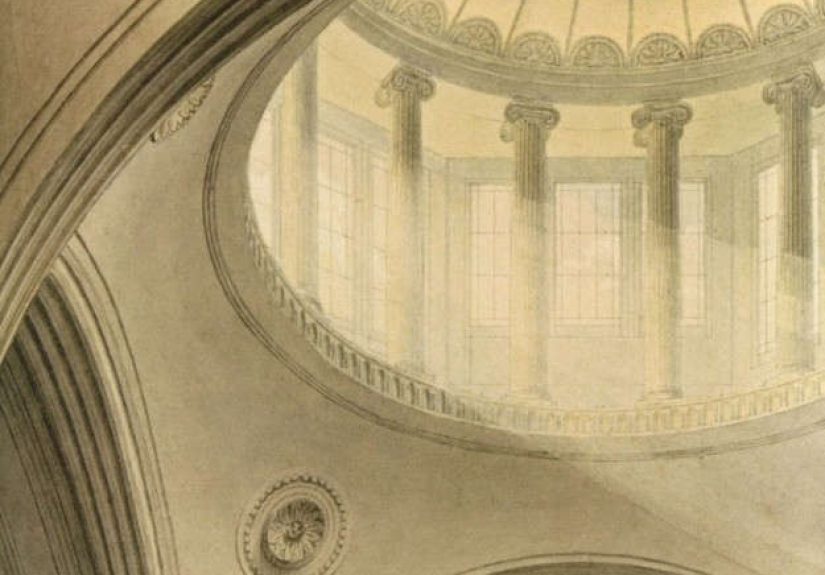
The simplest way to understand Soane is to imagine an architect who saw daylight not as a happy accident but as part of the actual design language. Skylights, roof lanterns, concealed sources of illumination, filtered light, reflected light, borrowed light from adjacent spaces: these were not side effects in Soane’s work. They were the event. He knew that light could soften mass, clarify circulation, create drama, and make a room feel sacred without a single sermon.
That approach helps explain why his interiors often feel so alive. Even when the forms are classical, the atmosphere is dynamic. A Soane interior can be calm one moment and theatrical the next. It can feel intimate, then unexpectedly expansive. He used domes, shallow vaults, mirrors, openings, and layered thresholds to keep the eye moving and the mind alert. If some buildings feel like they were designed for photographs, Soane’s feel designed for experience. They reward motion. They reward curiosity. They reward that very human instinct to peer around the corner and wonder, “Wait, where does that light come from?”
He made complexity feel effortless
There is a sneaky quality to Soane’s best work. Nothing seems overly flashy, yet the spatial intelligence is astonishing. He could make a relatively tight footprint feel rich and expansive by stacking visual relationships, introducing unexpected openings, and letting one room borrow energy from another. Modern architects often talk about spatial flow, compression and release, layered views, and experiential sequencing. Soane was already doing all of that while many others were still arranging columns like they were setting a formal dinner table.
The Buildings That Made the Legend
The Bank of England
If Soane’s name is attached to one monumental commission above all others, it is the Bank of England. Much of his work there has been lost, which is one of architecture history’s more irritating tragedies, but the project remains central to his legacy. At the bank, Soane reimagined what a major public institution could look and feel like. Rather than relying on ornament alone, he created powerful interior volumes and used top lighting to give commercial and administrative spaces a sense of dignity, gravity, and calm control. It was architecture as public confidence. Even in fragments and drawings, the project demonstrates how thoroughly he understood light, structure, and procession.
Dulwich Picture Gallery
Dulwich Picture Gallery reveals another side of Soane’s genius: the museum architect before the museum architect became a celebrity species. The building shows his gift for top-lit galleries and carefully tuned interior atmosphere. He understood that art needs light, but not chaos; presence, but not visual noise. Instead of making the architecture scream over the paintings, he created a setting that supported viewing while still carrying a strong architectural identity. It is restrained, lucid, and deeply intelligent. In a world of museums that sometimes seem determined to body-slam the art with spectacle, Soane’s restraint feels refreshingly mature.
Lincoln’s Inn Fields: the house-museum masterpiece
Then there is the place most closely associated with his personality: his house and museum at Lincoln’s Inn Fields in London. This is not just a residence. It is a manifesto disguised as a townhouse. Here Soane turned domestic architecture into an experiment in spatial illusion, collecting, memory, scholarship, and display. He packed the place with antiquities, fragments, models, paintings, mirrors, color, niches, hidden planes, and carefully controlled light. It is intimate, strange, scholarly, theatrical, and oddly moving.
What makes the house so important is that it shows how completely Soane merged living, teaching, collecting, and designing into one continuous act. This was not some side hobby. It was architecture thinking out loud. The museum became a three-dimensional autobiography, a design laboratory, and a machine for wonder. No wonder visitors still walk through it looking like they have accidentally wandered into the head of a very elegant genius.
Master of Space and Light: Soane’s Signature Design Moves
Top lighting
Soane loved light from above because it creates clarity without always revealing its source in a blunt, obvious way. A roof lantern or concealed skylight can make a room glow rather than merely brighten. That difference matters. Glow feels intentional. It also feels almost spiritual. Soane understood the psychological power of that effect.
Mirrors and visual extension
He used mirrors not just for decoration but to multiply space, deepen perspective, and create layered views. In Soane’s hands, a mirror could make a room feel like a puzzle box. It could also turn a single beam of daylight into a whole luminous event.
Compression and release
Soane often moved visitors through tighter, darker, or lower spaces before opening out into brighter, taller, more dramatic rooms. That sequence creates emotional lift. Contemporary architects still use the same strategy because it works. Humans feel scale comparatively. Soane knew how to make that comparison unforgettable.
Archaeology without stiffness
He loved classical architecture, but he did not treat it like a museum fossil. He abstracted details, reduced forms, and used ancient references with unusual freedom. The result was architecture that felt learned without becoming pedantic. That is harder than it sounds. Plenty of designers can quote history. Very few can make it feel alive.
The Collector Behind the Architect
One reason Soane’s work feels so layered is that he was not only an architect. He was also an obsessive collector, teacher, and curator of ideas. His house included a model room where students could study architecture through objects rather than distant travel. He collected architectural models, antiquities, fragments, and works of art not as random trophies but as tools for thought. Yale University Press has described his displays as “studies for my own mind,” which may be the most John Soane sentence ever written. It sounds intellectual, eccentric, and slightly haunted, which is pretty much the full brand.
This collecting instinct shaped his architecture in profound ways. He designed spaces as if they were exhibitions, and he exhibited objects as if they were part of architecture. Boundaries softened. A corridor became a gallery. A wall became a device. A ceiling became a source of drama. A domestic interior became a world. If that sounds familiar, it should. Today’s most compelling house museums, boutique hotels, gallery homes, and collector-driven interiors owe something to this Soanian blend of display and spatial storytelling.
John Soane’s Influence on Later Architecture
Soane’s legacy reaches well beyond Georgian and Regency Britain. A documentary on his American legacy argues that his influence can be traced through major modern and postmodern architects, including Philip Johnson, Richard Meier, Michael Graves, Henry Cobb, Robert Venturi, Denise Scott Brown, and Robert A.M. Stern. That claim makes sense. Soane offered a way out of rigid stylistic boxes. He showed that classical reference did not have to mean dead repetition, and that abstraction did not require coldness.
His impact is especially visible in the architecture of museums and cultural institutions, where light, circulation, and the staging of objects are everything. You can also feel his afterlife in architects who care about interiors as emotional experiences rather than leftover containers. He is one of those figures whose ideas keep resurfacing because they are rooted in human perception. People still respond to contrast, sequence, mystery, glow, and revelation. Soane designed for those responses with extraordinary precision.
What Designers and Homeowners Can Still Learn from Soane
- Natural light needs choreography. More windows are not automatically better. Better placement is better.
- Small spaces can be spectacular. Proportion, reflection, and sequence often matter more than square footage.
- History is a resource, not a prison. Borrow ideas, then reinterpret them with confidence.
- Interiors deserve as much thought as facades. The real emotional life of architecture often happens inside.
- Display can shape space. Books, art, models, collections, and even furniture can become part of the architecture itself.
These lessons are one reason John Soane continues to matter in design conversations now. He reminds us that architecture is not just composition. It is atmosphere. It is movement. It is memory. It is the art of making people feel something with walls, voids, and light.
An Experiential Reflection: What It Feels Like to Enter Soane’s World
To really understand John Soane, it helps to stop thinking like a historian for a moment and think like a visitor. Imagine stepping off a busy city street and entering a place that seems to fold time inward. Outside, traffic, noise, errands, deadlines. Inside, the air changes. The house tightens around you. Light slips in from above instead of barging through the sides. Colors deepen. Mirrors catch fragments of rooms you have not yet entered. Sculptures, books, casts, paintings, and architectural pieces appear not in neat modern isolation but in dense, deliberate conversation.
You begin to notice that Soane did not simply fill rooms; he tuned them. A narrow passage makes you slow down. A low ceiling makes you aware of your body. Then suddenly a space opens upward, and what felt modest a second ago now feels monumental. It is not a monument in the blunt sense, not the kind that puffs out its chest and demands applause. It is more intimate than that, almost conspiratorial. The building seems to reward attention the way a great novel does. Miss a detail and it will not punish you, but catch one and the whole chapter becomes richer.
There is also something wonderfully personal about the experience. Soane’s world does not feel neutral, and that is part of its charm. You feel the presence of a mind arranging, selecting, framing, and editing. Every object seems placed with purpose. Every sightline feels tested. Every shaft of daylight appears to have an opinion. In many modern buildings, light is bright because the code said so. In Soane’s world, light feels meaningful. It reveals. It conceals. It seduces. It turns ordinary surfaces into moments.
And then there is the strange emotional effect of all that layering. You are in a house, but it behaves like a museum. You are in a museum, but it still feels intimate enough to belong to a person. You are surrounded by the ancient world, yet the space itself feels startlingly contemporary. That tension is thrilling. It creates the sense that architecture can be both scholarly and playful, disciplined and eccentric, orderly and surprising. Soane gives you permission to believe that a room can be serious without being boring and beautiful without being obvious.
For anyone who loves architecture, interiors, museums, or even just memorable spaces, that experience lingers. You leave with a heightened awareness of ceilings, corners, shadows, skylights, thresholds, and reflections. You start noticing how many buildings settle for flatness when they could have offered drama, and how many rooms are simply lit when they could have been composed. Soane resets your expectations. He makes you want more from architecture, not more size or more luxury, but more intelligence and more feeling.
That may be his greatest gift. John Soane teaches that space is not empty volume waiting to be filled. It is an instrument. Light is not merely illumination. It is architecture’s most poetic material. And a building, at its best, is not a static object at all. It is an unfolding experience, one that changes with movement, time of day, and attention. That is why Soane still matters. He does not just show us how to look at architecture. He teaches us how to feel it.
Conclusion
John Soane was far more than a talented neoclassical architect. He was a master of atmosphere, a designer of spatial sequences, a collector with a curator’s mind, and a visionary who understood that light can do as much architectural work as stone. His greatest buildings and interiors show how powerful architecture becomes when it engages the eye, the body, and the imagination at the same time. That is why the phrase “master of space and light” fits him so well. It is not flattery. It is a fairly plain description of what he achieved.
In a design culture that still wrestles with the balance between history and innovation, clarity and richness, spectacle and subtlety, Soane remains a remarkably useful guide. He proves that architecture can be intellectual without becoming cold, expressive without becoming loud, and historically informed without feeling trapped in the past. The result is a body of work that continues to inspire architects, curators, designers, and visitors who want buildings to do more than stand there looking expensive.