Table of Contents >> Show >> Hide
- Who Is Venus (and Why Does Everyone Keep Staring)?
- What People Mean When They Say “Two-Faced Cat”
- The Genetics Behind Venus’s Look (Without the Headache)
- So Is Venus Actually a Chimera?
- What About Her Different-Colored Eyes?
- Does a Split-Face Pattern Affect Health?
- Why Venus Captivates People (Beyond the Cute Factor)
- How to Talk About Venus Responsibly (and Still Have Fun)
- Conclusion
- Bonus: of Real-Life “Venus” Experiences (Because This Kind of Cat Changes Your Day)
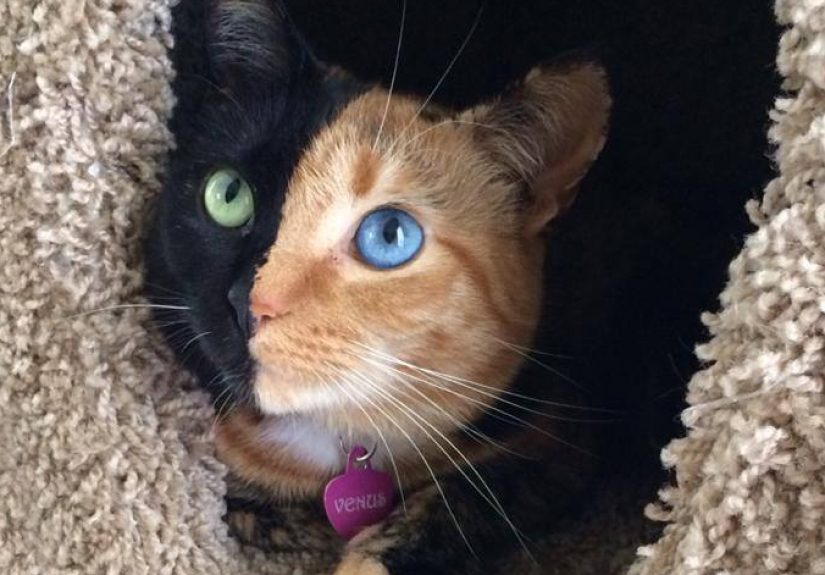
Some cats have resting “I know what you did” face. Venus has resting “I am literally two different vibes” face. One half of her face is jet-black with a green eye. The other half is warm orange tabby with a blue eye. The first time most people see her, their brain does a tiny rebootfollowed by the extremely scientific question: “Is this Photoshopped?”
Nope. Venus is real. She’s an American tortoiseshell domestic shorthair who became internet-famous because her coloring looks like nature tried out a perfect split-screen effect. But here’s the part that’s even more interesting than the visual magic: Venus is basically a walking (and purring) lesson in cat genetics, embryology, and how wildly creative biology can be when nobody’s micromanaging it.
In this article, we’ll meet Venus, unpack how a “two-faced” cat can happen, explain the difference between a true chimera and a lucky genetic mosaic, and cover what her odd-eyed look does (and doesn’t) mean for health. We’ll keep it accurate, easy to follow, and only slightly obsessedbecause honestly, how could we not be?
Who Is Venus (and Why Does Everyone Keep Staring)?
Venus is best known for a face that looks neatly divided down the middle: black on one side, orange tabby on the other. She also has heterochromia, meaning her eyes are different colorsone green, one blue. Add in tortoiseshell coloring across her body and you get a cat who looks like she was designed by a committee that couldn’t agree… and then accidentally made a masterpiece.
Her rise to fame followed a familiar internet pattern: someone shares a photo, the comments section argues about whether reality is still real, and the animal becomes a celebrity. Venus went from “stray cat” to “global conversation starter” because her look is rare enough to feel mythical, but natural enough to be a perfect example of how genes can express themselves in surprising ways.
And yespeople call her a “chimera cat.” That label can be accurate sometimes, but Venus also sits in a fascinating gray zone where genetics experts say the most honest answer might be: “She could be a chimera… but she might also be a different kind of genetic lottery winner.”
What People Mean When They Say “Two-Faced Cat”
Let’s clear up a common mix-up right away: “two-faced cat” can mean two totally different things.
1) A split-color face (like Venus)
This is what most people are talking about online: a cat whose facial coloring looks dramatically understoodoften half-and-half. This can happen through several genetic and developmental pathways, including chimerism or mosaicism (more on that in a minute).
2) A “Janus cat” (a rare congenital condition)
There’s also a condition informally called “Janus cat,” where a cat is born with duplicated facial features (named after the Roman god Janus). That’s a serious developmental abnormality, extremely rare, and very different from Venus’s situation. Venus does not have two physical facesshe has one face with two distinct color patterns, and she’s generally described as healthy and functional.
So when we say “two-faced” in Venus’s case, we’re talking about color and pattern, not anatomy.
The Genetics Behind Venus’s Look (Without the Headache)
Cat coat color is a masterpiece of genetics plus developmental timing. Venus’s appearance involves three big ideas:
- X-linked coat color (why orange + black patterns are usually female)
- X-inactivation (how patchwork patterns form)
- Chimerism vs. mosaicism (how “two DNA lines” or “one DNA line with mixed expression” can happen)
Why tortoiseshell and calico patterns are (almost always) female
Orange vs. black coloring in cats is tied to a gene on the X chromosome. Female cats typically have two X chromosomes, so they can carry two different versions of that geneone promoting orange pigment in some cells, and another promoting black pigment in other cells.
Male cats typically have one X chromosome, so they usually end up either orange or non-orange (black/brown-based), but not both. That’s why tortoiseshell and calico males are rare and often linked to unusual chromosomal situations.
X-inactivation: the reason cats can look like living patchwork quilts
Here’s the coolest part: in female mammals, cells tend to “turn off” one X chromosome early in development. This is called X-inactivation. In a cat with one orange-coded X and one non-orange-coded X, some cells silence the orange X, and some silence the non-orange X. Result: patches of orange and patches of black.
That’s how you can get tortoiseshell and calico patterns that look like someone tossed paint on a cat (respectfully).
So Is Venus Actually a Chimera?
The short, accurate answer: she’s often described as a chimera, but you can’t confirm that from photos alone.
A true chimera is an organism with cells from two different genetic lineages. In cats, that can happen if two embryos fuse early in developmentbasically, two potential siblings combine into one individual. If those two embryos had different coat-color genetics, you might see unusually sharp divisions of color.
However, Venus may not need two embryos to explain her look. Geneticists have noted that a striking split pattern can also come from mosaicism or unusual expression of pigment and white-spotting genes. Mosaicism means the cat starts from one embryo, but during early development, differences emerge in which genes are active in which cells. The outcome can still be dramaticespecially when color boundaries line up in an oddly symmetrical way.
In other words: Venus’s face could be the result of chimerism, or it could be a spectacular example of normal female coat-color mechanics lining up in a very rare, very tidy configuration. Confirming a true chimera would require genetic testing from tissues on both sides of her body. Without that, the most responsible stance is: “chimera-like,” but not guaranteed.
What About Her Different-Colored Eyes?
Venus’s eyes are part of what makes her look unreal: one green, one blue. That trait is called heterochromia, and in cats it’s often related to how pigment (melanin) is distributed in the iris during development.
When heterochromia is totally normal
Many cats with congenital heterochromia are perfectly healthy. In those cases, the different eye colors are simply cosmeticlike freckles, but for eyeballs.
When heterochromia should be checked by a vet
If an adult cat’s eye color changes suddenly, or one eye becomes cloudy, red, painful, or light-sensitive, that’s different. Eye color changes can sometimes be linked to inflammation, injury, or other medical issues. So the rule of thumb is:
- Born with it and stable? Often harmless.
- Developed it later or it’s changing? Worth a veterinary exam.
Venus’s heterochromia is typically discussed as congenital and stablepart of her original genetic “paint job.”
Does a Split-Face Pattern Affect Health?
For most cats, coat pattern and eye color are primarily aesthetics, not a diagnosis. A tortoiseshell pattern itself is not a disease.
That said, there are a few health-related associations people mix into this topic, so let’s separate fact from internet fog:
White fur + blue eyes and deafness (a real association)
All-white cats with blue eyes have a higher risk of congenital deafness. Cats with one blue eye can also have increased risk, especially when the white coat is caused by certain genes that reduce pigment in the inner ear. This is important context because people often assume “blue eye = problem,” but it’s really the combination of certain white-coat genetics plus blue eyes that raises the risk.
Venus is not an all-white cat; she has only small white areas. So this association is more of a general genetics footnote than a Venus-specific warning label.
Chimerism itself isn’t automatically dangerous
If a cat is a true chimera, that doesn’t automatically mean health problems. It mainly means the body contains two genetic lines. Many chimeric animals live normal lives, and their “symptom” is simply looking like a biological flex.
What to watch for in any cat (Venus included)
Regardless of pattern, responsible pet care stays the same: regular vet visits, dental care, parasite prevention, vaccinations as recommended, weight management, and prompt attention to changes in eating, behavior, or eyes.
Why Venus Captivates People (Beyond the Cute Factor)
Venus doesn’t just go viral because she’s beautiful. She’s a living reminder of a few bigger ideas people love:
- Nature isn’t “perfect” in the symmetrical, cookie-cutter way we imaginenature is inventive.
- Genetics is probabilistic: the same rules can produce wildly different outcomes depending on timing and cell-by-cell development.
- Science becomes relatable when it has whiskers. You can explain X-inactivation to a room full of people who swear they hate biology… if you start with a photo of Venus.
She also challenges a common assumption: that anything this visually dramatic must be artificial. Venus is basically a fuzzy rebuttal to cynicism. The world is weird, and sometimes it’s weird in a way that purrs.
How to Talk About Venus Responsibly (and Still Have Fun)
It’s easy to fall into the headline version of Venus“two-faced chimera cat!”but the best way to celebrate her is to keep the story accurate:
- Yes, her split face and heterochromia are real.
- Yes, she may be a chimerabut mosaicism and other genetic factors are also plausible without testing.
- No, she does not have two physical faces (that’s a different, rare condition).
- No, her look is not a “sign” that she’s unhealthy; it’s mainly a genetic pattern.
You can still be amazed. Just be amazed with your facts fully vaccinated.
Conclusion
Venus is more than an internet-famous cat with a dramatic split face. She’s a reminder that biology doesn’t always color inside the linesand that’s exactly what makes it so interesting. Whether her look comes from true chimerism or an extraordinary alignment of X-inactivation and pigment genes, Venus stands as a rare, real-life example of how genetics can create patterns that feel almost too perfect to believe.
If you take one thing from Venus’s story, let it be this: when science shows up in a form that’s soft, adorable, and staring into your soul with two different eye colors, it’s okay to be delighted and curious at the same time.
Bonus: of Real-Life “Venus” Experiences (Because This Kind of Cat Changes Your Day)
Living with (or even just following) a cat like Venus tends to create a very specific set of experienceshalf normal pet-parent life, half “Wait, why is my cat trending?” energy. The first experience is usually disbelief. Friends see a photo, squint at the screen, and respond like you just sent proof of a UFO: “That can’t be real.” Then you send five more photos. Then a video. Then you realize you’ve become an unpaid customer-support representative for reality.
Owners of unusually marked cats often talk about the constant questions. Walk into a vet office and you can feel heads turning. Bring your cat’s photo to a family group chat and someone will ask if you used a filter. Even when you’re just trying to share a regular “look at my cat loafing” moment, the conversation becomes a mini genetics seminar. Suddenly you’re saying sentences like, “Okay, so coat color can be X-linked,” while your cat is in the background licking her elbow like she pays taxes.
There’s also the oddly sweet part: a cat like Venus can pull people into caring about science. You don’t have to be a biology nerd to get curious about how a split face could happen. People who would never click a genetics article will happily learn about X-inactivation when it’s explained with whiskers and a dramatic color divide. In that way, Venus doesn’t just entertainshe quietly educates, one amazed comment at a time.
And then there’s the social media effect. Viral pet fame can be joyfulmessages from strangers saying your cat made their day, fan art, people sharing similar-looking pets, and the shared sense that the internet can still be wholesome for five minutes. But it also comes with responsibility: correcting misinformation (“No, she doesn’t have two faces”), discouraging people from bothering animals for photos, and reminding everyone that a “famous cat” is still… a cat. She still wants naps, snacks, a clean litter box, and the right to ignore you whenever she chooses.
Finally, cats like Venus tend to change how you notice beauty. After you’ve stared at a perfectly split face long enough, you start appreciating smaller details in every animaltiny color flecks, subtle patterns, the way light hits an eye. Venus is extraordinary, sure, but the lasting experience is realizing that nature is full of “ordinary” animals with their own quiet masterpieces. Venus just happens to wear hers in the most attention-grabbing place possible: right down the centerline of her adorable little nose.