Table of Contents >> Show >> Hide
- Why Kids Swear in the First Place (It’s Not a Sign You’ve Failed Parenting)
- The Hidden Truth About Swear Words: They’re About Context, Not Spelling
- The “3 C’s” of Teaching Context: Context, Consent, Consequences
- If You Allow Swearing at Home: How to Do It Without Regretting Everything
- What About Media, Friends, and School?
- What Words Should Always Be Off-Limits?
- Does Swearing Help With Pain or Stress? (Interesting Science, Not a Parenting Strategy)
- When to Be Concerned (And When It’s Just a Phase)
- The Real Goal: Raising a Kid Who Can Code-Switch
- Conclusion
- Experiences From Families Who Tried the “Home Words” Approach (About )
- SEO Tags
Picture this: you’re making mac and cheese, your 7-year-old drops a word that makes your eyebrows try to leave your face,
and for a split second you consider moving to a cabin in the woods where language is just grunts and vibes.
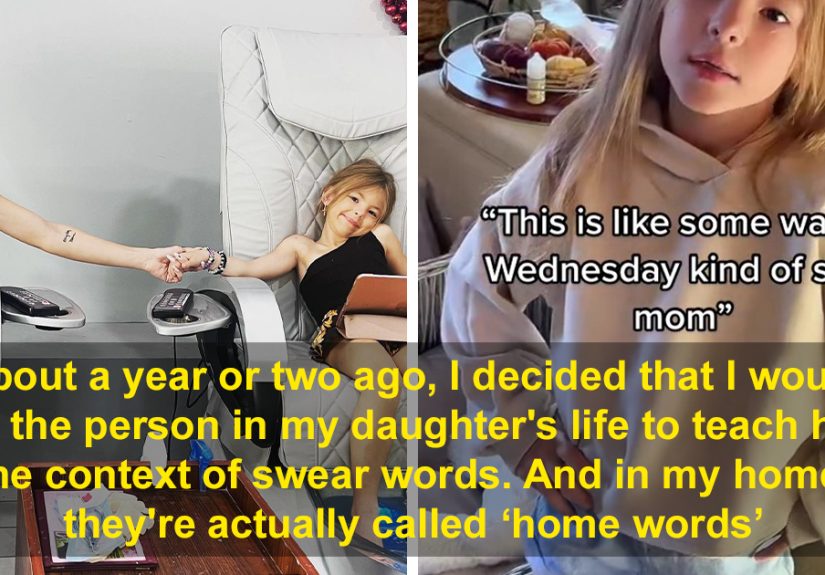
But instead of going full “we don’t say that word EVER,” one mom does something surprisingly modern: she teaches context.
Swear words aren’t magic spells. They’re social toolsand like scissors, they can be helpful in the right hands and
chaotic in the wrong ones. In this approach, the child can use certain swear words at home, with rules, meaning,
and boundaries that would make a courtroom proud.
Let’s break down why kids swear, what “teaching context” actually means, and how a home policy like this can be done thoughtfully
(without turning your living room into an uncensored comedy club).
Why Kids Swear in the First Place (It’s Not a Sign You’ve Failed Parenting)
Kids pick up swear words the same way they pick up dance trends and weird slang: by hearing them and noticing they get a reaction.
At around 7, kids are also developing stronger social awareness and testing boundariesespecially language boundaries.
Common reasons a 7-year-old uses “bad words”
- Copying adults or older kids: They hear it at school, sports, family gatherings, or online and try it on.
- Chasing a reaction: A shocked gasp is basically a standing ovation in kid-world.
- Expressing big feelings: Anger, frustration, surprise, embarrassmentswear words can feel like emotional shortcuts.
- Trying to sound older: Taboo language can signal “I’m in the know,” even when they don’t fully understand meaning.
- Testing power: Kids experiment to see what happens when they break a rule, especially a spicy one.
The key takeaway: a child swearing doesn’t automatically mean they’re “bad.” It usually means they’re learning how language works in the real world
and the real world is full of words that come with social consequences.
The Hidden Truth About Swear Words: They’re About Context, Not Spelling
A swear word isn’t “bad” because of its letters. It’s “bad” because of what it signalsemotion, taboo, disrespect, aggression, or social boundary-crossing.
In other words, swearing is less like grammar and more like social code.
That’s why one family might clutch pearls over a mild curse, while another family shrugs and says,
“Just don’t use it at Grandma’s or at school.” Same word, different environment, totally different outcome.
A useful way to frame it for kids
Think of swear words like a “volume knob.” They make speech louder emotionally. Sometimes that’s appropriate (like stubbing your toe at home),
and sometimes it’s not (like saying it at school, at a friend’s house, or at someone’s face).
The “3 C’s” of Teaching Context: Context, Consent, Consequences
If a parent allows swear words at home, the goal shouldn’t be “do whatever you want.”
The goal is teaching a child to navigate language with judgment and empathy.
One simple framework is the 3 C’s.
1) Context: Where, when, and with whom
Context is the setting: home vs. school, private vs. public, family vs. strangers, playtime vs. serious moments.
A 7-year-old can absolutely learn that some words are “home words” the way they learn “inside voice” and “outside voice.”
Example script:
“Some words are for private places. In our family, certain words can be used at home,
but not at school, not at other people’s houses, and not around adults who don’t want to hear them.”
2) Consent: Is the listener okay with it?
Consent in language means noticing how your words affect other people. Kids can learn:
if someone is uncomfortable, you stop. If a friend says “don’t say that,” you respect it.
This is also where a strong rule belongs:
Swear words should never be aimed at a person to insult or harm.
3) Consequences: What happens next?
Context teaching isn’t complete without consequences. Kids need to understand that words can trigger real outcomes:
teachers respond, friends react, and some spaces have strict rules.
A parent can say:
“At home, we can practice these words safely. Out there, you can get in trouble,
and you can hurt people. Knowing the rules helps you make smart choices.”
If You Allow Swearing at Home: How to Do It Without Regretting Everything
Let’s be honest: the “allowed at home” strategy can work well, but only if it’s paired with clear expectations.
Otherwise, you’ve basically opened a tiny language zoo and forgot the fences.
Step 1: Create a “Home Words Policy” (Yes, like a tiny constitution)
Keep it short, concrete, and predictable. For example:
- Location rule: Certain swear words are only allowed at home.
- Target rule: Never swear at someone (no insulting, name-calling, or bullying).
- Intensity rule: Some words are always off-limits (especially slurs or hateful language).
- Timing rule: Not at the dinner table, not during homework time, not when guests are over.
- Cleanup rule: If you break a rule, there’s a calm consequence (loss of a privilege, a reset, or an apology).
Tip: avoid making a huge dramatic performance out of “the forbidden list.”
If a child is curious, explain meaning simplywithout turning it into a treasure hunt.
Step 2: Teach “Emotion Words” so Swearing Isn’t the Only Tool
A lot of swearing is emotional expression. If a 7-year-old only has one emotional hammer,
every feeling starts to look like a nail.
Help them build a bigger toolkit:
- Feeling labels: mad, disappointed, embarrassed, overwhelmed, worried, frustrated.
- Repair phrases: “I didn’t like that.” “Stop, please.” “I need a break.”
- Release options: stomping in place, squeezing a stress ball, drawing an “angry picture,” taking breaths.
When kids have words for emotions, they rely less on shock-value words.
They can still feel the feelingwithout lighting the room on fire.
Step 3: Model the Rules (Because Kids Notice Everything)
If adults swear when angry at people, kids learn that’s the function of swearing: attacking.
If adults keep it rare, private, and not directed at others, kids learn it’s a controlled expressionnot a weapon.
A helpful guideline:
Swear words are for situations, not for people.
Step 4: Respond Calmly in the Moment (Don’t Feed the Reaction Monster)
Kids often repeat what gets the biggest reaction. If you gasp, lecture for 12 minutes, and call Grandma,
you’ve basically launched the word into superstardom.
Try a calm response:
- Pause: don’t snap back instantly.
- Name the moment: “I heard that word.”
- Ask what’s behind it: “What were you feeling when you said that?”
- Restate the rule: “That word is only for home, and not at people.”
- Follow through: a simple, consistent consequence if needed.
What About Media, Friends, and School?
A big reason kids learn profanity is exposuremovies, YouTube clips, older siblings, or classmates.
Pretending it doesn’t exist usually backfires; curiosity thrives in silence.
How to handle it when the source is media
- Ask what they heard: “What word did you hear? What do you think it means?”
- Give a simple definition: age-appropriate, no oversharing, no “forbidden fruit” drama.
- Connect it to values: “We don’t use words to make people feel small.”
- Set viewing limits: preview content when possible and keep screens age-appropriate.
How to handle it when school calls
If your child swears at school, don’t throw them under the busand don’t pretend you’ve never heard of the concept of swear words.
Treat it like a boundary lesson.
You can say to your child:
“School is a public space. Public spaces have rules. If you break them, there are consequences.
Let’s practice what you’ll say next time you’re frustrated.”
What Words Should Always Be Off-Limits?
Even families that allow some profanity at home usually draw a hard line around hateful language.
Words that target identity (race, ethnicity, religion, disability, gender, sexuality) aren’t “spicy words.”
They’re harmful and can cause real damage.
A clean way to teach it:
“Some words are not allowed anywhere because they hurt groups of people.
Our family doesn’t use those words.”
Does Swearing Help With Pain or Stress? (Interesting Science, Not a Parenting Strategy)
You may have heard that swearing can reduce pain or boost performance. Research suggests that, in adults,
traditional swear words can sometimes increase pain tolerance compared to neutral wordslikely because taboo words carry emotional charge.
That doesn’t mean kids need to swear for “health benefits,” but it does explain why these words feel powerful.
For parenting purposes, the useful takeaway is this: taboo words can act like emotional lightning.
Teaching kids to handle lightning safely is smarter than pretending storms don’t exist.
When to Be Concerned (And When It’s Just a Phase)
For many kids, swearing is brief experimentation. Still, it’s worth paying attention to patterns.
Consider extra support if you notice:
- Profanity is frequent and aggressive, especially directed at people.
- Swearing comes with rage, threats, or bullying.
- Your child seems unable to stop despite consistent boundaries.
- There are other concerning behavior changes (sleep, mood, school refusal, persistent anxiety).
In those cases, it can help to talk with a pediatrician or a child therapistnot because “swearing is the diagnosis,”
but because it can be a signal of bigger stress, skill gaps, or emotional overload.
The Real Goal: Raising a Kid Who Can Code-Switch
The most compelling argument for teaching context isn’t that swearing is “fine” or “funny.”
It’s that kids are growing up in a world where language changes by setting.
Being able to code-switchspeaking one way at home, another way at school, another way with friends
is a practical life skill. It’s also a respect skill. And when parents teach that skill directly,
kids aren’t left to figure it out through embarrassing mistakes in public.
So if a mom chooses to allow a 7-year-old to use certain swear words at home, the best version of that choice is not “anything goes.”
It’s “we learn meaning, empathy, and boundariestogether.”
Conclusion
Swear words are part of the language ecosystem, and kids will eventually encounter them.
The question isn’t whether your child will hear profanityit’s whether they’ll understand what it does.
Teaching context turns a risky moment into a teachable one: your child learns that words carry weight, audience matters,
and respect is non-negotiable. Whether you ban swearing entirely or allow “home words,” the strongest strategy is the same:
be calm, be consistent, and teach the whynot just the no.
Experiences From Families Who Tried the “Home Words” Approach (About )
One parent described the first week as the “grand opening of the Word Museum.” The 7-year-old tried a couple of forbidden-sounding words in the kitchen,
watched for a reaction like a scientist, and then looked almost disappointed when the adult response was calm: “That’s a home word, and it’s not for aiming at people.”
The novelty wore off fast. Without the shock factor, the word lost its sparklekind of like when you finally buy the cereal you begged for and realize it’s mostly air.
Another family treated it like a safety lesson. They said, “You can use certain words at home when you’re frustrated, but you have to tell us what you’re feeling too.”
The child started pairing language with emotion: “I’m really mad,” or “I’m embarrassed,” instead of only reaching for a taboo word.
The parent said the surprising win wasn’t “less swearing”it was more emotional clarity.
When the kid had better labels for big feelings, the swear words became less necessary.
A third parent tried something they jokingly called the “kindness upgrade.”
Instead of a traditional swear jar (which can accidentally turn swearing into a money-making game if you’re not careful),
they used a simple repair rule: if a child used a swear word at someone, the next step wasn’t shameit was repair.
The child had to (1) pause, (2) say what they were actually upset about, and (3) say one respectful sentence to fix the moment.
Over time, the kid learned that swearing at a person didn’t end the conversationit simply triggered a reset.
That reset made the behavior less rewarding.
Parents also shared the “unexpected public test”: a child tried a home word at a friend’s house.
Instead of panicking, the parent treated it as a predictable learning moment.
They reviewed the house rules on the drive home: “Different homes have different rules.
You follow the rules of the place you’re in.” The child apologized, and the parent later practiced a replacement phrase for next time:
“That’s so frustrating,” or “I’m annoyed,” or even a silly substitute word that still released tension without breaking the setting’s expectations.
The most consistent pattern across these stories was this: when adults stopped acting like swear words were mystical, irresistible artifacts,
kids stopped treating them like treasure. Clear rules, calm delivery, and lots of emotional vocabulary turned profanity from a power play into a minor language lesson.
And in many homes, that was the point all alongraising a kid who understands not just what words are, but what words do.