Table of Contents >> Show >> Hide
- What the Oliver Chandelier 5076 actually is (and why it’s not “just another Oliver”)
- Specs in plain English
- The design story: mid-century roots, revived for now
- Why it feels elegant and industrial
- How bright is it?
- Where it looks best (and where it’s merely “fine”)
- Hanging height: don’t bonk anyone’s head
- Unlacquered brass: the “living finish” that refuses to stay the same
- Keeping the glass cylinders crystal clear
- Candle safety (because we like ambiance, not drama)
- What to ask before you order (so you don’t end up playing email tag)
- Is it “worth it”? A practical way to think about value
- Styling ideas: five ways to make it look like it was always meant to be there
- Conclusion: the quiet flex chandelier
- Experiences with the Oliver Chandelier 5076 (the real-world part no one puts in product descriptions)
Some people buy art. Some people buy furniture. And then there are the folks who look up at a blank ceiling and think,
“This place needs jewelry.” Enter the Oliver Chandelier – 5076: a quietly dramatic, mid-century-leaning
candle-style chandelier that manages to feel both elegant and a tiny bit industrial—like it owns a tuxedo
and a toolbox.
If you’ve ever scrolled through lighting options and felt personally attacked by the words “farmhouse wagon wheel,”
Oliver 5076 is your palate cleanser. It’s not trying to cosplay as a barn. It’s trying to do one thing very well:
deliver a warm, candlelit glow in a clean, architectural silhouette.
What the Oliver Chandelier 5076 actually is (and why it’s not “just another Oliver”)
“Oliver” is one of those product names that shows up on all kinds of fixtures across the internet. The number
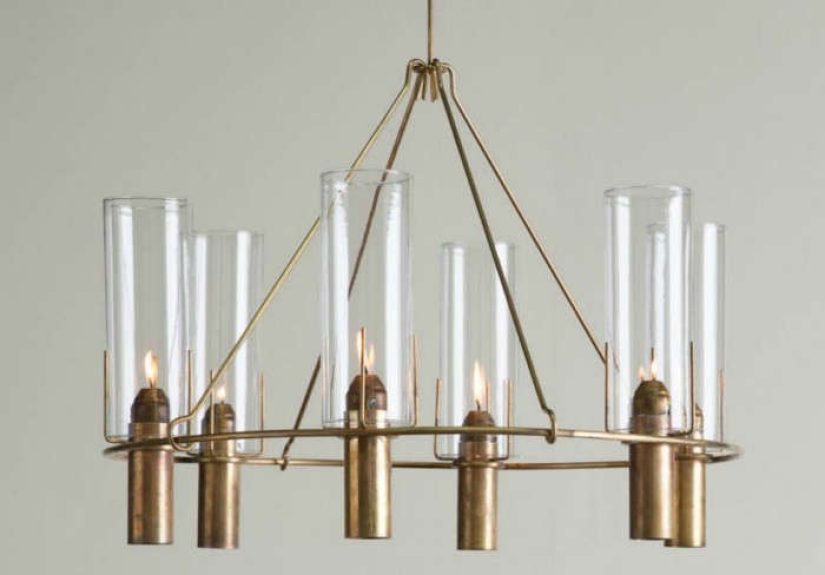
5076 is the detail that matters—it identifies this specific design: a circular arrangement of
six spring-loaded brass candleholders, each protected by an 8-inch glass cylinder (think “hurricane shade,”
but cleaner and more modern).
The spring-loaded holders are the unsung heroes here. Instead of wrestling with candles like you’re trying to load a
tiny cannon, the holders make swapping candles quick and tidy. That functionality is a big part of why the piece feels
“considered,” not fussy.
Specs in plain English
Here’s the cheat sheet you can screenshot mentally:
- Overall size: about 18 inches tall and 23 inches in diameter
- Finish: unlacquered brass (a “living” finish that changes over time)
- Light style: six dripless wax candles in spring-loaded holders
- Glass: six 8-inch cylinders around the candles for protection + glow diffusion
- Ordering reality: made-to-order vibes, with lead times commonly in the 4–6 week range
- Nice touch: typically ships with a set of complimentary candles
- Price point context: historically listed around the $2,600 mark (at time of publication)
The design story: mid-century roots, revived for now
The appeal of Oliver 5076 isn’t just the shape—it’s the lineage. This style sits comfortably in the
mid-century-modern world: straightforward geometry, honest materials, and a “less but better” attitude. It’s the kind
of fixture that doesn’t need 900 crystals to feel special.
In practical terms, it reads as a modern classic: brass for warmth, glass for clarity, and a circular form that plays
nicely with both round and rectangular furniture layouts. The result is a chandelier that doesn’t dominate your room;
it anchors it.
Why it feels elegant and industrial
This chandelier nails a balance that’s surprisingly hard to pull off:
- Elegant: candlelight, brass, symmetry, and that “dining room at golden hour” vibe.
- Industrial: exposed structure, cylindrical glass, and an almost lab-like clarity to the form.
The glass cylinders do a lot of work aesthetically. They create visual rhythm around the circle, and they soften the
candlelight so it looks intentional rather than “we lit six candles and hoped for the best.”
How bright is it?
Let’s set expectations like adults (but fun adults). The Oliver 5076 is primarily about
ambience. Think: warm glow, gentle flicker, flattering light for faces and food. It’s not trying to replace
a grid of recessed cans, and it’s not auditioning to be a stadium floodlight.
Make it work in real life
In most homes, the best lighting plan is layered: a statement fixture plus supporting light sources. If Oliver 5076 is
your “main character,” consider:
- Wall sconces or buffet lamps for side-to-side illumination
- Discreet recessed lights on a dimmer (for cleanup, homework, or the “why is my invoice due today” moment)
- Accent lighting for art or shelves, so the room has depth beyond the dining table
If you’re pairing Oliver with electric supporting lights, choosing efficient bulbs matters. Modern LEDs can provide
excellent quality light while using far less energy than older bulb types, and they tend to last dramatically longer.
Translation: fewer ladder trips and fewer “who put the spare bulbs in the mystery drawer?” arguments.
Where it looks best (and where it’s merely “fine”)
1) Over a dining table
This is Oliver 5076’s natural habitat. With a diameter around 23 inches, it works beautifully over smaller-to-medium
tables, especially round ones. A common rule of thumb is that a chandelier’s diameter should be roughly
one-half to two-thirds the width of the table. For example, on a 42-inch-wide table, you’d typically aim
for a fixture around 21–28 inches wide. Oliver slides right into that sweet spot.
2) In an entryway
If your entry has enough ceiling height, Oliver can give you that “welcome home” moment without feeling ornate.
Because the design is clean, it won’t visually fight with stair railings, art, or architectural trim.
3) In a bedroom (yes, really)
Bedroom chandeliers can be hit or miss, but candle-style light can be genuinely calming. The trick is scale: if your
room is modest, a 23-inch fixture can feel intentional. If your room is tiny, it can feel like the ceiling is wearing a
hat that’s two sizes too big.
Hanging height: don’t bonk anyone’s head
Over a dining table, many designers recommend hanging the bottom of the fixture roughly
30 to 36 inches above the tabletop (adjusting higher for taller ceilings). If you have an open-plan space,
also check sightlines from the kitchen and living area—you want glow, not glare or visual blockage.
In an entryway or hallway, prioritize clearance. You want enough headroom for tall humans, enthusiastic dogs, and
anyone carrying a houseplant like it’s a newborn.
Unlacquered brass: the “living finish” that refuses to stay the same
The Oliver 5076 is typically shown in unlacquered brass. That means it’s not sealed under a protective clear
coat. Over time, it will deepen, mellow, and develop a patina. This is not a defect. This is the point.
How patina behaves in the real world
- Humidity speeds things up. If you live somewhere steamy, brass will “age” with enthusiasm.
- Touch matters. Natural oils can create slightly darker, warmer areas where hands frequently contact the metal.
- Patina isn’t uniform. It’s a living finish; it won’t behave like a factory powder coat.
Cleaning it without ruining the vibe
If you like the patina (most people who choose unlacquered brass do), stick to gentle care:
- Dust regularly with a soft, dry cloth.
- For grime: a lightly damp cloth + mild dish soap, then dry thoroughly.
- Avoid harsh acids and abrasives if your goal is to preserve that aged character.
- For stubborn spots: use a soft toothbrush in crevices, then dry completely.
If you ever decide you want it shinier, brass polish will absolutely do that—but it can also erase the “earned”
look. Think of polishing as a design decision, not a routine chore.
Keeping the glass cylinders crystal clear
Clear glass looks amazing—right up until it collects dust and turns into a slightly foggy science experiment.
To keep Oliver’s cylinders looking sharp:
- Use a microfiber cloth for routine dusting.
- If you remove cylinders to wash them, use mild soap + lukewarm water and dry fully to avoid spots.
- Avoid harsh chemicals that can leave haze or residue.
Candle safety (because we like ambiance, not drama)
Oliver 5076 is designed around candles, and the glass cylinders help manage airflow and protect the flame zone. Still:
- Never leave candles unattended. “I’ll be back in a second” has lied to everyone at least once.
- Keep distance from curtains or anything that can sway into the flame path.
- Trim wicks to reduce soot and keep flames steady.
-
If you have pets, small kids, or a ceiling fan that lives for chaos, consider
high-quality flameless taper candles for the same look with a lot less risk.
What to ask before you order (so you don’t end up playing email tag)
With made-to-order lighting, the smartest move is to ask a few practical questions upfront:
- Drop length: What’s the standard hang, and can it be adjusted for your ceiling height?
- Canopy + mounting: What ceiling box requirements are needed?
- Finish expectations: How will the brass arrive, and how will it age?
- Replacement parts: How do you reorder candles or any specialty components later?
- Room fit: Will the 23-inch diameter feel right over your specific table size?
Is it “worth it”? A practical way to think about value
The Oliver 5076 sits in a category where you’re paying for more than illumination. You’re paying for:
- Materials that age well (solid-feeling metal, substantial glass)
- A design that’s not trend-chasing (it still looks right when the internet moves on)
- Craft and small-batch intent (the difference you feel when something isn’t mass-produced)
If your priority is maximum lumens per dollar, you can find cheaper fixtures. But if your priority is a statement piece
that feels like it belongs in the room for the next decade (or two), Oliver’s value proposition starts to make sense.
Styling ideas: five ways to make it look like it was always meant to be there
1) Modern farmhouse (but not “barn cosplay”)
Pair it with a simple wood table, linen textiles, and matte ceramics. Let the brass be the warm counterpoint to
neutral tones.
2) Mid-century modern, properly
Walnut furniture, sculptural chairs, and a few curved forms. Oliver’s circle echoes classic mid-century geometry without
looking like a museum reproduction.
3) Minimalist
White walls, quiet materials, and negative space. The glass cylinders keep it visually light, so it reads as “intentional”
rather than “busy.”
4) Industrial-soft
Concrete, black steel, and leather—but add softness with textiles and warm brass. Oliver bridges hard materials and
human comfort.
5) Classic + collected
Antique art, vintage rugs, and layered textures. Brass and candlelight are old friends in traditional interiors, and the
clean geometry keeps it from feeling overly ornate.
Conclusion: the quiet flex chandelier
The Oliver Chandelier – 5076 is the kind of fixture that doesn’t shout. It glows. It’s architectural without being
cold, romantic without being frilly, and practical in the ways that matter (hello, spring-loaded holders).
If you want a chandelier that makes a room feel “finished”—not in a staged, catalog way, but in a
people actually live here and have good taste way—Oliver 5076 is a compelling choice. It’s ceiling jewelry with
a backbone.
Experiences with the Oliver Chandelier 5076 (the real-world part no one puts in product descriptions)
Living with a chandelier like the Oliver 5076 tends to change how people use a room—not because it’s bossy, but
because it sets a mood on contact. Homeowners and designers often describe the first week as a series of tiny “oh”
moments: you walk into the dining room in the afternoon, the brass catches a little daylight, and you realize the
fixture looks different depending on the hour. Unlacquered brass has that living-finish personality; it doesn’t sit there
frozen in time. It shifts subtly, like the room is maturing along with it.
The candle routine becomes its own small ritual. People who love the Oliver tend to be the same people who enjoy
setting the table even when it’s just a Tuesday. Swapping in fresh candles is quick (those spring-loaded holders are
doing the most), and lighting them is the fastest way to make dinner feel like an event without changing anything else.
You’ll hear variations of: “We started eating at the table more.” Not because the table got bigger, but because the room
stopped feeling like a pass-through and started feeling like a destination.
There’s also a funny psychological effect: once the chandelier is up, the ceiling suddenly looks higher and the room
feels more intentional. It’s the same phenomenon as adding a great rug—everything around it gets promoted. That
slightly scuffed chair? Now it looks “characterful.” The mismatched dining chairs? “Eclectic.” The truth is, a strong
overhead focal point can unify a space even when the supporting cast is still figuring things out.
People do learn a couple of practical lessons quickly. First: clear glass cylinders are honest. If you ignore dust for too
long, the chandelier will not keep your secret. But the payoff is worth it; when the glass is clean, the light looks soft
and expensive in a way that’s hard to fake. Second: candlelight is flattering, but it’s not task lighting. If you’re hosting
a game night that requires reading tiny rulebooks, you’ll be grateful you layered in a lamp or two. Many folks end up
using the Oliver as their “mood layer” and rely on subtle secondary lighting for workhorse brightness.
And then there are the households with kids, pets, or a general preference for low-stakes living. A common experience
is starting with traditional dripless candles for special nights, then switching to high-quality flameless tapers for daily
use. The look stays, the risk goes down, and nobody has to sprint across the room because someone yelled,
“Why does it smell like birthday cake smoke?” In that sense, the Oliver 5076 is surprisingly adaptable: it can be a
romantic centerpiece for dinner parties, or a calm, sculptural fixture that quietly elevates everyday life.
The most consistent feedback is also the simplest: people notice it. Guests look up. Conversations start. Someone
inevitably asks, “Where did you get that?” And for once, the answer isn’t “a big-box store at 2 a.m. during a panic
renovation.” It’s a piece that feels chosen—like you meant it.