Table of Contents >> Show >> Hide
- Why Prom Dress Codes Exist (and Why They Spark Drama)
- The Most Common “Dress Code Offenses” at Prom
- Real-Life Examples of Outfits That Got Kids Kicked Out
- What These Controversies Reveal About School Culture
- How Not to Get Kicked Out of Prom: Practical Tips
- If You’re Turned Away at the Door
- Experiences From the Front Lines of Prom Dress Code Drama
- Conclusion: Keeping Prom Special Without the Dress-Code Disaster
Every spring, teenagers across the United States spend months obsessing over one magical night: prom. There are group chats, Pinterest boards, fittings, last-minute hair emergencies, and parents calculating how on earth a single evening got this expensive. And then, for a small but very vocal group of students, the night ends right at the door with an administrator saying, “Sorry, you can’t come in dressed like that.”
Outfits that got kids kicked out of prom have become a whole genre of viral story: dresses labeled “too short,” suits that supposedly break “feminine dress” rules, outfits with sheer panels, or clothes that challenge gender norms. These aren’t just fashion mishaps they sit at the intersection of teen self-expression, school authority, and evolving ideas about gender, modesty, and respect.
In this article, we’ll unpack why prom dress codes exist, the kinds of outfits that get students turned away, how those rules are enforced in real schools, and what teens and parents can do to avoid last-minute heartbreak at the door without giving up individuality.
Why Prom Dress Codes Exist (and Why They Spark Drama)
Most schools don’t wake up one day and decide to ruin prom for fun (even if it feels like that in the moment). Prom dress codes are usually extensions of the regular school dress code. Administrators argue that rules exist to:
- Keep the atmosphere “formal” and in line with school values
- Prevent outfits with offensive language, symbols, or images
- Avoid what adults consider overly revealing clothing
- Maintain a sense of “uniformity” and prevent disruptions
On paper, that can sound reasonable. In practice, dress codes are often vague (“no inappropriate clothing”) and enforced unevenly. One student’s “classy” fitted dress is another administrator’s “too tight.” A sheer panel that looks fine to one chaperone is suddenly “provocative” to another. And the person whose body is being judged has to deal with the fallout usually in front of their peers.
There’s also a legal layer. In public schools, dress codes can’t treat students differently based on gender or force them into sex-based stereotypes at least not without raising serious Title IX and equal-protection questions. That’s why rules that say “girls must wear dresses, boys must wear suits” or that focus mostly on girls’ shoulders, cleavage, or hemlines are increasingly being challenged by students, parents, and advocacy groups.
The Most Common “Dress Code Offenses” at Prom
1. Too Short, Too Tight, or Too Sheer
If there were a leaderboard for outfits that got kids kicked out of prom, short and fitted dresses would be dominating the rankings. The classic scenario goes like this: a student buys a dress that looks prom-perfect in the mirror. It’s not see-through. It’s not wildly revealing. Parents approve. Friends approve. Then, at the door, a staff member decides that the hemline is half an inch too high, the slit is too daring, or the fabric hugs a body curve “too much.”
Some schools try to spell things out with contracts or detailed diagrams. Prom guidelines might specify that dresses must reach “fingertip length” or “no more than four inches above the knee,” that no cut-outs are allowed, or that sheer fabric must be fully lined. The reality: bodies are different, and a rule that looks clear on paper can be very subjective when applied to real people on a crowded gym floor.
In several widely reported cases, teens were nearly turned away or actually removed from prom for wearing dresses with sheer backs, polka-dot prints with shorter hemlines, or styles that were similar to what other students wore but enforced more strictly on one particular girl. Those examples highlight a recurring complaint: enforcement can feel random and unfair, with one student singled out while others in nearly identical outfits dance the night away.
2. Shoulders, Straps, and the “Distraction” Argument
Another big category of “prom crimes” involves shoulders and necklines. Some schools ban strapless dresses completely. Others allow them but forbid plunging necklines, visible bra straps, or certain types of cut-outs. The explanation is often that exposed shoulders or cleavage are “distracting” or “inappropriate.”
Students and many parents push back, arguing that this logic unfairly sexualizes girls’ bodies and sends the message that boys’ concentration is more important than girls’ comfort. In multiple dress-code controversies, teens have pointed out that it’s hard to find prom dresses that are both fashionable and compliant with every restriction, especially when trends (like off-the-shoulder or open-back styles) clash with old rules.
When those rules are enforced at the door instead of being communicated clearly and consistently ahead of time students end up crying in parking lots, calling parents for emergency wardrobe changes, or being sent home entirely.
3. Suits, Gender, and “You Have to Look Like a Girl”
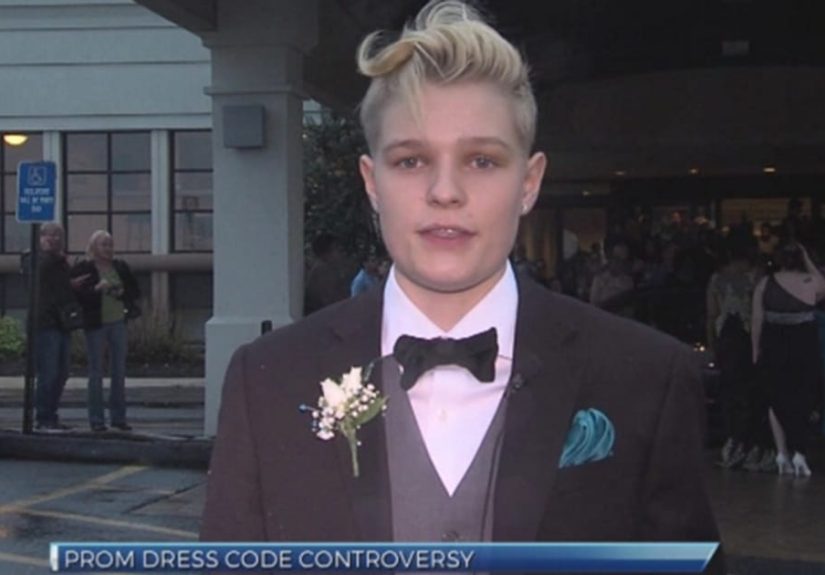
Not all prom outfit drama involves dresses. Some of the most talked-about cases in recent years have involved teens who wore suits especially LGBTQ+ and gender-nonconforming students.
In more than one instance, a school has told a student that “girls must wear dresses,” even when the written dress code didn’t clearly say that. Teens have been turned away at the door or removed from the event because they chose a tailored suit over a gown, or because their outfit didn’t match the administrators’ idea of how a “girl” should look at prom.
These cases blow up online for a reason: they dramatize the clash between traditional gender expectations and the reality of modern high school life. Many teens simply want to dress in a way that feels authentic and comfortable, whether that means a tux, a sparkly gown, or something in between. When a student is told that their outfit is unacceptable not because it’s revealing or offensive, but because it doesn’t look “feminine enough,” it hits a nerve far beyond one prom night.
4. Logos, Slogans, and “Inappropriate” Messages
Prom is usually a semi-formal event, so T-shirts with giant slogans aren’t common. Still, some schools include prom-specific rules about clothing with political messages, alcohol or drug references, or graphic imagery. These rules sometimes echo broader dress-code disputes over students’ rights to wear shirts criticizing politicians, supporting social causes, or mocking school policies.
At prom, administrators generally have more leeway to require formal wear and to keep the atmosphere non-confrontational. That said, once schools start punishing students for clothing that expresses a viewpoint especially in public schools they step into complicated First Amendment territory. Most of the time, prom drama is less about slogans and more about hemlines and gendered expectations, but those free-speech questions do pop up in the background.
Real-Life Examples of Outfits That Got Kids Kicked Out
The “Too Short” Dress at the Door
One common story involves a student arriving at prom in a short dress that according to her meets every written rule. She did the fingertip test. The dress was approved by a parent, maybe even by a staff member beforehand. But at the entrance, a different teacher or administrator decides the dress is too short after all.
Often, these situations escalate quickly. The student feels blindsided. Her friends are watching. Staff tell her to pull the dress down, cover up with a jacket, or go home. Parents get involved, arguing that other teens are wearing similar outfits. Before long, everyone is taking pictures and posting on social media, and a local news station shows up asking why a teenager had her big night ruined over two inches of fabric.
The Viral Polka-Dot Prom Dress
In one widely shared incident, a teen in a polka-dot dress was kicked out of prom after staff said her dress was too short and too tight for the event. Her mother pointed out that other students were wearing dresses with midriff cut-outs and sheer panels and were allowed to stay. Photos of the dress went viral, and many viewers said it looked perfectly appropriate.
The core of that controversy wasn’t just the dress; it was the inconsistency. When rules are enforced selectively, students understandably feel targeted. They start to wonder whether their body type, race, or prior reputation is being judged, not just the outfit.
The Students in Suits Who Were Turned Away
Another set of headline-grabbing stories centers around students often girls or nonbinary teens who opted to wear suits to prom. In one case at a Christian school, a senior who had worn pants and shirts throughout high school showed up in a suit and was told she couldn’t attend. In another, a nonbinary student in Tennessee posted a photo outside the venue holding a sign explaining they were denied entry because they wore a suit instead of a dress.
What turned these from local disputes into national conversations was the unfairness of telling a teen that their outfit is “inappropriate” simply because it doesn’t match a narrow version of femininity. These stories also highlight how dress codes, when badly written or enforced, can become tools of gender policing rather than simple guidelines for formal attire.
Prom Dreams vs. Last-Minute Rule Changes
A particularly painful version of the story happens when schools change or tighten prom rules shortly before the event. Girls who bought dresses months earlier suddenly receive emails saying no strapless gowns, no pants for girls, or no certain styles that are already hanging in their closets. For families who have already spent time and money, this feels less like “guidance” and more like moving the goalposts.
When teens choose to attend anyway, believing their outfits are reasonable, they risk being turned away at the door which is exactly what has happened in several cases. That sends a strong message about whose comfort matters more: the adults enforcing the rules or the students who have been working toward this milestone for years.
What These Controversies Reveal About School Culture
Prom outfit drama is not just about fashion. It reveals deeper tensions in school culture:
- Gender bias: Many dress codes focus almost entirely on what girls can and can’t wear, while boys face far fewer restrictions. That tells girls their bodies are a “problem” that must be managed.
- Body policing: The same dress may look different on two students with different body types, leading to curvier or taller students being punished more often.
- Outdated norms: Rules built around traditional ideas of femininity and masculinity collides with a generation that is more open about gender identity and expression.
- Power and trust: When rules are vague and enforcement is arbitrary, students lose trust in administrators and feel less safe and respected at school events.
On the flip side, schools that involve students in writing the dress code, explain the reasons behind each rule, and enforce those rules calmly and consistently tend to have far fewer viral disasters. Teens don’t necessarily mind having guidelines they just don’t want their bodies or identities to be treated as problems.
How Not to Get Kicked Out of Prom: Practical Tips
1. Actually Read the Dress Code (Yes, the Whole Thing)
It’s not fun, but it’s essential. Read the entire prom dress code carefully, not just the bolded bits. Look for specifics like:
- Minimum dress length (“no more than X inches above the knee”)
- Rules about slits, low backs, or plunging necklines
- Restrictions on sheer fabric, cut-outs, or midriff exposure
- Gendered language like “girls must wear dresses” or “boys must wear ties”
If anything is unclear, email the administration and ask for clarification in writing. A quick, polite message with a photo of the outfit is much better than a heated argument at the door.
2. Take Photos and Ask for Pre-Approval
Before prom, have the student try on the outfit with the shoes they’ll actually wear. Take clear front, side, and back photos. Send them to the designated staff member and ask, “Is this compliant with the prom dress code as written?”
Save any response you get. It’s not a magic shield, but it gives you something concrete to bring up if there’s confusion later.
3. Plan a Backup Option
Is this fair? Not particularly. Is it practical? Absolutely. Keeping a backup outfit or accessories can save the night:
- A wrap, shawl, or jacket in case someone decides the top is “too revealing”
- Leggings or tights if you’re worried about hemline length
- A second shirt, blazer, or dress that’s obviously more conservative
If a staff member insists on a change, you may be able to adjust and still enjoy the dance instead of going home in tears.
4. Know the Difference Between Public and Private Schools
Public schools are covered by constitutional protections and federal civil rights laws. They generally can’t enforce dress codes that discriminate based on sex or gender identity, or that punish students for not conforming to traditional gender norms.
Private and religious schools, on the other hand, often have more freedom to set and enforce their own standards, as long as they’re consistent with their policies and applicable state laws. That doesn’t make every decision fair or kind, but it does change your options for challenging those decisions.
5. Speak Up Before and After Prom
If you see a rule that seems clearly unfair, don’t wait until prom night. Talk with student council, trusted teachers, or administrators months in advance. Propose specific changes, like removing gendered language or clarifying vague terms.
After prom, if students were treated unfairly, consider organizing feedback sessions, writing op-eds in the school newspaper, or meeting with the school board. Many changes to dress codes start with students who push back respectfully but persistently.
If You’re Turned Away at the Door
Sometimes, even with preparation, things go wrong. Here’s how to handle it if a student is told they can’t come in:
- Stay as calm as possible. Easier said than done, but yelling rarely helps in the moment.
- Ask exactly which rule is being violated. Request that staff point to the specific line in the written dress code.
- Ask about options. Can the student adjust the outfit? Borrow a shawl or jacket? Change into something else and return?
- Document what’s happening. Parents or guardians should calmly note who made the decision, what was said, and whether other students in similar outfits were allowed in.
- Decide whether to fight now or later. Sometimes it’s better to salvage the night with a quick outfit change and address the policy the next day.
For families who feel the decision was discriminatory or clearly inconsistent, there may be options to file a complaint with the district, consult a local attorney, or reach out to civil-rights organizations. But for the teen in the moment, the priority is usually emotional support and the reminder that their worth is not measured in dress-code compliance.
Experiences From the Front Lines of Prom Dress Code Drama
Beyond headlines and policies, prom outfit controversies live in the memories of the people who experience them. Talk to a group of twenty-somethings today, and you’ll likely find at least one person whose prom night turned into a dress-code saga or who watched a friend go through it.
Some describe the shock of being stopped at the door after spending weeks getting ready. One former student remembers the exact feeling of standing in line with her friends, hearing laughter and music inside the gym, and then being pulled aside by a chaperone who whispered that her dress was “inappropriate.” She says she didn’t even understand what that meant at first. By the time she realized they were talking about the length and fit, she was already fighting back tears.
Another student, who wore a suit instead of a dress, recalls the mix of confidence and anxiety heading into prom. She’d chosen the outfit because it felt like her: sharp, comfortable, and a little bit daring. Instead of a joyful entrance, she ended up arguing with staff in the lobby while her friends checked in behind her. “It felt like my identity was on trial,” she later said. “Not just my clothes.”
Parents have their own stories. Some remember racing home to grab a different dress, sewing up slits in the car, or pinning straps and necklines in the parking lot with a travel sewing kit they brought “just in case.” Others admit they didn’t fully understand how strict the rules were until they watched their kids get humiliated over a perfectly normal prom outfit.
Teachers and administrators, too, sometimes feel caught in the middle. Many are handed a binder of rules and told to enforce them, even when they personally think the guidelines are outdated. They’re the ones who have to tap a teenager on the shoulder and say, “We need to talk about your dress,” knowing that conversation may end in tears and a viral TikTok.
Some schools have used those painful experiences as a turning point. After a particularly controversial prom where several students were removed over dress-code issues, one high school formed a committee with students, parents, and staff. They walked through examples of real outfits, discussed what actually felt disruptive versus what was simply different, and rewrote the rules to focus on inclusivity and respect instead of fear and control.
Students who were once on the receiving end of dress-code enforcement sometimes become the loudest voices for reform. They advocate for gender-neutral language, clearer guidelines, and a shift away from shaming bodies toward teaching consent, respect, and personal responsibility. They also share one consistent message with younger teens: your value is not tied to whether an adult approves your dress, your suit, or your shoulders.
Ultimately, outfits that got kids kicked out of prom are about much more than fashion. They’re about whose comfort matters, whose bodies are seen as “distractions,” and who gets to decide what “appropriate” looks like. The hope is that, as more people share their stories, schools will move toward dress codes that protect students from genuinely harmful behavior without punishing them for being themselves in a sparkly dress, a sharp suit, or anything in between.
Conclusion: Keeping Prom Special Without the Dress-Code Disaster
Prom should be about awkward dancing, goofy photos, and memories that make you smile years later not about being turned away at the door because of an outfit you thought was perfectly fine. Yet, every year, stories of outfits that got kids kicked out of prom remind us that dress codes are still a battlefield.
The good news is that students, parents, and many educators are pushing for change. Clearer, fairer, and more inclusive rules can protect the spirit of prom without humiliating the very teens it’s supposed to celebrate. Until then, the best strategy is to know the rules, advocate for yourself, support your friends, and remember: your worth is not defined by a hemline, a strap, or a suit.