Table of Contents >> Show >> Hide
- What “the Army way” actually meant
- Why field wire mattered so much
- The anatomy of a classic Army field-wire splice
- The T-splice: because sometimes you need to cut in without shutting down
- Splicing was only part of the craft
- From W-110-B to WD-1/TT and beyond
- Why the Army way still fascinates today
- Experience notes: what this kind of wire work felt like in the real world
If you have ever twisted two wires together and felt oddly proud of yourself, congratulations: you have taken the first step toward appreciating one of the least glamorous and most important skills in military communications. Long before encrypted apps, satellite links, and people saying “Can you hear me now?” into expensive headsets, armies relied on field wire. Miles and miles of it. And when that wire broke, got chewed up by weather, run over by trucks, or politely exploded by artillery, somebody had to splice it back together fast.
That is where the “Army way” comes in. It was not fancy. It was not cute. It was not designed to win awards from modern cable-management enthusiasts. It was designed to keep messages moving when a command post, an observation team, a switchboard, or a field telephone absolutely needed a working line. In other words, this was practical engineering with mud on its boots.
The phrase Retrotechtacular: Wire Splicing The Army Way sounds like a charming little stroll through vintage tech, and it is. But it is also a look at how military communications became reliable through discipline, repetition, and an almost heroic amount of knot-tying. Behind every “simple” splice was a logic shaped by rain, strain, corrosion, noise, speed, and the very real possibility that somebody on the other end of the line had a battlefield problem and zero patience.
What “the Army way” actually meant
In civilian life, a wire splice is often treated like a quick fix. In military life, it had to be more than that. A proper splice was expected to preserve electrical continuity, resist pulling forces, survive weather, avoid shorting out the paired conductors, and stay compact enough to remain useful in the field. A bad splice did not just look sloppy. It increased transmission loss, added noise, weakened the line, and created one more point of failure in a communication system that was already dealing with stress from terrain, moisture, and combat conditions.
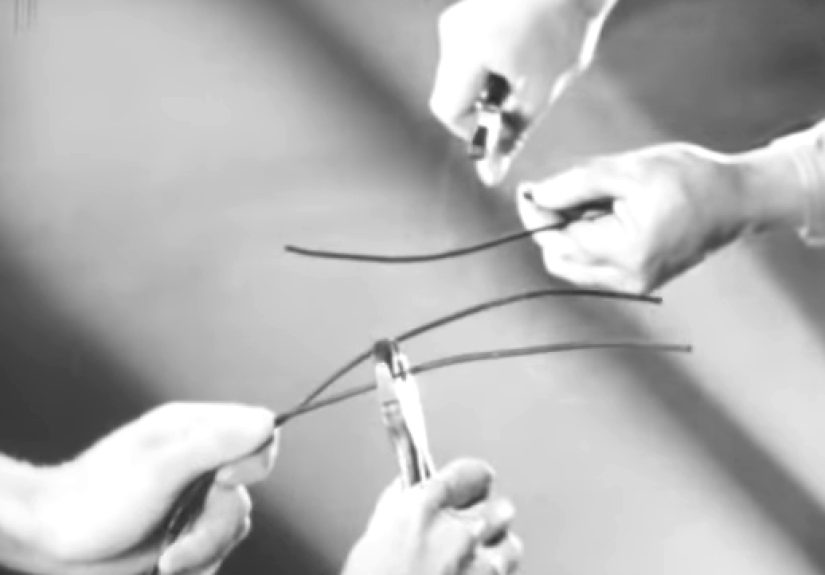
That helps explain why Army manuals broke the job into exact steps. The standard field-wire splice was not just “twist and pray.” It followed a sequence: stagger the conductors, strip insulation, tie a square knot, seize the knot for conductivity and strength, then tape the whole thing for insulation and weather protection. The method sounds almost stubbornly old-fashioned, but it was clever in a very military way. Every movement served a purpose.
And yes, there was a reason for all that ceremony. By the Second World War, the Signal Corps had decades of experience laying and maintaining communications lines. Wire was still the backbone of battlefield communication because it was dependable, hard to jam, and often more practical than radio for many tactical jobs. Radio was useful, of course, but wire remained the workhorse. If you wanted a line that could connect headquarters, observation posts, artillery positions, and rear areas with predictable performance, field wire was your friend. Temperamental, muddy, snag-prone friend, but friend nonetheless.
Why field wire mattered so much
Military field wire was not ordinary lamp cord wearing a uniform. Wartime Signal Corps wire had to be rugged, portable, and reliable across rough terrain. In the 1941 training film era, type W-110-B field wire was used to connect command posts to forward and rear positions. It was laid directly on the ground more often than not, which meant it had to tolerate moisture, abrasion, foot traffic, and the occasional mechanical insult from war doing what war does best: breaking everything.
Later postwar manuals standardized field wire such as WD-1/TT, a twisted pair made with conductors that combined copper and steel strands. That design balanced conductivity with tensile strength. The Army specified that WD-1/TT had a tensile strength of about 100 pounds, weighed about 48 pounds per mile, and offered a talking range that could reach roughly 18 miles in dry conditions and around 12 miles in wet conditions. Those details matter because they show the real design goal: this wire was built for communication and abuse.
That dual purpose shaped the splice. The Army was not just reconnecting metal. It was rebuilding a miniature mechanical system. A good splice had to conduct electricity, shed strain, resist weather, and avoid becoming a bulky snag magnet. So the “Army way” became a marriage of knot craft and signal maintenance. It was part electrician’s workbench, part sailor’s rope trick, and part survival skill.
The anatomy of a classic Army field-wire splice
1. Stagger the conductors
Field wire usually came as a pair of conductors. If both were spliced at exactly the same point, the result would be bulky, awkward, and more likely to short. So the Army staggered the splices. One conductor got repaired a little farther up the line than the other. That kept the pair slimmer and reduced the chance of electrical contact between the conductors. It was a small detail with big practical value.
2. Strip insulation with purpose
Army instructions did not treat stripping as a casual step. Too little exposed conductor and the splice would be weak. Too much and the repair became vulnerable. The wireman was expected to prepare enough bare conductor for a secure knot and good wrap while preserving as much insulation as possible. In field work, “close enough” is often code for “please enjoy fixing this again in an hour.”
3. Tie a square knot to carry the strain
This is the part that surprises modern readers. The Army intentionally used a square knot in the conductor itself. At first glance, that sounds like something an electrical engineer would stare at in horror. But in the field, the logic is solid. The knot helped retain tensile strength by making the splice responsible for mechanical load, not just electrical contact. In other words, the line was less likely to pull apart when somebody yanked it, stepped on it, or ran it around equipment and obstacles.
That is the genius of the method. Instead of pretending the splice only had one job, the Army assumed it would be stressed and designed accordingly. It was not pretty. It was resilient.
4. Seize the knot for conductivity
Once the knot was tied, the Army improved the electrical path by “seizing” the splice. If separate seizing wire was available, a short piece was passed through the knot and wrapped tightly to the left and right. If seizing wire was not available, copper strands from the conductor itself could be used. The goal was to bind the knot, increase contact surface, and keep the joint tight.
This step is where the Army method becomes especially smart. The knot handled strain; the seizing improved conduction and stability. It was a two-layer solution: mechanical first, electrical second, both protected together.
5. Tape it like you mean it
After the splice came insulation and weatherproofing. Army manuals specified wrapping with rubber tape and friction tape, or in some conditions electrical insulation tape plus friction tape. The wrapping pattern mattered too. The idea was to seal the splice, extend protection beyond the exposed area, and keep water from sneaking in and causing leakage or corrosion.
In other words, the final step was not cosmetic. Taping was the difference between “repaired” and “repaired until the next drizzle.”
The T-splice: because sometimes you need to cut in without shutting down
If the standard splice was the bread and butter of wire repair, the T-splice was the clever cousin who knew how to crash a party without turning off the lights. The Army used the T-splice to connect one field-wire line to another without interrupting service. That made it useful for rerouting an existing line or building a multiple-party line while the circuit stayed active.
This was not a hack. It was doctrine. Manuals described how to bare the existing conductors, position the new branch, form the proper square-knot arrangement, and complete the splice so the new line joined the old one without wrecking the circuit. The instructions even warned that the strain-bearing conductors had to sit on the correct side of the loop or the knot would not hold. That tiny detail tells you everything about Army training culture: there was always a right way, and the right way had probably been learned the hard way first.
Splicing was only part of the craft
The old manuals also show that military wire work was bigger than repair. Wiremen had to tie lead-ins, secure lines to posts, relieve strain at terminals, and keep water out of equipment. That is why you see features like the drip loop, which allowed water running down a lead-in wire to fall away before entering a telephone or terminal box. It is not dramatic, but it is deeply satisfying in the way only practical field engineering can be.
Then there were ties such as the clove hitch and loop-knot tie, each meant for specific conditions. The Army did not just teach people to run wire; it taught them how to make wire behave. That distinction matters. Battlefield communications fail at the margins: where the line bends, rubs, sags, gets wet, or takes tension it was never meant to take. Good tying reduced those failures before they started.
From W-110-B to WD-1/TT and beyond
One of the fun parts of looking at this old tech is seeing how the method evolved without losing its core logic. The 1941 Signal Corps film centered on W-110-B field wire, while later doctrine focused on WD-1/TT and its variants. Materials changed. The Army’s larger wartime logistics story included the need to adapt field wire production as rubber supplies shifted and synthetic insulation became more important. Yet the underlying design philosophy remained beautifully stubborn: make communication rugged, repairable, and standardized enough that another soldier can understand your work in lousy conditions.
Even later maintenance guidance still reflected that mentality. By the 2000s, Army field-wire care literature discussed grease-filled splice connectors such as the U1R for WD-1 and WD-1A wire. These connectors simplified the repair process and improved water resistance, showing how the Army modernized the tools while keeping the same goal: a splice must be mission-worthy, not merely passable. Guidance also set limits on how many splices were acceptable in a half-mile of wire and tied usability to resistance checks. The message was classic Army: yes, you can repair it, but you still have to respect system performance.
Why the Army way still fascinates today
There is something irresistible about vintage military communications because it turns ordinary materials into life-and-death infrastructure. A spool of wire does not look like strategy. A square knot does not look like command and control. A strip of friction tape does not look like battlefield reliability. But put them together the right way and suddenly an observation post can talk to a battery, a beachhead can route calls through a switchboard, and a headquarters can keep functioning when chaos is trying its best to unplug everything.
That is why Retrotechtacular: Wire Splicing The Army Way works as more than a nostalgic headline. It reminds us that great technology is not always shiny. Sometimes it is a standardized repair process built for rain, hurry, and human error. Sometimes it is a knot tied by somebody kneeling in mud, hoping this splice holds because the people on the line need it to hold.
Modern readers may laugh a little at the ritual of knot, seize, tape, repeat. Fair enough. But the joke is on us if we mistake simple for primitive. The Army way was a sophisticated answer to a brutally practical question: how do you keep communications alive when everything around them is trying to kill them?
Experience notes: what this kind of wire work felt like in the real world
If you want to understand the lived experience behind Army wire splicing, the archival record paints a picture that is equal parts craft, exhaustion, and low-grade paranoia. Signal personnel were not sitting at a tidy bench with good lighting and a cup of coffee nearby. They were moving through burned cities, beaches, jungle tracks, and shell-torn routes, laying or repairing lines that were expected to work immediately.
One early example comes from San Francisco after the 1906 earthquake, when Signal Corps troops had to reestablish communication lines through a city on fire. That kind of work tells you something important: military wire practice was shaped as much by emergency response as by battle. The standard methods had to work when streets were ruined, infrastructure was collapsing, and people needed messages carried now, not after a leisurely inspection.
By World War II, the pressure was even more obvious. Memoirs from Omaha Beach describe field wire connecting switchboards to headquarters and storage areas as communications expanded from temporary beach chaos into a functioning network. That image alone is remarkable. While huge events dominate the history books, somebody still had to make sure the line from one point to another actually worked. The beachhead did not become organized by magic. It became organized because wiremen, switchboard operators, and signal troops kept building communication out of cable, open wire, buried lines, and the ever-present field wire.
Those same recollections also mention “line-tappers,” people who cut lines and then waited to ambush the repair crew. Read that once and suddenly the Army splice stops looking quaint. In some places, fixing a broken line was dangerous enough that it could be safer to string an entirely new one rather than repair the cut. Jungle warfare accounts from the Pacific say almost exactly that. Broken wire was not just an inconvenience; it could be bait.
And then there was the environment. Humidity rotted things. Traffic crushed lines. Artillery broke them. Friendly troops walked over them. Water invaded everything. Even when the enemy was not deliberately targeting the wire, the landscape was. In Italy, Army histories describe telephone wires being knocked out during combat at exactly the moment coordination mattered most. In the Pacific, radio could degrade in jungle conditions, making wire essential even though it was fragile on the ground. Wiremen were constantly solving the same cruel puzzle: the system was necessary because conditions were bad, and those same conditions were what destroyed it.
That is why Army splicing methods feel so experience-driven. Every square knot, every staggered conductor, every wrap of tape sounds like a reply to some miserable lesson learned in the field. The Army way was not decorative procedure. It was institutional memory turned into muscle memory. You can almost picture the ideal wireman: knife in one hand, tape in the other, moving fast, checking strain, keeping the splice compact, and hoping the line stays alive long enough for the next message to get through. It is old tech, yes, but it carries the unmistakable fingerprint of people who earned every step the hard way.