Table of Contents >> Show >> Hide
- A Cosmic Baby Photo (Without the Tiny Hat)
- Meet HOPS-315: A Baby Sun in Orion
- What Exactly Did Scientists See?
- Why This Counts as the “Birth” of a Solar System
- How JWST and ALMA Pulled Off the Ultimate Cosmic Collab
- What This Tells Us About Our Own Solar System
- From Dust to Planets: The Long Road Ahead
- Big Open Questions (a.k.a. Why Astronomers Are Buzzing)
- What Comes Next for HOPS-315?
- Experiencing the Birth of a Solar System: A Human-Sized Perspective
- Conclusion: A New Chapter in Planet-Birth Watching
A Cosmic Baby Photo (Without the Tiny Hat)
For the first time in history, astronomers have caught a solar system in its
very earliest moments of formation. Not “baby planets already circling a star”
early, but pre-cradle earlywhen raw minerals are just starting to
solidify in a swirling disk of gas and dust around a newborn star. If our own
solar system had a baby album, this would be the very first fuzzy snapshot.
The star at the center of the excitement is called HOPS-315, a
proto-star about 1,300–1,400 light-years away in the constellation Orion. Using
the combined superpowers of NASA’s James Webb Space Telescope (JWST)
and the Atacama Large Millimeter/submillimeter Array (ALMA) in
Chile, scientists have watched the exact moment when dust and gas in a
protoplanetary disk began to turn into the solid building blocks of future planets.
That’s why headlines are calling it the
“birth of a solar system.” We’re not seeing finished planets yet
we’re seeing the first grains in the recipe that eventually makes worlds.
Meet HOPS-315: A Baby Sun in Orion
HOPS-315 is what astronomers call a protostar, a very young star
still forming inside a cocoon of gas and dust. It lives in Orion, one of the most
active stellar nurseries in our galaxy. If our Sun had a childhood photo, it might
look a lot like HOPS-315.
Around HOPS-315 is a protoplanetary diska flattened, rotating disk
made of gas, dust, and ice. These disks are the birthplaces of planets. Over time,
tiny grains in the disk collide, stick together, grow into pebbles, then rocks, then
kilometer-size planetesimals, and eventually planets. Until now, we’ve mostly seen
this process at a relatively “late” stage, when planets are already carving gaps in
the disk. HOPS-315 is special because it’s showing us what happens before
that.
Using JWST and ALMA, scientists found a region in the disk where
hot minerals are condensing from gas into solid grains. This
region is roughly analogous in distance to the asteroid belt in
our own solar system. In other words, we’re seeing something like the very first
seeds of future asteroids, comets, and possibly rocky planets.
What Exactly Did Scientists See?
The big breakthrough comes down to chemistry and clever observing.
-
JWST picked up infrared signatures of molecules close to the
starespecially silicon monoxide and other compounds that trace
rocky material. -
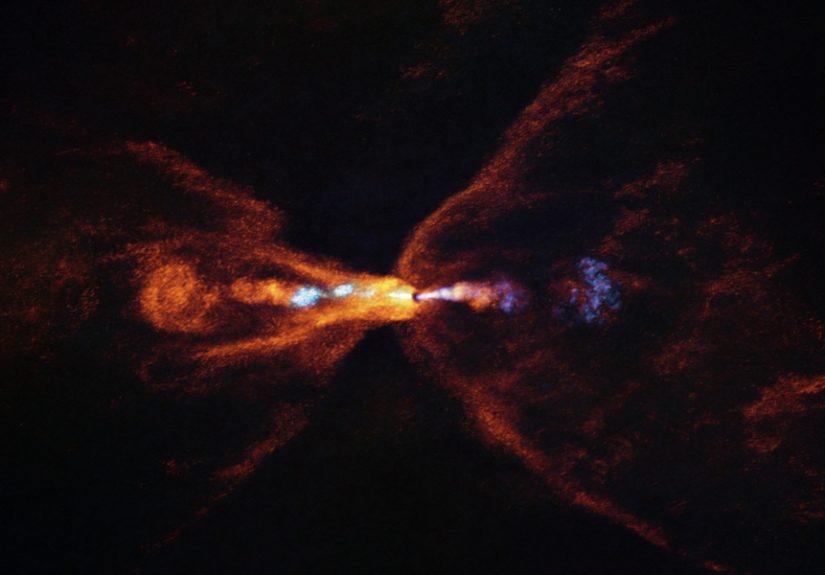
ALMA mapped radio emission from gas farther out in the disk,
including carbon monoxide streaming away in a butterfly-shaped
outflow and a narrow jet of silicon monoxide blasting from the young star. -
Together, these observations revealed warm silicon monoxide gas
plus crystalline silicate grainsbasically evidence that
silicon is cooling and turning from gas into solid mineral dust.
That phasewhen gas first condenses into solid mineral grainsis the crucial
starting line for planet formation. It doesn’t last long in cosmic terms,
only about 100,000 to 200,000 years. Catching it is like
photographing lightning mid-strike instead of just seeing the flash afterward.
Why This Counts as the “Birth” of a Solar System
Astronomers have seen plenty of protoplanetary disks and even
young planets already orbiting their stars. Famous examples include:
-
The spectacular HL Tauri disk, where dark rings and gaps reveal
planets that have already started shaping their orbits. -
The star PDS 70, where we’ve directly imaged newborn gas giants
embedded in a disk and even spotted a possible
circumplanetary diska baby planet’s own mini-disk that could
form moons.
Those snapshots show planetary systems that are already well on their way. HOPS-315
is different. Here, scientists aren’t just seeing disks and planetsthey’re seeing
the first solid material that will later become planets. This is
as close to “time zero” for planet formation as we’ve ever observed.
Think of it this way:
- Previous discoveries: catching a toddler or teenager version of a solar system.
-
HOPS-315: catching the moment the “cells” first dividewhen raw ingredients start
turning into something that can grow into planets.
How JWST and ALMA Pulled Off the Ultimate Cosmic Collab
This discovery is also a huge win for teamwork between telescopes.
James Webb Space Telescope (JWST) is a master of infrared light.
It can peer through dusty clouds that would completely block visible light and can
detect the chemical fingerprints of gases and tiny grains. For HOPS-315, JWST
saw “weird stuff” very close to the starsignatures that something interesting was
happening with hot gas and minerals.
ALMA, a giant array of radio telescopes in the Chilean desert,
excels at mapping cold gas and dust in exquisite detail. When astronomers used ALMA
to follow up, they could trace where that material was flowing and how it was
distributed in the disk.
Put together, JWST and ALMA revealed:
- A butterfly-shaped outflow of carbon monoxide gas.
- A slim jet of silicon monoxide shooting from the protostar.
-
A region in the disk where silicon is transitioning from gas to solid
grainsthe first building blocks of rocky planets.
Without JWST’s chemical sensitivity and ALMA’s detailed mapping, this fleeting
stage of solar system birth would have remained invisible.
What This Tells Us About Our Own Solar System
One of the coolest parts of the HOPS-315 discovery is how much it echoes our own
solar system’s early history.
When the Sun was young, it was also surrounded by a protoplanetary disk of gas and
dust. Somewhere in that disk, probably in a region similar to today’s
asteroid belt, minerals condensed out of the gas and began forming
tiny solids. Over time, those solids clumped into larger and larger bodies, some of
which became the building blocks of the rocky planets: Mercury, Venus, Earth, and
Mars.
By watching HOPS-315, scientists are basically looking back in time at a process
that might have unfolded in our own neighborhood 4.5 billion years ago. The region
where minerals are forming around HOPS-315 is at similar distances from the star as
our asteroid belt is from the Sun. That gives us a rare, real-world test for our
models of how Earth and its neighbors first formed.
It also raises big questions:
-
If this is what a young, Sun-like system looks like at the
instant of planet formation, how typical is it? - Do most stars like our Sun go through a similar “mineral condensation” phase?
-
How do the initial conditionsdisk mass, composition, and temperatureshape the
types of planets that eventually form?
From Dust to Planets: The Long Road Ahead
Just to be clear: HOPS-315 doesn’t have fully formed planets yet. We’re not
looking at a finished solar system with neat orbits and stable worlds. What we’re
seeing is Stage One.
The rough storyline now looks like this:
-
Gas collapses from a molecular cloud, forming a proto-star
(HOPS-315) surrounded by a disk. -
In parts of the disk, temperatures and pressures change enough
for minerals to condense out of gasexactly what we’re seeing now. -
Those grains collide and stick together, forming bigger and
bigger clumps. - Some clumps grow into planetesimals, then proto-planets.
-
Over millions of years, gravitational interactions sculpt a final family of
planets, moons, asteroids, and comets.
HOPS-315 sits right near step 2 going on step 3. It’s a reminder that planetary
systems aren’t rare miraclesthey’re a natural outcome of how stars form. Whenever
you see a star, especially a young one, there’s a decent chance it has a disk
around it and that somewhere, someday, planets will emerge.
Big Open Questions (a.k.a. Why Astronomers Are Buzzing)
Watching the birth of a solar system is amazing, but it also makes scientists
greedy for more data. Some of the key questions this discovery opens up include:
-
Timing: Exactly how early can planet formation begin? HOPS-315
suggests it might start earlier in a star’s life than we used to think. -
Chemistry: How does the initial mix of minerals and ices affect
the kinds of planets that formrocky, icy, or gas-rich? -
Habitability: If this process is common around Sun-like stars,
how many future Earth-like planets are quietly starting their journey right now?
With JWST, ALMA, and upcoming observatories, astronomers plan to study more systems
like HOPS-315 to see whether this is a “typical” birth or a particularly dramatic
one. Either way, we now know that it’s possible to catch a solar system in the act
of turning gas into rocksand eventually, perhaps, rocks into homes.
What Comes Next for HOPS-315?
HOPS-315 is not going anywhere fast (from our perspective), so it’s going to be a
long-term favorite target for telescopes.
Future observations will likely:
-
Track how the mineral-rich region evolvesdo solids grow and
clump, or get blasted away? -
Look for emerging gaps in the disk that might hint at
proto-planets starting to form. -
Probe the organic chemistry in the disk. When minerals condense,
they can be accompanied by complex organic molecules. That has big implications
for the ingredients of life.
In other words, the cosmic baby monitor is officially on, and astronomers are
settling in for a very, very long watch party.
Experiencing the Birth of a Solar System: A Human-Sized Perspective
What It Would Feel Like to “Be There”
Let’s imagine, just for a moment, that you could safely park a spaceship near
HOPS-315 and watch its solar system being born. (We’re ignoring details like
“instant death” and “no breathable atmosphere” for the sake of vibes.)
Out your window, you wouldn’t see cute little planets yet. Instead, you’d see a
swirling, glowing disk of gas and dust stretching far beyond the
star. The central protostar would be buried in haze, shining dimly through layers
of material. The region where minerals are condensing might look like a hazy,
faintly glowing band within the disk, heated just enough for chemistry to go wild.
If you switched to “JWST vision,” the scene would transform into a tapestry of
infrared light: hot jets of silicon monoxide streaking outward, carbon monoxide
flowing in delicate, butterfly-shaped plumes, and a warm ring where silicate
grains are just beginning to form. It would be messy, dynamic, and gorgeousmore
like standing inside a slow-motion volcanic eruption than strolling through a neat
model of the solar system.
What It Feels Like for the Scientists
For astronomers, witnessing the birth of a solar system isn’t a single “wow” moment
at a telescope. It’s a months-long (or years-long) process filled with calibration
files, data pipelines, statistics, and a lot of coffee.
First, there’s the anticipation. Proposals for time on JWST and
ALMA are fiercely competitive. When a project like HOPS-315 gets approved, the
team knows they’re taking a shot at a once-in-a-career discovery. Then comes the
nervous waiting as observations are scheduled, executed, and delivered.
When the data finally arrive, they don’t show up as a perfect “space poster.” They
appear as numbersspectra, brightness maps, and noisy images that require
painstaking analysis. The thrill happens when patterns emerge: a suspicious bump
in the spectrum here, a ring of emission there, a chemical fingerprint that
shouldn’t be there unless something special is happening.
In the HOPS-315 case, that “something special” was the combination of warm
silicon monoxide gas and crystalline silicates in exactly the right region of the
disk. It meant that the team wasn’t just looking at generic dust. They were
watching matter cross a thresholdfrom gas to solid, from formless to structured,
from ingredients to recipe.
Why This Discovery Resonates With Us
Part of the magic here is emotional. Even if you’re not an astronomer, there’s
something deeply satisfying about knowing that we’ve seen another solar system
begin. It makes our own story feel less lonely. Our planets aren’t a one-off
cosmic accident; they’re part of a broader pattern the universe repeats again and
again.
HOPS-315 also gives us a new way to talk about our place in the cosmos. The same
processes shaping that distant disk once shaped the material that became Earth,
our oceans, our continents, and ultimately us. The silicon now condensing into
grains around HOPS-315 is the same kind of silicon that ended up in your phone
screen, your computer chip, and the rocks beneath your feet.
So when you hear that scientists just witnessed the birth of a solar system,
you’re not just hearing about a star 1,300 light-years away. You’re getting a
rare glimpse into a process that makes worldsand maybe, someday, someone else
looking back at the sky and wondering how their solar system began.
Conclusion: A New Chapter in Planet-Birth Watching
The HOPS-315 discovery marks a major milestone in astronomy. Instead of inferring
the earliest steps of planet formation from theory alone, scientists now have
real, detailed observations of the moment when a disk around a young star begins
turning gas into solid mineral grains. That’s why people are calling it the
birth of a solar system.
With JWST, ALMA, and future observatories, we’re entering an era where catching
solar systems in the act of being born might become increasingly common. For now,
though, HOPS-315 holds a special place as the first time humanity has truly
watched the cosmic clock start on a brand-new planetary system.